
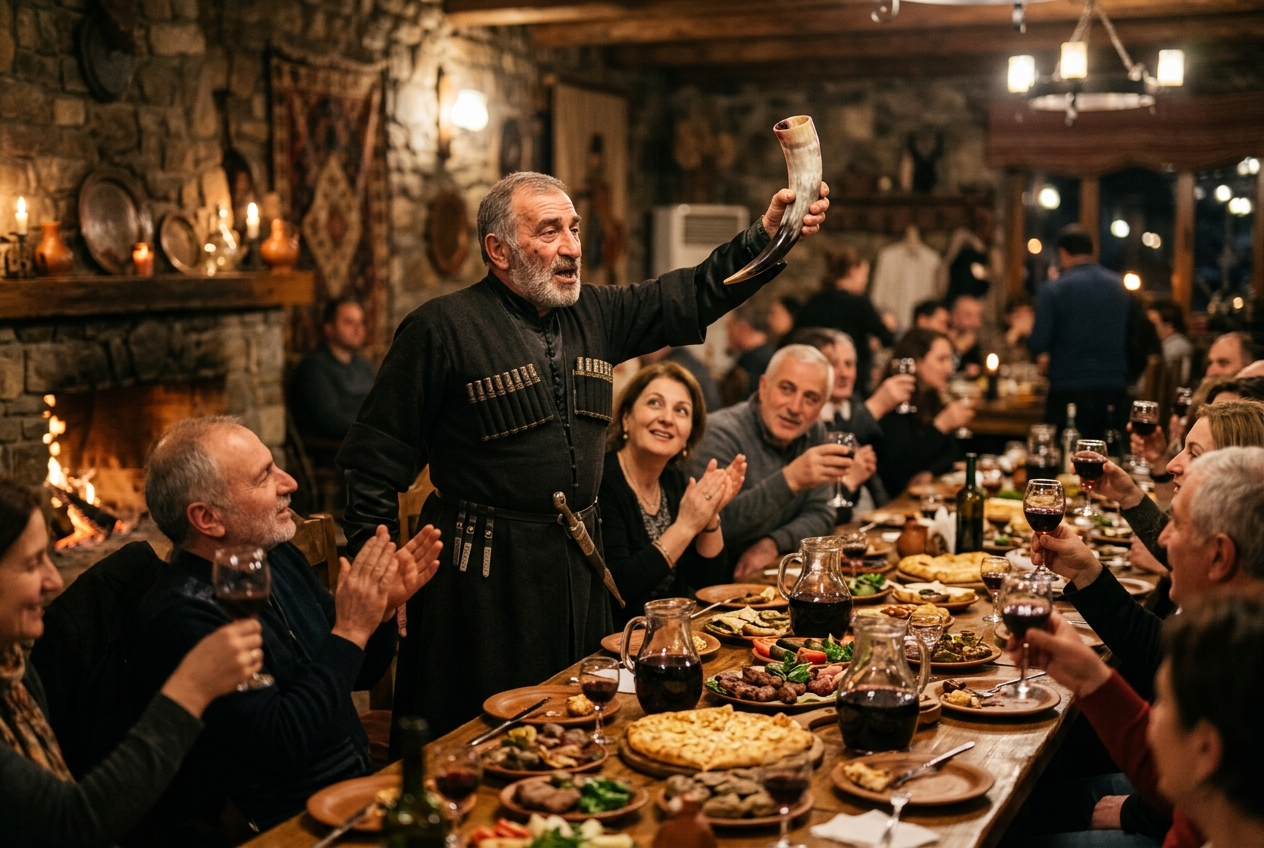
Every culture has a figure who holds a room together, someone whose presence turns a gathering into an event. In Georgia, that figure sits at the head of a long table overflowing with food and wine, and they carry a title that has no clean equivalent in English: the Tamada. The toastmaster at a Georgian feast is not simply someone who raises a glass and says a few nice words. This person is part philosopher, part comedian, part spiritual guide, and part benevolent dictator. They control the rhythm of the evening, decide who speaks and when, and weave together themes of God, family, ancestry, and love into a single coherent experience that can last five, six, or even eight hours. If you have ever attended a Georgian supra, you know the Tamada is the reason the night feels like something sacred rather than just a long dinner. If you have not attended one yet, understanding the Tamada’s function is the single best way to prepare yourself for a tradition that will likely leave a permanent mark on your memory.
Origins and Cultural Significance of the Supra
The Georgian supra is far more than a feast; it is a deeply rooted cultural ritual that speaks volumes about the country’s values: hospitality, faith, family bonds, and communal joy. The word “supra” itself comes from the Georgian word for tablecloth, which tells you something about the centrality of the table in Georgian life. Everything important happens around it: births are celebrated, the dead are honored, friendships are sealed, and conflicts are quietly resolved.
There are different types of supras. A celebratory supra might mark a wedding, a birthday, or the return of a loved one from abroad. A death day supra is held on the anniversary of a loved one’s passing, carrying a more somber but equally structured tone. Even casual gatherings among friends can transform into informal supras if the food, wine, and mood align.
The Supra as a Pillar of Georgian Identity
Georgians often say that you cannot truly understand their country without sitting at a supra. This is not an exaggeration. The supra functions as a living museum of Georgian values, where oral tradition, religious faith, and social bonds are all performed in real time. The Georgian phrase “stumari ghvtisaa” – meaning “a guest is a gift from God” – is not a quaint saying. It is a genuine operating principle, and the supra is where it finds its fullest expression.
Unlike transactional Western dinner parties where guests might bring a bottle of wine and leave after dessert, a Georgian supra demands total presence. You sit, you eat, you drink, you listen, you speak when invited, and you stay. Leaving early is a minor social offense. The supra is a collective experience, and the Tamada is its conductor.
Historical Evolution of the Toastmaster Tradition
The tradition of a designated toastmaster in Georgia stretches back centuries, with some historians tracing it to pre-Christian feasting rituals in the Caucasus. Bronze figurines from the Colchis culture, dating to roughly the 7th century BC, depict a man holding a drinking horn aloft, which many scholars interpret as an early representation of the Tamada. One such figurine is now a symbol of Georgian winemaking and hospitality.
After Georgia’s conversion to Christianity in the 4th century AD, the supra absorbed religious elements. Toasts to God and saints became standard. During the Soviet era, the tradition survived despite pressure to suppress national customs, partly because the supra could be disguised as a simple dinner party. The Tamada’s role quietly preserved Georgian identity through decades of cultural suppression. Since independence in 1991, the tradition has experienced a renaissance, with younger Georgians increasingly proud of the supra as a marker of national identity.
Essential Qualities and Selection of the Tamada
Not just anyone can be a Tamada. The selection process, whether formal or informal, reflects the seriousness with which Georgians treat the role. A poor Tamada can ruin a supra. A great one can make it the most memorable night of your life.
Eloquence, Wisdom, and Emotional Intelligence
The Tamada must be a gifted speaker, but eloquence alone is not enough. Georgians value wisdom, humor, and the ability to read a room. The ideal Tamada can shift from a deeply philosophical toast about the nature of love to a witty anecdote about a mutual friend without missing a beat. They need to sense when the table is getting too heavy and lighten the mood, or when the energy is too scattered and bring everyone back to a shared emotional center.
Georgians like to say that the Tamada is a dictator of the table, but it would be more appropriate to compare them to a leader or even a teacher. This distinction matters. The Tamada commands respect not through force but through skill. They earn their authority toast by toast, and the best ones make it look effortless.
Physical and Mental Stamina at the Table
Here is something most guides do not mention: being a Tamada is physically demanding. A formal supra can last six to eight hours. The Tamada is expected to drink with every toast, and at a large supra, there might be 20 to 30 toasts over the course of the evening. Each toast requires the Tamada to drain their glass or horn completely.
This means the Tamada must have a high tolerance for wine and an ability to pace themselves without appearing to hold back. Mental sharpness is equally critical. The 15th toast needs to be as coherent and moving as the first. A Tamada who slurs or loses their thread embarrasses the host and diminishes the entire event.
| Quality | Why It Matters |
|---|---|
| Eloquence | Toasts are mini-speeches; poor delivery kills the mood |
| Emotional intelligence | Reading the room determines toast order and tone |
| Humor | Breaks tension and keeps energy alive across hours |
| Cultural knowledge | Must know traditional toast themes and regional customs |
| Physical stamina | Must drink at every toast while staying sharp |
| Respect in the community | Authority comes from reputation, not just appointment |
The Art of the Toast: Structure and Sequence
A supra is not a free-for-all. The toast sequence follows a recognized structure, though the Tamada has discretion to adjust based on the occasion and the guests present. This structure gives the evening its emotional arc: it moves from the sacred to the personal, from the universal to the intimate.
Mandatory Themes: Peace, God, and Ancestry
The first toast almost always addresses something transcendent. Regional variations exist: in Guria, the opening toast is to peace; in Kakheti, it is to icons and shrines; in Kartli, it is to God. Regardless of the specific phrasing, the opening toast establishes that this gathering is not merely social but spiritual.
Subsequent toasts typically follow a loose but recognizable sequence: toasts to the host, to the motherland, to ancestors and the departed, to family, to children, to love, and to friendship. The Tamada is said to help bridge the gap between past, present, and future, toasting ancestors and descendants as well as the other guests at the table. A toast to the dead is always included, and during this toast, glasses are not clinked. The mood shifts palpably, and even the most boisterous table falls quiet.
Balancing Humor and Solemnity
A skilled Tamada knows that a supra cannot sustain solemnity for eight hours. After a heavy toast about lost loved ones, a good Tamada will pivot to something lighter: a toast to love that includes a self-deprecating story about their own marriage, or a toast to friendship that gently roasts someone at the table. This emotional oscillation is not random. It is deliberate craftsmanship. The toasts often cover themes like gratitude for family, remembrance of loved ones, wishes for peace and health, and celebrations of creativity and love, and the Tamada must weave between these registers with grace.
I have seen a Tamada in Kakheti bring an entire table to tears with a toast about a friend who had recently passed, then have the same table roaring with laughter three minutes later with a story about that friend’s legendary stubbornness. That range is what separates a competent Tamada from a great one.
The Tamada as the Architect of Social Harmony
The Tamada’s function extends well beyond speechmaking. They are responsible for the social fabric of the evening. Every guest should feel seen, included, and valued. No one should dominate the conversation, and no one should feel ignored.
Managing Table Dynamics and Guest Engagement
At a large supra with 30 or 40 guests, managing dynamics is genuinely complex. The Tamada watches for guests who are withdrawing, for tensions between individuals, and for moments when the energy dips. They might call on a quiet guest to share a story, redirect a conversation that is veering into politics, or propose a song to reset the room’s energy.
The Tamada gives the supra its structure, and the structure is the point. Without that structure, a long evening of heavy food and wine would dissolve into chaos. With it, the evening becomes something closer to a collective meditation, punctuated by laughter, tears, and song.
The Alaverdi: Passing the Right to Speak
One of the most distinctive features of the Georgian supra is the alaverdi, a tradition where the Tamada passes the right to speak to another guest. The word itself is borrowed from Turkish and roughly means “God has given.” After the Tamada delivers a toast, they may invite a specific guest to elaborate on the theme or add their own words.
This is not an open mic. The guest speaks on the Tamada’s chosen topic, not on whatever they feel like discussing. The alaverdi allows individual voices to be heard while maintaining the Tamada’s control over the evening’s thematic arc. It is a brilliant social mechanism: it gives guests agency without surrendering the structure that holds the supra together. A guest who receives an alaverdi should keep their remarks relatively brief and on topic. Going off on a tangent is considered poor form.
Rituals, Wine, and Table Etiquette
Wine is not incidental to the supra. It is central. Georgia has roughly 8,000 years of winemaking history, and the supra is where that history is performed, glass by glass. The Tamada functions as the mood manager and authority figure who determines the drinking rhythm. In formal supras, no one drinks until the Tamada finishes the toast and proclaims “bolo mde,” meaning “until the end,” signaling that the glass should be emptied completely.
Drinking outside the toast structure is frowned upon at formal supras. You do not casually sip your wine between toasts the way you might at a Western dinner party. The wine is consumed as part of the ritual, and each drink carries the weight of the words that preceded it. A Tamada’s toast is like a blessing, and during the feast, so many prayers and words full of sincere wishes are expressed that it is impossible not to leave with positive energy.
Drinking Vessels: From Glasses to Kantsi
The vessel you drink from at a supra depends on the formality of the occasion and the region. Standard wine glasses are common at urban supras in Tbilisi. But at traditional gatherings, especially in rural areas like Kakheti or Tusheti, you may encounter the kantsi: a drinking horn made from a bull or ram’s horn that can hold anywhere from half a liter to over a liter of wine.
The kantsi has a critical design feature: it has no flat bottom. You cannot set it down without spilling. Once you pick it up, you must drink it all. This is not a gimmick. It reinforces the communal commitment of the toast. When the Tamada raises a kantsi and says “bolo mde,” everyone at the table is making the same physical and symbolic gesture of total participation. Clay cups called “piali” also appear at some supras, particularly those emphasizing traditional qvevri wine. The vessel always matches the spirit of the occasion.
Preserving the Tamada Tradition in the Modern World
The Tamada tradition faces an interesting tension. Younger Georgians, particularly in Tbilisi, live increasingly globalized lives. English-speaking post-2003 generations are connected to international culture in ways their Soviet-era, Russian-speaking parents and grandparents were not. Some worry that the supra and its toastmaster are becoming performative, trotted out for tourists or special occasions rather than practiced as a regular part of life.
But the evidence suggests otherwise. Supras remain common at family gatherings throughout the country, and the role of the toastmaster at a Georgian feast continues to carry genuine social weight. In rural regions like Svaneti, Racha, and Kakheti, the tradition is essentially unchanged. Even in Tbilisi, young professionals who might spend their weekdays in coworking spaces still sit at supras on weekends, and many take genuine pride in developing their own skills as potential Tamadas.
The tradition is also gaining international attention. Georgian restaurants abroad sometimes host supras with a Tamada, and travel writers increasingly highlight the supra as one of the most distinctive cultural experiences available anywhere. If you visit Georgia and have the chance to attend a supra, say yes. Do not worry about the rules. A good Tamada will guide you through everything. Just bring your full attention, an empty stomach, and a willingness to be moved by strangers who, by the end of the night, will feel like family.