
Table of Contents
- Embracing Winter in Georgia: Weather and Atmosphere
- Top Ski Resorts for a December Getaway
- Festive Traditions and Christmas Markets
- Cultural Festivals and New Year’s Eve Celebrations
- Winter Gastronomy and Seasonal Comfort Foods
- Essential Travel Tips for Georgia in December
Georgia in December is one of those rare destinations where you can carve through fresh powder in the morning and wander a candlelit Christmas market by evening. The country – Sakartvelo, as Georgians call it – transforms into a winter wonderland that most Western travelers still haven’t discovered. I’ve spent multiple Decembers here, and every time I’m struck by how the cold seems to amplify the warmth of Georgian hospitality. If you’re wondering where to go in Georgia in December for skiing and festivals, the short answer is: almost everywhere has something worth your time. But the details matter, so here’s what I’ve learned from actually being on the ground.
Embracing Winter in Georgia: Weather and Atmosphere
December in Georgia isn’t a single weather experience – it’s several, depending on where you are. Tbilisi sits in a valley and stays relatively mild, hovering around 2-6°C during the day with occasional rain. The air is crisp, the plane trees along Rustaveli Avenue are bare, and the city takes on a moody, cinematic quality that I honestly prefer to the sweltering summers.
Head north into the Greater Caucasus, though, and you’re in a completely different world. Mountain towns like Gudauri and Mestia receive heavy snowfall starting in late November, and by mid-December, conditions are genuinely alpine. The Adjara highlands around Goderdzi get buried under meters of snow, making it one of the snowiest spots in the entire Caucasus range.
The atmosphere shifts too. Georgians are preparing for their New Year celebrations (which are massive here – arguably bigger than Christmas itself), and you’ll notice markets popping up, strings of lights appearing overnight, and the smell of roasting chestnuts and churchkhela drifting through old town streets. December 31 is the main event, but the entire month builds toward it with a kind of festive anticipation that feels genuinely communal rather than commercial.
December Temperature and Snowfall Table by Region
| Region | Avg. High (°C) | Avg. Low (°C) | Snowfall | Best For |
|---|---|---|---|---|
| Tbilisi | 5-7 | 0-2 | Rare, light dustings | Markets, nightlife, culture |
| Gudauri | -3 to -1 | -10 to -7 | Heavy (80-120 cm base by late Dec) | Skiing, heli-skiing |
| Bakuriani | -1 to 2 | -8 to -5 | Moderate to heavy | Family skiing, cross-country |
| Mestia (Svaneti) | -2 to 1 | -9 to -6 | Heavy | Off-piste skiing, culture |
| Goderdzi | -4 to -1 | -12 to -8 | Very heavy (deepest in Georgia) | Powder skiing, solitude |
| Batumi | 9-12 | 4-6 | Almost never | Coastal winter escape |
One thing to note: mountain weather is unpredictable. I’ve seen Gudauri go from bluebird skies to whiteout conditions in under an hour. Pack layers and don’t rely on a single forecast app.
Top Ski Resorts for a December Getaway
Georgia’s ski infrastructure has improved dramatically over the past decade. Lift prices remain a fraction of what you’d pay in the Alps or even Eastern European resorts like Bansko. A full-day lift pass at Gudauri costs around 50-60 GEL (roughly $18-22 USD in 2026), which still feels almost absurdly cheap for the quality of terrain. The season typically runs from mid-December through April, though early December can be hit-or-miss depending on snowfall.
Gudauri: High-Altitude Thrills and Heli-Skiing
Gudauri is Georgia’s flagship resort, sitting at 2,196 meters on the south-facing slopes of the Greater Caucasus, about two hours north of Tbilisi along the Georgian Military Highway. The resort has 57 kilometers of marked runs served by modern gondolas and chairlifts, many of which were upgraded between 2020 and 2024.
What makes Gudauri special isn’t just the groomed runs – it’s the off-piste access. The backcountry terrain here is vast, and heli-skiing operations run by companies like Heliski Georgia offer drops onto untouched peaks for around $1,200-1,500 per day (typically four to five runs). That’s roughly half the price of comparable heli-skiing in British Columbia or Alaska.
The freeride culture is strong. I’ve shared chairlifts with everyone from Russian expats to French ski bums who came for a week and stayed the season. Accommodation ranges from budget guesthouses at 80-120 GEL per night to newer apart-hotels charging 250-400 GEL. Restaurants on the mountain serve proper Georgian food, not the overpriced cafeteria fare you’d expect at a European resort. A bowl of kharcho soup and khinkali at a slope-side café runs about 25 GEL.
Bakuriani: Family-Friendly Slopes and Olympic History
Bakuriani has a softer personality. This resort hosted events during the 1950s Soviet-era competitions and has been a training ground for Georgian athletes for decades. Located in the Borjomi Gorge at about 1,700 meters, it’s lower and warmer than Gudauri, which makes it more comfortable for families with young children.
The runs are gentler overall, with plenty of green and blue-rated slopes. The Didveli sector offers some steeper terrain for intermediate skiers, and a newer gondola has improved access significantly. Cross-country skiing trails wind through pine forests, and there’s a small but charming toboggan run that kids love.
Bakuriani is also connected to the spa town of Borjomi by the narrow-gauge Kukushka train, a rattling, Soviet-era rail line that takes about 40 minutes and costs practically nothing. It’s one of those experiences that has nothing to do with skiing but becomes a highlight of the trip. Accommodation here tends to be family-run guesthouses where dinner is included and the host insists you try their homemade wine. Expect to pay 100-180 GEL per night for a double room with meals.
Mestia and Goderdzi: Off-the-Beaten-Path Powder
If you want to ski where few international tourists go, Mestia and Goderdzi are your spots. Mestia, the capital of Upper Svaneti, is a UNESCO-adjacent region famous for its medieval stone towers. The Hatsvali and Tetnuldi ski areas here offer serious vertical drop and almost no crowds. Tetnuldi, which opened in 2016, has runs descending from 3,040 meters and the kind of wide-open bowls that make you feel like you’re the only person on the mountain.
Goderdzi, in the Adjara highlands, is even more remote. It receives the heaviest snowfall in Georgia – sometimes exceeding 4 meters of accumulation by January. The resort is still developing, with limited lifts and basic facilities, but for powder hunters willing to earn their turns, it’s extraordinary. Getting there requires a winding mountain road from Akhaltsikhe that can be challenging in heavy snow, so a 4×4 is essential.
Both destinations reward the effort with something you won’t find at polished European resorts: genuine isolation and the feeling of discovering something before the rest of the world catches on.
Festive Traditions and Christmas Markets
Georgia operates on the Orthodox calendar, so Christmas falls on January 7 rather than December 25. But December is far from quiet. The country throws itself into New Year preparations with an intensity that rivals any Western Christmas celebration. Streets are decorated, markets appear, and there’s a palpable buzz of anticipation.
Tbilisi’s Sparkling Christmas Villages
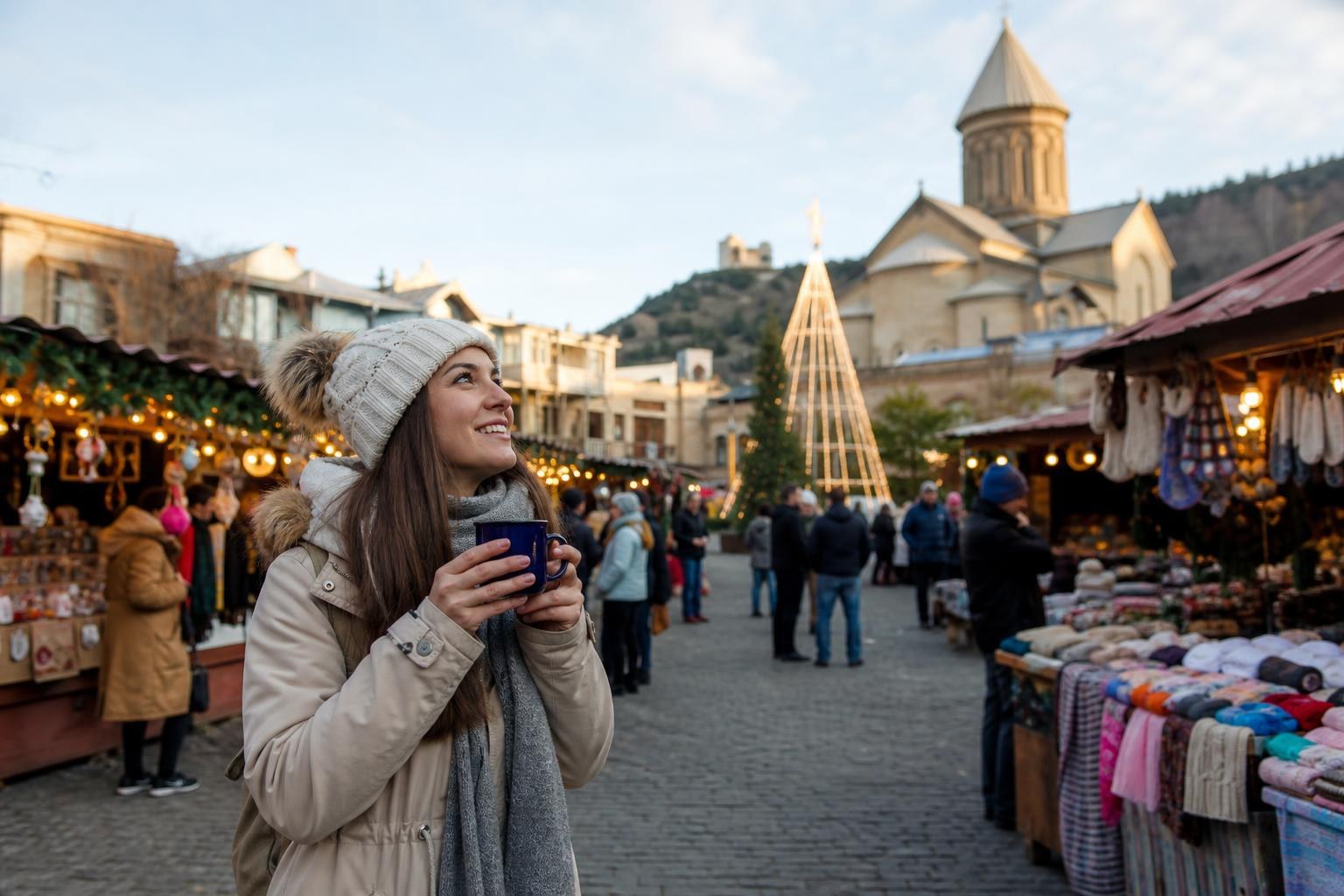
Tbilisi’s main Christmas market sets up along Rustaveli Avenue and in the area around the old Parliament building. Wooden stalls sell handmade ornaments, Georgian sweets, churchkhela, and mulled wine (both the European-style glühwein and a Georgian version made with local Saperavi). The giant Christmas tree in the center of town usually goes up in early December and stays through mid-January.
A smaller but more atmospheric market operates in the Fabrika complex in the Marjanishvili neighborhood, where local artisans sell ceramics, textiles, and jewelry alongside food vendors. I’ve found some of my favorite Georgian gifts here: hand-carved wooden wine cups, felt ornaments shaped like Caucasus animals, and small-batch chacha (grape brandy) in handmade bottles. Prices are reasonable, with most handcrafted items running 15-60 GEL.
The Old Town (Kala) district adds to the atmosphere with its narrow streets, sulfur bath steam rising into the cold air, and the Narikala Fortress lit up above. Walking through Abanotubani on a December evening, with snow dusting the carved wooden balconies, is one of those travel moments that sticks with you.
Orthodox Traditions and the Chichilaki Tree
While Georgia has adopted the Western Christmas tree in public spaces, the traditional Georgian “tree” is something entirely different. The chichilaki is made from dried hazelnut or walnut branches, shaved into thin curling strips that create a white, beard-like shape. It represents the Tree of Life and has pre-Christian roots, though it’s now firmly associated with Orthodox Christmas.
You’ll see chichilaki for sale in markets throughout December, ranging from small tabletop versions (10-15 GEL) to elaborate floor-standing ones. Many Georgian families display both a chichilaki and a Western-style tree, blending traditions without any sense of contradiction. After January 7, the chichilaki is traditionally burned, symbolizing the release of the past year’s troubles – a ritual I find far more satisfying than dragging a dried-out pine to the curb.
Cultural Festivals and New Year’s Eve Celebrations
New Year’s Eve is the biggest celebration on the Georgian calendar. Families prepare for days, and the feast (supra) on December 31 is often the most elaborate meal of the year. The energy in Tbilisi on that night is electric.
The Grand Fireworks of Freedom Square
Freedom Square becomes the epicenter of Tbilisi’s public celebration. A massive concert stage hosts Georgian pop and folk musicians, and at midnight, a fireworks display erupts over the city that rivals anything I’ve seen in major European capitals. Thousands of people gather in the square and along Rustaveli Avenue, and the mood is jubilant without the aggressive edge you sometimes feel at large Western New Year events.
The celebration spills into the side streets, where restaurants and wine bars stay open until dawn. Many Georgians move between the public festivities and private family supras throughout the night. If you’re invited to a Georgian home for New Year’s – and the chances are surprisingly high if you’re friendly and open – expect a table groaning with food, endless toasts led by a tamada (toastmaster), and the kind of hospitality that makes you feel like family rather than a guest. Georgians have a saying: “stumari ghvtisaa” – a guest is a gift from God. They mean it.
Mekvleoba: The First Guest Tradition
One of Georgia’s most distinctive New Year customs is mekvleoba, the tradition of the “first footer.” The first person to enter a home after midnight on January 1 is believed to bring the household’s fortune for the coming year. Families carefully choose their mekvle – typically someone considered lucky, kind, or successful.
The mekvle brings symbolic gifts: sweets for a sweet year, wheat or coins for prosperity, sometimes a bottle of wine. In rural areas, this tradition is taken very seriously, and being chosen as someone’s mekvle is a genuine honor. Even in cosmopolitan Tbilisi, most families observe some version of it. If a Georgian friend asks you to be their mekvle, understand that it’s a significant gesture of trust and affection, not a casual invitation.
Winter Gastronomy and Seasonal Comfort Foods
Georgian cuisine is hearty year-round, but December brings out the most warming dishes. Khinkali – the oversized soup dumplings that are Georgia’s most iconic food – taste even better when it’s freezing outside. The trick is to eat them by hand, biting a small hole in the top, sipping the broth, then eating the rest. Never use a fork, and never eat the twisted top knob; leave it on your plate as a count of how many you’ve consumed.
Winter supras feature dishes like chanakhi (lamb stew baked in clay pots with eggplant and tomatoes), lobio (spiced bean stew served in a clay pot with cornbread called mchadi), and shkmeruli (chicken smothered in garlic cream sauce, which originated in the village of Shkmeri in Racha). Pkhali – walnut-paste-based vegetable dishes – appear in jewel-toned mounds alongside pickled jonjoli (bladdernut buds) and fresh herbs even in winter.
For something sweet, look for gozinaki: caramelized walnuts in honey that appear specifically during the New Year season. Street vendors sell them in flat slabs, and every family has their own recipe. A generous portion from a market vendor costs about 5-8 GEL. Pair it with a glass of hot Saperavi or a cup of Turkish-style coffee from one of Tbilisi’s old-school cafés, and you’ve got the perfect December afternoon.
The wine deserves its own mention. Georgia has over 8,000 years of winemaking history, and winter is an excellent time to visit natural wine bars in Tbilisi like Vino Underground or g.Vino, where you can try qvevri-aged amber wines by the glass for 8-15 GEL. These wines, fermented in buried clay vessels, have a tannic depth that pairs perfectly with rich winter food.
Essential Travel Tips for Georgia in December
Getting around Georgia in winter requires some planning. Tbilisi’s metro and bus system works well within the city (a metro ride costs 1 GEL), and Bolt is the go-to ride-hailing app. For mountain destinations, marshrutkas (minibuses) run from Tbilisi’s Didube station to Gudauri and other ski areas, but schedules can be irregular. Renting a car gives you more flexibility, though winter tires or chains are mandatory on mountain roads. A compact SUV rental runs about 120-180 GEL per day.
- Download the Bolt app before arrival for affordable city transport
- Grab an offline Georgian language pack on Google Translate: English is spoken in Tbilisi’s tourist areas but scarce in rural regions
- Carry cash in smaller denominations: many guesthouses and market vendors don’t accept cards
- Book Gudauri accommodation early if visiting between December 25 and January 7, as this is peak domestic holiday season
- Travel insurance with winter sports coverage is essential: basic policies often exclude skiing
- The Georgian Military Highway to Gudauri can close temporarily during heavy snowfall: check road conditions via the Georgian Road Department’s updates before departing
- Dress in layers: you’ll move between heated indoor spaces and freezing outdoor temperatures constantly
Solo travelers, including women, generally find Georgia very safe. The tourist police in Tbilisi are responsive and helpful, and violent crime against visitors is extremely rare. The main practical annoyance is aggressive driving, which gets worse on icy mountain roads, so choose your rental car driver carefully or hire a local.
Georgia in December rewards curiosity. Whether you come for the skiing, the festivals, or simply the chance to eat khinkali in a warm guesthouse while snow falls outside, you’ll leave with the kind of memories that mass-market winter destinations rarely provide. Book your flights, pack your warmest coat, and let this small, fiercely hospitable country surprise you.