
Table of Contents
- Racha: Georgia’s Hidden Alpine Gem
- Self-Drive Guide: The Road from Kutaisi to Ambrolauri
- Exploring Ambrolauri and the Home of Khvanchkara Wine
- Upper Racha: Oni and the Mountain Retreat of Shovi
- The Perfect 3-Day Racha Road Trip Itinerary
- Practical Travel Tips: When to Go and Where to Stay
- Racha Travel Essentials: Distances and Seasonal Access
- Frequently Asked Questions About Visiting Racha
Racha is Georgia’s least-visited wine region, a mountainous pocket of the western Caucasus where semi-sweet reds age in clay qvevri, alpine meadows roll above the treeline, and entire villages might have more cows than people. If you’re renting a car in Kutaisi and wondering what lies north beyond the Nakerala Pass, the answer is one of the most rewarding two- or three-day detours in the country. The roads are real roads (mostly), the guesthouses serve homemade everything, and the wineries don’t charge tasting fees because the concept hasn’t occurred to anyone yet. This guide covers the full self-drive loop: Kutaisi to Ambrolauri, the wine micro-zone villages, Oni, and the mountain retreat of Shovi, with road conditions, seasonal timing, and a day-by-day itinerary you can actually follow.
Racha: Georgia’s Hidden Alpine Gem
Racha sits in a natural amphitheater formed by the Greater Caucasus to the north and the Racha Ridge to the south, with elevations ranging from about 500 meters in the Rioni river valley to over 4,000 meters at the Shoda-Kedela peaks. The region’s official name is Racha-Lechkhumi and Kvemo Svaneti, but most travelers simply say Racha, and they’re usually referring to the area around Ambrolauri and Oni.
What makes this corner of Georgia unusual is how little tourism infrastructure exists relative to how much there is to see. Svaneti gets the trekkers, Kakheti gets the wine tourists, and Racha gets a handful of Georgians on summer holiday and a trickle of foreign visitors who heard about Khvanchkara wine and wanted to see where it comes from. That’s changing, but slowly. The Racha-Likhi Ridge restoration project covers 153,000 hectares and is even assessing the feasibility of reintroducing European bison, which tells you something about how wild the landscape remains.
The Transcaucasian Trail team completed new sections connecting Racha to Svaneti in 2025, opening multi-day trekking routes through high-altitude terrain. For drivers, though, the appeal is different: winding roads through gorges, a reservoir that looks like it belongs in the Swiss Alps, medieval churches with carved stone facades, and wine cellars where families pour you glasses of a wine that sells for premium prices in Tbilisi but costs almost nothing at the source.
Self-Drive Guide: The Road from Kutaisi to Ambrolauri
The main route from Kutaisi to Ambrolauri runs north through the town of Tkibuli, past Shaori Lake, and over the Nakerala Pass. The total distance is roughly 130 km, and in good conditions you should budget about 2.5 to 3 hours. That time estimate assumes you don’t stop, which you absolutely will.
Driving Logistics and Road Conditions
Leave Kutaisi heading north on the road toward Tkibuli. The first 40 km or so is decent two-lane asphalt through the Imereti lowlands. After Tkibuli, the road narrows and begins climbing. Sections between Tkibuli and Shaori Lake have been repaved in recent years, but you’ll still encounter patches of broken asphalt and occasional gravel stretches, especially after spring snowmelt.
A standard sedan can handle this route from May through October without serious trouble, but ground clearance matters. If you’re in a Hyundai Accent from one of the Kutaisi rental agencies, take it slow on the rougher patches. A compact SUV or crossover is more comfortable. The road is not suitable after heavy snowfall, and the Nakerala Pass typically closes or becomes treacherous from late November through March.
Important: There are no fuel stations between Tkibuli and Ambrolauri. Fill up in Tkibuli. The stretch is only about 90 km, but if you’re exploring side roads to Shaori or Nikortsminda, you’ll burn more than you expect.
Shaori Lake: The Mirror of Racha
About 20 km past Tkibuli, you’ll see a signed turnoff for Shaori Lake, a reservoir created in the 1950s that sits at roughly 1,100 meters elevation. The lake is large enough to have its own microclimate, and on calm mornings the water reflects the surrounding forests so perfectly it looks digitally altered.
There’s a gravel road that loops partway around the lake’s southern shore. You can drive it in a regular car if you’re patient, but an SUV is better. The best viewpoint is from the western side, about 3 km past the turnoff, where a clearing gives you an unobstructed view across the water toward the mountains. Bring lunch: there are no restaurants here, just forest, water, and silence. A few basic picnic shelters exist near the shore, and locals sometimes fish here for trout.
Nikortsminda Cathedral and the Nakerala Pass
Back on the main road, continue north toward the Nakerala Pass (about 1,200 meters). The pass itself isn’t dramatic in the way Abuli or Tusheti passes are, but the views of the Racha valley opening up below you are worth a stop. On the descent, the village of Nikortsminda appears on your left.
Nikortsminda Cathedral dates to 1010-1014 AD and is one of the finest examples of medieval Georgian stone carving in the country. The exterior walls are covered with relief sculptures depicting biblical scenes, hunting imagery, and intricate geometric patterns. Entry is free. The church is usually open during daylight hours, and there’s a small parking area beside it. Spend 30 minutes here at minimum: the carvings reward close inspection.
Exploring Ambrolauri and the Home of Khvanchkara Wine
Ambrolauri is the regional capital of Racha, though “capital” might set the wrong expectations. It’s a small town of a few thousand people strung along the Rioni River, with a central square, a handful of shops, and a relaxed pace that makes Kutaisi feel like a metropolis. The town itself isn’t the draw: the wine villages surrounding it are.
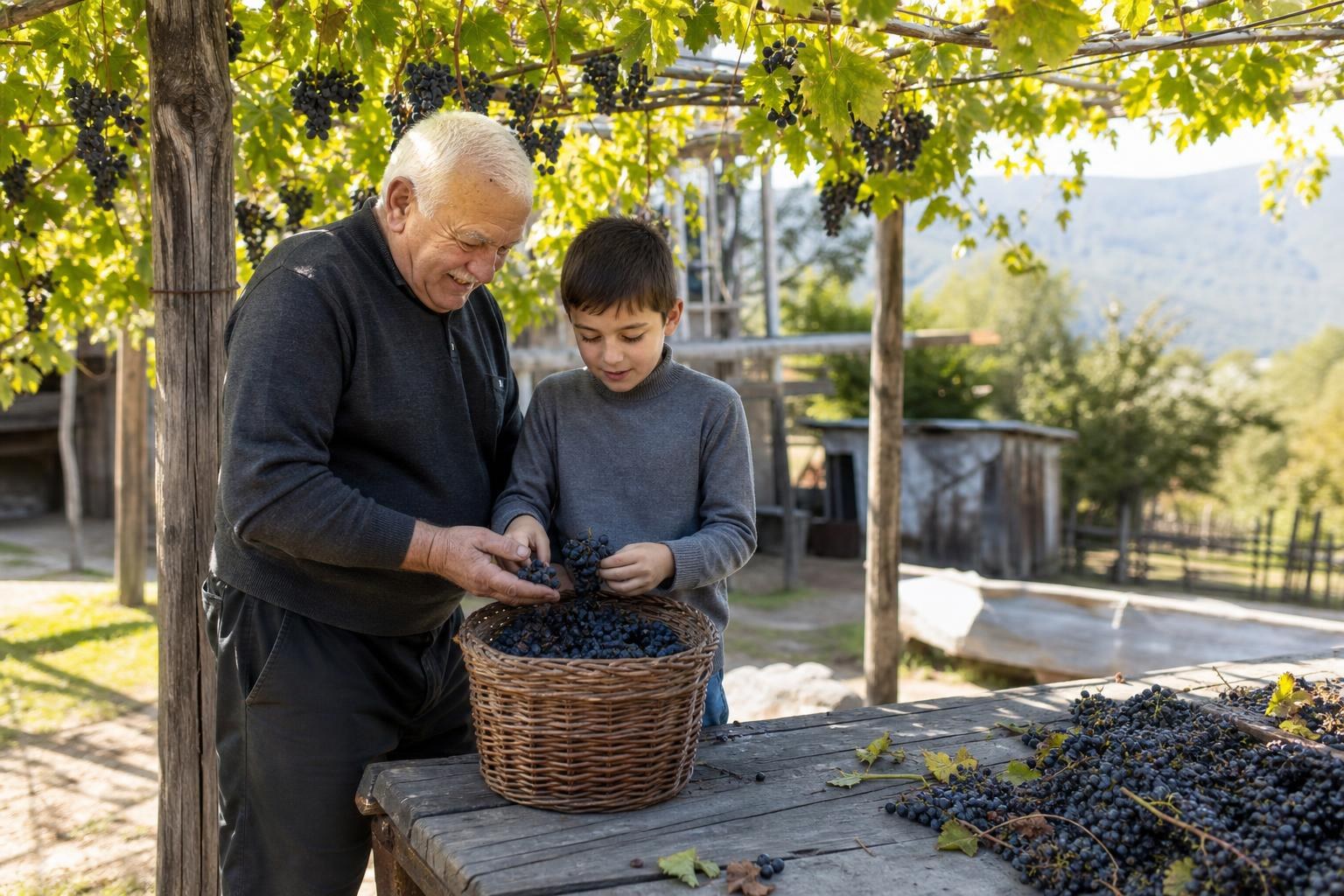
Khvanchkara is Georgia’s most famous semi-sweet red wine, made from a blend of Alexandrouli and Mujuretuli grapes that grow only in a specific micro-zone along the right bank of the Rioni. The Georgian government supported the 2025 harvest with a state subsidy of 4 GEL per kilogram for these grape varieties, which reflects both their cultural importance and the economic fragility of small-scale viticulture in the region.
The wine gets its natural sweetness not from added sugar but from the cold mountain air that interrupts fermentation. When autumn temperatures drop, the yeast goes dormant before converting all the sugar to alcohol, leaving a naturally semi-sweet wine with deep berry flavors. This is terroir-driven winemaking in the most literal sense: you can’t replicate it elsewhere.
Wine Tasting in the Micro-zone Villages
The villages of Khvanchkara, Chrebalo, and Bugheulis Ubani sit within the designated micro-zone, about 5-10 km west of Ambrolauri along a paved road that follows the river. Several family cellars welcome visitors, though “welcome” in Racha means you’ll be seated at a table, fed cheese and bread, and poured glass after glass with no mention of payment until you insist.
A few names to look for: the Buachidze family cellar in Khvanchkara village has been producing wine for generations and offers tastings in a traditional marani. In Chrebalo, ask at any guesthouse and they’ll point you to a neighbor who makes wine. Prices for a bottle of homemade Khvanchkara range from 15-30 GEL (2026 prices), a fraction of what you’d pay in Tbilisi.
Tip: Do not drink and drive. If you’re planning a tasting day, either designate a sober driver, arrange a local taxi through your guesthouse, or simply stay overnight in one of the villages. Guesthouses in the micro-zone typically cost 60-100 GEL per person including meals.
Upper Racha: Oni and the Mountain Retreat of Shovi
From Ambrolauri, the road east to Oni is about 40 km of mostly paved road following the Rioni River upstream. Oni is a larger town than you’d expect, with a surprising history: it once had a significant Jewish community, and the synagogue still stands in the center of town, though it’s no longer in active use.
Oni serves as the gateway to Upper Racha and the Racha National Park, established in 2023, which encompasses 50,835 hectares in the Oni municipality. The park protects old-growth forests, alpine meadows, and the watershed that feeds the Rioni. From Oni, a 30 km road climbs south into the mountains toward Shovi, a Soviet-era resort village at about 1,600 meters that’s been slowly reinventing itself.
Hiking and Mineral Springs in Shovi
Shovi sits in a narrow valley surrounded by conifer forests, and the air here smells like pine and mineral water, because natural mineral springs bubble up throughout the area. Several springs are accessible on foot from the main road through the village, each with slightly different mineral compositions and temperatures.
Hiking options from Shovi range from easy forest walks to serious alpine routes. A popular day hike leads to the Buba Glacier viewpoint, about 4-5 hours round trip, following a trail through forest and then above the treeline. The trail is marked but not maintained to Western European standards: bring proper footwear, water, and a rain layer regardless of the forecast.
The Eco Village in Glola, a new sustainable tourism project that opened on June 1, 2026, features high-altitude eco-cottages and local gastronomy experiences. It’s located near Shovi and represents a new model for accommodation in Upper Racha: small-scale, environmentally conscious, and rooted in local food traditions.
Note: The road from Oni to Shovi is paved for the first 15 km, then deteriorates to gravel and dirt. A 4×4 or high-clearance vehicle is strongly recommended, especially after rain. The road is typically passable from late May through October only.
The Perfect 3-Day Racha Road Trip Itinerary
Here’s a practical day-by-day plan starting and ending in Kutaisi:
| Day | Route | Distance | Drive Time | Key Stops |
|---|---|---|---|---|
| Day 1 | Kutaisi to Ambrolauri | ~130 km | 2.5-3 hrs | Shaori Lake, Nakerala Pass, Nikortsminda |
| Day 2 | Ambrolauri to Shovi (via Oni) | ~70 km | 2 hrs | Khvanchkara villages (morning), Oni, Shovi |
| Day 3 | Shovi to Kutaisi | ~200 km | 4-5 hrs | Mineral springs walk, return via Ambrolauri |
Day 1: Leave Kutaisi by 9 AM. Stop at Shaori Lake for photos and a picnic, then continue over the Nakerala Pass. Visit Nikortsminda Cathedral in the afternoon. Arrive in Ambrolauri by late afternoon and check into a guesthouse. Evening: homemade dinner with your hosts.
Day 2: Spend the morning visiting wine cellars in the Khvanchkara micro-zone. After lunch, drive to Oni and continue to Shovi. Check into a guesthouse or the new eco-cottages in Glola. Evening walk to the mineral springs.
Day 3: Morning hike from Shovi (the Buba Glacier viewpoint if you’re fit, or a shorter forest loop). Drive back to Kutaisi via Ambrolauri in the afternoon.
Practical Travel Tips: When to Go and Where to Stay
The best time to visit Racha by car is mid-May through mid-October. September and October are ideal: the grape harvest is underway, the forests turn gold and amber, and the weather is warm but not hot. July and August are popular with Georgian families, so guesthouses in Shovi can fill up on weekends.
Accommodation is almost exclusively guesthouses and homestays. Ambrolauri has a few small hotels, but the best experiences are in village homes where dinner is included and the host’s family wine flows freely. Expect to pay 60-120 GEL per person per night with full board in 2026. Booking platforms list some options, but many guesthouses operate by phone only: ask your previous host to call ahead, which is how the system works here.
- Pack layers even in summer: Shovi can drop to single digits at night
- Download offline maps before leaving Kutaisi: mobile signal is unreliable past Tkibuli
- Carry cash: card payment is rare outside Ambrolauri and Oni
- A basic first-aid kit and a spare tire are not optional on Upper Racha roads
For planning your Racha driving route, resources like Triproadwayplanner can help with up-to-date road conditions and seasonal access information.
Racha Travel Essentials: Distances and Seasonal Access
| Route | Distance | Drive Time | Road Surface | 4×4 Needed? | Seasonal Access |
|---|---|---|---|---|---|
| Kutaisi to Tkibuli | 40 km | 45 min | Asphalt | No | Year-round |
| Tkibuli to Shaori Lake | 20 km | 30 min | Mixed asphalt/gravel | Recommended | May-October |
| Shaori to Ambrolauri (via Nakerala) | 70 km | 1.5 hrs | Asphalt, some patches | No | April-November |
| Ambrolauri to Oni | 40 km | 50 min | Asphalt | No | Year-round |
| Oni to Shovi | 30 km | 1 hr | Gravel/dirt | Yes | Late May-October |
| Tbilisi to Ambrolauri (via Zestafoni) | 300 km | 5-6 hrs | Mostly highway + mountain road | No | Year-round (Nakerala may close in winter) |
Important: Winter driving in Racha is not recommended for tourists. The Nakerala Pass can close without warning after snowfall, and road clearing equipment is limited. If you’re visiting between November and April, check road conditions with locals before departing Kutaisi.
Frequently Asked Questions About Visiting Racha
Is Racha worth visiting for just one day from Kutaisi?
You can do a long day trip to Ambrolauri and back, stopping at Shaori Lake and Nikortsminda, but you’ll be rushing. Two nights is the minimum to see both the wine villages and Upper Racha. Three nights lets you actually relax, which is the whole point.
Do I need a 4×4 to drive in Racha?
Not for the main Kutaisi-Ambrolauri-Oni route. A regular sedan handles that loop from May to October. You do need a 4×4 or at least a high-clearance vehicle for the Oni-to-Shovi road and for the track around Shaori Lake. If you’re renting in Kutaisi, a compact SUV like a Mitsubishi Outlander or Hyundai Tucson covers all bases.
Where can I buy Khvanchkara wine in Racha?
Directly from family cellars in the micro-zone villages near Ambrolauri. Prices in 2026 range from about 15-30 GEL per bottle for homemade versions. Small shops in Ambrolauri also stock local wines. The homemade versions taste different from commercial Khvanchkara: less polished, more character.
Is there mobile phone signal in Racha?
Magti and Geocell both have coverage in Ambrolauri and Oni. Signal becomes patchy between towns and mostly disappears on the road to Shovi. Download offline Google Maps for the region before you leave Kutaisi.
What food should I try in Racha?
Lobiani (bean-stuffed bread) is Racha’s signature dish, and the local version is richer and more flavorful than what you’ll find elsewhere in Georgia. Also try shkmeruli (chicken in garlic cream sauce, which actually originates from this region), smoked pork lori, and fresh trout from mountain streams. Every guesthouse dinner will include more food than you can physically eat.
Racha rewards the kind of traveler who doesn’t need a checklist. The region is quiet, the roads demand attention, and the hospitality is so intense it can catch you off guard. A grandmother in Khvanchkara village once told me that guests don’t choose Racha: Racha chooses them. Whether or not that’s true, the people who end up here tend to come back. Fill the tank in Tkibuli, pack your appetite, and give this region the time it deserves.