
Table of Contents
- Exploring Lagodekhi National Park: Georgia’s Autumn Wilderness
- Planning Your Drive to Lagodekhi from Tbilisi and Sighnaghi
- Essential Visitor Center Registration and Trail Logistics
- The Best Day Hikes: Waterfalls and Fortresses
- The Black Rock Lake Expedition: Multi-Day High Altitude Trek
- Comparing Lagodekhi Trails: Distance, Difficulty, and Duration
- Autumn in Kakheti: Foliage Peaks and Post-Hike Wine Tasting
- Frequently Asked Questions About Lagodekhi National Park
Lagodekhi National Park sits in Georgia’s far northeastern corner, right where the Greater Caucasus mountains meet the Alazani Valley. If you’re planning autumn hikes in Kakheti, this is the single best destination for waterfalls, old-growth forest, and trails that range from a casual two-hour stroll to a serious multi-day expedition above the treeline. The park protects over 24,000 hectares of forest, alpine meadows, and glacial lakes, and it remains one of the least crowded protected areas in the country despite Georgia’s protected areas recording a record 1.25 million visitors in 2025. October and early November bring some of the most striking foliage in the Caucasus here, and the proximity to Kakheti’s wine country means you can pair a solid day on the trail with a cellar visit the same evening. This guide covers every trail, the logistics of getting there, and how to build a full autumn itinerary around the park.
Exploring Lagodekhi National Park: Georgia’s Autumn Wilderness
Lagodekhi was Georgia’s first nature reserve, established in 1912, and it still feels like a place that hasn’t been overly managed or commercialized. There are no zip lines, no overpriced cafes at the trailhead, and no shuttle buses. You register at the visitor center, walk through the gate, and within ten minutes you’re in dense, centuries-old beech and chestnut forest.
The park spans elevations from roughly 400 meters at the entrance to over 3,500 meters at the ridgeline along the Dagestan border. That range means the ecosystem shifts dramatically as you climb: lowland broadleaf forest gives way to birch and rhododendron, then subalpine meadow, then bare rock and glacial terrain. In autumn, the lower and middle elevations turn gold and copper while the higher zones are already dusted with early snow.
What makes Lagodekhi particularly appealing for independent travelers is its simplicity. Four marked trails cover the full spectrum of difficulty. You don’t need a guide for the day hikes (though one is required for the multi-day route to Black Rock Lake). The town of Lagodekhi itself is small and quiet, with a handful of guesthouses and a couple of restaurants serving solid Kakhetian food. It’s not a tourist hub, which is part of the charm.
Planning Your Drive to Lagodekhi from Tbilisi and Sighnaghi
Lagodekhi sits about 270 km from Tbilisi, and the drive takes roughly 3.5 to 4 hours depending on traffic leaving the capital. The route follows the main highway east through Sagarejo and then north along the Alazani Valley floor. Road conditions are generally good on this stretch: it’s a paved two-lane highway the entire way, and you don’t need a 4×4.
If you’re coming from Sighnaghi, the drive is shorter but still takes about 2 to 2.5 hours (approximately 150 km). The road runs through Tsnori and Gurjaani before joining the main valley highway. Expect some slower stretches through towns where livestock and tractors share the road.
Tip: Leave Tbilisi early. The first hour of highway toward Kakheti can be congested on weekends, especially Friday afternoons. Departing by 7:00 a.m. puts you at the park entrance by 10:30 or 11:00 with time for a full day hike.
Parking is straightforward. A small lot sits directly outside the visitor center and park entrance in the town of Lagodekhi. It’s free and usually has space, even in peak autumn season. If you’ve rented a car for a Kakheti road trip, this is an easy stop to build into a larger loop through the wine region.
Getting there by car:
- Starting city: Tbilisi or Sighnaghi
- Distance: 270 km from Tbilisi / 150 km from Sighnaghi
- Drive time: 3.5-4 hours from Tbilisi / 2-2.5 hours from Sighnaghi
- Road condition: Paved highway, no 4×4 needed
- Parking: Free lot at the visitor center
- Seasonal closures: The park entrance road stays open year-round, but the multi-day trail to Black Rock Lake closes in winter (typically November through June, depending on snow)
Essential Visitor Center Registration and Trail Logistics
Every hiker must register at the Lagodekhi Protected Areas visitor center before entering the park. This is not optional. The center sits right at the park entrance in town, and you’ll need to provide your name, passport number, nationality, and which trail you plan to hike.
Registration is free for the day hike trails (Ninoskhevi Waterfall, Black Grouse Waterfall, and Machi Fortress). The multi-day Black Rock Lake trek requires a small fee and a mandatory guide, which the visitor center can arrange. Check current pricing at the center, as fees have been updated in recent years as Georgia’s Agency of Protected Areas has been expanding its ecotourism offerings and increasing revenue.
The visitor center opens at 9:00 a.m. in autumn, but I’d recommend confirming hours locally as they sometimes shift. Staff speak basic English and can provide a trail map. The map is simple but adequate for the marked day hikes.
Important: Register your return time honestly. If you’re not back by the time you stated, park rangers may initiate a search. Sign back in when you exit. This system exists for your safety, and it works.
There are basic toilet facilities at the visitor center. Once you’re on the trail, there’s nothing: no shops, no shelters on the day hikes, no water refill stations. Bring at least 1.5 liters of water, snacks, and rain gear. Autumn weather in the Caucasus foothills can shift from sunshine to cold rain in an hour.
The Best Day Hikes: Waterfalls and Fortresses
Lagodekhi’s three day hikes are all out-and-back routes starting from the same trailhead just past the visitor center. They share the first kilometer or so of path before splitting, so you’ll get a sense of the forest immediately regardless of which route you choose.
Ninoskhevi Waterfall: The Great Cascade Trail
This is the park’s flagship hike and the one most visitors come for. The Ninoskhevi waterfall drops roughly 35 meters into a rocky pool surrounded by moss-covered cliffs. The trail is about 7 km round trip and takes 3 to 4 hours at a comfortable pace.
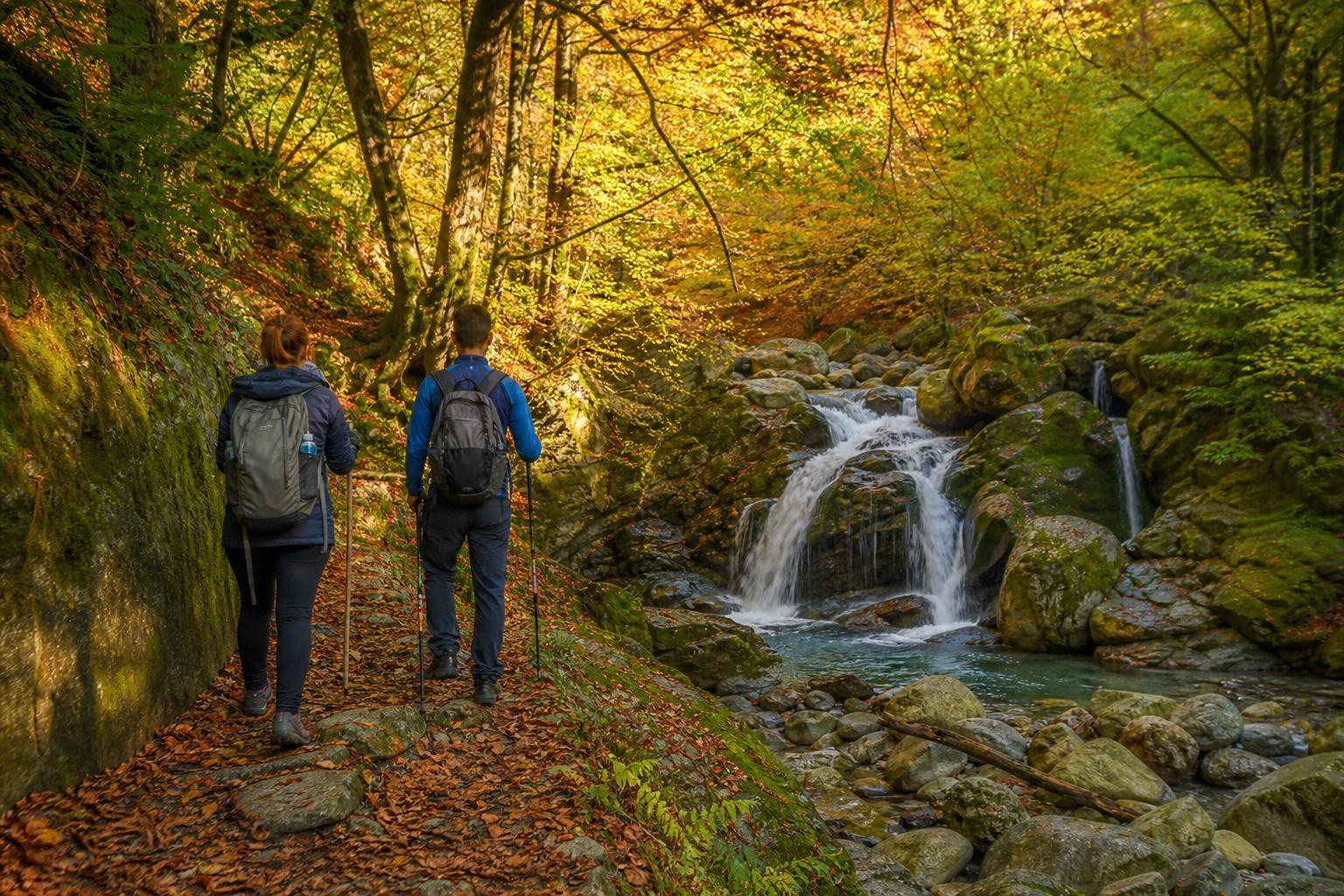
The path follows the Ninoskhevi River upstream through dense forest. In October, the canopy turns shades of amber and rust, and the light filtering through the leaves onto the river is genuinely spectacular. The trail is well-marked with occasional wooden bridges and is moderate in difficulty: some uphill sections and uneven ground, but nothing technical. Sturdy hiking shoes are sufficient.
The waterfall itself is loudest in autumn after summer rains have fed the river system. You can get quite close to the base, though the rocks are slippery. This is the trail I’d recommend if you only have time for one hike.
Black Grouse Waterfall: The Shorter Forest Path
If you have less time or energy, the Black Grouse waterfall trail is the easier option. It’s roughly 3 km round trip and takes about 1.5 to 2 hours. The waterfall is smaller than Ninoskhevi but still worth the walk, especially for the forest itself.
The trail branches off the main path early and follows a different tributary. It’s flatter and shorter, making it a good choice for families or anyone arriving at the park in the afternoon. The forest here is just as impressive as on the longer route: towering beech trees, ferns, and in autumn, a thick carpet of fallen leaves.
Machi Fortress: A Walk Through History
The Machi Fortress trail takes you to the ruins of a medieval fortification perched on a ridge above the forest. The hike is roughly 5 to 6 km round trip and moderate in difficulty, with a steeper climb toward the fortress itself.
The ruins aren’t extensively restored, which honestly makes them more interesting. You’re looking at crumbling stone walls overtaken by forest, with views down toward the Alazani Valley. On a clear autumn day, the panorama from the ridge extends across the valley floor to the distant hills of Kakheti. This trail sees fewer hikers than the waterfall routes, so you’ll likely have the fortress to yourself.
The Black Rock Lake Expedition: Multi-Day High Altitude Trek
Black Rock Lake (Shavi Klde) sits at approximately 2,800 meters in the alpine zone above the forest. The trek is roughly 38 km round trip and takes two to three days. This is a serious mountain hike, not a casual day out.
A guide is mandatory, and the visitor center arranges this. You’ll also need to carry camping equipment or arrange mule support through the center. The trail climbs from the forested valley floor through subalpine meadows and into bare, rocky terrain. The lake itself sits in a glacial cirque and is frozen or partially frozen for much of the year.
The Black Rock Lake route typically opens in late June or July and closes by late October or early November, depending on snowfall. Autumn attempts are possible but risky: weather at altitude is unpredictable, and early snowstorms can make the upper sections dangerous. If you’re planning this trek in October, be prepared for the visitor center to refuse registration if conditions are poor. They take safety seriously, and rightfully so.
Note: This trek requires real mountain hiking experience, proper gear (cold-weather sleeping bag, layers for sub-zero temperatures, waterproofs), and physical fitness for sustained uphill walking with a loaded pack. Don’t underestimate the altitude gain.
Comparing Lagodekhi Trails: Distance, Difficulty, and Duration
Here’s a side-by-side comparison of all four routes to help you decide which fits your schedule and fitness level.
| Trail | Distance (round trip) | Duration | Difficulty | Guide Required | Best For |
|---|---|---|---|---|---|
| Ninoskhevi Waterfall | ~7 km | 3-4 hours | Moderate | No | The full Lagodekhi experience |
| Black Grouse Waterfall | ~3 km | 1.5-2 hours | Easy | No | Short visits, families |
| Machi Fortress | ~5-6 km | 2.5-3.5 hours | Moderate | No | History, views, solitude |
| Black Rock Lake | ~38 km | 2-3 days | Difficult | Yes | Experienced trekkers |
The three day hikes can be combined if you start early. Doing Black Grouse in the morning and Ninoskhevi in the afternoon is realistic if you’re in decent shape and arrive at the park by 9:30 a.m. Machi Fortress plus one waterfall trail also works as a full-day combination.
All day hike trails are free. The Black Rock Lake trek has fees for the guide and potentially for mule hire. Confirm current costs at the visitor center, as these tend to change year to year.
Autumn in Kakheti: Foliage Peaks and Post-Hike Wine Tasting
October is the sweet spot for visiting the park. The lower-elevation forests hit peak autumn color between mid-October and early November, with beech, chestnut, and hornbeam trees turning the valleys into a patchwork of gold, orange, and deep red. Temperatures at the trailhead hover around 12 to 18°C during the day, dropping to 5 to 8°C at night: comfortable hiking weather with a light jacket.
This timing also coincides with rtveli, Georgia’s grape harvest season, which runs from roughly September through mid-October across Kakheti. The region produces about 70% of Georgia’s wine, and many family cellars and larger wineries welcome visitors for tastings during and just after the harvest.
The combination of hiking and wine tasting is what makes an autumn Kakheti trip special. You spend the morning on a trail in old-growth forest, then drive an hour south to taste amber wine straight from a qvevri (the traditional clay vessel buried underground). Few regions anywhere offer that kind of contrast in a single day.
Combining Lagodekhi with the Kakheti Wine Route
A practical three- or four-day itinerary might look like this:
- Drive from Tbilisi to Sighnaghi (1.5 hours). Explore the town, visit a winery.
- Drive to Lagodekhi (2-2.5 hours). Hike Ninoskhevi Waterfall. Stay overnight in a Lagodekhi guesthouse.
- Morning hike to Black Grouse Waterfall or Machi Fortress. Afternoon drive to Kvareli or Telavi for wine tastings.
- Return to Tbilisi via the main highway.
Guesthouses in Lagodekhi town are simple but clean, and most hosts cook excellent home meals. Expect to pay in the range of 60 to 100 GEL per person for a room with dinner and breakfast, though you should verify current rates when booking. Triproadwayplanner’s route guides can help you map the driving segments and plan fuel stops along the way.
Important: If you’re visiting wineries and tasting wine, do not drive afterward. Use a designated driver, arrange a taxi through Bolt or a local service, or plan your tastings at the end of the day where you’re staying overnight.
Frequently Asked Questions About Lagodekhi National Park
Is Lagodekhi National Park free to visit?
The three day hike trails (Ninoskhevi Waterfall, Black Grouse Waterfall, and Machi Fortress) are free. You only need to register at the visitor center. The multi-day Black Rock Lake trek involves guide fees and possible mule hire costs. Check at the visitor center for current pricing in 2026.
Do I need hiking boots for the day trails?
Sturdy shoes with good grip are sufficient for the day hikes. The trails have some rocky and rooty sections, and autumn rain makes surfaces slippery. Full hiking boots are recommended for the Black Rock Lake expedition.
Can I visit Lagodekhi in winter?
The park is technically accessible year-round, but the day hike trails can be icy and slippery from December through February. The Black Rock Lake trail is closed in winter. Autumn (October to early November) and late spring (May to June) are the best seasons.
Is there mobile phone signal on the trails?
Signal is weak to nonexistent once you’re inside the forest. You may get intermittent reception near the park entrance. Download offline maps (Google Maps or Maps.me) before you go.
How far is Lagodekhi from the nearest winery?
The Kvareli wine region is about 60 to 70 km south of Lagodekhi, roughly a one-hour drive. Kindzmarauli and Mukuzani vineyards are along this route. Telavi, Kakheti’s main town, is about 100 km away.
Lagodekhi rewards the kind of traveler who doesn’t need a polished tourist experience. The trails are honest: well-marked, physically satisfying, and set in some of the most intact forest left in the Caucasus. Pair a day or two here with the Kakheti wine route, and you have one of the best autumn road trips in Georgia. Register at the visitor center, bring enough water, lace up your shoes, and let the forest do the rest.