
Table of Contents
- Planning Your Trip: When the Khevsureti Road is Open
- Driving to Shatili: Routes, Road Conditions, and 4×4 Requirements
- Exploring Shatili: The Medieval Citadel of Stone
- Mutso and Beyond: The Dead City and Border Zone Safety
- Cultural Heritage and Anatori’s Crypts
- Where to Stay: Guesthouses and Camping in Upper Khevsureti
- Essential Packing and Vehicle Preparation for Remote Georgia
- Frequently Asked Questions About Visiting Khevsureti
Georgia’s highland fortress region of Khevsureti sits wedged between the Greater Caucasus ridge and the Chechen border, and it’s one of the most dramatic places you can reach by car anywhere in Europe. The road to Shatili, its main settlement, is only open roughly five months a year, and getting there requires a high-clearance vehicle, a tolerance for gravel switchbacks, and a willingness to accept that plans might change. If you’re renting a car in Tbilisi and wondering whether the drive is worth the effort: it is, but only if you go prepared.
The region draws a specific kind of traveler. Not someone looking for comfort, but someone who wants to stand inside a 12th-century stone tower and hear nothing but wind and river water. Georgia’s tourism numbers have been climbing fast, with the country welcoming a record 5.5 million international visitors in 2025, and the first half of 2026 has maintained that pace. But Khevsureti still sees only a fraction of those visitors, and the infrastructure reflects that reality. Here’s what you actually need to know before going.
Planning Your Trip: When the Khevsureti Road is Open
The single road into upper Khevsureti crosses the Datvisjvari Pass at roughly 2,676 meters. Snow closes it every winter, typically from late November through May, and the exact opening date shifts year to year depending on snowmelt and landslide clearance.
In 2026, the road officially opened in early June, but significant landslides in May delayed regular marshrutka (minibus) services until July 1. This is a pattern, not an exception. Even after the road department declares the pass open, conditions can remain rough for weeks.
Your realistic window is mid-June through mid-October, with July through September being the most reliable months. Early and late season trips carry real risk of finding the road blocked or impassable.
| Month | Road Status | Notes |
|---|---|---|
| Nov – May | Closed | Snow and ice block the pass |
| June | Officially open, often unstable | Landslides common; 4×4 essential |
| July – Sept | Best conditions | Gravel road passable; marshrutkas running |
| October | Open but deteriorating | Early snow possible at the pass |
Tip: Before driving, check road conditions with your guesthouse host in Shatili or ask at the police checkpoint near Barisakho. The Georgian road department’s official status updates don’t always reflect reality on the ground.
Driving to Shatili: Routes, Road Conditions, and 4×4 Requirements
The standard route from Tbilisi to Shatili is approximately 170 km and takes 5 to 7 hours depending on conditions. You leave Tbilisi heading north on the main highway, pass through Zhinvali, and eventually join the Sh26 national road. The first half is paved. The second half is not.
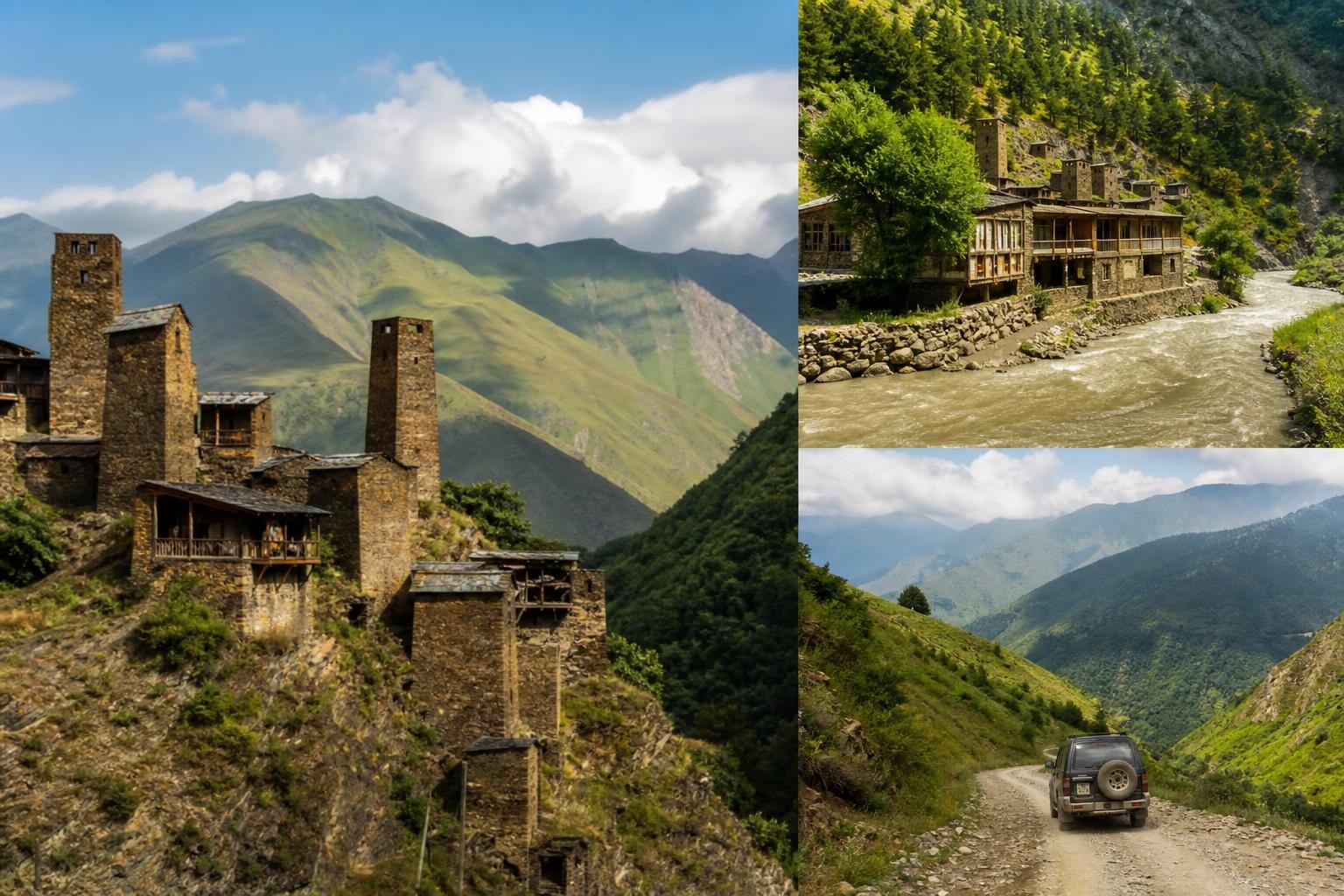
From the village of Korsha onward, the road is unpaved gravel with exposed rock, narrow sections, and no guardrails in places. A standard sedan will not make it. You need a 4×4 or at minimum a high-clearance vehicle with good tires.
Navigating the Datvisjvari Pass
The pass itself is the crux of the drive. The road climbs through a series of tight switchbacks above the treeline, with loose gravel and occasional drop-offs. In dry conditions, the surface is manageable for an experienced driver in a proper vehicle. After rain, sections become muddy and slippery.
Two-way traffic is possible on most of the road, but there are stretches near the pass where only one vehicle fits. If you meet an oncoming truck, someone has to reverse. Drive slowly, use your horn on blind corners, and keep your headlights on even during the day.
Self-Drive Logistics: Zhinvali to the High Caucasus
From Zhinvali, you pass the reservoir and continue through Barisakho, where there’s a police checkpoint. Officers will note your passport details. This is routine and takes a few minutes. Stock up on fuel before leaving Tbilisi or Zhinvali; there are no gas stations between Barisakho and Shatili.
- Start with a full tank in Tbilisi
- Carry at least 10 liters of reserve fuel
- Download offline maps (Google Maps or Maps.me) before losing signal
- Mobile coverage drops out entirely past Barisakho and doesn’t return until Shatili, where it’s sporadic at best
If you’re planning a trip around Georgia by car, Triproadwayplanner’s route guides can help you figure out which roads require 4×4 and which don’t, which saves real headaches in a country where road quality changes dramatically within a few kilometers.
Important: Never attempt this drive after dark. The road has no lighting, no reflectors, and livestock wander freely. Start from Tbilisi by 8 AM at the latest.
Exploring Shatili: The Medieval Citadel of Stone
Shatili hits you all at once. You round a bend in the valley and suddenly there it is: a cluster of stone towers and fortified houses stacked against a hillside above the Argun River gorge. The settlement dates to at least the 12th century, though some structures may be older.
The old village is essentially one massive interconnected fortress. Houses share walls, and the upper floors of one building serve as the ground floor of the next one uphill. Defensive towers rise above the residential structures, built to withstand raids from across the Chechen border. Walking through the complex feels less like visiting ruins and more like entering a vertical stone maze.
A newer village sits across the river, where a handful of families live year-round. Most of the old fortress is uninhabited but structurally intact. You can walk through many of the buildings freely, climbing stone staircases and ducking through low doorways. There are no ticket booths, no ropes, no signs telling you where to stand. This is not a museum. It’s an abandoned medieval settlement that happens to still be standing.
Spend at least two to three hours exploring the old village. The light is best in the morning when the sun hits the eastern towers. Bring a headlamp if you want to explore the interior rooms, which are dark even at midday.
Mutso and Beyond: The Dead City and Border Zone Safety
About 10 km past Shatili, the valley narrows and the road deteriorates further on the way to Mutso, a ruined fortress village perched at 1,880 meters on a cliff above the river. Mutso is sometimes called the “Dead City” because it was permanently abandoned in the mid-20th century when Soviet authorities relocated its residents to the lowlands.
The site received a Europa Nostra Award in 2019 for cultural preservation efforts, and some stabilization work has been done on the most endangered towers. But Mutso remains wild and largely unrestored, which is exactly what makes it compelling.
Hiking to the Mutso Fortress
You can drive to within about a kilometer of Mutso, then hike up a steep trail to the fortress. The climb takes 20 to 30 minutes and gains roughly 150 meters of elevation. Wear proper hiking shoes; the trail is rocky and exposed. The reward is a view straight down the Argun gorge with Chechen mountains visible to the north.
The fortress complex includes defensive towers, residential structures, and a small church. Some walls are unstable, so watch your footing and avoid leaning on anything.
Border Permits and Security Near Chechnya
Khevsureti sits directly on Georgia’s border with Russia’s Chechen Republic. Georgian border police maintain checkpoints along the valley, and you’ll encounter patrols near Shatili and beyond.
As of 2026, foreign visitors do not need a special border permit to visit Shatili or Mutso. However, the road beyond Mutso toward the actual border is restricted. Do not attempt to hike or drive toward the border without explicit permission from border police. This is taken seriously, and the area is actively patrolled.
Note: Carry your passport at all times in the valley. You will be asked to show it at checkpoints, and border patrols may stop you on the road or on hiking trails.
Cultural Heritage and Anatori’s Crypts
The Khevsureti region preserves a fascinating mix of Christianity and older pre-Christian traditions. The Khevsurs historically practiced a syncretic faith that blended Orthodox Christianity with pagan rituals, animal sacrifice, and sacred groves. Some of these traditions survived well into the 20th century.
One of the most striking cultural sites in the valley is the Anatori crypt complex, located between Shatili and Mutso. Stone burial vaults sit on an exposed hillside, and some still contain human remains and bones visible through openings in the walls. These crypts date to periods of plague when the sick would voluntarily isolate themselves inside to die, sparing their families.
The Anatori crypts are not fenced or protected in any formal way. Treat them with respect. Do not touch or move bones, and do not enter the vaults. This is a burial site, not a curiosity.
Khevsur material culture is also distinctive. Traditional clothing included chain mail and small shields, a legacy of the region’s constant border warfare. You won’t see anyone wearing chain mail today, but some guesthouses display traditional items, and the Shatili museum (a single room in the old village) has a small collection.
Where to Stay: Guesthouses and Camping in Upper Khevsureti
Accommodation in the valley is limited to family-run guesthouses and wild camping. There are no hotels, no booking platforms that reliably work here, and no restaurants outside of guesthouse dining rooms.
Shatili has three to five guesthouses operating in any given summer, with the number varying year to year. Expect to pay roughly 60-80 GEL per person for a bed and three meals. The food is home-cooked Georgian: khinkali, bread baked in a tone oven, cheese, beans, and whatever else is available. Portions are generous. Electricity comes from generators and may be limited to certain hours.
- Book by phone before arriving; your Tbilisi hotel or rental car agency can often help arrange this
- Bring cash in Georgian lari; there are no ATMs or card machines in the valley
- Hot water is not guaranteed; some guesthouses have solar-heated showers
- Camping is possible near the river or in meadows above the villages; leave no trace
The guesthouse experience here is genuinely warm. Hosts will feed you until you physically cannot eat more, pour you homemade chacha (grape brandy), and tell stories about the valley. If chacha is offered, and it will be, remember that you still need to drive. Use a designated driver or stay the night.
Essential Packing and Vehicle Preparation for Remote Georgia
This is not a day trip from Tbilisi where you can pop back for something you forgot. Once you’re past Barisakho, you’re committed. Pack accordingly.
Vehicle essentials:
- Full-size spare tire (not a space saver)
- Basic tool kit and tire repair supplies
- Tow rope
- Extra engine oil and coolant
- 10+ liters of reserve fuel in a proper jerry can
Personal essentials:
- Warm layers even in July; temperatures drop sharply at elevation and after sunset
- Rain gear
- Headlamp with extra batteries
- First aid kit including blister treatment and basic medications
- Sunscreen and sunglasses; UV is intense above 2,000 meters
- Enough food and water for 24 hours beyond what you plan to consume
Road construction is ongoing in parts of the region. The Barisakho-Roshka-Arkhoti road is being widened to improve both comfort and safety, which may cause temporary delays or detours during the 2026 season. Ask about construction zones before you set out.
Frequently Asked Questions About Visiting Khevsureti
Do I need a 4×4 to reach Shatili?
Yes. The road from Korsha onward is unpaved gravel with steep sections and no paving expected in the near term. A high-clearance 4×4 is the minimum. Sedans and low-clearance crossovers risk damage or getting stuck.
Can I visit Shatili as a day trip from Tbilisi?
Technically possible but not recommended. The drive takes 5 to 7 hours each way, leaving you almost no time at the site. Plan for at least one overnight stay, ideally two if you want to see Mutso as well.
Is the Khevsureti region safe?
The valley itself is safe for visitors. The proximity to the Chechen border means there is a military and police presence, but this is a security measure, not an indication of danger. Follow border zone rules, carry your passport, and don’t wander toward the actual border.
When is the best time to visit?
Late July through early September offers the most reliable road conditions and warmest weather. June and October are possible but carry higher risk of road closures or early snow.
Are there guided tours available?
Several Tbilisi-based tour operators run multi-day trips to Shatili and Mutso, typically in shared 4×4 vehicles. This is a good option if you don’t want to self-drive. Expect to pay 200-350 GEL per person per day for a group tour including transport, food, and accommodation. Verify current pricing directly with operators.
Khevsureti rewards the effort it demands. The fortress villages of Shatili and Mutso are unlike anything else in Georgia or anywhere in the Caucasus, and the fact that reaching them requires genuine commitment keeps the experience raw and honest. Check road conditions before you go, bring more supplies than you think you need, and give yourself enough time to actually absorb what you’re seeing. The mountains don’t care about your schedule, and that’s exactly the point.