
Table of Contents
- Choosing Your Ideal Georgian Destination
- Timing Your Visit for Optimal Weather
- Logistics and Transportation Essentials
- Immersive Cultural and Culinary Experiences
- Practical Tips for a Seamless Journey
Georgia has a way of catching travelers off guard. You arrive expecting beautiful scenery and good food, and you leave having been pulled into a stranger’s feast, sung to by a polyphonic choir in a 6th-century church, and handed a horn of wine you couldn’t refuse if you tried. The country recorded a historic high of 5.52 million tourist visits in 2025, an 8.4% increase over the prior year, and 2026 is shaping up to push those numbers even higher. Whether you’re drawn by the Caucasus peaks, the world’s oldest wine region, or a capital city that feels like Istanbul and Prague had a baby, planning an excursion in Georgia rewards those who do a bit of homework beforehand. The country is compact enough that you can cover wildly different terrain in a single week, but varied enough that rushing through it would be a mistake. This guide is designed to help you plan deliberately, so you spend less time figuring out logistics and more time at the table, on the trail, or staring at a view that makes you forget your phone exists.
Choosing Your Ideal Georgian Destination
Georgia is roughly the size of West Virginia, yet it packs in subtropical coastline, alpine glaciers, arid steppe, and lush wine valleys. The trick isn’t finding something worth seeing: it’s narrowing down your list so you don’t burn half your trip in transit. Most first-timers try to cram in Tbilisi, Kazbegi, and Kakheti in a week, and that’s actually doable. But if you have ten days or more, Svaneti and the Black Sea coast open up entirely different dimensions of the country.
The Urban Charm of Tbilisi
Tbilisi is one of those rare capitals where you can feel centuries colliding on a single block. The Old Town’s sulfur baths, carved wooden balconies, and the Narikala Fortress ruins sit within walking distance of brutalist Soviet apartment blocks and sleek new wine bars in converted industrial spaces. I’d recommend at least three full days here, not because there’s a checklist of attractions to grind through, but because the city reveals itself slowly: the hidden courtyards, the bread bakers pulling shotis puri from tone ovens at 7 a.m., the antique dealers on the Dry Bridge Market who’ll tell you the entire history of a Soviet-era pin if you let them.
Getting around is cheap. A metro ride costs 1 GEL (about $0.35 USD in 2026), and Bolt rides across the city rarely exceed 8-10 GEL. The Fabrika hostel complex in Marjanishvili has become a social hub for travelers, and the restaurants along Aghmashenebeli Avenue serve full khinkali dinners for under $5.
The High Peaks of Svaneti and Kazbegi
If mountains are your priority, Georgia delivers at a level that rivals the Alps for a fraction of the cost. Kazbegi (officially Stepantsminda) is the easier option: it’s a three-hour drive from Tbilisi along the Georgian Military Highway, one of the most dramatic road trips in the Caucasus. The payoff is Gergeti Trinity Church perched at 2,170 meters with Mount Kazbek towering behind it. You can hike to the church in about 90 minutes, and guesthouses in town charge 80-120 GEL per night with breakfast included.
Svaneti is wilder and more remote. The medieval stone towers of Ushguli, Europe’s highest continuously inhabited settlement at roughly 2,200 meters, feel like stepping into a different century. Getting there requires either a bumpy marshrutka ride from Zugdidi (6-7 hours) or a short flight to Mestia on Vanilla Sky. The multi-day trek from Mestia to Ushguli is one of the best hikes in the Caucasus, covering about 58 kilometers through valleys where you’ll encounter more cows than people.
Wine Regions and the Alazani Valley
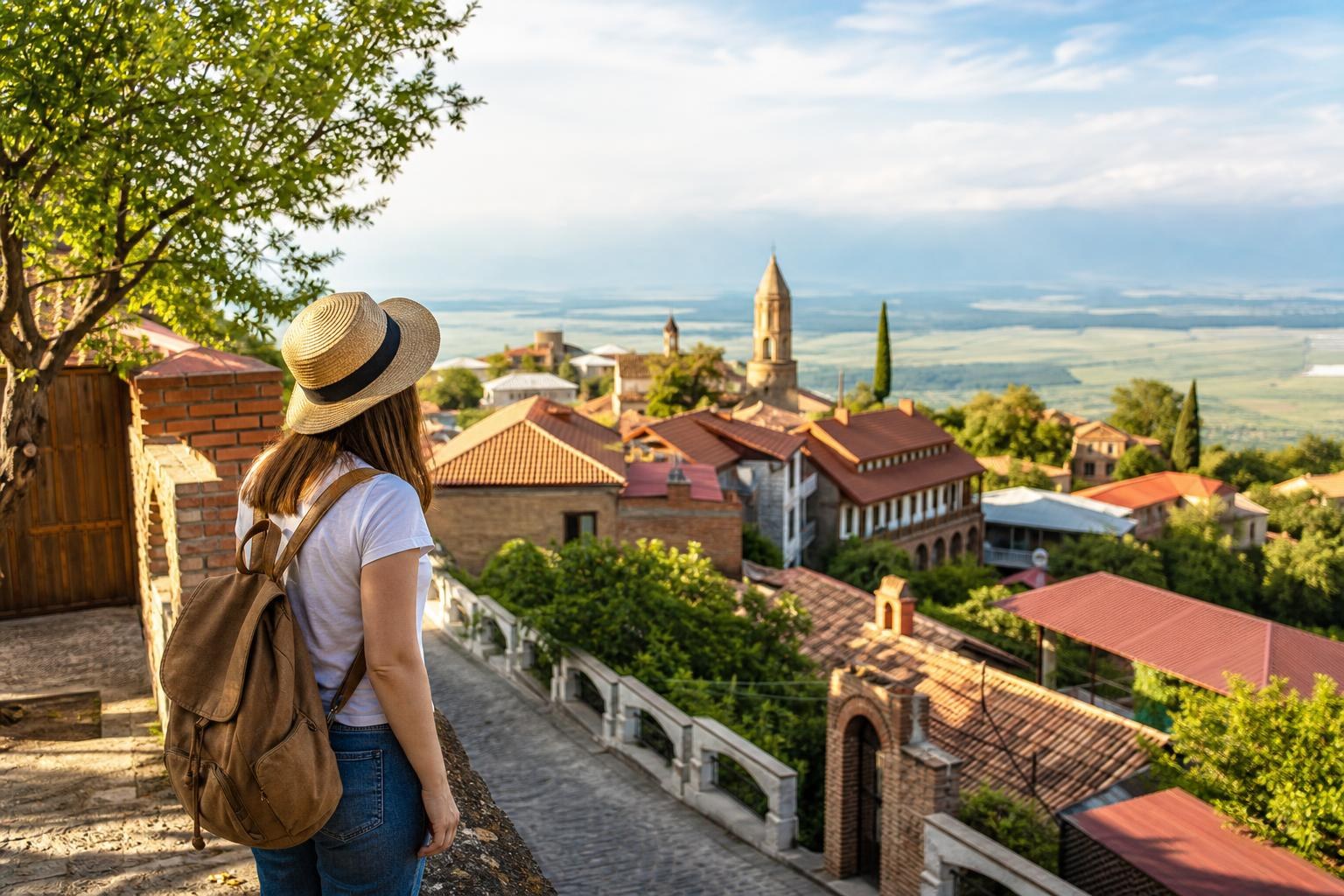
Georgia has been making wine for over 8,000 years, and the Kakheti region produces about 70% of the country’s output. The Alazani Valley, framed by the snow-capped Greater Caucasus on one side and rolling vineyards on the other, is where most wine tourism happens. Towns like Sighnaghi (the “City of Love,” perched on a hilltop with fortress walls) and Telavi serve as good bases.
What makes Georgian wine distinct is the qvevri method: fermenting grape juice with skins, seeds, and stems in large clay vessels buried underground. This produces amber wines with a tannic structure that surprises anyone expecting conventional whites. The country has emerged as Europe’s next wine tourism hotspot, with family-run wineries like Pheasant’s Tears in Sighnaghi offering tastings and meals that blur the line between a cellar visit and a full-blown feast. Expect to pay 30-50 GEL for a tasting with food at most family operations.
Timing Your Visit for Optimal Weather
Georgia’s climate varies dramatically by region and elevation. Tbilisi can hit 38°C in July, while Svaneti might still have snow patches in June. The sweet spot for most travelers is May through June or September through mid-October, when temperatures are comfortable, crowds are manageable, and the landscapes are at their most vivid.
Spring brings wildflowers to the valleys and green hillsides everywhere, but some high-altitude passes (particularly the road to Ushguli) may not open until late June. Autumn is harvest season in Kakheti, and the rtveli (grape harvest) in September and October is a genuinely participatory event: many guesthouses invite visitors to help pick grapes and stomp them in traditional fashion.
Winter has its own appeal if you’re a skier. Gudauri, about two hours from Tbilisi, offers surprisingly good powder skiing with lift passes around 50-60 GEL per day: a fraction of what you’d pay in the Alps.
Seasonal Climate and Activity Comparison Table
| Season | Tbilisi Temp (°C) | Best Regions | Key Activities | Crowd Level |
|---|---|---|---|---|
| Spring (Apr-Jun) | 15-28 | Kakheti, Tbilisi, Kazbegi | Hiking, wine tours, city exploration | Moderate |
| Summer (Jul-Aug) | 28-38 | Svaneti, Tusheti, Black Sea | High-altitude trekking, beach towns | High |
| Autumn (Sep-Oct) | 15-25 | Kakheti, Tbilisi, Kazbegi | Grape harvest, hiking, food festivals | Moderate |
| Winter (Nov-Mar) | 0-8 | Gudauri, Bakuriani, Tbilisi | Skiing, hot springs, indoor culture | Low |
The shoulder months of May and October often deliver the best combination of weather, price, and crowd levels. Hotel rates in Tbilisi can drop 30-40% outside peak summer.
Logistics and Transportation Essentials
Getting around Georgia is part of the adventure, but it requires adjusting your expectations if you’re used to Western European rail networks. The country doesn’t have a high-speed train system, and road conditions outside major highways range from decent to genuinely nerve-wracking. That said, travel here is affordable and surprisingly flexible once you understand the options.
Tbilisi’s international airport (TBS) has direct connections to most major European and Middle Eastern hubs. From the airport, a Bolt or Yandex Go ride to the city center costs about 15-20 GEL. Download both apps before you land: they’re far more reliable than hailing a cab, and the pricing is transparent.
Navigating by Marshrutka and Train
Marshrutkas are the backbone of Georgia’s intercity transport. These minibuses depart from stations like Tbilisi’s Didube and Ortachala terminals and connect to virtually every town in the country. They’re cheap (Tbilisi to Kutaisi runs about 15 GEL) but not always comfortable: expect cramped seating, no air conditioning on older vehicles, and drivers who treat speed limits as gentle suggestions.
Georgian Railways operates a more relaxed alternative for certain routes. The overnight train from Tbilisi to Zugdidi (gateway to Svaneti) costs around 25-35 GEL for a sleeper berth and saves you a hotel night. The Tbilisi-to-Batumi express is another good option, covering the route in about five hours with comfortable seating and wifi that works intermittently.
For both marshrutkas and trains, buy tickets at the station or through the TKT.ge app. Schedules can shift, so checking a day ahead saves headaches.
Hiring Private Drivers for Remote Areas
For places like Tusheti, Upper Svaneti, or the David Gareja monastery complex, a private driver isn’t a luxury: it’s often the only practical option. Roads to these areas are unpaved, steep, and sometimes require 4WD vehicles that marshrutkas don’t provide.
Expect to pay 150-250 GEL per day for a driver with a vehicle, depending on distance and terrain. Your guesthouse host can almost always arrange one, and this is often better than booking through an agency because local drivers know the roads intimately. A good driver doubles as a guide: they’ll stop at viewpoints, translate at roadside stalls, and occasionally insist on buying you churchkhela (the walnut-and-grape candy that looks like a candle).
I’d suggest agreeing on the full itinerary and price before departure. Most drivers are honest, but clarity upfront prevents awkwardness later.
Immersive Cultural and Culinary Experiences
Georgia’s culture runs deep, shaped by its position at the crossroads of empires and its fierce independence from all of them. The phrase “stumari ghvtisaa” – “a guest is a gift from God” – isn’t a tourism slogan. It’s a social code that Georgians take seriously, and it shows up in ways that can feel overwhelming if you’re used to more transactional hospitality.
Participating in a Traditional Supra
The supra is Georgia’s ritual feast, and if you spend more than a few days in the country, you’ll likely find yourself at one. A tamada (toastmaster) leads a structured series of toasts: to God, to Georgia, to family, to the departed, to peace, and eventually to the guests. Each toast is followed by drinking wine (or chacha, the local grape brandy that could strip paint), and refusing is considered poor form. You don’t have to drain your glass every time, but you should at least sip.
The food at a supra is staggering in both quantity and variety. Expect khinkali (soup dumplings), khachapuri (cheese-filled bread in various regional styles), pkhali (walnut-herb spreads), jonjoli (pickled bladdernut flowers), and grilled meats. A home supra can last four or five hours, and the conversation ranges from politics to poetry to who makes the best tkemali sauce in the village.
If you’re not lucky enough to be invited to a private supra, several restaurants in Tbilisi stage traditional feasts with live polyphonic singing. Shavi Lomi and Azarphesha both do this well, though the experience is naturally more curated than a spontaneous village gathering.
Exploring UNESCO World Heritage Sites
Georgia has four UNESCO World Heritage Sites, and each tells a different chapter of the country’s story. The ancient capital of Mtskheta, just 20 minutes from Tbilisi, holds the Jvari Monastery (6th century) and Svetitskhoveli Cathedral, where tradition says Christ’s robe is buried. Gelati Monastery near Kutaisi was the intellectual center of medieval Georgia and houses some of the finest Byzantine-style frescoes in the Caucasus.
The Upper Svaneti cultural landscape is a UNESCO site as much for its living traditions as its architecture: the defensive towers date from the 9th-12th centuries, and some families still use them. Bagrati Cathedral in Kutaisi, though controversially reconstructed, remains an important pilgrimage site.
Entry to most religious and historical sites is free, though donations are appreciated. Dress modestly at churches and monasteries: women should cover their heads (scarves are usually available at the entrance), and shorts are frowned upon for both men and women.
Practical Tips for a Seamless Journey
A few things that will make your Georgia excursion run smoother, based on what I’ve seen trip up first-time visitors:
- Cash is still king outside Tbilisi. ATMs exist in smaller towns but aren’t always reliable. Carry enough lari (GEL) for a day or two of expenses when heading to rural areas. Credit cards work at most Tbilisi restaurants and hotels, but village guesthouses and marshrutka drivers deal in cash only.
- Learn a few Georgian phrases. “Gamarjoba” (hello), “madloba” (thank you), and “gamajveba” (cheers) go a long way. Georgia ranks relatively low on the EF English Proficiency Index, and outside Tbilisi’s tourist core, English speakers are uncommon. Download Google Translate’s Georgian offline pack before you leave home.
- Solo female travelers report feeling very safe. Georgian culture places high value on protecting guests, and violent crime against tourists is extremely rare. Police are generally helpful and responsive. That said, exercise normal caution at night and be aware that some rural areas hold conservative social views.
- Avoid political conversations about Russia and occupied territories. Georgians have strong feelings about Abkhazia and South Ossetia, and the topic is sensitive. Listen more than you talk on this one.
- Water is safe to drink in Tbilisi but stick to bottled water in rural areas. Borjomi, the famous Georgian mineral water, is available everywhere for about 1-2 GEL per bottle.
- Travel insurance is non-negotiable. Mountain activities, remote locations, and unpaved roads mean that evacuation costs can add up fast if something goes wrong. Make sure your policy covers adventure activities if you plan to hike or ski.
Georgia has never received as many travelers from EU countries as it has recently, and the infrastructure is catching up quickly. New guesthouses and tour operators open every season, but the country’s core appeal remains unchanged: raw landscapes, ancient traditions, and a hospitality culture that treats every visitor like a long-lost relative.
The best Georgia excursion isn’t necessarily the one that covers the most ground. It’s the one that leaves room for the unplanned: the detour to a roadside winery, the extra night in a mountain village because the host insisted, the three-hour lunch that turned into a life story. Plan your route, book your first couple of nights, and then let the country do what it does best. You’ll come home with more stories than photos, and that’s exactly the point.