
Table of Contents
- Discovering the Mineral Waters of Borjomi Central Park
- Hiking Trails in Borjomi-Kharagauli National Park
- Summary of Popular Hiking Routes and Difficulty Levels
- Architectural Landmarks and Cultural Sites
- Cable Car Rides and Plateau Views
- Essential Travel Tips for Your Borjomi Visit
Borjomi sits in a narrow gorge in south-central Georgia, wrapped in dense forest and fed by volcanic geology that has pushed mineral-rich water to the surface for centuries. The town is small: maybe 14,000 residents, a single main street, and a pace of life that feels like it belongs to another era. But that quietness is exactly the point. People come here to drink water straight from the earth, to hike through one of Europe’s largest protected forests, and to soak in sulfur pools while staring at mountains. Georgia as a whole has been on a steep tourism trajectory, with the country welcoming over 5.5 million international visitors in 2025, and Borjomi has been a direct beneficiary of that growth. If you’re wondering what to do in Borjomi, the answer splits neatly between its famous springs and its exceptional hiking, but there’s more texture here than most guides let on. I spent time walking these trails, tasting the water (an acquired taste, trust me), and riding the cable car, and what follows is everything I wish I’d known before arriving.
Discovering the Mineral Waters of Borjomi Central Park
Borjomi Central Park is the heart of the town, both geographically and spiritually. It stretches along the Borjomula River, a narrow tributary that cuts through the gorge, and the park itself has been a destination since the Russian imperial era in the 1800s. The entire area has been undergoing major rehabilitation work in recent years, with upgrades to pathways, lighting, and visitor infrastructure that have modernized the experience without stripping its character.
Walking through the park feels less like a tourist attraction and more like a town square where locals happen to gather. You’ll see families filling bottles at the springs, kids splashing near the river, and older men playing backgammon on benches. The entrance fee is a token 2 GEL (less than a dollar), which gets you into the park and access to the spring pavilions. Vendors near the entrance sell empty bottles for about 1 GEL if you forget to bring your own.
The park stretches about a kilometer from the entrance to the sulfur pools at the back, and the walk itself is pleasant: tree-lined, shaded, with the sound of running water throughout. It’s a good idea to budget at least two hours here, more if you plan to swim.
Tasting the Famous Springs at the Blue Pavilion
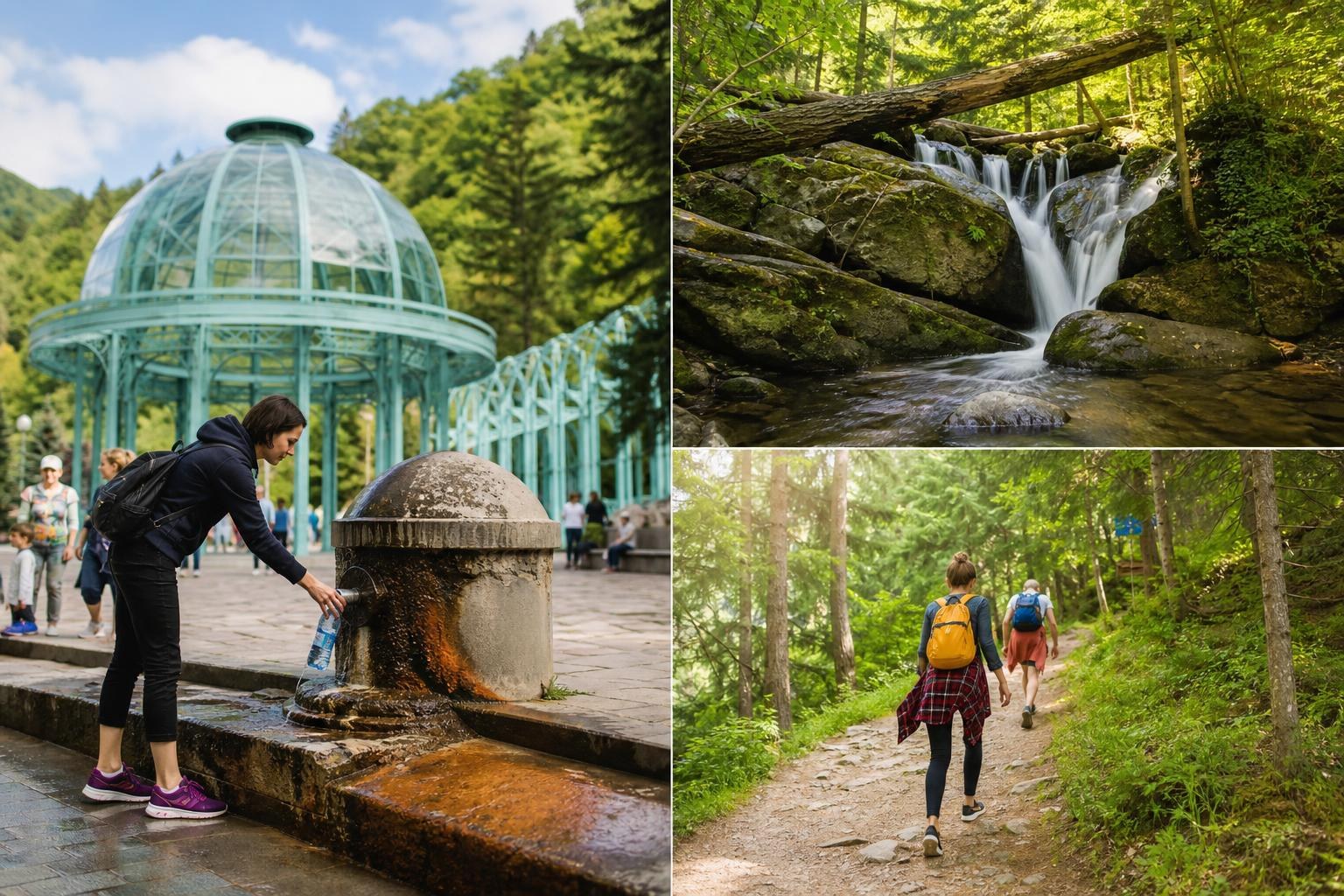
The Blue Pavilion, a small ornamental structure near the park’s midpoint, is where most visitors have their first encounter with Borjomi mineral water. The water flows freely from a tap, and it’s warm: around 35-40°C. It tastes nothing like the bottled Borjomi you find in supermarkets across Europe. The fresh spring water is intensely mineral, slightly sulfuric, and has a metallic finish that catches you off guard. Some people love it immediately. I needed a few sips.
The water contains bicarbonate, sodium, and trace minerals pushed up from volcanic rock roughly 1,500 meters below the surface. Locals swear by its digestive benefits, and Georgian physicians have historically prescribed Borjomi water for stomach and kidney issues. Whether you buy into the medicinal claims or not, the ritual of drinking warm mineral water from a centuries-old spring is worth the experience alone.
Bring a reusable bottle. The water stays drinkable for about 24 hours before it loses its carbonation and mineral intensity. There’s a second, less crowded spring source deeper in the park, past the main pavilion, that’s worth seeking out if the Blue Pavilion has a line.
Relaxing in the Sulfur Water Swimming Pools
At the far end of the park, tucked against the hillside, you’ll find three open-air sulfur pools. These are not luxury spa pools: they’re concrete basins filled with naturally heated sulfur water, and the experience is closer to a public bathhouse than a resort. The water hovers around 27°C in the outdoor pools, which feels cool at first but becomes comfortable quickly.
Entry costs roughly 5 GEL per person, and towel rental is available for another 2-3 GEL. The pools get busiest on weekends and during summer afternoons, so arriving before noon on a weekday gives you the most space. The sulfur smell is noticeable but not overwhelming, and most people adjust within minutes.
There are also private indoor pools available for small groups at a higher price, usually around 20-30 GEL per hour. These are warmer and more secluded. After soaking, the walk back through the park feels different: your muscles are looser, the air smells sharper, and the whole gorge seems to settle around you.
Hiking Trails in Borjomi-Kharagauli National Park
Borjomi-Kharagauli National Park covers over 85,000 hectares, making it one of the largest protected areas in Europe. The park spans elevations from 800 to 2,600 meters, which means the ecosystems shift dramatically depending on which trail you choose: dense deciduous forest at the lower elevations, subalpine meadows higher up, and conifer stands in between.
Registration is required before starting any trail, and it’s free. You check in at the park’s visitor center in Borjomi, where rangers will brief you on trail conditions and weather. This isn’t a formality: weather in the mountains can shift fast, and some trails become impassable after heavy rain. The visitor center also rents basic camping gear if you’re planning an overnight route.
The park maintains about 12 marked trails of varying length and difficulty, and most are well-signed with colored blazes. I’d recommend downloading offline maps before heading out, as cell service drops off quickly once you’re past the first kilometer.
The Information Trail for Beginners
The Information Trail (sometimes called Trail #1) is the most accessible route in the park. It’s a 3-kilometer loop that starts directly from the visitor center and gains only about 200 meters of elevation. The entire thing takes roughly 90 minutes at a comfortable pace, and the path is wide, well-maintained, and marked with interpretive signs explaining the local flora and geology.
This trail is ideal if you’re traveling with children or if you simply want a taste of the forest without committing to a full day. The canopy cover is thick, so even on hot July days the trail stays cool. You’ll cross a few small streams and pass through groves of beech and oak that feel almost impossibly green during summer.
Don’t skip this trail just because it’s labeled “beginner.” The forest here is genuinely beautiful, and the interpretive signs offer context about the park’s biodiversity that enriches any longer hikes you do afterward.
St. Andrew’s Trail for Panoramic Views
St. Andrew’s Trail (Trail #2) is a more serious commitment: roughly 12 kilometers one way, with significant elevation gain that takes you above the tree line. Most hikers do it as a full-day out-and-back, though overnight camping is permitted at designated shelters along the route.
The first few kilometers wind through dense forest, similar to the Information Trail. Around the 5-kilometer mark, the trees begin to thin, and the trail opens into subalpine meadows with views that stretch across the entire Borjomi gorge. On clear days, you can see the snow-capped peaks of the Lesser Caucasus to the south.
The trail is named for a small chapel dedicated to St. Andrew near the summit area. The chapel itself is modest, but the views from its location are the real reward. Carry at least 2 liters of water per person, sun protection, and layers: the temperature at the top can be 10-15°C cooler than in town. The trail is best attempted between May and October, with June and September offering the most stable weather.
Summary of Popular Hiking Routes and Difficulty Levels
| Trail Name | Distance | Elevation Gain | Duration | Difficulty |
|---|---|---|---|---|
| Information Trail (#1) | 3 km loop | ~200 m | 1.5 hours | Easy |
| St. Andrew’s Trail (#2) | 12 km one way | ~1,200 m | 6-8 hours | Moderate-Hard |
| Likani Trail (#3) | 6 km one way | ~500 m | 3-4 hours | Moderate |
| Nikoloz Trail (#6) | 13 km one way | ~1,000 m | Full day | Hard |
| Amarati Plateau (#9) | 18 km one way | ~1,400 m | 2 days (overnight) | Hard |
Registration at the visitor center is mandatory for all trails. Multi-day routes require advance booking of mountain shelters, which fill up during peak season (July-August). Shelter fees are minimal, usually around 15-20 GEL per night, and include basic bunk beds and wood stoves. Bring your own food and sleeping bag.
Architectural Landmarks and Cultural Sites
Borjomi’s architecture tells the story of its past as a retreat for Russian imperial elites. The town became fashionable in the mid-19th century after Russian military officers discovered the mineral springs, and the buildings from that era still define much of Borjomi’s visual character. There’s a particular charm to the faded grandeur: ornate facades that have weathered a century of mountain winters, wrought-iron balconies, and garden walls half-swallowed by ivy.
Beyond the imperial-era buildings, the town has several churches and a small local museum that covers the region’s history from ancient Colchis through the Soviet period. The museum is worth an hour if you’re interested in context, and entry is about 5 GEL.
The Romanov Summer Palace in Likani
About 3 kilometers from Borjomi’s center, in the village of Likani, sits the Romanov Summer Palace. Built in the 1890s for Grand Duke Nikolai Mikhailovich, the palace is a Moorish-influenced structure that looks almost out of place against the forested mountains. The building served as a summer residence for the Romanov family and later became a retreat for Soviet leaders, including Stalin, who reportedly used it frequently.
The palace grounds include manicured gardens and views over the Mtkvari River. Interior access has been intermittent over the years depending on restoration status, but the exterior and gardens alone justify the visit. A taxi from central Borjomi costs about 5-7 GEL, or you can walk the riverside path in about 40 minutes.
The Firuza House and Imperial History
The Firuza House, sometimes called the “Turquoise House” for its distinctive facade color, is another remnant of Borjomi’s imperial past. Originally built as a residence for the Iranian consul in the late 19th century, the building reflects the cosmopolitan character of Borjomi during its heyday as a spa destination for the Russian and Persian elite.
The house has been partially restored and occasionally hosts small exhibitions, though it’s not always open to visitors on a fixed schedule. Check with the local tourist information office on Meskheti Street for current hours. Even from the outside, the building’s Persian-influenced decorative elements and its turquoise tile work make it one of the most photogenic structures in town.
Cable Car Rides and Plateau Views
The Borjomi cable car departs from inside Central Park and climbs about 300 meters to a forested plateau above the gorge. The ride takes roughly 10 minutes each way and costs about 5 GEL for a round trip. The cabins are small, holding four to six people, and they move slowly enough that you can take photos without everything blurring.
At the top, there’s a small amusement area, a Ferris wheel (which looks slightly precarious but has been operating safely for years), and a few food stalls selling churchkhela, roasted nuts, and khachapuri. The real draw is the viewpoint at the edge of the plateau, where you can look down over the entire Borjomi gorge and the town nestled within it.
I’d recommend timing your cable car ride for late afternoon, when the light hits the gorge at an angle and the forest canopy glows. The plateau is also a starting point for informal walking paths through the upper forest, though these aren’t part of the national park’s maintained trail system. Bring a jacket: the temperature at the top is noticeably cooler than in town, especially after sunset.
Essential Travel Tips for Your Borjomi Visit
Getting to Borjomi from Tbilisi takes about 3 to 3.5 hours by marshrutka (minibus), which departs from Didube station and costs roughly 15-20 GEL. Private transfers run about 100-150 GEL each way. There’s also the historic narrow-gauge “Kukushka” train connecting Borjomi and Bakuriani, which has been undergoing restoration and is expected to resume service in January 2027. When it returns, it will be one of the most scenic short rail journeys in the Caucasus.
Accommodation in Borjomi ranges from family-run guesthouses at 50-80 GEL per night to mid-range hotels around 150-200 GEL. Guesthouses are the better choice if you want home-cooked Georgian meals: many hosts prepare dinner for guests, and a full supra-style spread might cost an additional 20-30 GEL. The Georgian concept of “stumari ghvtisaa” (the guest is from God) is alive and well here, and guesthouse hosts in Borjomi tend to treat visitors like extended family.
For food, the town has a handful of restaurants along the main street serving standard Georgian fare. Expect to pay 15-25 GEL for a main course. If you visit during autumn, the regional Gemo Fest food festival in Samtskhe-Javakheti showcases local cheeses, honey, and wines that you won’t find elsewhere in Georgia.
Practical apps to have on your phone: Bolt for taxis (works in Borjomi, though drivers are limited), Google Translate with the Georgian offline pack downloaded, and Maps.me for offline trail navigation. ATMs exist in town but can occasionally run out of cash on busy weekends, so carry some lari with you.
The springs and hiking around Borjomi reward slow travel. Rushing through in a single day means missing the rhythm of the place: the morning mist in the gorge, the afternoon light on the plateau, the quiet satisfaction of drinking warm mineral water that tastes like the earth itself. Give it at least two full days, three if you want to tackle a longer trail in the national park. Borjomi isn’t a place that reveals itself all at once, and that patience is part of what makes it memorable.