
Table of Contents
- Top Family-Friendly Neighborhoods at a Glance
- Vake: The Upscale Choice for Quiet and Parks
- Saburtalo: Residential Convenience and Space
- Old Tbilisi and Sololaki: Cultural Immersion
- Vera: A Central and Charming Alternative
- Essential Tips for Traveling in Tbilisi with Children
- Picking the Right Base for Your Family
Tbilisi is one of those cities that surprises families. You expect a quick Caucasus stopover, and instead you find a place where kids can ride cable cars over a gorge, splash in sulfur baths, and eat khachapuri the size of their heads – all for a fraction of what a week in Western Europe would cost. But the city’s neighborhoods feel genuinely different from one another, and picking the wrong base can mean dragging tired children up steep hills or sitting in traffic when you’d rather be exploring. Choosing the right area for your family shapes the entire trip. I’ve spent enough time walking Tbilisi’s streets with kids in tow to know that where you sleep matters almost as much as what you do. The neighborhoods below each serve a different kind of family: those who want green space and quiet, those who want cultural immersion, and those who want easy access to malls and playgrounds. Here’s an honest breakdown of the best family-friendly areas in Tbilisi for 2026, what each one actually delivers, and what trade-offs you’ll face.
Top Family-Friendly Neighborhoods at a Glance
Before getting into the details, a quick overview helps. Tbilisi’s family-friendly zones cluster into four main options: Vake, Saburtalo, Old Tbilisi (including Sololaki), and Vera. Each has a distinct personality, and the right pick depends on your family’s priorities – whether that’s park access, walkability, apartment size, or proximity to major sights.
Vake is the upscale, leafy choice. Saburtalo is the practical, spacious one. Old Tbilisi is for families who want to live inside the postcard. Vera splits the difference between central location and residential calm. None of them is a bad option, but they’re not interchangeable.
Comparison Table: Amenities, Safety, and Proximity
| Feature | Vake | Saburtalo | Old Tbilisi / Sololaki | Vera |
|---|---|---|---|---|
| Safety | Very high | High | High (tourist police present) | High |
| Green Space | Excellent (Vake Park, Turtle Lake) | Moderate (scattered parks) | Limited (Rike Park nearby) | Moderate (small parks) |
| Walkability with Kids | Good (flat main streets) | Good (flat, wide sidewalks) | Challenging (hills, cobblestones) | Good (mostly flat) |
| Proximity to Old Town Sights | 15-20 min by taxi | 20-25 min by taxi | Walking distance | 5-10 min walk |
| Apartment Size | Medium to large | Large | Small to medium | Small to medium |
| Average Nightly Rate (2-bed) | $55-90 | $35-60 | $50-80 | $45-75 |
| Grocery/Pharmacy Access | Excellent | Excellent | Limited | Good |
| Restaurant Variety | High (international + Georgian) | Moderate (mostly Georgian) | High (tourist-oriented) | Good (cafés, bistros) |
Prices reflect 2026 averages for vacation rental apartments in Tbilisi, which tend to offer far better value for families than hotels. A two-bedroom apartment in Saburtalo can run as low as 90 GEL (about $35) per night, while Vake commands a premium for its polished surroundings.
Vake: The Upscale Choice for Quiet and Parks
Vake is where Tbilisi’s professional class lives, and it shows. The streets are cleaner, the buildings newer, and the cafés serve flat whites alongside traditional Turkish coffee. For families, the main draw is simple: green space and calm. You won’t hear honking at midnight, and your kids can run around Vake Park without you worrying about traffic.
The neighborhood sits southwest of the city center, connected by Chavchavadze Avenue, one of Tbilisi’s main arteries. Most of the family-friendly rentals line this avenue or branch off it. You’ll find pharmacies, supermarkets (Goodwill and Carrefour both have locations here), and pediatric clinics within walking distance. The area also hosts several international schools, which tells you something about the demographic.
The trade-off is distance from the Old Town. You’re looking at a 15-20 minute taxi ride (roughly 8-12 GEL via Bolt) to reach Narikala Fortress or the sulfur baths. That’s not terrible, but it adds up with small children who need naps and snack breaks.
Vake Park and Turtle Lake Activities
Vake Park is one of the largest urban parks in the Caucasus, stretching across 300 hectares of forested hills. Kids can bike, scooter, or just chase pigeons along the wide paths. There’s a small amusement area with bumper cars and a Ferris wheel that costs next to nothing – expect to pay 2-3 GEL per ride.
From the park, a cable car climbs to Turtle Lake (Kus Tba), a small alpine lake at about 700 meters elevation. The lake has a modest beach area and pedal boats that kids love, plus a few restaurants with terraces overlooking the water. On weekends, local families dominate the scene, and it feels more like a community gathering than a tourist attraction. The cable car ride itself is a highlight for children – it takes about five minutes and offers views over the city’s western hills.
Family Dining and Modern Infrastructure
Vake’s restaurant scene skews international. You’ll find sushi, Italian, and even decent Mexican food alongside traditional Georgian restaurants. For picky eaters (and let’s be honest, most kids qualify), this variety is a lifesaver. Luca Polare, a local gelato chain with a Vake location, is a reliable bribe for good behavior.
The neighborhood’s modern infrastructure extends to medical care. The Todua Clinic and several private pediatric offices operate in Vake, and English-speaking doctors are easier to find here than in other parts of the city. If your child has allergies or a medical condition that requires monitoring, Vake offers the most peace of mind.
Saburtalo: Residential Convenience and Space
Saburtalo is the neighborhood nobody writes Instagram captions about, and that’s exactly why families love it. It’s a sprawling residential district north of Vake, built primarily during the Soviet era and expanded since. The architecture won’t win awards, but the apartments are big – genuinely big – and the prices are the lowest of any safe, central-ish neighborhood.
A typical Saburtalo rental gives you three bedrooms, a full kitchen, and a washing machine for what you’d pay for a cramped studio in Old Tbilisi. For families of four or more, this math matters. The neighborhood also feels authentically Georgian in a way that tourist-heavy areas don’t. Your neighbors are teachers, engineers, and university students (Tbilisi State University’s campus borders the district). Kids playing in courtyards is a normal sight, not an anomaly.
Access to Shopping Malls and Entertainment
The East Point and Tbilisi Mall shopping centers are both accessible from Saburtalo within 15-20 minutes by bus or taxi. East Point, the larger of the two, has a cinema with English-language screenings, a bowling alley, an indoor play zone, and a food court that can absorb an entire rainy afternoon. Tbilisi Mall offers similar entertainment plus a decent supermarket for stocking up.
Saburtalo itself has a Carrefour hypermarket on Vazha-Pshavela Avenue, which is the most convenient large grocery store for families in the district. You’ll find familiar international brands alongside Georgian staples. A liter of milk runs about 4-5 GEL, bread is 1-2 GEL, and a kilo of seasonal fruit rarely exceeds 3 GEL.
Spacious Apartment Rentals for Larger Families
This is where Saburtalo genuinely stands apart. Platforms like Airbnb list dozens of family-sized apartments in the district, many with three or four bedrooms. Hosts in Saburtalo tend to be long-term rental owners who’ve furnished their places practically rather than aesthetically – think full-size refrigerators, proper dining tables, and sometimes even cribs and high chairs on request.
For families staying longer than a week, Saburtalo also makes financial sense. Monthly rental rates drop significantly, with some three-bedroom apartments available for $600-800 per month including utilities. If you’re combining remote work with family travel (a common pattern in 2026), this district gives you the space and quiet to actually get things done while the kids nap.
Old Tbilisi and Sololaki: Cultural Immersion
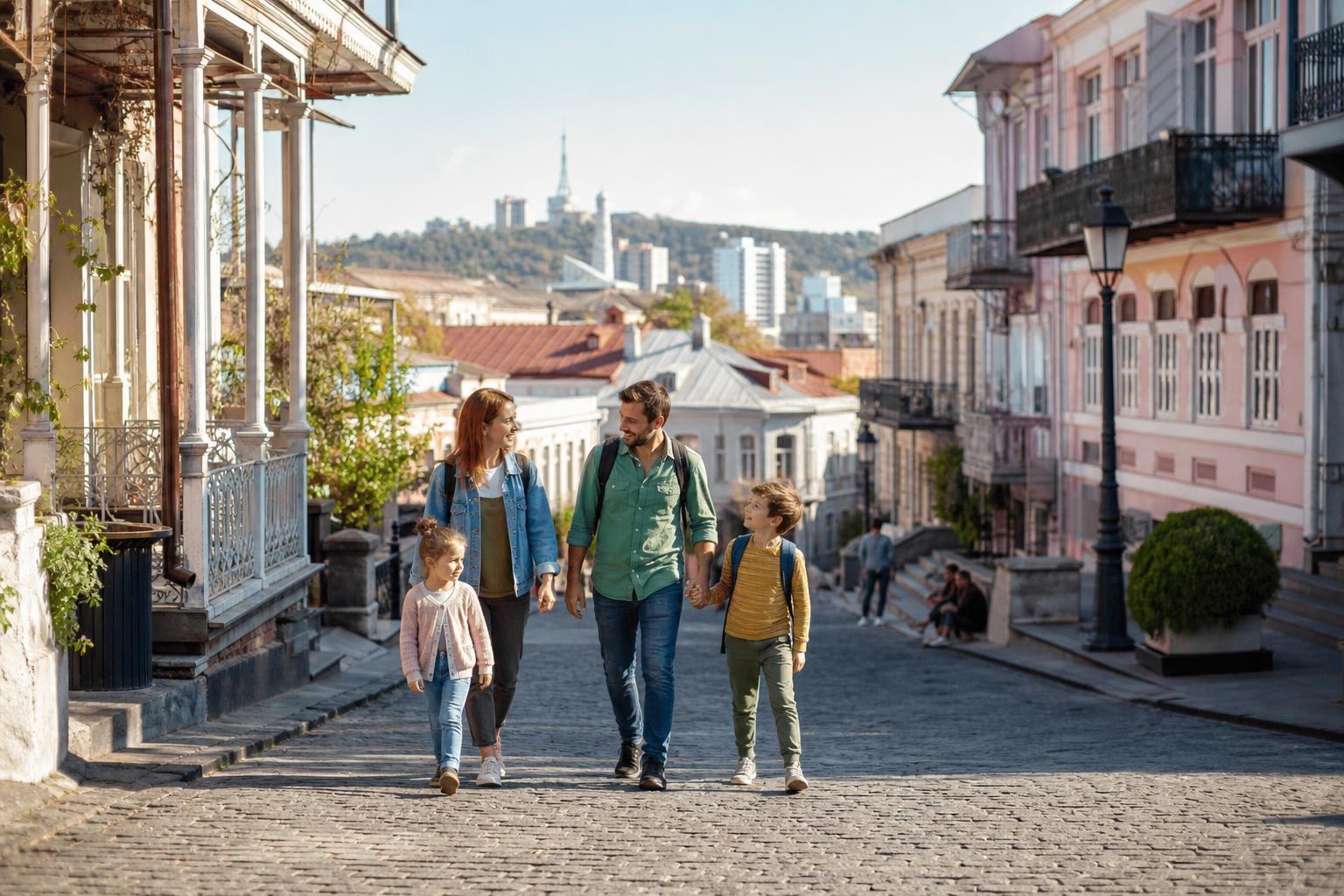
Old Tbilisi is the city’s beating heart: the sulfur baths, the leaning wooden balconies, the churches carved into cliffsides, the narrow streets that smell like fresh bread and grilled meat. Staying here means your family wakes up inside the experience rather than commuting to it. Kids who are old enough to walk confidently (roughly age five and up) will find the whole neighborhood an adventure.
Sololaki, the hillside residential area adjacent to Old Tbilisi, offers slightly quieter streets with the same proximity to major sights. Many of the best family rentals sit on Sololaki’s upper streets, where you get balconies with views of Narikala Fortress and the Mtkvari River below.
The honest downside: this area is hilly, the streets are uneven, and grocery options are limited to small corner shops. You’ll pay tourist-area prices at restaurants, and parking is essentially nonexistent.
Navigating Cobblestone Streets with Strollers
I won’t sugarcoat this. If you have a child under three in a stroller, Old Tbilisi will test your patience. The cobblestones are charming but brutal on wheels, and several key streets involve steep inclines. A lightweight umbrella stroller handles the terrain better than a full-size travel system, but a baby carrier or structured backpack is the smartest choice for this neighborhood.
That said, the city has invested in improving pedestrian access around major attractions. Rike Park, the Bridge of Peace, and the main sulfur bath district all have paved, stroller-accessible paths. The challenge is getting between these points, where you’ll encounter stairs, broken sidewalks, and the occasional stray dog (friendly but startling for toddlers).
Proximity to Rike Park and the Cable Car
Rike Park is the single best family space in central Tbilisi. It sits along the river with a modern playground, open lawns, musical fountains that kids can run through in summer, and direct access to the Aerial Tramway. The cable car ride to Narikala Fortress costs just 2.50 GEL per person (free for children under six) and takes about two minutes – but those two minutes, floating above the Mtkvari River gorge, are unforgettable for kids.
From Narikala, you can walk down to the Abanotubani sulfur bath district or climb to the Mother of Georgia statue. Both are manageable with school-age children, though the paths are steep in places. The botanical garden, accessible from behind the fortress, is another solid option – it’s shaded, quiet, and costs 4 GEL for adults.
Vera: A Central and Charming Alternative
Vera is the neighborhood I recommend most often to families who can’t decide between Old Tbilisi’s character and Vake’s convenience. It sits right between them, physically and in personality. The streets are tree-lined and relatively flat, dotted with small cafés, bakeries, and art galleries. It feels residential without being boring, and central without being chaotic.
The district’s main advantage is walkability. From a Vera apartment, you can reach Freedom Square (the gateway to Old Tbilisi) in about ten minutes on foot, and Vake Park in about fifteen. The Tbilisi metro’s Rustaveli station is nearby, connecting you to the rest of the city for 1 GEL per ride. Vera also has a handful of small playgrounds tucked into its side streets – nothing spectacular, but enough to burn off energy between sightseeing stops.
Apartment options in Vera tend to be smaller than Saburtalo but more characterful. Many are in renovated pre-Soviet buildings with high ceilings and wooden floors. Expect to pay $45-75 per night for a two-bedroom unit. The neighborhood’s restaurant scene punches above its weight: places like Cafe Littera (in the Writers’ House courtyard) serve some of Tbilisi’s best food, though that particular spot is more of a parents’ date-night option than a kids’ meal destination.
For families with older children or teenagers, Vera hits a sweet spot. Teens can explore the nearby Rustaveli Avenue independently (it’s safe and well-lit), while parents enjoy the neighborhood’s quieter side streets. The area also has reliable Wi-Fi infrastructure and several coworking spaces, which matters for families balancing travel with school or work schedules. Georgia’s growing international school options also cluster in or near Vera and Vake, relevant for families considering extended stays.
Essential Tips for Traveling in Tbilisi with Children
Beyond choosing the right neighborhood, a few practical details can make or break a family trip to Tbilisi. The city is genuinely welcoming to children – Georgian culture treats kids as communal treasures, and strangers will smile at your toddler, offer candy (always ask first), and help you carry a stroller up stairs. But the infrastructure doesn’t always match the warmth.
Tap water in Tbilisi is safe to drink in 2026, which eliminates one common worry. Most restaurants will accommodate children without a dedicated kids’ menu – just ask for a half portion of khinkali (dumplings) or a plain khachapuri. Tipping is appreciated but not obligatory; 10% is generous by local standards.
Public Transport vs. Ride-Hailing Apps
Tbilisi’s metro system is clean, safe, and absurdly cheap at 1 GEL per ride (about $0.37). It has two lines and covers the main corridor from Saburtalo through the center. The catch: stations involve long escalators and no elevators, making it impractical with strollers. Buses are similarly affordable but crowded during rush hours, and routes can be confusing without Georgian language skills.
Ride-hailing apps are the practical winner for families. Bolt is the dominant platform in 2026, with Yandex Go as a secondary option. A typical cross-city ride costs 5-10 GEL, and most drivers will wait while you wrestle a car seat into place. Speaking of car seats: bring your own. Georgian taxis almost never have them, and while enforcement is lax, your child’s safety isn’t something to gamble on. A compact, FAA-approved travel car seat fits in luggage and works in Georgian vehicles.
Best Times of Year for Family Outdoor Exploration
Tbilisi’s climate swings hard. Summers (June through August) regularly hit 35-40°C, which is miserable for young children and makes midday sightseeing a bad idea. If you visit in summer, plan outdoor activities for early morning or after 5 PM, and keep your afternoons for air-conditioned malls or museums.
The sweet spots for families are May and September through mid-October. Temperatures hover around 20-28°C, the parks are green, and the city isn’t yet overrun with peak-season tourists. Spring brings wildflowers to the botanical garden, while autumn means fresh grape harvest season – several family-friendly vineyards within an hour of Tbilisi offer grape-stomping experiences that kids remember for years.
Winter (December through February) is cold but manageable, with temperatures around 0-5°C. The Christmas markets along Rustaveli Avenue are charming, and Tbilisi’s proximity to ski resorts like Gudauri (two hours north) makes it a viable winter family base.
Picking the Right Base for Your Family
The best area in Tbilisi for your family comes down to a simple question: what does your hardest day look like? If it’s a rainy Tuesday with cranky kids, Saburtalo’s big apartments and nearby malls save you. If it’s a day when everyone’s energized and curious, Old Tbilisi puts you steps from the city’s best experiences. Vake works when you want both comfort and outdoor space. Vera works when you want a bit of everything without committing fully to any extreme.
Tbilisi rewards families who stay longer than a weekend. Three to five nights lets you settle into a rhythm – morning walks, long Georgian lunches, afternoon naps, evening strolls along the river. The city’s affordability makes extended stays realistic, and its warmth toward children makes them genuinely enjoyable. Pick the neighborhood that matches your family’s energy, book an apartment with a kitchen, and let Tbilisi do what it does best: make you feel like a guest in someone’s home rather than a tourist passing through.