
Table of Contents
- The Old Town: A Tapestry of History and Architecture
- Religious Landmarks and Spiritual Heritage
- Hidden Corners and Secret Courtyards
- Modern Tbilisi: Innovation and Contemporary Art
- Panoramic Views and Natural Escapes
- Quick Reference: Planning Your Sightseeing
Tbilisi is a city that doesn’t reveal itself all at once. You catch a glimpse of a crumbling Art Nouveau balcony through a courtyard archway, stumble onto a sulfur bath district that smells faintly of eggs and feels like the 18th century, then round a corner to find a glass-and-steel pedestrian bridge glowing over the Mtkvari River. The Georgian capital has been conquered, burned, and rebuilt roughly 40 times throughout its 1,500-year history, and every layer is still visible if you know where to look. That layering is exactly what makes figuring out the landmarks and hidden corners of Tbilisi so rewarding: the famous sights sit shoulder-to-shoulder with places most visitors walk right past.
Georgia’s tourism sector has been surging, with visitor numbers climbing steadily in recent years despite global disruptions. The country welcomed over 5 million international visitors in the first half of 2025 alone, and 2026 projections look even stronger. Tbilisi absorbs the bulk of that attention, yet the city still feels surprisingly intimate. A metro ride costs 1 GEL (about $0.35), a khachapuri from a neighborhood bakery runs 3-5 GEL, and most major sights are either free or charge nominal entrance fees. The economics alone make this one of Europe’s most accessible capitals for travelers on any budget.
The Old Town: A Tapestry of History and Architecture
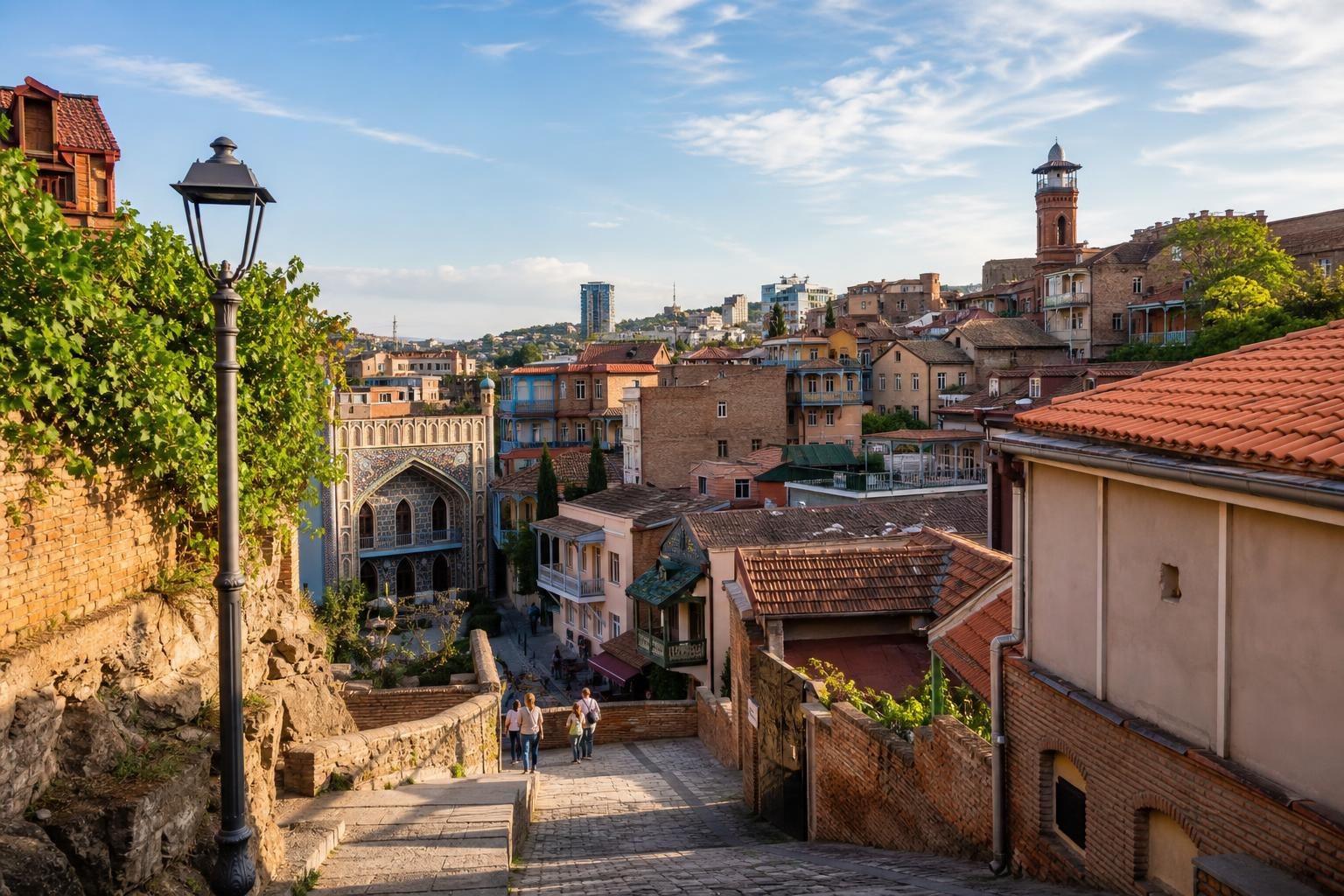
The Old Town, locally called Dzveli Tbilisi, occupies a compact stretch between Narikala Fortress and the Mtkvari River. Walking its narrow streets is less like touring a museum and more like rummaging through someone’s attic: Persian-era bathhouses sit below Soviet apartment blocks, which lean against medieval churches, which overlook brand-new wine bars. The district runs on foot traffic, and the best strategy is to simply wander without a fixed route.
What strikes most first-time visitors is the architecture’s honesty. Nothing has been overly polished for tourists. Balconies sag under the weight of grapevines. Stray dogs nap in doorways of buildings that predate the Russian Empire. I’ve watched elderly women hang laundry from windows that frame views of a 4th-century fortress, completely indifferent to the tourists photographing them from below. That lived-in quality is the Old Town’s greatest asset: it’s a neighborhood first and a tourist attraction second.
The Sulfur Baths of Abanotubani
King Vakhtang Gorgasali reportedly discovered Tbilisi’s hot sulfur springs in the 5th century when his falcon chased a pheasant into the steaming waters. The city’s name itself derives from “tbili,” meaning “warm” in Georgian. The bathhouse district of Abanotubani still operates on those same natural springs, and a private room with a sulfur soak and a traditional scrub (called a kisi) costs between 50 and 150 GEL depending on the bathhouse.
Orbeliani Baths, with their blue-tiled Moorish facade, are the most photographed. But locals tend to prefer Bathhouse No. 5 for its no-frills atmosphere and lower prices. The water temperature hovers around 40-46°C, and the sulfur content is genuinely therapeutic for skin and joints. Aim for a morning visit on a weekday: by Saturday evening, the wait for a private room can stretch past an hour.
Narikala Fortress and the Mother of Georgia
Narikala sits on a ridge above the Old Town and has guarded the city since the 4th century, though most of what you see today dates to the 7th and 8th centuries. You can hike up from Abanotubani in about 20 minutes, or take the aerial tramway from Rike Park for 2.50 GEL each way. The fortress walls are open and unguarded, which means you can scramble along them freely: a thrilling experience, though not one for anyone uncomfortable with heights and no railings.
The 20-meter aluminum statue of Kartlis Deda, the Mother of Georgia, stands just east of the fortress. She holds a sword in one hand and a bowl of wine in the other: a symbol of Georgia’s dual identity as both fiercely defensive and deeply hospitable. The concept of “stumari ghvtisaa” (a guest is a gift from God) runs deep here, and you’ll feel it in every interaction from taxi drivers to grandmothers offering churchkhela from their balconies.
The Leaning Clock Tower of Rezo Gabriadze
Tucked beside the Gabriadze Theater on Shavteli Street, this whimsical clock tower looks like it was designed by someone who studied architecture and then decided to ignore all of it. The structure leans deliberately, covered in mismatched tiles and topped with a small angel that emerges on the hour. Rezo Gabriadze, the beloved Georgian filmmaker and puppeteer who built it in 2010, intended it as a tribute to the imperfection and beauty of time itself.
The tower is tiny: you could walk past it in 10 seconds. But it rewards patience. Wait for the hourly puppet show, grab a coffee at the adjacent cafe, and watch how Tbilisi residents interact with it. They don’t stop and gawk. They glance up, smile, and keep walking. It’s theirs. That casual ownership of public art says more about this city’s creative spirit than any gallery could.
Religious Landmarks and Spiritual Heritage
Georgia adopted Christianity in 337 AD, making it one of the earliest Christian nations on earth. That heritage is woven into every hilltop, street corner, and family dinner (where the tamada, or toastmaster, still offers quasi-religious toasts). The churches here aren’t just historical sites: they’re active places of worship where incense burns daily and baptisms happen on weekends.
Holy Trinity Cathedral (Sameba)
Sameba dominates the Tbilisi skyline from Elia Hill. Completed in 2004, it’s the largest religious building in the South Caucasus, with a main dome reaching 84 meters. The cathedral divides opinion: some find it a powerful statement of post-Soviet Georgian identity, while others consider it architecturally heavy-handed. Regardless of aesthetics, the interior is worth seeing for its gold-leaf iconography and the sheer scale of the nave.
Entry is free, but dress codes are enforced. Women need head coverings and long skirts (wraps are available at the entrance), and men should avoid shorts. Visit in the late afternoon when the light filters through the upper windows and the crowds thin out.
Metekhi Church and the Mtkvari River Views
Metekhi Church sits on a cliff directly above the Mtkvari River, and the equestrian statue of King Vakhtang Gorgasali in front of it is one of Tbilisi’s most recognizable silhouettes. The church dates to the 13th century, though it was used as a prison and then a theater during the Soviet era before being restored as a place of worship in 1988.
The real draw here is the vantage point. From the Metekhi cliff, you get a panoramic sweep of the Old Town, Narikala, and the river below. Come at sunset. The light turns the city’s brick and stone facades a warm amber, and the call to prayer from the nearby mosque mingles with church bells. It’s one of those moments that reminds you Tbilisi has always been a crossroads city, shaped by Persian, Ottoman, Russian, and European influences simultaneously.
Hidden Corners and Secret Courtyards
The famous sights get the Instagram posts, but the hidden corners of Tbilisi are where the city’s personality lives. These are places that don’t appear on most tourist maps and require either local knowledge or a willingness to push open unmarked doors.
The Italian Courtyards of Sololaki
The Sololaki district, just south of Rustaveli Avenue, is famous for its “Italian courtyards”: shared interior spaces surrounded by multi-story residential buildings with ornate wooden balconies. These courtyards were designed in the 19th century during a period of heavy Italian architectural influence, and they function as semi-public living rooms where neighbors hang laundry, grow herbs, and argue about politics.
Most guidebooks mention them in passing but don’t tell you where to find the best ones. Head to Assatiani Street and Lado Gudiashvili Street, and simply walk into any open courtyard entrance. Residents are generally welcoming: a nod and a “gamarjoba” (hello) goes a long way. The courtyards on Betlemi Street, near the synagogue, are particularly photogenic, with crumbling plaster walls overgrown with ivy and cats lounging on every available surface.
Gardenia Shevardnadze: A Botanical Escape
This one surprises people. Hidden behind an unassuming wall on Tsinamdzgvrishvili Street, Gardenia Shevardnadze is a plant shop and cafe built inside a converted greenhouse. The space is packed with tropical plants, vintage furniture, and the kind of quiet that feels almost impossible in a capital city. A flat white costs about 8 GEL, and you can sit among the greenery for hours without anyone rushing you.
It’s one of those local gems that most guidebooks miss entirely, which is exactly why it still feels special. The crowd is mostly young Tbilisi creatives: designers, writers, and musicians who treat it as a second office.
Modern Tbilisi: Innovation and Contemporary Art
Tbilisi’s creative scene has exploded over the past decade. The city now hosts an annual architecture biennial, a growing tech startup ecosystem, and a food scene that ranks among the most exciting in the Caucasus region. The contrast between ancient and contemporary is part of the appeal: you can eat a 12-course tasting menu in a converted Soviet factory, then walk five minutes to a 6th-century basilica.
The Bridge of Peace and Rike Park
The Bridge of Peace, designed by Italian architect Michele De Lucchi and opened in 2010, is a 150-meter glass-and-steel pedestrian bridge that connects the Old Town to Rike Park. It’s become one of the city’s most divisive structures: locals either love it or consider it an eyesore that clashes with the historic skyline. I think it works precisely because of that tension. Tbilisi has never been a city of architectural uniformity.
Rike Park, on the east bank, offers green space, a small amphitheater, and views back toward Narikala. The park also houses the oddly shaped concert hall and exhibition space designed by Massimiliano Fuksas, though its programming remains inconsistent. On warm evenings, the park fills with families, street musicians, and vendors selling roasted sunflower seeds.
Fabrika: A Soviet Sewing Factory Turned Creative Hub
Fabrika, located in the Marjanishvili district, was a Soviet-era sewing factory until it was converted into a hostel, co-working space, and cultural venue around 2016. The courtyard hosts pop-up markets, live music, and art installations, and the surrounding shops sell everything from handmade ceramics to vintage Georgian film posters. It’s a good place to get a feel for Tbilisi’s younger creative class.
The hostel dorm beds start around 30 GEL per night, making it popular with budget travelers. But even if you’re staying elsewhere, the courtyard bar is worth a visit for its natural wine selection. Georgia is the birthplace of winemaking (8,000 years and counting), and Fabrika stocks bottles from small-batch producers you won’t find outside the country.
Panoramic Views and Natural Escapes
Tbilisi is built across hills and river valleys, which means elevated viewpoints are everywhere. Two in particular deserve the trip, and neither is in the Old Town.
Mtatsminda Park and the Funicular Railway
Mtatsminda Park sits at the top of Mount Mtatsminda, 770 meters above sea level. The funicular railway that carries you up dates to 1903 (rebuilt in 2012) and costs 15 GEL round-trip. The park itself is a slightly retro amusement park: Ferris wheel, bumper cars, carnival games. It’s not Disneyland, and that’s the charm.
The real reason to come is the observation deck. On a clear day, you can see the entire city spread below, with the Caucasus Mountains visible on the northern horizon. Bring a jacket: even in summer, the temperature at the top drops noticeably. The restaurant at the summit, Funicular, serves solid Georgian food at slightly inflated prices, but you’re paying for the view.
Chronicle of Georgia: The Stonehenge of Tbilisi
About 15 minutes by taxi from the city center, the Chronicle of Georgia is a collection of massive stone pillars erected by sculptor Zurab Tsereteli on the shore of the Tbilisi Sea (actually a reservoir). Each pillar is carved with scenes from Georgian history and Biblical narratives. The monument was never officially completed, and it sits in a somewhat neglected area, which only adds to its strange power.
Almost no tourists visit. The site is free, unguarded, and eerily quiet. You can walk right up to the pillars and trace the carvings with your hands. A taxi from central Tbilisi costs about 10-15 GEL each way: ask the driver to wait, since finding a return ride from the reservoir can be tricky. The latest tourism updates for Georgia in 2026 suggest the site may finally receive improved infrastructure, but for now, its raw, unfinished quality is part of the experience.
Quick Reference: Planning Your Sightseeing
Most of Tbilisi’s major landmarks cluster within a walkable radius in and around the Old Town. A determined walker could hit Abanotubani, Narikala, Metekhi, the Bridge of Peace, and the Gabriadze Clock Tower in a single morning. But the hidden corners require more time and a willingness to get slightly lost. Budget at least three full days to cover both the iconic sights and the quieter spots.
Download the Bolt app for affordable taxi rides (most trips within the city cost 5-10 GEL), and grab an offline Georgian language pack on Google Translate before you arrive. English is spoken widely in tourist areas, but once you step into Sololaki’s courtyards or the neighborhoods around Fabrika, a few Georgian phrases will open doors that remain closed to the phrase-book-free traveler.
Comparison Table: Top Landmarks at a Glance
| Landmark | Area | Cost | Best Time to Visit | Time Needed |
|---|---|---|---|---|
| Sulfur Baths (Abanotubani) | Old Town | 50-150 GEL (private room) | Weekday mornings | 1-2 hours |
| Narikala Fortress | Old Town | Free | Late afternoon | 1 hour |
| Gabriadze Clock Tower | Old Town | Free | On the hour | 15-30 minutes |
| Holy Trinity Cathedral | Elia Hill | Free | Late afternoon | 45 minutes |
| Metekhi Church | Old Town | Free | Sunset | 30 minutes |
| Sololaki Courtyards | Sololaki | Free | Morning light | 1-2 hours |
| Bridge of Peace / Rike Park | City Center | Free | Evening | 30-45 minutes |
| Fabrika | Marjanishvili | Free (courtyard) | Evening | 1-3 hours |
| Mtatsminda Park | Mount Mtatsminda | 15 GEL (funicular) | Clear days | 2-3 hours |
| Chronicle of Georgia | Tbilisi Sea | Free | Any time | 1 hour |
Tbilisi is not a city you conquer with a checklist. The landmarks give you the framework: the fortress, the cathedral, the bridge. But the real character lives in the spaces between: a courtyard where a grandmother offers you a glass of homemade wine, a clock tower that celebrates imperfection, a greenhouse cafe where the loudest sound is a coffee grinder. The best version of this city reveals itself to people who leave room in their itinerary for the unplanned. Put away the map for an afternoon, follow a side street that looks interesting, and let Tbilisi show you what it wants you to see.