
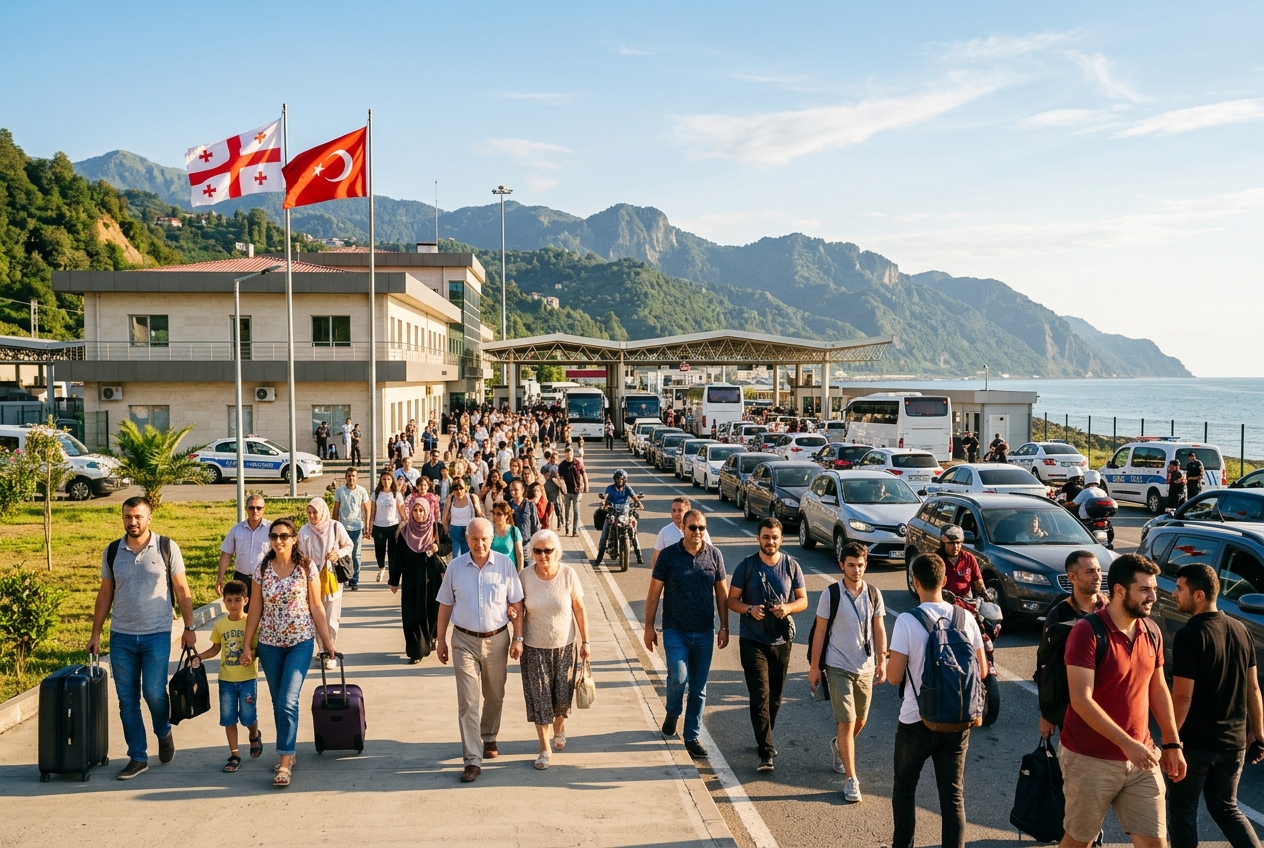
The Sarpi-Sarp border crossing sits right where the Black Sea coastline meets the Georgia-Turkey frontier, a narrow strip of land where two countries, two cultures, and two very different bureaucratic systems collide. If you’ve traveled overland between Batumi and Trabzon, you already know this spot. If you haven’t, you’re probably wondering what the experience actually looks like when you show up on a Friday afternoon or during Bayram. I’ve crossed here multiple times, and each time the experience has been different depending on the day and hour. The crossing itself is compact, a bit chaotic on busy days, and surprisingly efficient when the stars align. But weekends and holidays? That’s a different animal entirely. Georgian families heading to Turkish malls, Turkish tourists pouring into Batumi for the casinos and nightlife, shuttle traders hauling goods back and forth: the mix of travelers creates a unique bottleneck that you can either plan around or suffer through. Here’s what you actually need to know before you go.

The Sarpi-Sarp Gateway: Weekend and Holiday Dynamics
Sarpi sits on the Georgian side, Sarp on the Turkish side, and the border post connects the two through a modern building that handles both pedestrians and vehicles. The crossing operates 24 hours a day, seven days a week, including all weekends and holidays, which sounds convenient until you realize that “open” doesn’t mean “fast.” The real question isn’t whether you can cross but how long you’ll spend doing it.
Weekend and holiday traffic patterns at Sarpi are driven by a few predictable forces. Georgian citizens regularly cross into Turkey for shopping, since Hopa and Trabzon offer goods at prices that undercut Batumi’s markets. Turkish visitors, meanwhile, flood into Batumi for its casino scene, which doesn’t exist on their side of the border. This two-way flow intensifies dramatically from Friday evening through Sunday afternoon.
Peak Hours and Typical Wait Times
On a quiet weekday morning, you might breeze through the entire process in 15 to 30 minutes. Weekends tell a different story. Friday evenings between 5 PM and 9 PM are consistently the worst for outbound traffic from Georgia, as shuttle traders and weekend shoppers pile up at the vehicle lanes. Saturday mornings see the reverse: Turkish tourists heading into Georgia for the weekend.
Here’s a rough guide based on repeated crossings and reports from fellow travelers:
| Time Period | Direction | Typical Wait (Pedestrian) | Typical Wait (Vehicle) |
|---|---|---|---|
| Friday 5-9 PM | Georgia → Turkey | 30-60 min | 1-3 hours |
| Saturday 9 AM-1 PM | Turkey → Georgia | 20-45 min | 45 min-2 hours |
| Sunday 3-7 PM | Turkey → Georgia | 30-60 min | 1-3 hours |
| Weekday mornings | Either direction | 5-20 min | 15-45 min |
These numbers fluctuate, but the pattern holds. Sunday afternoons are brutal because everyone tries to return to Georgia before the work week starts. If you’re on foot, you’ll always move faster than the car queue, but “faster” is relative.
Seasonal Spikes During Religious and National Holidays
The real chaos hits during overlapping holidays. Turkey’s Bayram holidays, both Eid al-Fitr (Ramazan Bayramı) and Eid al-Adha (Kurban Bayramı), send enormous waves of Turkish tourists into Georgia. These multi-day holidays give Turkish families time off, and Batumi is a short, affordable trip. During Bayram, vehicle wait times can stretch to four or five hours, and even pedestrians may wait over an hour.
On the Georgian side, major holidays like Independence Day (May 26) and Orthodox Easter don’t generate the same border pressure, but they do coincide with general travel spikes as Georgians take advantage of long weekends. The summer months, particularly July and August, compound everything. Combine a Bayram holiday with peak summer and you’ve got a perfect storm.
New Year’s is another pinch point. Both countries celebrate it enthusiastically, and the days surrounding January 1 see heavy cross-border movement in both directions. Georgian Christmas on January 7 adds another wave. If you’re planning a crossing during any of these periods, build at least two extra hours into your schedule and consider crossing on foot.
Navigating the Pedestrian and Vehicle Terminals
The Sarpi border complex is relatively modern, rebuilt in the 2010s with a distinctive wave-shaped canopy on the Georgian side that looks impressive from a distance. Up close, the experience is more functional than elegant. Pedestrians and vehicles use separate channels, and understanding how each works saves real time.
The Pedestrian Experience: Crowds and Corridor Flow
Walking across is almost always the smarter choice on weekends and holidays. The pedestrian terminal funnels you through a series of checkpoints: Georgian exit passport control, a short walk through a corridor, then Turkish entry passport control (or vice versa). The whole distance is maybe 200 meters.
On busy days, the corridor between the two passport control points can feel cramped. There’s no formal queuing system with numbered tickets or organized lanes: it’s essentially a single-file line that sometimes becomes a double-file crowd. Georgian border officers tend to process people quickly, often spending less than a minute per passport. The Turkish side can be slightly slower, particularly when officers need to verify visa status or ask questions about the purpose of visit.
I’ve noticed a generational split in who crosses on foot. Older Georgian shuttle traders, many of them women hauling rolling suitcases stuffed with goods, are regulars who know the drill. Younger travelers and backpackers tend to look more confused. My advice: watch what the regulars do and follow their lead. They know which line moves faster and when to have documents ready.
One thing that catches first-timers off guard is the lack of a physical barrier between the pedestrian and vehicle areas in certain spots. Stay on the marked pedestrian path. Wandering into the vehicle lane area will get you yelled at by border guards in Georgian, Turkish, or both.
Driving Across: Queue Management for Private Cars
If you’re in a car, prepare for patience. The vehicle lane operates on a first-come, first-served basis with no reservation system. On weekends, the queue can stretch back along the coastal road, sometimes reaching a kilometer or more during peak hours.
The process involves stopping at the Georgian checkpoint for passport and vehicle document inspection, then proceeding to the Turkish side for the same. Turkish customs officers may inspect your vehicle, particularly if you’re driving a rental or a car with non-Georgian plates. This inspection adds time, especially when officers are dealing with high volumes.
Rental cars present a specific challenge. Not all Georgian rental companies allow their vehicles to cross into Turkey, and those that do require specific paperwork. If your rental agreement doesn’t explicitly authorize cross-border travel, you’ll be turned back. I’ve seen this happen to travelers who assumed they could just drive across. Sort this out with your rental company days before your trip, not at the border.
Logistics and Essential Documentation
Getting your paperwork wrong at Sarpi means getting turned around, and on a busy weekend, that’s not just an inconvenience: it’s a lost day. The documentation requirements differ depending on your nationality and whether you’re on foot or driving.
Visa Requirements and Passport Control Procedures
Georgia allows citizens of over 90 countries to enter visa-free for up to one year, which is remarkably generous. Turkey offers e-visas to many nationalities, and these must be obtained before arrival. Do not show up at Sarpi expecting to get a Turkish visa on the spot: the e-visa system requires you to apply online at evisa.gov.tr and have either a printed copy or the PDF on your phone.
For EU, US, Canadian, and UK citizens, the Georgia side is straightforward: your passport gets stamped, and you’re through. The Turkish side requires the e-visa for many of these same nationalities. Citizens of countries in the CIS region often have different arrangements, with some enjoying visa-free access to Turkey and others needing consular visas obtained in advance.
Your passport needs at least six months of validity beyond your intended stay for Turkey. Georgia is slightly more relaxed but still requires valid travel documents. Expired or soon-to-expire passports are the number one reason people get stuck at this crossing.
Both Georgian and Turkish officers speak limited English, particularly during busy shifts when less senior staff are on duty. Having your documents organized and accessible, with your e-visa printed or loaded on your phone, speeds things up enormously. I keep a clear plastic folder with everything pre-sorted: passport, e-visa printout, vehicle papers, insurance documents.
Vehicle Insurance and Mandatory Cross-Border Papers
Driving into Turkey requires Turkish vehicle insurance, which you can purchase at small kiosks near the border on the Turkish side. These kiosks operate during business hours but may have reduced availability late at night. The cost is modest: typically between $30 and $50 for short-term coverage, depending on the vehicle type and duration.
You’ll also need your vehicle registration document and, if the car isn’t registered in your name, a notarized power of attorney from the owner. Turkish customs takes vehicle documentation seriously, and missing papers mean you’re not crossing. For Georgian-registered vehicles, the “tekdatvla” (technical inspection certificate) should be current.
If you’re bringing a vehicle from Turkey into Georgia, Georgian customs will want to see proof of ownership and may issue a temporary import permit. Vehicles can stay in Georgia for up to one year under temporary import rules, but exceeding this period triggers fines and potential confiscation.
On-Site Amenities and Transportation Links
The border area isn’t a ghost town: there’s a small ecosystem of services catering to the thousands of people who cross daily. But “services” is a generous term on busy days when everything is strained.
Currency Exchange and Duty-Free Shopping on Busy Days
Small exchange booths operate on both sides of the border. Rates are predictably worse than what you’d find in Batumi or Trabzon, but they’re convenient if you need Turkish lira or Georgian lari immediately. On weekends, these booths sometimes run low on specific currencies, particularly if there’s been heavy one-directional traffic. My recommendation: exchange a small amount at the border for immediate transport costs and handle the rest at a bank or ATM in the nearest city.
Duty-free shops exist on both sides, though the selection is standard: alcohol, cigarettes, perfume, and chocolate. The Georgian duty-free is small but functional. The Turkish side offers a slightly larger selection. Prices are competitive for alcohol and tobacco but unremarkable for everything else. On holidays, these shops get crowded, and checkout lines can add 15 to 20 minutes to your crossing time. Skip the duty-free if you’re in a rush.
Connecting via Marshrutkas, Buses, and Taxis
On the Georgian side, marshrutkas (minibuses) run regularly between Sarpi and Batumi, a trip of about 20 minutes covering roughly 15 kilometers. These depart when full, which on weekends means minimal waiting. The fare is around 2 to 3 lari. Taxis cluster near the border and will charge 20 to 40 lari for the same trip: always agree on the price before getting in. The Bolt app works in Batumi and occasionally picks up requests from Sarpi, though driver availability this far from the city center can be spotty.
On the Turkish side, dolmuş minibuses connect Sarp to Hopa (about 20 minutes) and onward to Trabzon. Service frequency drops in the evening, so if you’re crossing late, a taxi might be your only option. Turkish taxis in this area are generally metered, but confirm before departing. For longer distances, buses from Hopa’s otogar serve Trabzon, Ankara, and Istanbul.
Practical Tips for a Faster Crossing
Experience at Sarpi teaches you patterns, and those patterns translate into real time savings. The difference between a 20-minute crossing and a two-hour ordeal often comes down to timing and preparation.
The Best Times to Arrive to Avoid the Rush
If you must cross on a weekend, aim for early morning. Saturday between 6 AM and 8 AM is consistently the quietest window for Georgia-to-Turkey crossings. Sunday mornings offer a similar window for Turkey-to-Georgia. The logic is simple: most weekend travelers sleep in or start their journeys mid-morning, so early birds face minimal competition.
Weekday crossings are almost always smoother. Tuesday and Wednesday are the lightest days in my experience. If your travel dates are flexible, shifting your crossing by even one day can save hours.
For holiday periods, consider crossing the day before the holiday begins rather than the first day. Most people start traveling on the holiday itself, so the preceding day is often surprisingly calm. Late-night crossings, between 11 PM and 5 AM, are another underused option since the border operates around the clock.
Download offline language packs for Google Translate in both Georgian and Turkish before you arrive. Cell service can be patchy right at the border, and being able to communicate basic questions to border officers or taxi drivers without internet makes a real difference.
Customs Regulations and Prohibited Items
Turkey and Georgia both enforce limits on what you can bring across. For Turkey, the main restrictions travelers encounter involve alcohol (one liter per person), cigarettes (400 for entry into Turkey, with recent changes tightening this), and cash declarations required for amounts exceeding $10,000 or equivalent.
Georgia’s customs rules allow up to 4 liters of alcohol and 400 cigarettes for incoming travelers. Prescription medications should be accompanied by a doctor’s note, particularly anything containing controlled substances. Fresh produce, meat, and dairy products face restrictions in both directions, and agricultural inspections can add time to your vehicle crossing.
Items that will get you stopped or turned back:
- Weapons or ammunition without proper permits
- Narcotics of any kind (Georgia has extremely strict drug laws)
- Large quantities of commercial goods without proper import documentation
- Drones, which require specific permits in both countries
- Antiquities or items of cultural heritage value
The shuttle traders who cross regularly know the exact thresholds for commercial goods and sometimes push them. If customs officers are cracking down on a particular weekend, this slows the line for everyone. Don’t try to bring large quantities of anything without understanding the duty thresholds.
Making Your Sarpi Crossing Count
The Sarpi border experience on weekends and holidays comes down to one principle: the more you plan, the less you wait. Cross early, cross on foot if possible, and have every document printed and organized before you’re standing in line. The crossing itself is manageable even on the busiest days, but it rewards preparation and punishes improvisation.
Keep your expectations realistic. This is a busy international border between two countries with different systems, languages, and bureaucratic cultures. A two-hour wait during Bayram isn’t a disaster: it’s normal. Pack snacks, charge your phone, and bring a good podcast. The coast on both sides is beautiful, and once you’re through, either Batumi’s boulevards or Turkey’s Black Sea villages are waiting. The crossing is just the price of admission.