
Table of Contents
- Why Ananuri is the Essential Stop on the Road to Kazbegi
- Planning Your Drive: Getting to Ananuri by Car
- The Turquoise Waters of Zhinvali Reservoir
- Exploring Ananuri Fortress: History and Architecture
- Practical Tips for Visiting the Complex
- Continuing North: Other Georgian Military Highway Stops
- Route Logistics: Distance and Time Table
- Frequently Asked Questions About Ananuri
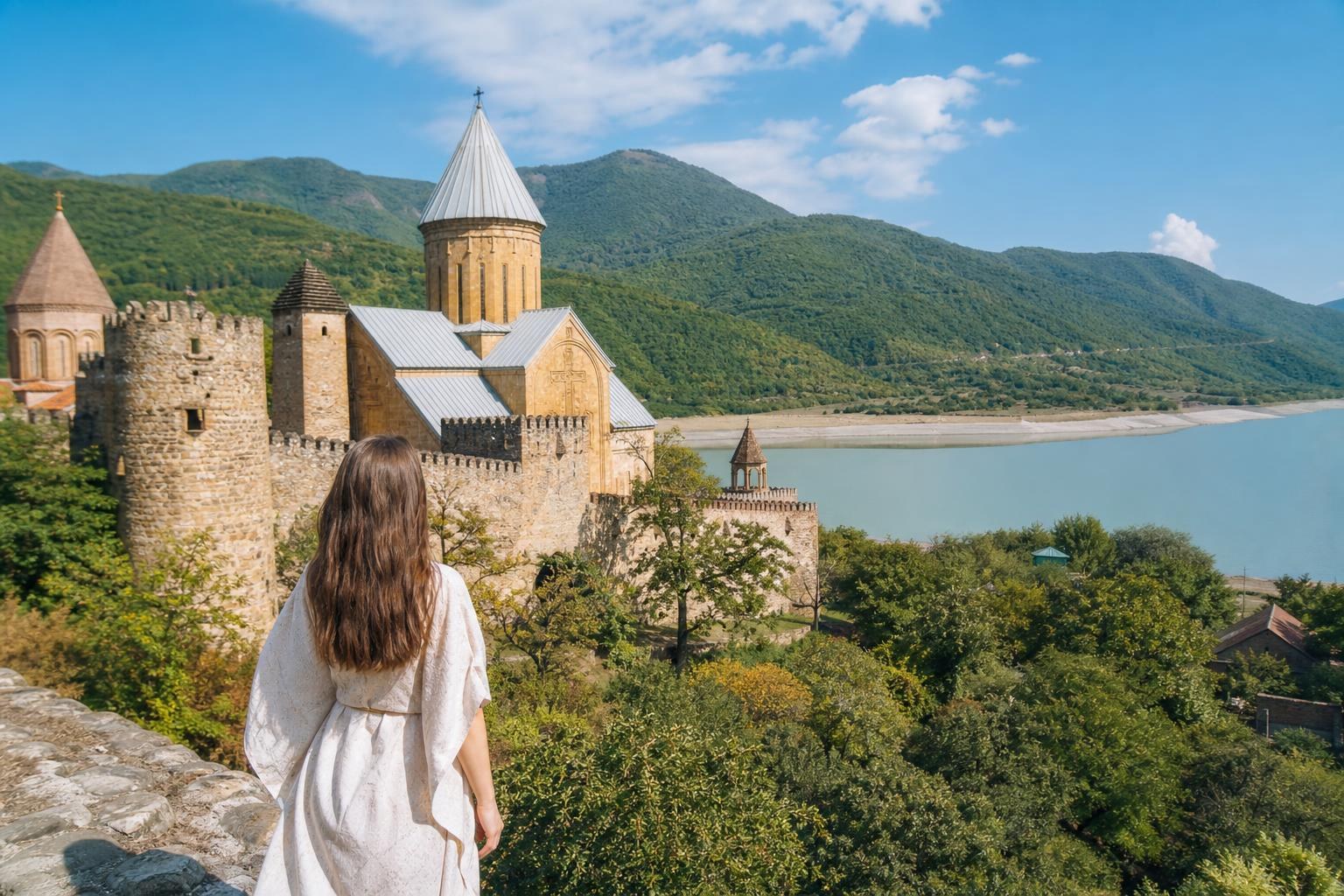
Ananuri fortress sits about 70 km north of Tbilisi on the Georgian Military Highway, and it’s the single best reason to pull over on your drive to Kazbegi. The fortified complex overlooks the turquoise Zhinvali Reservoir, combines centuries of Georgian church architecture in one compact site, and takes under an hour to explore. If you’re renting a car and driving the highway yourself, this is where you want to stop first. Georgia welcomed over 5.5 million international visitors in 2025, and a huge share of them passed this exact spot on their way north. Here’s everything you need to know to plan your stop properly: what you’ll see, how long it takes, where to park, and what else to hit on the road to Kazbegi.
Why Ananuri is the Essential Stop on the Road to Kazbegi
Most people driving the Tbilisi to Kazbegi route treat the journey as a means to an end: get to Stepantsminda, see Gergeti Trinity Church, take photos, drive back. That’s a mistake. The Georgian Military Highway is one of the most scenic drives in the Caucasus, and Ananuri is its first major reward.
The fortress sits at a natural chokepoint where the Aragvi River meets its reservoir, and the Aragvi dynasty controlled the Daryal Gorge trade route from this position for centuries, taxing merchants moving between the North and South Caucasus. That strategic importance is written into every stone wall and watchtower you’ll walk through.
What makes this stop work so well for drivers is timing. It’s roughly one hour from Tbilisi, which means you arrive before the tour buses from the capital have loaded up. If you leave Tbilisi by 8 AM, you can have the complex mostly to yourself for 30 to 45 minutes before the crowds roll in. The combination of history, views, and convenience makes it the obvious first stop on any self-drive itinerary heading north.
Tip: Visiting during early morning or late afternoon gives you the best light for photos and far fewer people. The midday rush between 11 AM and 2 PM can feel like a parking lot.
Planning Your Drive: Getting to Ananuri by Car
The drive from Tbilisi is straightforward. You’ll head north on the E60 highway toward Mtskheta, then continue along the Georgian Military Highway (which locals just call the Kazbegi road). The fortress is on the left side of the road, clearly signed, about 66 km from central Tbilisi.
Here’s what you need to know for the drive:
- Starting point: Tbilisi (any central location)
- Distance: 66 km
- Drive time: 1 hour to 1 hour 15 minutes, depending on traffic leaving the city
- Road condition: Paved two-lane highway in good condition; no 4×4 needed
- Parking: Free gravel lot directly below the fortress, fits roughly 30 cars
- Seasonal closures: None for this section; the road stays open year-round
The parking area fills up quickly after 10 AM during summer months (June through September). If you find it full, there’s overflow space along the road shoulder about 100 meters south. The walk up from the parking lot to the fortress entrance takes about three minutes on a gentle incline.
One thing I always tell people: the stretch of highway between Mtskheta and Ananuri passes through some lovely river valley scenery, but there aren’t great places to pull over safely. Save your photo stops for the fortress and the reservoir viewpoint just before it.
Important: Speed cameras are common on this highway, and Georgian traffic police do issue fines. Keep to the posted 80 km/h limit outside towns and 60 km/h within them.
The Turquoise Waters of Zhinvali Reservoir
About two minutes before you reach the fortress coming from Tbilisi, the road curves and the Zhinvali Reservoir opens up below you on the left. The color is striking: a deep turquoise-green that shifts depending on the season and the light. In spring and early summer, when snowmelt feeds the reservoir, the water level is high and the color is at its most intense.
The reservoir was built in the 1980s to supply Tbilisi’s drinking water and generate hydroelectric power. It drowned several villages in the valley below, which is a detail that adds a strange weight to the beauty of the place. On very low-water days in late autumn, you can sometimes spot remnants of old structures poking above the surface.
There’s no formal viewpoint or pullover for the reservoir itself, but many drivers stop at the fortress parking lot and walk to the edge of the complex walls for the best angle. From the upper towers of the fortress (more on that below), you get a panoramic view of the reservoir stretching south through the valley. This is one of the most photographed scenes on the entire Tbilisi to Kazbegi drive, and for good reason.
The reservoir is not open for swimming. It’s a protected water supply, and local authorities enforce this. You’ll occasionally see people fishing along the edges, but that’s about it.
Exploring Ananuri Fortress: History and Architecture
The fortified complex you see today dates from the 13th century through the 18th century and served as the seat of the Dukes of Aragvi, a powerful feudal dynasty that controlled this stretch of the highway for roughly 500 years. The Upper Fortress is well preserved, while the Lower Fortress is mostly in ruins. Most visitors spend their time in the Upper Fortress, which contains the main churches, towers, and defensive walls.
The complex features defensive walls, three churches, and a distinctive octagonal bell tower, all packed into a relatively compact space. You can walk the entire site in 30 to 45 minutes without rushing. Entry is free as of 2026, though there’s a donation box near the entrance.
What strikes most visitors is how much variety is packed into such a small footprint. You’ve got medieval defensive architecture, finely carved religious stonework, and sweeping natural views all within a few hundred meters of each other. It’s a concentrated dose of Georgian history that doesn’t require a full-day commitment.
The Church of the Mother of God and Stone Carvings
The larger of the two main churches, the Church of the Assumption (often called the Church of the Mother of God), dates to 1689. Its exterior is covered in elaborate stone carvings: grapevines, crosses, angels, and a striking scene of two dragons. The quality of the carving work is remarkable for a fortress church, and it reflects the wealth the Aragvi dukes accumulated from their control of the trade route.
Inside, fragments of frescoes survive on the walls, though many were damaged by a fire during a siege in 1739 that effectively ended the Aragvi dynasty’s rule. The smaller Church of the Savior, dating to the early 16th century, is plainer but has a quiet, contemplative atmosphere. Look for the carved cross on its south facade, which is one of the finest examples of Georgian stone carving from that period.
Climbing the Defensive Towers for the Best Views
The main watchtower on the east side of the complex is climbable, and you should absolutely go up. The narrow stone steps lead to observation platforms overlooking the Aragvi river basin and the reservoir. The staircase is tight and uneven, so wear shoes with decent grip and watch your head on the low doorways.
From the top, you get a 360-degree view: the reservoir to the south, the river valley to the north, and the fortress walls and churches spread below you. On a clear day, you can see the highway snaking north toward the mountains. This is the single best vantage point at the site, and it’s worth the slightly awkward climb.
The tower is not roped off or regulated, so use common sense. There are no guardrails at the top, and the stone can be slippery after rain. Keep children close.
Practical Tips for Visiting the Complex
Here’s a quick rundown of what you need to know before you arrive:
- Entrance fee: Free (as of 2026)
- Opening hours: The site is open daily and unfenced, so you can technically visit at any time. The churches may be locked outside of roughly 9 AM to 6 PM.
- Time needed: 30 to 45 minutes for a thorough visit
- Facilities: A few small shops and a cafe near the parking lot sell water, snacks, and souvenirs. No public restrooms inside the complex; there’s a basic toilet block near the parking area.
- Accessibility: The site involves uneven stone paths and steep stairs. Wheelchair access is limited to the lower courtyard area.
Bring water, especially in summer. The fortress is exposed with little shade, and temperatures can hit 35°C in July and August. A hat and sunscreen are worth packing.
Note: Ananuri is an active religious site. Both churches are functioning, and visitors should dress modestly: covered shoulders and knees. Women may need a headscarf to enter the churches, and free scarves are sometimes available at the door.
Continuing North: Other Georgian Military Highway Stops
The fortress at Ananuri is just the beginning. The Georgian Military Highway continues north for another 90 km to Stepantsminda (Kazbegi), and there are several worthwhile stops along the way. Here are the two most popular.
Pasanauri: The Home of Khinkali
About 25 km north of Ananuri, the small town of Pasanauri sits at the confluence of the Black and White Aragvi rivers. The town’s claim to fame is khinkali: the oversized Georgian dumplings filled with spiced meat and broth. Pasanauri-style khinkali are considered the original and best by many Georgians, and several roadside restaurants here serve them fresh.
Stop at any of the restaurants along the main road. A single khinkali costs about 1.5 to 1.8 GEL (roughly $0.58 to $0.77 USD in 2026), and most people order five to ten. Eat them by hand, drink the broth from the top first, and leave the twisted dough knob on your plate. It’s a 15-minute stop that doubles as a genuine cultural experience.
Gudauri Panorama and the Russia-Georgia Friendship Monument
About 40 km past Pasanauri, near the ski resort town of Gudauri, you’ll find the Russia-Georgia Friendship Monument. Built in 1983 to mark 200 years of the Treaty of Georgievsk, it’s a large semicircular mosaic overlooking the Devil’s Valley. The views from here are enormous: deep gorges, snow-capped peaks, and the highway threading through the mountains below.
The monument has a large parking area and is well signed. It’s a 10-minute stop unless you want to linger. The altitude here is around 2,300 meters, so expect cooler temperatures even in summer. Bring a jacket.
Route Logistics: Distance and Time Table
Here’s a practical reference table for the full drive from Tbilisi to Kazbegi with the main stops:
| Segment | Distance | Drive Time | Suggested Stop |
|---|---|---|---|
| Tbilisi to Ananuri | 66 km | 1 hr – 1 hr 15 min | 30-45 min |
| Ananuri to Pasanauri | 25 km | 25 min | 20-30 min (for khinkali) |
| Pasanauri to Gudauri Monument | 40 km | 45 min | 10-15 min |
| Gudauri Monument to Stepantsminda | 50 km | 1 hr | Final destination |
| Total Tbilisi to Stepantsminda | ~181 km | ~3 hr driving | Add 1-1.5 hr for stops |
The total journey with stops takes about four to four and a half hours. Without stops, the drive is roughly three hours, but skipping these places defeats the purpose of driving the route yourself. If you’re using Triproadwayplanner’s Georgian Military Highway guide, you’ll find more detail on road conditions for each segment.
Plan to leave Tbilisi early. If you depart by 7:30 or 8 AM, you’ll reach Stepantsminda before lunch with comfortable stops along the way.
Frequently Asked Questions About Ananuri
How long should I spend at Ananuri Fortress?
Most visitors spend 30 to 45 minutes, which is enough to walk the churches, climb the tower, and take photos of the reservoir. If you’re a history or architecture enthusiast, you could stretch it to an hour, but the site is compact enough that you won’t need more.
Is the fortress at Ananuri worth stopping for, or should I drive straight to Kazbegi?
It’s absolutely worth the stop. The combination of medieval architecture, the reservoir views, and the easy access from the highway make it one of the most rewarding 30-minute stops in Georgia. Skipping it to save half an hour on a drive you’re already making doesn’t make sense.
Do I need a 4×4 to reach Ananuri from Tbilisi?
No. The road is a paved two-lane highway in good condition. Any rental car will handle it fine year-round. You only need a 4×4 if you plan to drive up to Gergeti Trinity Church from Stepantsminda, which is a separate unpaved mountain road.
Is there an entrance fee?
No, the site is free to enter as of 2026. There are no tickets, no gates, and no official guides on site. You can hire a guide through local tour agencies in Tbilisi if you want one, but the site is small enough to explore independently.
Can I swim in Zhinvali Reservoir?
No. The reservoir supplies Tbilisi’s drinking water and swimming is not permitted. You’ll see signs to this effect along the shore.
The drive from Tbilisi to Kazbegi is one of the best road trips in the Caucasus, and the fortress at Ananuri is the moment the trip shifts from “nice highway drive” to “this is why I came to Georgia.” Give it the 45 minutes it deserves, eat khinkali in Pasanauri, gawk at the Gudauri panorama, and arrive in Stepantsminda knowing you’ve actually experienced the road, not just driven it. That’s the whole point of doing this trip by car.