
Table of Contents
- What is Giorgoba? Celebrating St George’s Day in Georgia
- Public Holidays in November: Practical Travel Logistics for Giorgoba 2026
- Where to Experience Giorgoba Traditions and Liturgy
- Planning Your November Long Weekend Road Trip from Tbilisi
- Route 1: The Kakheti Wine Harvest Aftermath (Sighnaghi and Telavi)
- Route 2: Borjomi Pine Forests and the Vardzia Cave City
- Route 3: Kutaisi Culture and Imeretian Nature
- Route 4: The Black Sea Coast and Batumi’s Late Autumn Charm
- November Road Conditions and Driving Tips for Georgia
- Comparison of Giorgoba Weekend Destinations
- Frequently Asked Questions About Giorgoba
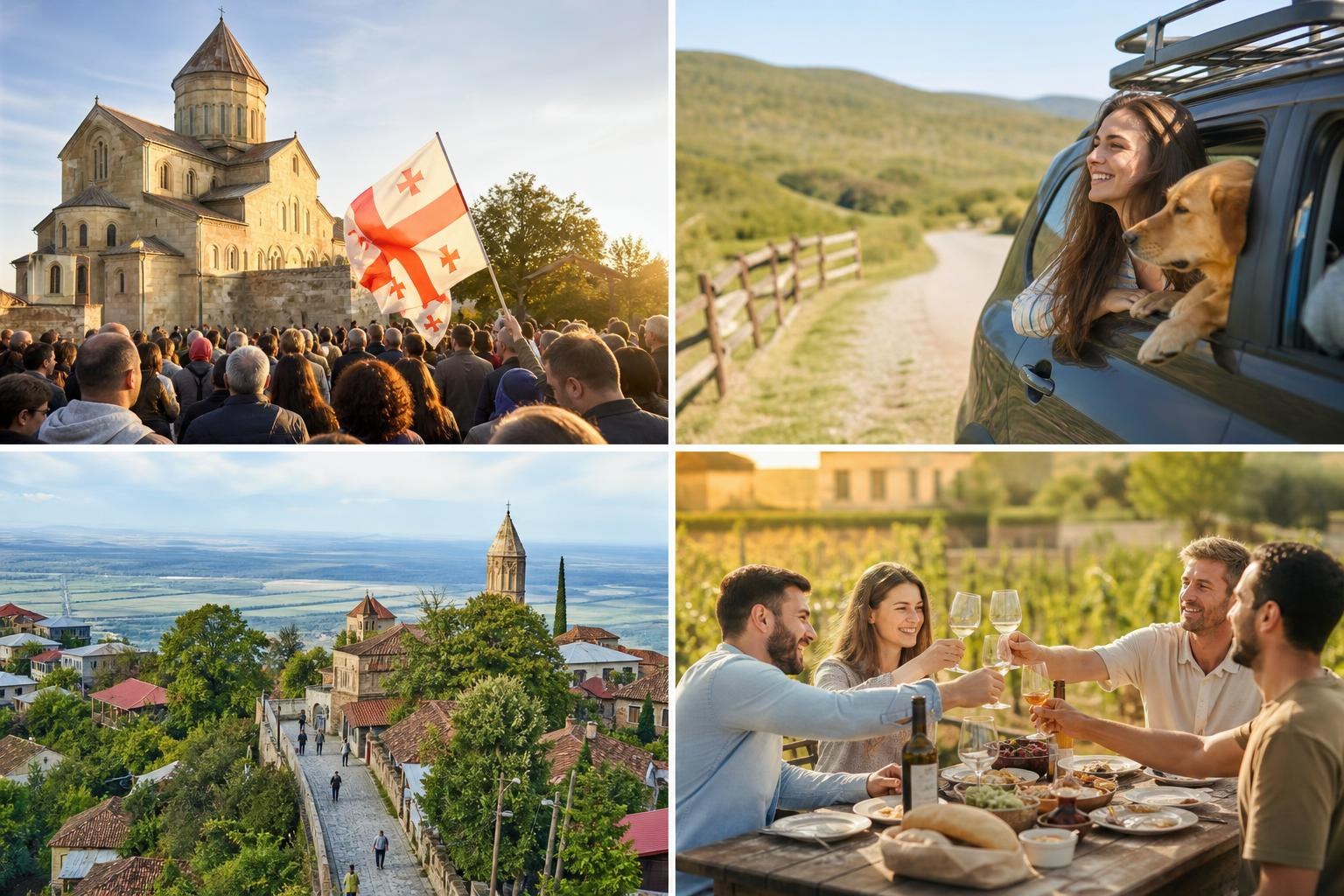
Every November, Georgia celebrates one of its most beloved national holidays: Giorgoba, the feast day of St George. In 2026, November 23 falls on a Monday, which means a natural three-day weekend stretching from Saturday through Monday. For travellers already in the country or planning a late-autumn visit, this is one of the best windows to combine cultural immersion with a road trip through Georgia’s dramatic landscapes. Banks, government offices, and many shops close for the day, but churches come alive with liturgy, candles, and centuries-old rituals. If you’re renting a car in Tbilisi or already have your own wheels, the long weekend is an invitation to explore well beyond the capital.
What is Giorgoba? Celebrating St George’s Day in Georgia
St George holds a singular place in Georgian identity. The country’s English name itself derives from the saint, and Georgians consider him their heavenly patron and protector. Giorgoba is celebrated twice a year: once on May 6 (marking the saint’s martyrdom) and again on November 23. The autumn date carries particular weight because, according to Georgian Church tradition, it was established by St Nino, the woman credited with converting Georgia to Christianity in the 4th century.
The holiday is deeply personal for many Georgians. Families named Giorgi, Nino, or other saint-related names often hold private feasts, and it’s common for people to visit the graves of relatives on this day. Churches across the country hold special liturgies, and in rural areas you’ll sometimes see animal sacrifices and communal meals rooted in pre-Christian traditions that have blended with Orthodox practice over centuries.
For visitors, Giorgoba offers a window into the way religious faith and national identity intertwine in Georgian culture. It’s not a tourist spectacle: it’s a lived tradition, and that’s exactly what makes it worth experiencing.
Public Holidays in November: Practical Travel Logistics for Giorgoba 2026
Since the 2026 holiday lands on Monday, November 23, most Georgians will treat Saturday through Monday as a long weekend. Government offices, banks, and post offices close on Monday. Many smaller shops and family-run restaurants outside Tbilisi may also shut or operate on reduced hours, so stock up on essentials (fuel, snacks, cash) before Sunday evening.
Supermarket chains in larger towns generally stay open on public holidays, but don’t count on this in villages. ATMs are widely available in regional centres like Kutaisi, Batumi, and Telavi, but can be scarce in mountain areas.
Important: As of January 1, 2026, all foreign tourists entering Georgia must hold health and accident insurance with minimum coverage of 30,000 GEL (roughly $11,000 USD). Carry proof of your policy: border officials and rental agencies may ask for it.
Fuel prices in late 2026 hover around 3.00-3.30 GEL per litre for regular petrol, though prices shift. Fill up in Tbilisi or major towns before heading into rural stretches.
Where to Experience Giorgoba Traditions and Liturgy
The most authentic way to experience St George’s Day in Georgia is to attend a morning liturgy at one of the churches dedicated to the saint. Services typically begin early, around 9:00 or 10:00 AM, and the atmosphere is reverent but welcoming to respectful visitors. Dress modestly: women should cover their heads and shoulders, and men should avoid shorts.
Top Churches for St George Festivities
- Kashveti Church of St George, Tbilisi: Located on Rustaveli Avenue directly opposite Parliament, this is the most accessible option for visitors staying in the capital. Expect a packed service and a powerful choir.
- Alaverdi Cathedral, Kakheti: A towering 11th-century cathedral about 20 km from Telavi. Not dedicated solely to St George, but its Giorgoba services draw large crowds from the surrounding wine region.
- Gelati Monastery, near Kutaisi: A UNESCO World Heritage Site where the liturgy carries a particular grandeur. Arrive early for parking.
- Lomisa Church, Khevi region: High in the mountains north of Tbilisi, this remote church hosts one of the most intense Giorgoba celebrations in the country, including traditional animal sacrifice. The road is rough and may require a 4×4 depending on conditions.
In rural villages, look for supra (feast) gatherings after the church service. If you’re invited to join, accept: Georgian hospitality, or stumari ghvtisaa (“the guest is from God”), means you’ll be fed generously and toasted repeatedly.
Note: Do not drink and drive. If you plan to join a supra with wine or chacha, arrange a designated driver, call a Bolt taxi, or stay overnight locally.
Planning Your November Long Weekend Road Trip from Tbilisi
A three-day weekend gives you enough time for a focused loop from Tbilisi, covering 300 to 600 km depending on your route. Late November in Georgia means short days (sunset around 5:15 PM), cool to cold temperatures, and the possibility of rain or early snow at higher elevations. Plan to be at your destination before dark, especially on mountain roads without lighting.
Here’s a quick comparison to help you choose your route:
| Route | Distance from Tbilisi | Drive Time (one way) | Best For | 4×4 Needed? |
|---|---|---|---|---|
| Kakheti (Sighnaghi/Telavi) | 110-150 km | 1.5-2.5 hrs | Wine, views, easy driving | No |
| Borjomi-Vardzia | 230-270 km | 3.5-4 hrs | Nature, caves, hot springs | No (but helpful for Vardzia approach) |
| Kutaisi area | 230 km | 3-3.5 hrs | Culture, canyons, caves | No |
| Batumi | 370 km | 5-6 hrs | Sea, city life, mild weather | No |
All four routes use paved highways for the main stretches. Triproadwayplanner’s route guides can help you plan the specifics, but here’s what each trip looks like in practice.
Route 1: The Kakheti Wine Harvest Aftermath (Sighnaghi and Telavi)
By late November, the frantic grape harvest (rtveli) is long finished, and Kakheti settles into a quieter rhythm. The vineyards are golden and rust-coloured, the air smells of fermenting wine from qvevri buried in cellar floors, and the tourist crowds have thinned considerably.
The drive from Tbilisi to Sighnaghi takes about 1.5 hours on a well-maintained road. Sighnaghi itself is a small hilltop town with cobblestone streets, a famous 24-hour wedding registry, and panoramic views of the Alazani Valley with the snow-dusted Caucasus peaks behind it. From there, continue northwest to Telavi (about 50 km, roughly an hour), the regional capital, where you’ll find more restaurants, guesthouses, and easy access to monasteries like Alaverdi and Ikalto.
A typical Kakheti loop covers 300 km over two to three days. Wineries are generally open year-round, though calling ahead in November is wise. Expect to pay 15-30 GEL for a tasting at smaller family cellars.
Tip: The stretch between Sighnaghi and Telavi passes through several villages with family-run wine cellars. Stop at any house with a sign reading “ღვინო” (wine) for an impromptu tasting, but remember: if you’re driving, spit or limit yourself to small sips.
Route 2: Borjomi Pine Forests and the Vardzia Cave City
This route heads southwest from Tbilisi through the Borjomi-Kharagauli National Park, one of the largest protected areas in Europe. The town of Borjomi itself is famous for its mineral water (you can fill bottles for free at the spring in the central park) and its surrounding pine forests, which in November are often dusted with the season’s first snow.
The drive from Tbilisi to Borjomi is about 160 km and takes roughly 2.5 hours on the main highway. From Borjomi, continue another 100 km south to Vardzia, the extraordinary 12th-century cave monastery carved into a cliff face by Queen Tamar’s Georgia. The road to Vardzia is paved but narrow in sections, and in late November you should check conditions locally: ice is possible in shaded stretches after Akhaltsikhe.
Vardzia itself is open year-round, and November means you’ll often have the caves nearly to yourself. Entrance fees for foreign visitors at major state-managed natural sites increased to 40 GEL as of April 2026, so budget accordingly.
Spend one night in Borjomi and one near Vardzia (the village of Tmogvi has a few guesthouses) for a comfortable pace.
Route 3: Kutaisi Culture and Imeretian Nature
Kutaisi, Georgia’s second city, is a 3 to 3.5 hour drive west of Tbilisi on the modern highway. The city is home to two UNESCO-listed sites: Bagrati Cathedral (under ongoing restoration) and the magnificent Gelati Monastery, where attending a Giorgoba liturgy on November 23 would be a memorable experience.
Beyond the city, the Imereti region offers Prometheus Cave and Martvili Canyon, both of which are open in November though with shorter winter hours. Entrance fees at these state-managed sites are now 40 GEL for foreign visitors (as of April 2026). Martvili Canyon boat rides may be suspended in late November depending on water levels: check before making the detour.
The countryside around Kutaisi is green even in November, and the region’s cuisine is distinct from eastern Georgia. Look for lobiani (bean-stuffed bread), gebzhalia (cheese rolls in mint sauce), and Imeretian khachapuri, which is subtly different from the Adjarian version most tourists know.
A two-night stay gives you a full day for Kutaisi’s churches and a day for the natural sites, with the drive back to Tbilisi on Monday afternoon.
Route 4: The Black Sea Coast and Batumi’s Late Autumn Charm
Batumi is the longest drive from Tbilisi: roughly 370 km and five to six hours, depending on traffic through the mountain section near Khashuri. But if you leave Saturday morning, you’ll arrive by early afternoon with two full days to explore.
Late November in Batumi is mild compared to inland Georgia: expect daytime temperatures around 12-16°C with a good chance of rain. The summer crowds are gone, hotel prices drop significantly, and the city’s mix of Belle Époque architecture, modern towers, and seaside promenade feels pleasantly unhurried.
The Batumi Botanical Garden, perched on a hillside above the coast, is worth a half-day visit. The old town has good restaurants and a lively food market. For a day trip, drive 30 minutes south to the border area near Sarpi, where the coastline is dramatic and the Turkish border crossing gives the area an interesting cultural overlap.
The return drive on Monday can feel long after a weekend away. Consider breaking it up with a stop in Kutaisi or Borjomi if you have the energy.
November Road Conditions and Driving Tips for Georgia
Late November is the transition into winter, and road conditions vary dramatically by elevation. The main east-west highway connecting Tbilisi to Kutaisi and Batumi is well-maintained and rarely affected by snow at its lower elevations. North-south routes into the mountains are another story.
Key things to know:
- Snow chains or winter tyres are not legally mandated on most routes, but they’re essential if you’re heading above 1,500 metres. Rental agencies can usually provide chains on request.
- The Georgian Military Highway (Tbilisi to Kazbegi) may experience closures or restrictions due to snow and avalanche risk. This route is not recommended for a casual November weekend trip unless you’re experienced with winter mountain driving.
- Fuel stations are plentiful along main highways but sparse in mountain areas. Never let your tank drop below half when heading into rural zones.
- Driving style in Georgia can be aggressive by Western European standards. Overtaking on blind curves happens. Stay alert, use your horn on mountain bends, and don’t drive after dark on unfamiliar roads.
- Speed limits are 60 km/h in towns, 80 km/h on regional roads, and 110 km/h on the highway. Speed cameras are common, and fines are issued automatically.
Important: Georgian police are generally professional and helpful to tourists. If you’re stopped, stay calm and polite. Roadside police checks are routine, not a cause for concern.
Comparison of Giorgoba Weekend Destinations
| Factor | Kakheti | Borjomi-Vardzia | Kutaisi | Batumi |
|---|---|---|---|---|
| Drive from Tbilisi | 1.5-2.5 hrs | 2.5-4 hrs | 3-3.5 hrs | 5-6 hrs |
| Nov. Temperature | 5-12°C | 2-8°C | 6-14°C | 12-16°C |
| Rain Risk | Low-moderate | Moderate | Moderate-high | High |
| Snow Risk | Low | Moderate (Vardzia road) | Low | Very low |
| Best For | Wine, quiet villages | History, nature, hot springs | Churches, caves, food | Seaside, mild weather |
| Budget (2 nights, per person) | 100-180 GEL | 120-200 GEL | 120-200 GEL | 150-250 GEL |
| Giorgoba Atmosphere | Strong (Alaverdi) | Moderate | Strong (Gelati) | Mild |
Budget estimates include guesthouse accommodation and meals but not fuel or entrance fees. Prices reflect late 2026 ranges and will vary by property.
Frequently Asked Questions About Giorgoba
Is Giorgoba a public holiday in 2026, and what date does it fall on?
Yes, Giorgoba is an official public holiday on November 23, 2026, which is a Monday. Banks, government offices, and many businesses close. Restaurants in tourist areas generally remain open.
Can tourists attend Giorgoba church services?
Absolutely. Georgian Orthodox churches are open to visitors during services. Dress modestly, stand quietly (there are no pews in most churches), and avoid flash photography. You don’t need to be Orthodox or Christian to attend.
Do I need a 4×4 for a November road trip in Georgia?
For the four routes described here, a standard car with good tyres will handle the main roads. A 4×4 becomes useful if you want to reach remote churches like Lomisa or explore unpaved side roads near Vardzia. Check conditions locally before venturing off paved routes.
What should I pack for a late November trip?
Layers are essential. Mornings can be near freezing inland, while afternoons might reach 12-15°C in the sun. Bring a waterproof jacket, warm hat, and comfortable walking shoes. If you plan to enter churches, women should carry a headscarf.
Is it safe to drive in Georgia in November?
The main highways are safe and well-maintained. The primary risks are aggressive local driving habits and reduced visibility after dark on unlit rural roads. Avoid driving at night outside cities, keep your headlights on during the day, and don’t rush. Georgia’s roads reward patience and attention.
Giorgoba is one of those holidays that reveals something real about a country. It’s not staged for visitors, and it hasn’t been commercialised. Whether you spend the day at a candlelit liturgy in Tbilisi’s Kashveti Church or at a village supra in Kakheti where someone’s grandmother insists you eat more khinkali, you’ll leave with a sense of what Georgia actually feels like beneath the surface. Pair it with a road trip, and you get the best kind of travel weekend: culture, landscape, and just enough adventure to keep things interesting. Start planning your route now, check your insurance paperwork, and give yourself permission to drive slowly. The views are worth it.