
Table of Contents
- The Perfect Half-Day Mtskheta Self-Drive Itinerary
- Planning Your Drive: Logistics and Route Overview
- Stop 1: Jvari Church and the Iconic Confluence View
- Stop 2: Svetitskhoveli Cathedral and Old Mtskheta
- Stop 3: Shio-Mgvime Monastery and the Limestone Canyon
- Essential Driving Tips and Road Conditions
- Where to Eat: Best Stops for a Quick Georgian Lunch
- Mtskheta Half-Day Trip FAQ
Mtskheta sits just 20 km north of Tbilisi, and you can hit three of Georgia’s most important religious sites in a single morning: Jvari Monastery on its hilltop, Svetitskhoveli Cathedral in the old town, and the remote Shio-Mgvime monastery tucked into a limestone gorge. This half-day loop works best by car because public transport doesn’t connect all three stops, and the order matters if you want to avoid backtracking. I’ve driven this route more times than I can count, and the version below reflects what actually works in 2026, including current road conditions, parking realities, and a lunch stop that won’t eat into your sightseeing time.
The Perfect Half-Day Mtskheta Self-Drive Itinerary
The ideal sequence is Jvari first, then Svetitskhoveli and Samtavro in Mtskheta town center, then Shio-Mgvime on the way back toward Tbilisi. Starting at Jvari means you get the best morning light for photos of the river confluence below, and you avoid the tour-bus crowds that pile in after 11:00.
Here’s the route at a glance:
| Stop | Site | Time Needed | Distance from Previous | Parking |
|---|---|---|---|---|
| 1 | Jvari Church | 30-45 min | 25 km from central Tbilisi | Free lot, ~30 spaces |
| 2 | Svetitskhoveli Cathedral + Samtavro | 60-90 min | 5 km from Jvari | Free lot on Arsukidze St. |
| 3 | Shio-Mgvime Monastery | 45-60 min | 13 km from Mtskheta | Small free lot at trailhead |
| Return | Back to Tbilisi | – | 30 km from Shio-Mgvime | – |
Total driving time is about 1 hour 15 minutes. Total trip time, including stops and a quick lunch in Mtskheta, runs 4 to 5 hours. Leave Tbilisi by 08:30 and you’ll be back before 14:00.
Planning Your Drive: Logistics and Route Overview
Getting There by Car: Tbilisi to Mtskheta Loop
From central Tbilisi, take the E60 highway (also signed as ს1) north toward Mtskheta. The highway is a well-maintained dual carriageway for most of the 20 km stretch. At the Mtskheta junction, don’t exit into town yet. Instead, follow signs for Jvari, which branch off to the right and wind up the hill.
After Jvari, you’ll descend back to the main road and cross into Mtskheta proper. For Shio-Mgvime, leave Mtskheta heading south on the road toward Tserovani, then turn west following brown heritage signs. The last 9 km to Shio-Mgvime is a narrow but paved road that runs along the Mtkvari river gorge. No 4×4 needed in dry conditions, though the road gets slippery after heavy rain.
If you’re renting a car in Tbilisi, this loop is one of the easiest first-day drives you can do: short distances, decent roads, and zero mountain passes.
Why Self-Driving Beats the Marshrutka for this Route
Marshrutkas run from Tbilisi’s Didube station to Mtskheta town every 20–30 minutes for about 2 GEL. That gets you to Svetitskhoveli, but not to Jvari or Shio-Mgvime. Jvari sits on a hilltop across the river with no public transport link. You’d need a taxi from Mtskheta (roughly 25 GEL round trip with waiting time), and then another taxi to Shio-Mgvime (around 30-40 GEL round trip). By the time you’ve negotiated two separate taxi rides, you’ve spent more than a day’s car rental and lost an hour waiting around.
A car lets you control the order of stops, skip crowded windows, and carry water and snacks for the Shio-Mgvime hike. It also means you can leave Shio-Mgvime via the southern route toward Tserovani and hop back on the highway without retracing through Mtskheta.
Tip: Download offline maps for the Mtskheta district before you leave Tbilisi. Mobile signal drops out on the Shio-Mgvime road, and the turnoff is easy to miss without GPS.
Stop 1: Jvari Church and the Iconic Confluence View
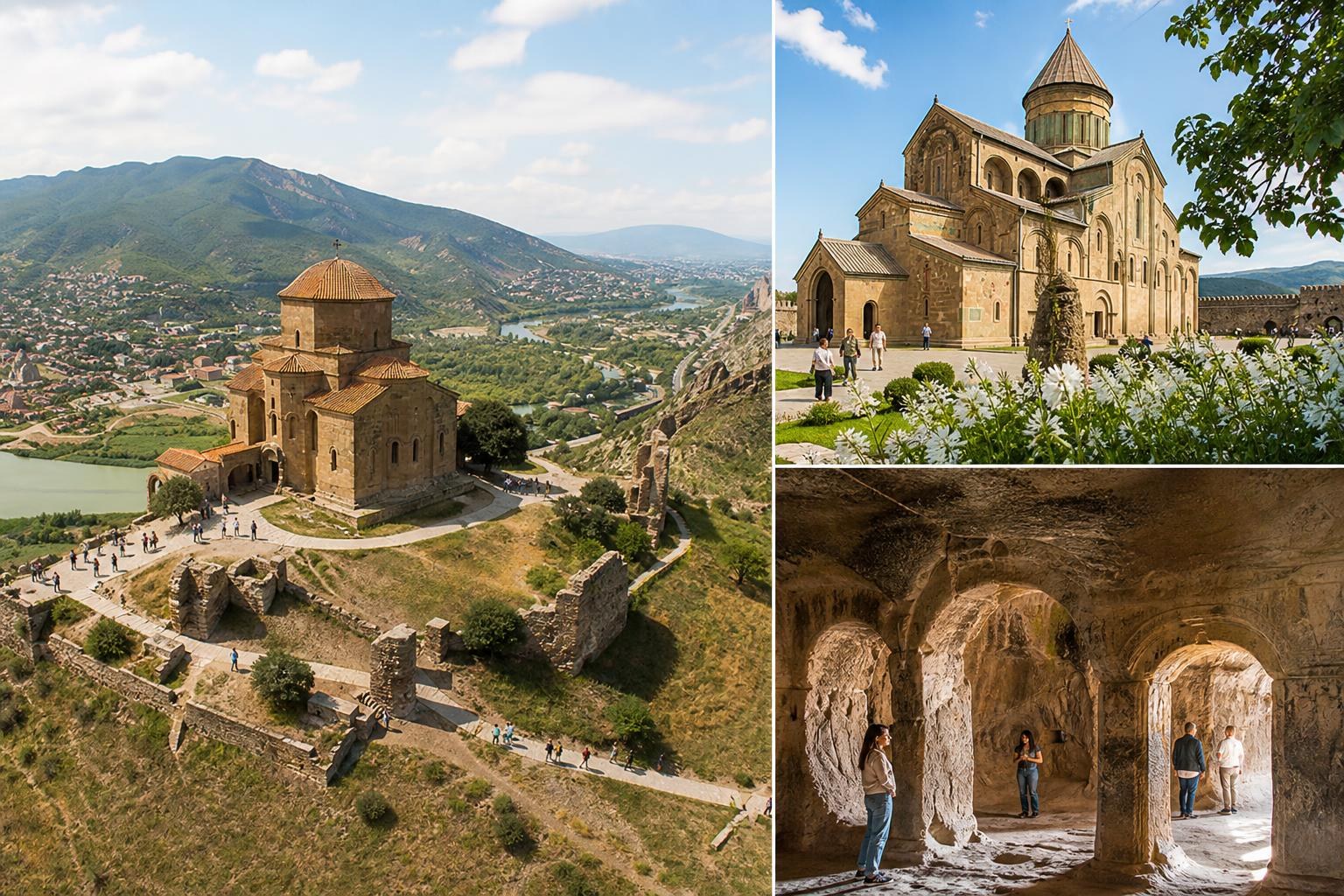
Jvari Monastery is a 6th-century church perched on a rocky hilltop where the Mtkvari and Aragvi rivers merge below. It’s one of the earliest examples of the Georgian cross-dome architectural style, and its silhouette against the sky is probably the single most photographed image in the country. The poet Lermontov wrote about this exact view in the 1830s, and honestly, the scene hasn’t changed much since.
The church itself is compact: a single-nave structure you can walk around in ten minutes. What makes the stop special is the panorama. On a clear morning you can see Svetitskhoveli Cathedral directly below in Mtskheta, the two rivers splitting the valley, and the Caucasus foothills beyond.
The U.S. Ambassadors Fund for Cultural Preservation has provided over $600,000 for conservation of Jvari’s major church, specifically to address the soft sandstone facades that are slowly eroding from wind and water. You’ll notice some scaffolding on the eastern wall, but it doesn’t block access or views.
Parking is a small gravel lot about 50 meters from the church. It fills up fast after 10:00 when tour buses arrive, which is another reason to start here early. There’s no entrance fee, no ticket booth, and no gift shop. Just the church, the view, and a few vendors selling churchkhela.
Important: Dress code applies here and at all churches on this route. Women should cover shoulders and hair (scarves are sometimes available at the entrance). Men need long trousers. Shorts and tank tops will get you turned away.
Stop 2: Svetitskhoveli Cathedral and Old Mtskheta
Drive down from Jvari, cross the bridge, and you’re in Mtskheta within five minutes. Park on Arsukidze Street near the town’s main pedestrian zone: the lot is free and usually has space before noon.
Svetitskhoveli Cathedral is Georgia’s spiritual heart. The current structure dates to the 11th century, though a church has stood on this spot since the 4th century, when Christianity was adopted as the state religion. Tradition holds that Christ’s robe is buried beneath the cathedral, making it one of the holiest sites in the Georgian Orthodox world.
The interior is dim and heavy with incense. Look for the tiny chapel-within-a-chapel near the center of the nave: that’s the symbolic marker of the buried robe. The frescoes along the walls mix biblical scenes with uniquely Georgian iconographic traditions, including a famous zodiac wheel on the south face.
A major conservation project is underway through 2027, with approximately 5 million GEL allocated to address structural risks and water infiltration. Some interior sections may be partially screened, but the cathedral remains open daily from 09:00 to 19:00 with free admission.
A new Mtskheta Museum and landscaped riverside park with a pedestrian bridge and bike paths are expected to open in late 2026, which will add another reason to linger in town.
Exploring Samtavro Monastery and Mtskheta Things to Do
Samtavro Monastery is a five-minute walk north of Svetitskhoveli, and most visitors skip it entirely. That’s a mistake. The complex includes the Church of the Transfiguration and a small nunnery, and it’s where King Mirian III and Queen Nana, who brought Christianity to Georgia, are buried.
The atmosphere here is quieter and more contemplative than Svetitskhoveli. You’ll likely have the courtyard to yourself.
Beyond the churches, Mtskheta’s pedestrian streets offer a few things worth your time:
- Small family-run souvenir shops selling cloisonné enamel jewelry, a traditional Georgian craft called “minankari”
- A handful of wine shops where you can taste local Kartli-region wines (stick to tasting if you’re driving)
- The old town bridge over the Aragvi, which gives you a different angle on the Jvari hilltop
Local small businesses capture a significant share of visitor spending in the town center, so buying a bottle of wine or a handmade cross here directly supports the community.
Stop 3: Shio-Mgvime Monastery and the Limestone Canyon
This is the stop most people miss, and it’s arguably the most atmospheric of the three. Shio-Mgvime monastery sits at the end of a narrow limestone canyon about 13 km southwest of Mtskheta. The drive takes 20 to 25 minutes on a winding but paved road that follows the gorge.
The monastery was founded in the 6th century by a Syrian monk named Shio, who lived as a hermit in a deep vertical cave that’s still accessible today. The complex includes the 6th-century Church of St. John the Baptist, the Cave of St. Shio, and an active monastic community with resident monks. This is not a museum. It’s a working monastery, and you’ll see monks going about their routines.
The cave itself is the highlight. You descend a narrow stone staircase into a shaft where Shio reportedly spent years in solitary prayer. It’s dark, cool, and slightly claustrophobic. Bring a phone flashlight.
Shio-Mgvime is open from 11:00 to 19:00 with free admission. Parking is at a small lot about 200 meters from the monastery entrance, connected by a paved path. The setting, with sheer limestone walls rising on both sides, feels completely removed from the highway you were on an hour earlier.
Note: The monastery road has no guardrails in several sections. Drive slowly, especially on curves. If you visit after rain, watch for loose gravel and small rockfalls near the canyon walls.
Essential Driving Tips and Road Conditions
The E60 highway to Mtskheta is one of the best-maintained roads in Georgia: smooth asphalt, clear markings, and regular police presence. Speed cameras are active on this stretch, and the limit is 110 km/h on the highway, dropping to 60 km/h in town.
The road up to Jvari is steep and has a few tight switchbacks, but it’s fully paved and manageable in any rental car. The Shio-Mgvime road is the only section that requires attention: it’s single-lane in places, with oncoming traffic around blind corners. Honk before curves. Seriously.
A few practical driving notes:
- Fuel up in Tbilisi or at the Mtskheta junction. There’s no fuel station near Shio-Mgvime.
- Georgian drivers can be aggressive on the highway. Stay in the right lane unless overtaking.
- Parking in Mtskheta town is free but limited. Arrive before 11:00 or expect to circle.
- The Jvari lot has no shade. Crack your windows or use a sunshade in summer: interior temperatures hit 50°C easily.
The entire loop works year-round. Winter brings occasional snow to the Jvari hilltop, but the road is usually cleared within hours. The Shio-Mgvime road can ice over in January and February, so check conditions locally if you’re visiting in deep winter.
Where to Eat: Best Stops for a Quick Georgian Lunch
Mtskheta town center has a cluster of small restaurants along the pedestrian street leading to Svetitskhoveli. Prices are slightly higher than Tbilisi but still reasonable: expect to pay 30–45 GEL per person for a full meal with a drink.
For a fast, filling lunch between stops, look for a spot serving fresh khachapuri and lobiani straight from the tone oven. These cost 5-8 GEL each and are the perfect car-friendly meal. Pair one with a bottle of Natakhtari lemonade and you’re set.
If you want to sit down properly, the restaurants on the main drag serve standard Georgian fare: mtsvadi (grilled pork skewers), shkmeruli (garlic chicken), and seasonal salads. Service is generally quick because these places are geared toward day-trippers. Eat in Mtskheta between your Svetitskhoveli and Shio-Mgvime stops so you’re not rushing.
Skip the restaurants right at the cathedral entrance: they charge a premium for the view. Walk one block further and you’ll find the same food for 30% less.
Mtskheta Half-Day Trip FAQ
Do I need a 4×4 for the Mtskheta-Jvari-Shio-Mgvime loop?
No. The entire route is paved and accessible in a standard sedan. The Shio-Mgvime road is narrow and winding but doesn’t require high clearance. After heavy rain, drive cautiously on the canyon road, but 4×4 is not necessary.
Is Jvari Monastery open at sunrise?
The church grounds are technically accessible 24 hours since there’s no gate, but the church door is usually locked before about 08:00. For sunrise photography of the confluence view, you can access the hilltop and surrounding area freely.
Can I visit all three sites with kids?
Yes, with some caveats. The Jvari viewpoint has no railing at the cliff edge, so keep small children close. The Shio-Mgvime cave descent involves steep, narrow stone steps that aren’t suitable for toddlers or anyone with mobility issues. Svetitskhoveli and Samtavro are fully accessible.
How much time should I budget for the whole loop?
Four to five hours including driving, all three stops, and a quick lunch. If you’re a photographer or history enthusiast, add an extra hour. If you’re just checking boxes, three and a half hours is doable but rushed.
Is there an entrance fee at any of the three sites?
No. All three sites are free to enter as of 2026. Donations are welcome at each location, and there are small donation boxes inside the churches.
This half-day loop from Tbilisi packs in three UNESCO-worthy sites, a river confluence that’s been inspiring poets for centuries, and a cave hermitage that feels like it belongs in another era entirely. The key is starting early, hitting Jvari before the crowds, and saving Shio-Mgvime for last when the midday light fills the canyon. If you’re planning your own route through Georgia, Triproadwayplanner covers road conditions and seasonal tips for drives like this across the country. Keep a scarf in the car for church visits, download your maps offline, and leave Tbilisi by 08:30. You’ll be back in time for a late lunch on Aghmashenebeli.