
Table of Contents
- Discovering Kutaisi: The Cultural Heart of Imereti
- Majestic Temples and Spiritual Landmarks
- Lush Forests and Natural Wonders Near the City
- Planning Your Visit: Logistics and Best Times
- Navigating Kutaisi: From Old Town to Sacred Sites
Georgia’s second-largest city doesn’t try to compete with Tbilisi’s cosmopolitan energy, and that’s precisely what makes it so compelling. Kutaisi sits in the Imereti region, cradled by river valleys and forested hills, with a history that stretches back more than 3,500 years. This was the ancient capital of the Colchis kingdom, the place where Greek mythology says Jason came searching for the Golden Fleece. Today, visitors wondering what to see in Kutaisi find a city where medieval cathedrals crown hilltops, subtropical forests press right up against the urban edge, and a 2-lari marshrutka ride can deliver you from a bustling bazaar to a canyon walkway suspended 140 meters above a river gorge. The city has also been quietly reinventing itself: the former Parliament building, relocated here from Tbilisi in 2012, is being transformed into a major IT hub, signaling that Kutaisi’s identity is evolving even as its ancient roots hold firm. Whether you have two days or a full week, the combination of sacred architecture and wild nature here is hard to match anywhere else in the Caucasus.
Discovering Kutaisi: The Cultural Heart of Imereti
Kutaisi has always been a crossroads city, but not in the way Tbilisi is. Where the capital looks east toward Azerbaijan and south toward Turkey, Kutaisi faces inward, toward the green heart of western Georgia. The Rioni River cuts through the city center, and the surrounding Imereti region produces some of the country’s best wine, honey, and churchkhela. There’s a slower rhythm here, one that rewards patience.
Walking through the old town, you’ll notice how the city layers its history. Soviet-era apartment blocks sit below a cathedral that predates the Crusades. Street vendors selling tkemali sauce from plastic bottles operate a few hundred meters from a restored 19th-century synagogue. The central market, known locally as the Green Bazaar, is one of the most authentic in Georgia: a place where a kilo of fresh walnuts costs around 8-10 GEL and nobody is performing for tourists.
I’ve found that Kutaisi works best as a base rather than a day trip. Most visitors flying into David the Builder Kutaisi International Airport, which handles Wizz Air and other budget carriers from across Europe, treat the city as a stopover. That’s a mistake. The temples and forests that define this region deserve at least three days, and the city itself has a warmth, a specific Imeretian hospitality, that takes a little time to feel. Locals here use the phrase “stumari ghvtisaa” – the guest is a gift from God – and they mean it with an intensity that goes beyond polite tourism-industry smiles.
The Kutaisi Botanical Garden is a perfect example of the city’s understated charm. Established in the 19th century, it sits on a hillside overlooking the Rioni and holds over 700 plant species. It’s not manicured like a European botanical garden. It’s wilder, more tangled, more honest. Admission is just 2 GEL, and on weekday mornings you’ll often have entire sections to yourself.
Majestic Temples and Spiritual Landmarks
Georgia adopted Christianity in 337 AD, making it one of the oldest Christian nations on earth, and Kutaisi holds some of the most important surviving evidence of that heritage. The temples here aren’t museums. They’re active places of worship where incense smoke drifts through 11th-century frescoes and priests in black robes move between services. Visiting them requires a certain respect: covered shoulders for everyone, head coverings for women, and a willingness to stand quietly rather than rush through with a camera.
What sets Kutaisi’s sacred sites apart from Tbilisi’s churches is their setting. These monasteries and cathedrals were built on hilltops and cliff edges, deliberately positioned to dominate the landscape and inspire awe. The architects understood something about the relationship between spirituality and geography that still resonates.
Bagrati Cathedral: The Icon of the Golden Age
Bagrati Cathedral sits on Ukimerioni Hill, visible from almost anywhere in the city. Built in the early 11th century during the reign of King Bagrat III, it was one of the finest examples of medieval Georgian architecture until Ottoman forces partially destroyed it in 1691. For centuries, the cathedral stood as a majestic ruin, its walls open to the sky.
A controversial reconstruction completed in 2012 restored the cathedral’s dome and interior, using modern materials that drew criticism from UNESCO, which removed Bagrati from its World Heritage List in 2017. Opinions on the restoration remain divided. Some Georgian architects argue the new elements clash with the original stonework. Others say the cathedral needed to function as a living church, not a preserved ruin. Whatever your view, the experience of climbing the hill at sunset, watching the Rioni Valley turn gold below you, is undeniable. The panoramic view alone justifies the visit.
Entry is free, and the cathedral is open daily. The climb from the city center takes about 15 minutes on foot, following a paved path that passes through a small park.
Gelati Monastery: A UNESCO World Heritage Academy
If you see only one site near Kutaisi, make it Gelati. Founded in 1106 by King David IV (David the Builder), this monastery complex was not just a place of worship but a major medieval academy, one of the most important centers of learning in the entire Eastern Christian world. Scholars here translated Greek philosophical texts, studied astronomy, and produced manuscripts that influenced Georgian intellectual life for centuries.
The monastery retains its UNESCO World Heritage status, and a multi-phase rehabilitation project has been carefully restoring its extraordinary mosaics and frescoes. The Virgin Mary mosaic in the main church is one of the finest surviving examples of Byzantine-style art in the Caucasus: luminous gold tiles that have survived nearly a millennium of wars, earthquakes, and neglect.
Gelati sits about 11 kilometers northeast of Kutaisi. A taxi costs roughly 15-20 GEL one way, or you can catch a marshrutka from the central station. Give yourself at least an hour here. The grounds include three churches, a bell tower, and the burial site of David the Builder himself, whose tomb is placed at the entrance so that every visitor walks over it, fulfilling his wish to remain humble even in death.
Motsameta Monastery: The Cliffside Sanctuary
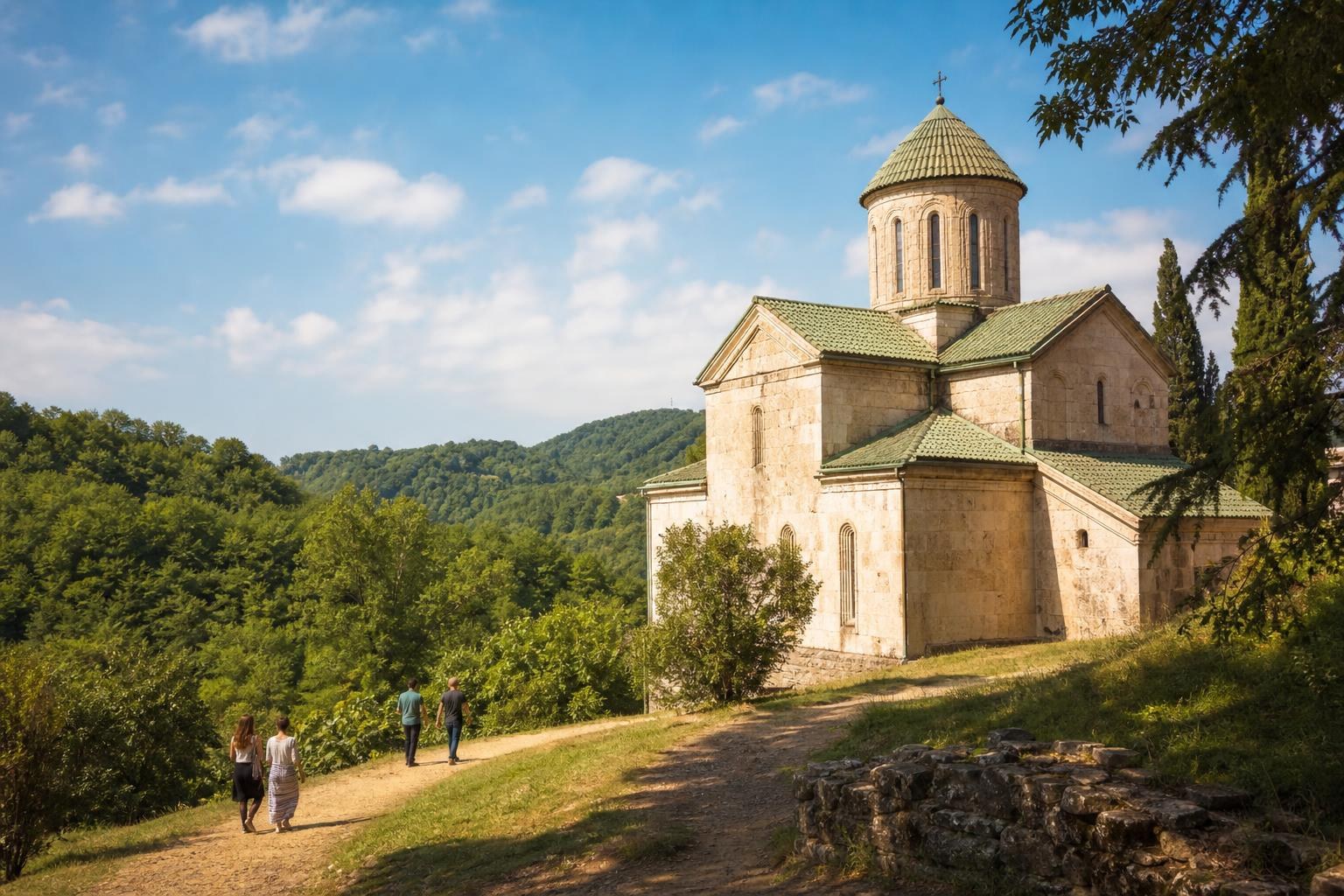
Just 6 kilometers from Gelati, perched on a cliff above a bend in the Tskaltsitela River, Motsameta Monastery is smaller and less visited but arguably more atmospheric. The name means “place of martyrs,” honoring two 8th-century brothers, David and Constantine, who were killed by Arab invaders for refusing to convert to Islam. Their remains are kept in a wooden sarcophagus inside the church.
A local tradition says that if you crawl under the sarcophagus three times and make a wish, it will come true. You’ll see Georgian visitors doing exactly this, often with complete sincerity. The monastery’s setting is stunning: dense forest drops away on three sides, and the river runs green and fast far below. If you’re visiting Gelati, combining both sites into a single half-day trip is easy and highly recommended.
Lush Forests and Natural Wonders Near the City
The temples tell you about Kutaisi’s human history, but the forests around the city tell a much older story. Western Georgia receives significantly more rainfall than the east, and the Imereti region is covered in dense subtropical and temperate forests that feel almost prehistoric. Ferns grow to head height. Box trees twist into shapes that look like they belong in a fantasy novel. And beneath the surface, millions of years of geological activity have carved out caves and canyons that rank among the most impressive natural sites in the Caucasus.
Sataplia Nature Reserve: Ancient Woods and Dinosaur Tracks
About 9 kilometers northwest of Kutaisi, Sataplia Nature Reserve protects a patch of Colchic forest that feels genuinely primeval. The reserve’s most famous attraction is a set of fossilized dinosaur footprints discovered in 1933, preserved in limestone and dating back roughly 120 million years. A small museum on site provides context, though the displays are modest.
The real highlight is the glass observation platform that extends over the edge of a cliff, giving you a vertigo-inducing view of the forested valley below. The forest itself is worth exploring slowly: trails wind through groves of yew and box trees, and if you visit in spring, the wildflower displays are remarkable. Entry costs around 17 GEL for adults, which includes the cave, the dinosaur tracks, and the viewing platform. Budget about two hours for a comfortable visit.
Prometheus Cave: Underground Forests of Stone
Prometheus Cave, located about 20 kilometers from Kutaisi near the village of Kumistavi, is one of the largest caves in Georgia, with over 1,600 meters of illuminated walkways open to visitors. The stalactites and stalagmites here are extraordinary: some formations are estimated to be tens of millions of years old, and the lighting system, while occasionally a bit dramatic with its colored LEDs, does highlight the scale of the underground chambers effectively.
The cave maintains a constant temperature of around 14°C year-round, making it a welcome escape from summer heat. An optional boat ride through an underground river adds about 15 GEL to the standard 23 GEL entry fee, and it’s worth it for the eerie silence of floating through a pitch-dark tunnel. Tours run on a fixed schedule, typically every hour, and last about 45 minutes. Wear shoes with grip: the walkways can be slippery.
Okatse Canyon: Walking Above the Forest Canopy
Okatse Canyon might be the single most thrilling experience near Kutaisi. A metal walkway bolted to the canyon wall extends 780 meters along the edge of a sheer cliff, with a viewing platform at the end that hangs 140 meters above the Okatse River. The walkway is narrow, and the drop is real. If you have a fear of heights, this will test it.
The canyon is located about 42 kilometers from Kutaisi, near the village of Gordi. You can arrange a combined canyons and cave tour that covers Okatse, Martvili Canyon, and Prometheus Cave in a single day, though doing all three feels rushed. I’d recommend pairing Okatse with Martvili and saving Prometheus for a separate trip. Entry to Okatse costs around 17 GEL, and you should allow at least 90 minutes, including the 2.5-kilometer forest trail from the parking area to the canyon walkway. The trail itself is beautiful, passing through old-growth forest with towering beech and chestnut trees.
Planning Your Visit: Logistics and Best Times
Kutaisi’s climate is mild and humid, with warm summers and relatively gentle winters compared to Tbilisi. The best months for visiting are May through June and September through October. July and August bring heat and occasional heavy rain, though the caves and forested canyons remain comfortable. Spring is particularly beautiful, when the forests are at their greenest and wildflowers blanket the hillsides.
Getting to Kutaisi from Tbilisi takes about 3.5 hours by car or marshrutka, with regular departures from Tbilisi’s Didube station costing around 20 GEL. The Kutaisi airport receives direct flights from dozens of European cities, often at remarkably low fares. Budget accommodation in the city center starts at around 60-80 GEL per night for a clean guesthouse, while mid-range hotels run 150-250 GEL.
For getting around the region, Bolt works within the city, but for day trips to caves and canyons, you’ll want either a rental car or a hired driver. Local drivers typically charge 100-150 GEL for a full day, which is reasonable when split between two or more travelers. Download Google Translate’s offline Georgian language pack before you arrive: English is spoken at major tourist sites, but less so in villages and marshrutkas.
Comparison of Top Sites: Entry Fees and Distances
| Site | Distance from Kutaisi | Entry Fee (2026) | Time Needed | Best For |
|---|---|---|---|---|
| Bagrati Cathedral | 1 km (city center) | Free | 30-45 min | Views, history |
| Gelati Monastery | 11 km | Free | 1-1.5 hours | Architecture, frescoes |
| Motsameta Monastery | 17 km | Free | 30-45 min | Atmosphere, scenery |
| Sataplia Nature Reserve | 9 km | ~17 GEL | 1.5-2 hours | Dinosaur tracks, forest |
| Prometheus Cave | 20 km | ~23 GEL (+15 boat) | 1-1.5 hours | Underground formations |
| Okatse Canyon | 42 km | ~17 GEL | 1.5-2.5 hours | Canyon walkway, thrill |
Navigating Kutaisi: From Old Town to Sacred Sites
Kutaisi rewards exploration on foot more than most Georgian cities. The old town clusters along both banks of the Rioni, connected by the White Bridge (Tetri Khidi), a pedestrian bridge that’s become something of a local landmark. From the bridge, Bagrati Cathedral is visible on its hill to the east, and the central market sprawls to the west. A morning routine that works well: coffee at one of the small cafes near Kutaisi’s main fountain, then a walk through the Green Bazaar for fresh fruit and churchkhela before heading out to the day’s main destination.
For the monasteries and nature reserves, start early. Gelati and Motsameta can be combined into a morning trip, leaving the afternoon free for Sataplia or the Botanical Garden. Save Okatse Canyon and Prometheus Cave for separate days, since both involve more travel time and physical effort. If you’re visiting in peak season, arriving at popular sites by 9 or 10 AM helps you avoid the tour bus crowds that typically show up around midday.
Kutaisi is a city that doesn’t oversell itself. There are no flashy marketing campaigns, no Instagram-bait installations. What you get instead is the real thing: temples that have stood for a thousand years, forests that have been growing for millions, and a community that treats hospitality not as an industry but as a deeply held value. The combination of sacred architecture and raw natural beauty in this corner of Georgia is genuinely special. Give it more time than you think you need, and it will give back more than you expected.