
Table of Contents
- Why April is the Ideal Time to Visit Georgia
- Best Low-Altitude Hiking Trails for Spring
- Wine Tasting Journeys in Kakheti
- Alternative Wine Regions: Kartli and Imereti
- Cultural Festivals and April Events
- Essential Packing Tips for a Georgia Spring Adventure
Georgia in April is one of those rare travel sweet spots: the snow is melting off the high passes, wildflowers carpet the lowland valleys, and winemakers across Kakheti are throwing open their cellar doors after a quiet winter. I’ve spent multiple springs wandering this country, and April consistently delivers the best balance of comfortable weather, manageable crowds, and sheer natural beauty. If you’re wondering what to do in Georgia in April, the short answer is hike through landscapes that look like they belong in a fantasy novel, then reward yourself with some of the oldest wine traditions on Earth. The longer answer fills the rest of this page, and it’s worth your time.
Why April is the Ideal Time to Visit Georgia
Georgia – or Sakartvelo, as Georgians call their homeland – sits at the crossroads of Europe and Asia, meaning its climate varies wildly by region. April lands right in the transition zone between the cool, rainy early spring and the hot summers that bake the eastern plains. Most trails below 2,000 meters are already accessible, and the tourist surge of June through September hasn’t started yet. That matters practically: guesthouses in places like Sighnaghi or Lagodekhi still have rooms available without advance booking, and you won’t share a canyon viewpoint with forty other hikers.
Weather Conditions and Spring Blooms
Tbilisi in April feels like a mild European spring, with daytime temperatures hovering between 15 and 20°C. Mornings can be crisp, especially in the first week, but by mid-month you’ll be comfortable in a light jacket. The eastern lowlands around the Alazani Valley tend to be a few degrees warmer, while the western regions near Kutaisi see more rainfall due to moisture from the Black Sea. I’ve been caught in afternoon showers in Imereti more than once, but they pass quickly and leave the air smelling incredible.
The real magic of April is the bloom. Wild poppies, irises, and orchids appear across the lower elevations, and fruit orchards throughout Kakheti burst into white and pink blossoms. Almond trees flower early, and by mid-April the countryside has a softness to it that disappears once summer heat sets in. If you’re a photographer, this is your month.
April Travel Data: Temperature and Precipitation Table
Here’s a breakdown of what to expect across the main regions you’re likely to visit:
| Region | Avg. High (°C) | Avg. Low (°C) | Rainfall (mm) | Trail Accessibility |
|---|---|---|---|---|
| Tbilisi | 18-21 | 8-10 | 45-55 | City trails fully open |
| Kakheti (Alazani Valley) | 19-23 | 9-12 | 40-50 | All lowland trails open |
| Imereti (Kutaisi area) | 17-20 | 8-11 | 80-100 | Open, expect rain |
| Lagodekhi | 16-19 | 7-10 | 60-75 | Lower trails open; upper routes may have snow |
| Vashlovani | 20-24 | 10-13 | 30-40 | Fully accessible |
These numbers come from Georgia’s National Environmental Agency historical averages, adjusted for recent seasonal patterns through 2025. The takeaway: pack layers, bring a rain shell, and expect sunshine most days.
Best Low-Altitude Hiking Trails for Spring
Georgia’s high-altitude treks – the Mestia to Ushguli route, for instance – don’t really open until late June. But April is prime time for lower-elevation hikes that most visitors overlook entirely. These trails offer dramatic geology, rich biodiversity, and far fewer people than the Svaneti routes that dominate Instagram.
Vashlovani National Park’s Desert Landscapes
Vashlovani sits in Georgia’s far southeast corner, near the Azerbaijani border, and it looks nothing like what most people picture when they think of the Caucasus. This is semi-arid steppe and badlands terrain: eroded mud volcanoes, rust-colored canyons, and dry grasslands stretching to the horizon. April is arguably the only comfortable month to hike here, since summer temperatures regularly exceed 40°C.
The park requires a permit from the National Agency of Protected Areas, which costs about 5 GEL (roughly $1.80 USD in 2026). You’ll also need a 4×4 to reach the trailheads, or you can arrange transport through the ranger station in Dedoplistskaro. The Eagle Canyon trail is the standout: a 12-kilometer loop that winds along cliff edges above the Iori River valley. I saw three other hikers the entire day I walked it. The solitude is genuine.
Bring plenty of water. There are no reliable sources along most routes, and the dry climate will dehydrate you faster than you expect.
The Dramatic Canyons of Dashbashi and Okatse
These two canyon systems sit in different parts of the country but share a similar appeal: vertigo-inducing walkways suspended above deep gorges. Dashbashi Canyon, near Tsalka in the Kvemo Kartli region, features a glass-bottomed bridge that opened in 2022 and has become one of Georgia’s most popular natural attractions. The bridge itself is impressive, but the real hiking happens on the trails descending into the canyon below, where waterfalls pour over basalt columns.
Okatse Canyon, near Kutaisi, offers a different experience. A metal walkway bolted to the cliff face extends over the gorge, and the trail leading to it passes through dense forest that’s especially lush in April. The entry fee is around 17.25 GEL for international visitors. Both canyons are day-trip accessible from major cities, making them easy to combine with wine touring if you’re based in Tbilisi or Kutaisi.
Lagodekhi Nature Reserve: Waterfalls and Flora
Lagodekhi is the oldest protected area in the Caucasus, established in 1912, and it remains one of the best-maintained reserves in Georgia. The park sits in the northeast, right on the border with Azerbaijan and Dagestan, and its lower trails are perfect for April hiking.
The most popular route leads to Ninoskhevi Waterfall, a 3-kilometer out-and-back that takes about two hours round trip. It’s an easy walk through beech and hornbeam forest, crossing wooden bridges over clear streams. For something more demanding, the trail to Rocho Waterfall extends to about 14 kilometers and gains significant elevation, though in early April the upper sections can still be muddy or partially snow-covered.
What makes Lagodekhi special in spring is the wildflower density. The forest floor is carpeted with primroses, violets, and Caucasian snowdrops. Birdwatchers will spot species that are difficult to find elsewhere in Europe, including Caucasian black grouse and wallcreepers on the rock faces.
Wine Tasting Journeys in Kakheti
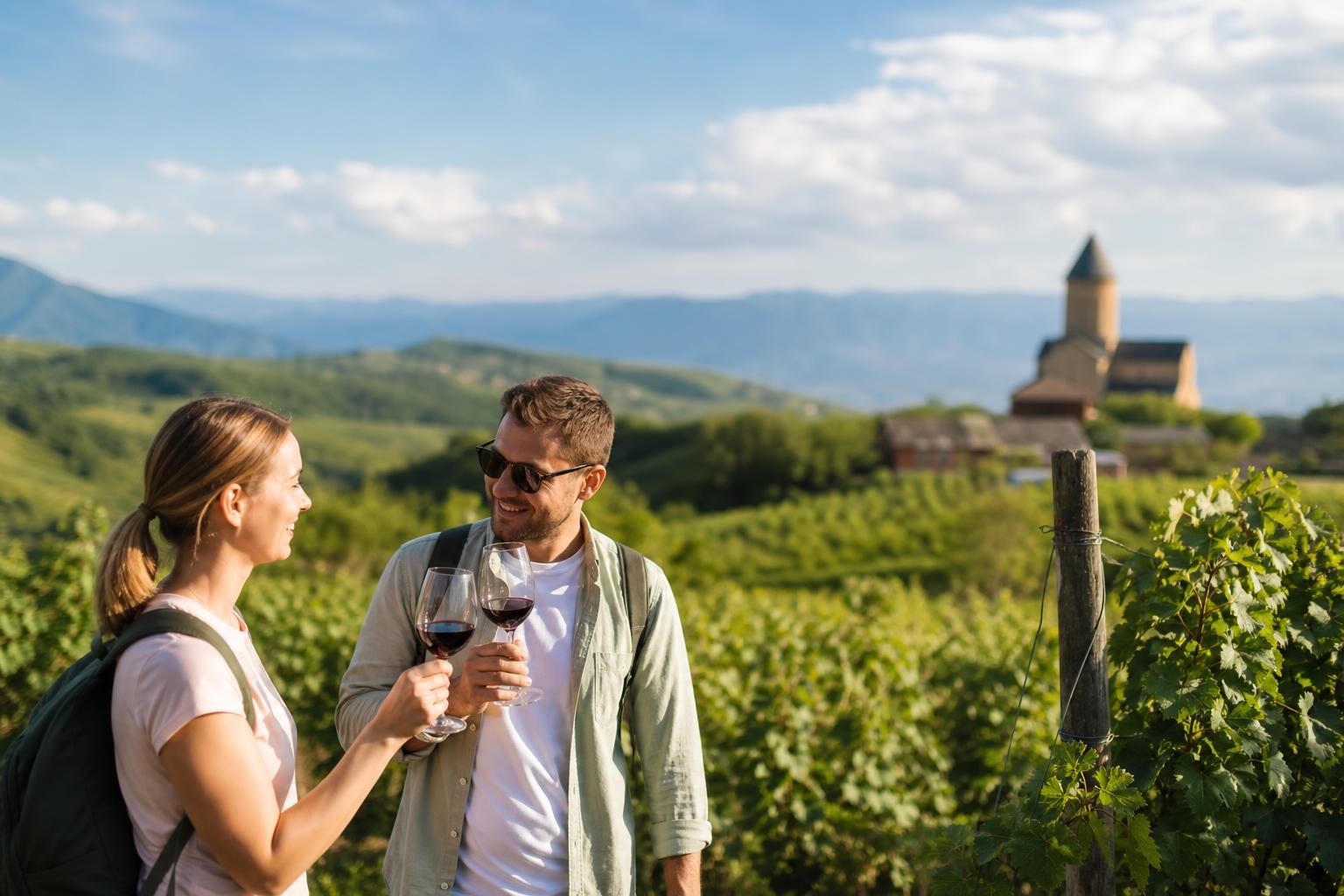
Georgia has been making wine for roughly 8,000 years – that’s not marketing hyperbole, it’s backed by archaeological evidence from Gadachrili Gora, where the world’s oldest known grape residue was found on clay vessel fragments. Kakheti produces about 70% of the country’s wine, and April is when the vineyards are waking up, with new growth on the vines and cellars eager for visitors after the quieter winter months.
Exploring the Alazani Valley Vineyards
The Alazani Valley stretches between the Greater Caucasus mountains to the north and the Gombori Range to the south, creating a natural corridor of fertile soil and warm air. This is where Georgia’s most celebrated grape varieties thrive: Saperavi (the backbone of Georgian reds) and Rkatsiteli (the dominant white, though “white” barely describes the amber-hued wine it often produces).
A typical vineyard visit in the Alazani Valley costs between 20 and 50 GEL ($7-18 USD), which usually includes a tasting of four to six wines plus bread, cheese, and churchkhela (those candle-shaped walnut-and-grape-juice snacks you’ll see hanging everywhere). Some family-run operations charge nothing at all and simply expect you to buy a bottle or two if you enjoy what you taste. This is a culture where the guest is considered a gift from God – stumari ghvtisaa – and that ethos shows up in how winemakers welcome strangers.
I’d recommend visiting at least one large producer and one family cellar. The contrast is instructive.
Traditional Qvevri Methods vs. Modern Cellars
The qvevri is a large clay vessel, egg-shaped and buried underground, where grapes ferment with their skins, seeds, and sometimes stems for months. This method produces Georgia’s distinctive amber wines, which have a tannic, slightly oxidative character that’s completely unlike anything from France or California. UNESCO recognized qvevri winemaking as intangible cultural heritage in 2013, and the technique has seen a global revival since then.
Modern Georgian cellars, by contrast, use stainless steel tanks and temperature-controlled fermentation to produce cleaner, fruit-forward wines that appeal to international palates. Neither approach is “better” – they’re different philosophies. Visiting both types of operation gives you a complete picture of where Georgian wine has been and where it’s heading.
Pheasant’s Tears in Sighnaghi is one of the best-known natural wine producers using qvevri methods. Teliani Valley, headquartered near Telavi, represents the polished, export-oriented side of the industry. Both welcome visitors in April, though booking a day ahead is smart.
Sighnaghi: The City of Love and Wine
Sighnaghi is a small hilltop town overlooking the Alazani Valley, and it’s almost absurdly picturesque. The town was restored in 2007 with cobblestone streets, pastel-colored houses, and a defensive wall with watchtowers that you can walk along for panoramic views of the valley and snow-capped Caucasus peaks beyond.
The town earned its romantic nickname because its marriage registration office operates 24 hours a day – couples can legally marry here at 3 AM if they want. But for most visitors, Sighnaghi is a base for wine tasting and a place to eat extraordinarily well for very little money. A full dinner with wine at a local restaurant rarely exceeds 40 GEL ($14 USD) per person.
The Sighnaghi Museum also houses a surprisingly strong collection of paintings by Niko Pirosmani, Georgia’s most beloved folk artist. It’s worth an hour of your time.
Alternative Wine Regions: Kartli and Imereti
Kakheti gets most of the attention, but Georgia’s other wine regions deserve a stop, especially if you’re spending more than a week in the country. Kartli, the region surrounding and west of Tbilisi, produces excellent sparkling wines using the traditional method. Bagrationi 1882, Georgia’s oldest sparkling wine house, is based here and offers tours of its production facility.
Imereti, centered around Kutaisi, has its own distinct winemaking identity. The wines tend to be lighter and more acidic than Kakhetian varieties, partly because Imeretian winemakers traditionally use less skin contact in their qvevri. Tsolikouri and Tsitska are the grapes to look for here: crisp, citrusy whites that pair beautifully with Imeretian khachapuri (which is different from the Adjarian boat-shaped version most tourists know).
A visit to the Imereti wine region combines naturally with hiking at Okatse Canyon and exploring the Prometheus Cave near Kutaisi. You can cover all three in two full days.
Cultural Festivals and April Events
April brings several events worth planning around. Easter is the biggest, and in 2026 Georgian Orthodox Easter falls on April 12. The celebration is intense and deeply communal: midnight church services, elaborate feasts, and egg-dyeing traditions that go back centuries. If you’re invited to a supra (traditional feast) during Easter, say yes. The tamada, or toastmaster, will guide the evening through a structured series of toasts to God, country, family, and the departed. It’s one of the most memorable dining experiences you can have anywhere.
Tbilisoba, the capital’s main city festival, happens in autumn, but April has its own cultural energy. The Tbilisi International Film Festival typically runs in late April, screening Georgian and international independent cinema. Art galleries along Rustaveli Avenue host spring exhibition openings, and the Dry Bridge flea market is at its most vibrant as vendors bring out items stored away during winter.
Check local listings through the Visit Georgia website for exact dates, as smaller regional festivals shift from year to year.
Essential Packing Tips for a Georgia Spring Adventure
Georgia in April demands versatile packing. The temperature swings between morning chill and afternoon warmth are real, and you’ll likely move between urban settings and trail environments within the same day.
- Footwear: waterproof hiking boots for trails, plus comfortable walking shoes for cobblestone towns like Sighnaghi and Tbilisi’s Old Town
- Layers: a merino base layer, fleece mid-layer, and a packable rain jacket cover most April conditions
- Sun protection: UV is strong at elevation, even on cloudy days; bring SPF 50 and sunglasses
- Daypack: a 20-25 liter pack works for day hikes and doubles as your wine-tasting bag (padded inserts help if you’re buying bottles)
- Tech: download offline maps via Maps.me or Google Maps before heading to rural areas; cell coverage is spotty in places like Vashlovani and upper Lagodekhi
- Transport apps: Bolt works well in Tbilisi and larger cities for affordable rides; for rural transfers, arrange through your guesthouse
One thing people forget: Georgian electrical outlets use the European two-pin Type C plug. Bring an adapter or buy one at any Tbilisi pharmacy for about 3 GEL.
Spring hiking and wine touring in Georgia offer something genuinely rare: a country where ancient traditions aren’t museum exhibits but living daily practice, where a winemaker will pour you a glass from a vessel buried in his grandfather’s yard, and where a two-hour hike ends at a canyon that would be a major national attraction in any other country but here is just another Tuesday. April gives you all of this with mild weather, blooming landscapes, and the space to enjoy it without fighting crowds. Book your flights, pack your layers, and come hungry. Georgia will take care of the rest.