
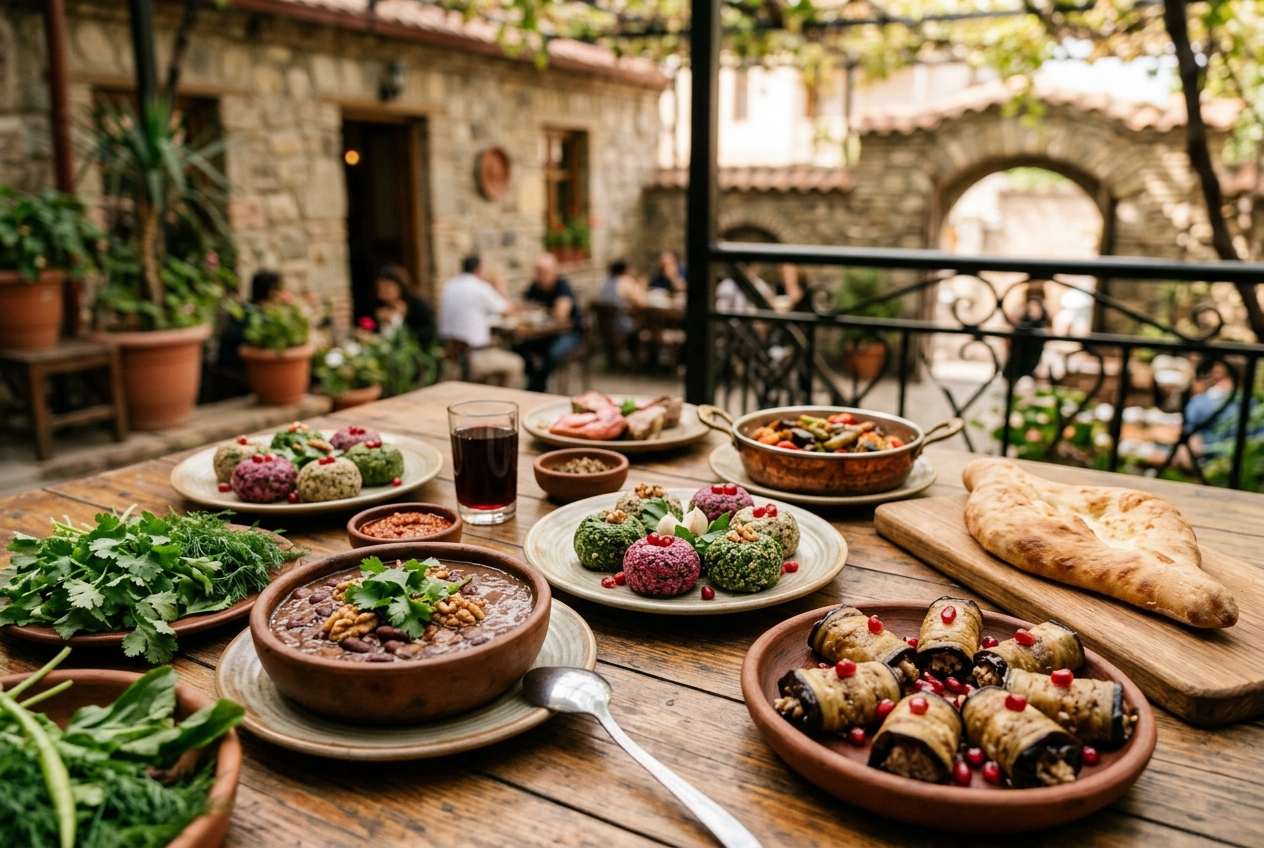
Georgia, the small Caucasus nation wedged between Europe and Asia, is one of those places where the food alone justifies the plane ticket. But if you’re vegetarian or vegan, you might wonder whether a meat-loving culture famous for its supra feasts can actually feed you well. The short answer: yes, and spectacularly so. Georgian cuisine has deep roots in Orthodox fasting traditions, a walnut-obsessed pantry, and a produce culture that puts most Western farmers’ markets to shame. This guide to vegetarian and vegan eating in Georgia covers everything from essential dishes and restaurant picks to the phrases you’ll need in a village kitchen where nobody speaks English. Whether you’re spending a week in Tbilisi or road-tripping through Kakheti and Svaneti, you’ll eat far better than you expect.
The Landscape of Georgian Cuisine for Plant-Based Travelers
Georgian food culture revolves around the supra, the traditional feast presided over by a tamada (toastmaster), where dishes pile up across the table in seemingly endless waves. At first glance, it looks like a meat-heavy affair: grilled pork, chicken tabaka, beef khinkali. But look closer, and you’ll notice that a huge portion of the table is already plant-based. Walnut-paste vegetable rolls, bean stews, eggplant dishes, fresh herb platters, and flatbreads dominate the spread even when meat is present.
This isn’t accidental. Georgia’s culinary identity was shaped by geography, agriculture, and religion in equal measure. The country sits at a crossroads of empires, borrowing techniques from Persia, Turkey, and Russia while maintaining a fiercely independent food identity. The result is a cuisine where vegetables aren’t side dishes but stars in their own right.
Traditional Fasting Traditions and ‘Samarkhvo’ Dishes
The Georgian Orthodox Church prescribes roughly 200 fasting days per year, during which observant Christians abstain from all animal products: meat, dairy, eggs, and sometimes even oil. These fasting periods, including the long Lenten fast before Easter, created an entire category of dishes called samarkhvo (literally “for fasting”). These aren’t afterthoughts or deprivation meals. They’re fully developed recipes refined over centuries.
During fasting seasons, restaurants and home cooks alike shift their menus. You’ll find lobio (bean stew) made without butter, pkhali prepared with only walnuts and herbs, and mushroom-stuffed khinkali. Even bakeries adapt, offering lobiani (bean-filled bread) without the cheese. For vegan travelers, timing a visit during a fasting period means an even wider selection of accidentally vegan food everywhere you go. The major fasting periods fall before Easter (roughly 48 days) and before Christmas (40 days), though shorter fasts happen throughout the year.
Naturally Vegan Staples: From Walnuts to Pomegranates
Georgian cooking relies on a handful of ingredients that happen to be entirely plant-based. Walnuts are the backbone: ground into sauces, pounded into pastes, and folded into nearly everything. The walnut-garlic-herb combination called bazhe functions as Georgia’s answer to béchamel, and it’s completely vegan. Pomegranate seeds and pomegranate molasses add tartness and color. Fresh herbs like cilantro, dill, tarragon, and blue fenugreek (utskho suneli) appear in quantities that would shock a Western chef.
Tkemali, a sour plum sauce, is another staple that’s naturally vegan and shows up alongside almost every meal. Ajika, a spicy paste made from peppers and garlic, adds heat. These condiments mean that even simple bread and vegetables become something memorable. The Georgian pantry, built around nuts, fruits, herbs, and spices, is inherently friendly to plant-based eaters.
Essential Vegetarian and Vegan Dishes to Try
Knowing what to order is half the battle. Here’s a practical breakdown of the dishes that should be on every plant-based traveler’s radar.
Pkhali: The Colorful Vegetable Pâté
Pkhali (sometimes spelled mkhali) is arguably the most versatile vegetarian dish in Georgian cuisine. It’s a family of dishes rather than a single recipe: finely chopped or ground vegetables mixed with a walnut paste seasoned with garlic, vinegar, and herbs. The vegetable base changes with the season and the cook’s preference.
Common varieties include spinach, beet, cabbage, and green bean pkhali. They’re typically shaped into small rounds or balls, topped with pomegranate seeds, and served as appetizers. Every version is naturally vegan. At a supra, you might see four or five types arranged on a single platter, each a different color. The walnut paste gives them a rich, almost creamy texture that satisfies in a way raw vegetables never could.
Hearty Classics: Lobio, Ajapsandali, and Mushroom Khinkali
Lobio is Georgia’s beloved kidney bean stew, slow-cooked with onions, garlic, and a fragrant mix of spices. The classic version is vegan by default, though some cooks add butter, so it’s worth asking. It’s often served in a clay pot with cornbread (mchadi) on the side, and it’s one of the most filling meals you’ll find for under 10 lari (about $3.50).
Ajapsandali is a summer vegetable stew built around eggplant, tomatoes, peppers, and potatoes, seasoned generously with herbs. Think of it as Georgia’s ratatouille, but spicier and more substantial. Khinkali, the iconic soup dumplings, traditionally contain meat, but mushroom-filled versions (sokos khinkali) are increasingly common in Tbilisi and tourist-friendly restaurants. The technique for eating them is the same: grab the top knot, bite a small hole, slurp the broth, then eat the dumpling. Discard the doughy knob at the top.
Cheese-Centric Delights for Vegetarians
If you eat dairy, Georgia is paradise. Khachapuri, the cheese-filled bread that’s practically a national symbol, comes in regional varieties. Adjarian khachapuri from Batumi arrives shaped like a boat, filled with molten cheese, and topped with a raw egg and butter. Imeruli khachapuri is a simpler round version stuffed with Imeretian cheese. Sulguni, a briny, stretchy cheese similar to mozzarella, appears grilled, fried, or stuffed into breads.
| Dish | Vegan | Vegetarian | Notes |
|---|---|---|---|
| Pkhali | Yes | Yes | All varieties are naturally vegan |
| Lobio | Usually | Yes | Ask if butter is added |
| Ajapsandali | Yes | Yes | Always vegan |
| Mushroom Khinkali | Yes | Yes | Confirm no meat broth in dough |
| Khachapuri | No | Yes | Heavy on cheese and butter |
| Badrijani | Yes | Yes | Eggplant with walnut paste |
| Jonjoli | Yes | Yes | Pickled bladdernut flowers |
Navigating the Restaurant Scene in Tbilisi and Beyond
Top-Rated Vegan and Vegetarian Cafes in the Capital
Tbilisi’s food scene has exploded in the past decade. While this isn’t Atlanta, which has 366 plant-based eateries serving its 514,000 residents, Tbilisi punches well above its weight for a city of its size. Dedicated vegan spots like Kiwi Vegan Cafe, Shavi Lomi (which always has strong vegetarian options), and the plant-forward menu at Cafe Littera give you plenty of choice.
The Vera and Sololaki neighborhoods are particularly good for finding modern cafes with clearly labeled vegan menus. Many of these places are run by the post-2003 generation of Georgians who speak excellent English and are tuned into global food trends. Apps like Google Maps with offline packs and Bolt for transportation make getting between restaurants easy. Most menus in central Tbilisi now have English translations, and staff can usually explain ingredients.
For a more upscale experience, several high-end restaurants offer dedicated plant-based tasting menus. This mirrors a global trend: even in cities like Atlanta, upscale restaurants now offer vegetarian and vegan tasting menus as standard practice. Tbilisi’s fine dining scene is following suit.
Dining in Rural Areas: What to Expect and How to Order
Leave Tbilisi, and the situation changes. In small towns like Mestia, Stepantsminda, or Sighnaghi, dedicated vegan restaurants are rare to nonexistent. But this doesn’t mean you’ll go hungry. Guesthouses (which are the primary accommodation in rural Georgia) serve home-cooked meals, and the host grandmother will almost always have pkhali, lobio, pickled vegetables, and fresh salads available.
The key difference is communication. The Soviet-educated generation running many rural guesthouses speaks Russian but little English. Younger family members might translate, but don’t count on it. Google Translate’s camera feature, which works offline with downloaded Georgian and Russian language packs, has saved me more than once. Point at a dish, scan a menu, or type out “no meat, no dairy” and show the screen. It works surprisingly well.
Expect fewer choices but higher quality ingredients. Village tomatoes in August taste like nothing you’ve had before. Home-pressed sunflower oil, freshly baked shotis puri from a tone oven, and garden herbs picked that morning make even simple meals extraordinary.
Practical Tips for Communicating Dietary Needs
Useful Georgian Phrases for Vegans and Vegetarians
Georgian uses its own unique alphabet (Mkhedruli), so learning a few written phrases helps when showing text to cooks or servers. Here are the essentials:
- “I don’t eat meat” – me khortss ar vcham (მე ხორცს არ ვჭამ)
- “Without meat, please” – khortsiss gareshe, tu sheidzleba (ხორცის გარეშე, თუ შეიძლება)
- “I don’t eat dairy or eggs” – rdzis produktebs da kverts ar vcham (რძის პროდუქტებს და კვერცხს არ ვჭამ)
- “Is there meat in this?” – aris khortsi amashi? (არის ხორცი ამაში?)
Write these on your phone or a card. In my experience, showing the Georgian script gets a much warmer response than English, even if the person can read English. It signals respect for the culture, and Georgians notice that. The concept of “stumari ghvtisaa” (the guest is from God) runs deep here, and most hosts will go out of their way to accommodate you once they understand your needs.
Identifying Hidden Non-Vegan Ingredients
The trickiest part of eating vegan in Georgia isn’t the obvious dishes but the hidden ingredients. Butter (karaqi) sneaks into bean dishes, soups, and breads. Matsoni (Georgian yogurt) appears in sauces. Some versions of tkemali contain small amounts of animal fat. Chicken or beef broth is sometimes used as a base for vegetable soups.
Ask specifically about karaqi (butter) and bulioni (broth) when ordering. Fried dishes might be cooked in butter rather than oil. Shotis puri and other traditional breads are typically vegan (flour, water, salt, yeast), but some enriched breads contain eggs or milk. The safest bet is to eat at places that explicitly mark vegan options or to request samarkhvo (fasting) versions of dishes, which any Georgian cook will understand immediately.
Sweets, Snacks, and Liquid Gold
Churchkhela and Pelamushi: Ancient Vegan Desserts
Churchkhela, those colorful sausage-shaped sweets hanging in market stalls, are one of Georgia’s oldest foods and completely vegan. They’re made by threading walnuts (or hazelnuts) onto a string and dipping them repeatedly into thickened grape juice (tatara). The result is a chewy, sweet, nutritious snack that was historically carried by soldiers and travelers. Varieties differ by region: Kakhetian churchkhela uses grape juice, while versions from western Georgia sometimes use pomegranate or mulberry juice.
Pelamushi is the pudding-like base made from the same grape juice, thickened with flour and served warm or chilled. It’s essentially the deconstructed version of churchkhela, and it appears at autumn harvest festivals across the country. Both are naturally free of dairy, eggs, and any animal products. Buy churchkhela from market vendors who make their own rather than factory-produced versions, which sometimes contain added sugar or artificial colors.
Georgian Wine and Qvevri Culture for the Ethical Traveler
Georgia claims to be the birthplace of wine, with evidence of winemaking dating back 8,000 years. The traditional method uses qvevri, large clay vessels buried underground where grape juice ferments with its skins, seeds, and stems. This produces amber wine (sometimes called orange wine), which has a tannic, complex character unlike anything from France or California.
The good news for vegans: qvevri wines are almost always naturally vegan. Conventional winemaking often uses animal-derived fining agents like egg whites, casein, or fish bladder to clarify wine. The qvevri method skips this entirely, relying on gravity and time for clarification. Natural winemakers like Pheasant’s Tears in Sighnaghi, Iago’s Wine in Chardakhi, and Lapati Wines are all producing wines that are vegan by tradition rather than by marketing choice. The U.S. plant-based market, which reached $3.21 billion in 2024, reflects a growing global demand for plant-based products, and Georgia’s ancient winemaking traditions happen to align perfectly with this modern movement.
Shopping Local: Markets and Specialty Stores
Tbilisi’s Dezerter Bazaar is the city’s largest and most chaotic market, and it’s a treasure trove for plant-based shoppers. Entire sections are devoted to spices (buy utskho suneli and khmeli suneli here for a fraction of tourist-shop prices), dried fruits, churchkhela, fresh produce, and pickled vegetables. Vendors will let you taste before buying, and prices are negotiable. Go early in the morning for the best selection.
The smaller Goodwill market near Rustaveli Avenue is more curated and popular with expats. For specialty items like nutritional yeast, plant-based milk, or tofu, Carrefour and Nikora supermarket chains in Tbilisi carry a growing selection of imported products. Prices for imported vegan specialty items are higher than in Western Europe, so stock up on local alternatives instead. Georgian bazhe sauce, for instance, does the same job as many store-bought vegan sauces, and it tastes infinitely better.
In regional towns, look for small roadside stands selling seasonal fruit, pickles, and homemade churchkhela. These family-run operations offer the freshest products at the lowest prices. A bag of perfect peaches in Kakheti during August costs about 2 lari (less than a dollar). Tklapi, a dried fruit leather made from plums or grapes, is another portable vegan snack sold everywhere.
Your best strategy for eating plant-based in Georgia is simple: lean into the local food culture rather than fighting it. This isn’t a country where you need to seek out specialty vegan restaurants to survive. The traditional cuisine already has you covered, from the walnut-laden appetizers of a Tbilisi supra to the bean stews of a Svaneti guesthouse. Learn a few key phrases, embrace the samarkhvo tradition, and let Georgia’s extraordinary ingredients do the rest. Pack an offline translation app, bring an open mind, and prepare to eat some of the best plant-based food of your life in a country most people don’t associate with it.