
Table of Contents
- Top Destinations and Travel Statistics
- Tbilisi: The Dynamic Heart of Georgia
- Hidden Gems in the Caucasus Mountains
- The Birthplace of Wine: Kakheti Region
- Seaside Serenity and Ancient History
- Essential Tips for Navigating Georgia
Georgia, the small country wedged between the Caucasus Mountains and the Black Sea, has a way of catching travelers off guard. You come expecting a budget-friendly alternative to Western Europe and leave with a genuine emotional attachment to a place where 8,000 years of winemaking tradition meets Soviet-era architecture, medieval fortress towers, and some of the most outrageously generous hospitality on the planet. The Georgian concept of “stumari ghvtisaa” – the guest is a gift from God – isn’t a tourism slogan. It’s a deeply held belief you’ll feel in every shared meal, every unsolicited offer of homemade chacha, and every taxi driver who refuses to let you pay because you’re a visitor in his country.
I’ve spent months crisscrossing Sakartvelo (as Georgians call their homeland), and the sheer variety packed into a country roughly the size of Ireland still surprises me. From the subtropical coastline of Batumi to the 5,000-meter peaks of Svaneti, from Tbilisi’s thriving techno scene to Tusheti’s roadless villages accessible only four months a year, Georgia compresses a continent’s worth of experiences into a space you can drive across in a day. If you’re looking for the best places to travel in Georgia, this guide covers the destinations that genuinely deserve your time.
Top Destinations and Travel Statistics
Georgia’s tourism trajectory tells a striking story. The country welcomed a record 7.8 million international visitors in 2025, generating a historical high of $4.69 billion in revenue – remarkable numbers for a nation of just 3.7 million people. That means more than two tourists arrived for every single Georgian resident. In 2026, those numbers are expected to climb further, with new direct flight routes from Asian and Middle Eastern hubs adding to existing European connections.
Where are all these visitors going? Here’s a quick breakdown of the most visited regions and what draws people there:
| Region | Top Draw | Best Season | Avg. Daily Budget (USD) |
|---|---|---|---|
| Tbilisi | Culture, food, nightlife | Year-round | $50-80 |
| Kakheti | Wine, countryside | May-Oct | $40-60 |
| Svaneti | Mountain trekking, towers | June-Sept | $35-55 |
| Kazbegi | Gergeti Church, hiking | May-Oct | $40-60 |
| Batumi | Beach, architecture | June-Sept | $45-70 |
| Tusheti | Remote wilderness | July-Sept | $30-50 |
| Vardzia | Cave monastery | Apr-Nov | $35-50 |
The affordability factor is real. A filling meal at a local restaurant in Tbilisi runs 15-25 GEL ($5-9 USD), a metro ride costs 1 GEL ($0.37), and a bottle of excellent Georgian wine from a family cellar can be yours for 10-20 GEL ($3.70-7.40). Budget travelers can comfortably get by on $35-45 per day outside the capital.
Georgia’s tourism infrastructure has matured significantly since 2020, with improved road conditions to mountain regions, better-marked hiking trails, and a growing network of guesthouses in rural areas. That said, part of the charm is that this isn’t an over-polished destination. You’ll still find rough edges, and that’s exactly the point.
Tbilisi: The Dynamic Heart of Georgia
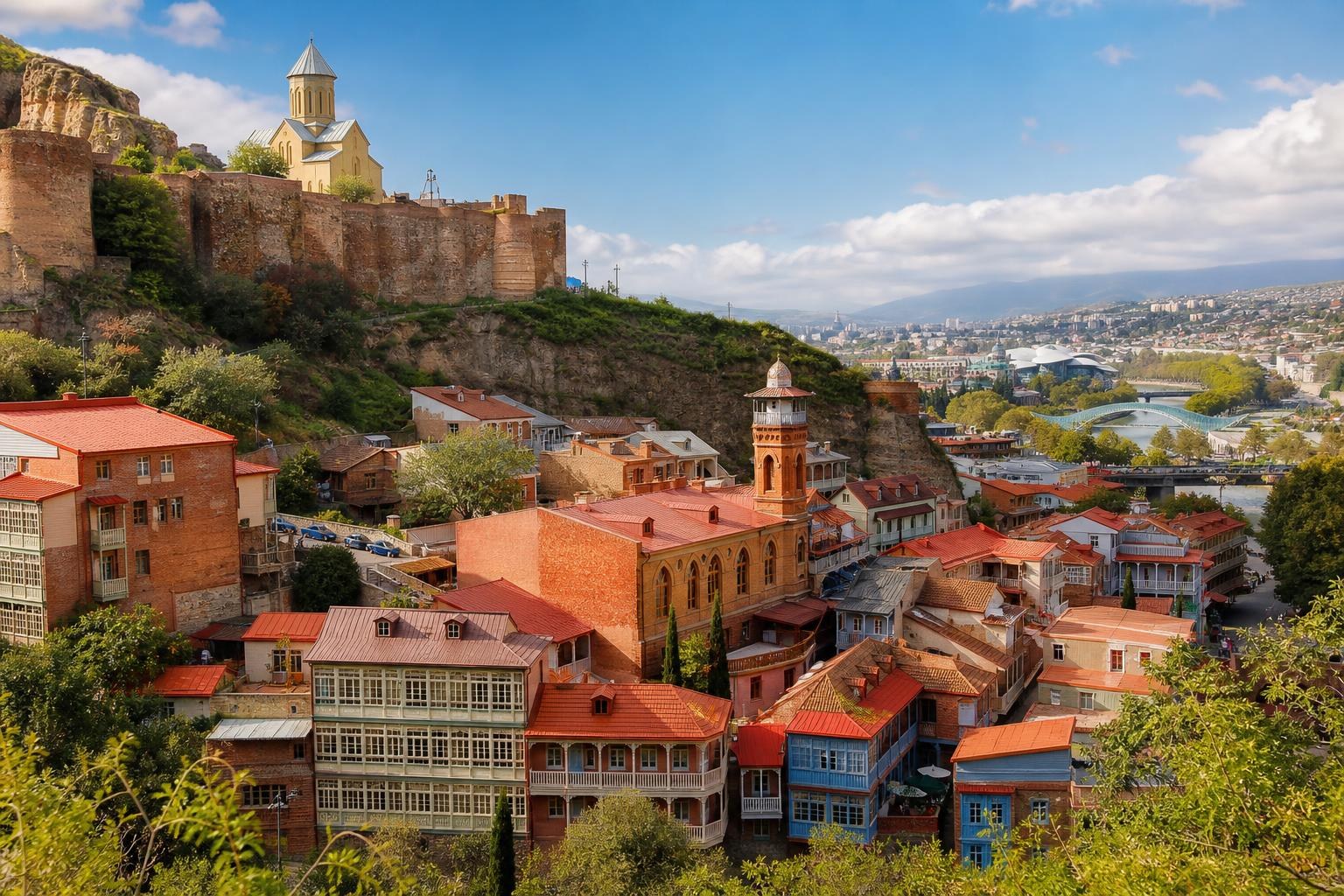
Tbilisi is one of those cities that rewards aimless wandering. Founded in the 5th century by King Vakhtang Gorgasali – supposedly after his falcon’s prey fell into a hot spring – the capital has been conquered, burned, and rebuilt dozens of times by Persians, Mongols, Ottomans, and Russians. That layered history shows up in the architecture, where carved wooden balconies hang over narrow streets next to brutalist apartment blocks and glass-and-steel contemporary structures.
The city sits in a valley along the Mtkvari River, with neighborhoods climbing steeply up both sides. You can take the cable car from Rike Park to the Narikala Fortress for a panoramic view that puts the whole city in context: ancient churches, Soviet housing blocks, and modern development all jumbled together without any attempt at visual harmony. It works because it’s honest.
Old Town Charms and Sulfur Baths
The Old Town (Kala) is where most first-time visitors spend their initial days, and for good reason. The sulfur baths in the Abanotubani district are Tbilisi’s origin story made tangible. These domed brick bathhouses sit directly over natural hot sulfur springs, and a private room with a hot pool costs between 50-120 GEL ($18-44) per hour depending on the establishment. Orbeliani Baths, with its blue-tiled facade, is the most photographed, but locals often prefer the less touristy options like Bath No. 5.
Walking uphill from the baths, you’ll pass through streets lined with houses featuring the distinctive Tbilisi balconies: wooden structures that seem to defy engineering logic as they lean out over the cobblestones. The Sioni Cathedral and Anchiskhati Basilica (the oldest surviving church in Tbilisi, dating to the 6th century) anchor the spiritual heart of the old city. The weekend flea market at the Dry Bridge is worth a visit for Soviet-era memorabilia, antique daggers, and genuinely beautiful enamel work.
Modern Landmarks and Culinary Hotspots
Tbilisi’s modern identity pulses through neighborhoods like Vera, Vake, and the rapidly developing left bank of the Mtkvari. The Bridge of Peace, a glass-and-steel pedestrian walkway designed by Italian architect Michele De Lucchi, has become a symbol of the city’s forward-looking ambitions. Nearby, the Tbilisi Concert Hall and Exhibition Center (a pair of tubular structures locals have nicknamed “the pipes”) represent the more controversial side of modern Georgian architecture.
The food scene deserves serious attention. Khinkali (soup dumplings that require a specific eating technique: twist, bite, sip the broth, then eat) are best at Zakhar Zakharich or Pasanauri in the old town. Khachapuri, the cheese-filled bread that varies by region, reaches its most decadent form as Adjarian khachapuri: a boat-shaped bread pool of melted cheese, butter, and a raw egg. For a modern Georgian dining experience, Shavi Lomi and Cafe Littera (set in the Writers’ House courtyard) offer creative takes on traditional dishes at prices that would seem absurdly cheap in any Western European capital. A full dinner with wine at a mid-range restaurant rarely exceeds $20 per person.
Hidden Gems in the Caucasus Mountains
The Greater Caucasus range forms Georgia’s northern border with Russia, and these mountains contain some of the most spectacular and least-visited terrain in Europe. While the Alps draw tens of millions of visitors annually, the Georgian Caucasus offers comparable scenery with a fraction of the crowds. These are genuine hidden gems in the Caucasus mountains: places where you can hike for days without seeing another tourist.
Svaneti: Medieval Towers and Glaciers
Svaneti is the crown jewel of Georgian mountain travel. This remote region in the northwest is home to the Svan people, who maintained fierce independence for centuries and built distinctive defensive towers (koshkebi) that still dot the landscape. The town of Mestia serves as the main base, with a small airport offering flights from Tbilisi (around $30 one-way when available) and a dramatically improved road that’s cut driving time from the capital to about eight hours.
The four-day trek from Mestia to Ushguli is one of Europe’s great walks. Ushguli, at 2,200 meters, claims the title of highest continuously inhabited settlement in Europe, and its cluster of medieval towers against the backdrop of Mount Shkhara (5,193 meters) is the kind of scene that makes you understand why people become travel photographers. Guesthouses in Ushguli charge 80-120 GEL ($30-44) per night including meals, and the food – heavy on cheese, meat, and kubdari (meat-filled bread) – is fuel for mountain days.
Kazbegi and the Gergeti Trinity Church
Kazbegi (officially Stepantsminda) is the most accessible mountain destination from Tbilisi, sitting just three hours north along the Georgian Military Highway. The drive itself is half the experience, passing through the Jvari Pass at 2,379 meters with views that earned this road its reputation as one of the world’s great drives.
The Gergeti Trinity Church, perched at 2,170 meters with Mount Kazbek (5,047 meters) towering behind it, is probably the single most photographed site in Georgia. You can hike up in about 90 minutes or take a 4×4 taxi for 50-70 GEL ($18-26). The church dates to the 14th century and was used to store Georgian national treasures during invasions. For hikers, the Kazbek base camp trek (two days round trip) offers glacier views and a chance to sleep at 3,600 meters in a mountain hut. The Rooms Hotel Kazbegi, perched on the hillside above town, has become a destination in itself, with a terrace that frames Kazbek perfectly – rooms start around $150 per night in peak season.
Tusheti: The Remote High-Altitude Frontier
Tusheti is Georgia’s wildcard. This northeastern region is accessible only from late June through September via the Abano Pass road, widely considered one of the most dangerous roads on earth: a narrow, unpaved track climbing to 2,926 meters with sheer drops and no guardrails. The reward for surviving the drive is a landscape of alpine meadows, stone villages, and a way of life that hasn’t changed dramatically in centuries.
The village of Dartlo, with its slate-roofed towers and wildflower meadows, feels like stepping into a medieval painting. Omalo, the “capital” of Tusheti (population: roughly 30 in winter, a few hundred in summer), has basic guesthouses and serves as a starting point for multi-day treks. The Tushetians traditionally practiced transhumance, moving their sheep herds between highland summer pastures and lowland winter grazing, and some families still follow this pattern. If you want a Georgia experience that feels genuinely untouched, Tusheti is it, but come prepared for basic facilities and unpredictable weather.
The Birthplace of Wine: Kakheti Region
Georgia’s claim to being the birthplace of wine isn’t marketing fluff. Archaeological evidence from 6000 BCE confirms that Georgians were fermenting grapes in clay vessels thousands of years before anyone else. Kakheti, the eastern region bordering Azerbaijan, produces about 70% of Georgia’s wine and offers a travel experience built around vineyards, monasteries, and some of the country’s best food.
The region is an easy day trip from Tbilisi (about 90 minutes to the nearest wine areas), but spending two or three nights allows you to properly explore. The landscape shifts from the dry, almost Mediterranean terrain around Sighnaghi to the lusher Alazani Valley floor, with the snow-capped Caucasus always visible to the north.
Sighnaghi: The City of Love
Sighnaghi is a small hilltop town that Georgia has positioned as its “City of Love” – you can get married here 24 hours a day, no appointment needed, which has made it popular with eloping couples. But the real draw is the town itself: a restored 18th-century fortified settlement with cobblestone streets, a surrounding wall with 23 towers, and views across the Alazani Valley that are genuinely staggering at sunset.
The Sighnaghi Museum houses an unexpectedly excellent collection of paintings by Niko Pirosmani, Georgia’s most beloved artist, a self-taught painter whose naive style captures Georgian life with remarkable emotional depth. His works sell for millions at auction, and seeing them here, in the landscape that inspired them, adds a layer of meaning you won’t get in a Tbilisi gallery. Guesthouses in Sighnaghi run 80-150 GEL ($30-55) per night, and several offer wine tastings from their own family vineyards.
Traditional Qvevri Winemaking Experiences
Qvevri (large clay vessels buried underground) are the heart of Georgian winemaking, and the technique was added to UNESCO’s Intangible Cultural Heritage list in 2013. Unlike conventional winemaking, the qvevri method ferments grape juice with skins, seeds, and sometimes stems for months in these sealed clay pots, producing amber wines with a tannic structure completely unlike anything from France or California.
Several family wineries in Kakheti offer hands-on qvevri experiences. Pheasant’s Tears in Sighnaghi, run by American-born winemaker John Wurdeman, is probably the most internationally known, but smaller operations like Nika’s Wine Cellar in Velistsikhe or Twins Wine Cellar in Napareuli offer more intimate experiences. Expect to pay 30-60 GEL ($11-22) for a tasting with food, and don’t be surprised if a “tasting” turns into a three-hour supra (feast) with a tamada (toastmaster) leading increasingly elaborate toasts. The wine is the entry point; the real product is the experience of Georgian hospitality at its most intense.
Seaside Serenity and Ancient History
Georgia’s geographic range means you can go from skiing to swimming in the Black Sea in a single day. The western coastline and southern regions offer a completely different character from the mountains and wine country, with subtropical vegetation, ancient cave cities, and a cosmopolitan port city that’s reinvented itself as a modern resort destination.
Batumi: The Pearl of the Black Sea
Batumi, the capital of the Adjara region, is Georgia’s second city and its primary beach destination. The city has undergone a dramatic transformation over the past fifteen years, with a waterfront boulevard lined with modern architecture, including the Alphabet Tower (a 130-meter structure shaped like a DNA helix incorporating the Georgian alphabet) and the moving sculpture of Ali and Nino, two figures that pass through each other every ten minutes.
The beach itself is pebbly rather than sandy, which can be a surprise if you’re expecting Mediterranean-style shores. The old town retains a pleasant jumble of 19th-century architecture, and the Batumi Botanical Garden, perched on a hillside just north of the city, is one of the finest in the Caucasus region. Batumi’s casino strip has earned it a reputation as the “Las Vegas of the Black Sea,” which is either a selling point or a warning depending on your preferences. Budget about $45-70 per day here, slightly more than the national average due to resort pricing in summer.
Vardzia: The Majestic Cave Monastery
Vardzia is one of those places that makes you question everything you thought you knew about medieval engineering. Carved into the face of Mount Erusheti in the 12th century under Queen Tamar, this cave monastery once contained over 6,000 apartments, a church, a throne room, and a pharmacy, all connected by tunnels within the cliff face. An earthquake in 1283 sheared off much of the outer wall, exposing the honeycomb interior to the elements.
What remains is still extraordinary: roughly 400 rooms spread across 13 stories of cliff face, with the Church of the Assumption at its center containing vivid frescoes including a portrait of Queen Tamar herself. The site is in southern Georgia, about five hours from Tbilisi, and works well as a stop on a loop that includes the cave town of Uplistsikhe and the spa town of Borjomi (home of the mineral water that’s a household name across the former Soviet Union). Admission is 15 GEL ($5.50), and you’ll want at least two hours to explore properly. Bring good shoes: the paths are steep and can be slippery.
Essential Tips for Navigating Georgia
Getting around Georgia has gotten easier, but it still requires some flexibility. Here’s what actually matters for planning your trip:
- Download Bolt and Yandex Go for taxis in cities: they’re cheaper than negotiating with drivers and eliminate the language barrier for pricing. A cross-Tbilisi ride rarely exceeds 10 GEL ($3.70).
- Marshrutkas (minibuses) connect most towns and leave when full, not on a schedule. They’re cheap (Tbilisi to Mestia costs about 40 GEL/$15) but not comfortable for long distances. For mountain routes, consider hiring a driver: a full-day hire runs 150-250 GEL ($55-92).
- Google Translate’s offline Georgian pack is essential outside Tbilisi. English proficiency drops significantly in rural areas, though younger Georgians in cities generally speak it well. Georgia ranks in the lower-middle range on the EF English Proficiency Index.
- Georgian script (Mkhedruli) is unique and beautiful but completely unrelated to any other alphabet. Learn to recognize key words like “saswrafod” (pharmacy), “sakhli” (house), and “ghvino” (wine).
- Solo female travelers consistently report feeling safe throughout the country. Police are generally reliable and helpful. Avoid discussing the political situations in Abkhazia and South Ossetia, as these are sensitive topics.
- The best overall window for visiting is May through October, with June and September offering the sweet spot of good weather and manageable tourist numbers. July and August bring peak heat to Tbilisi (regularly above 35°C) and peak crowds to Batumi.
- Carry cash in smaller towns. While Tbilisi is increasingly card-friendly, rural guesthouses and marshrutka drivers deal in cash only. ATMs are available in all major towns.
Georgia rewards spontaneity more than rigid planning. Some of the best experiences – an unexpected supra at a village guesthouse, a detour to a monastery you spotted from the road, a conversation with a winemaker who insists you try his latest vintage – happen when you leave room in your itinerary for the unplanned.
The places worth traveling to in Georgia share a common thread: they feel earned rather than handed to you. Whether you’re sweating up to Gergeti Church, white-knuckling the road to Tusheti, or simply sitting through your fifth toast at a Kakhetian supra, this country asks something of you. What it gives back – the views, the flavors, the warmth of people who treat hospitality as a sacred duty – is worth every bit of effort. Start with Tbilisi, pick one mountain region, add Kakheti for the wine, and leave at least two days unplanned. Georgia will fill them for you.