
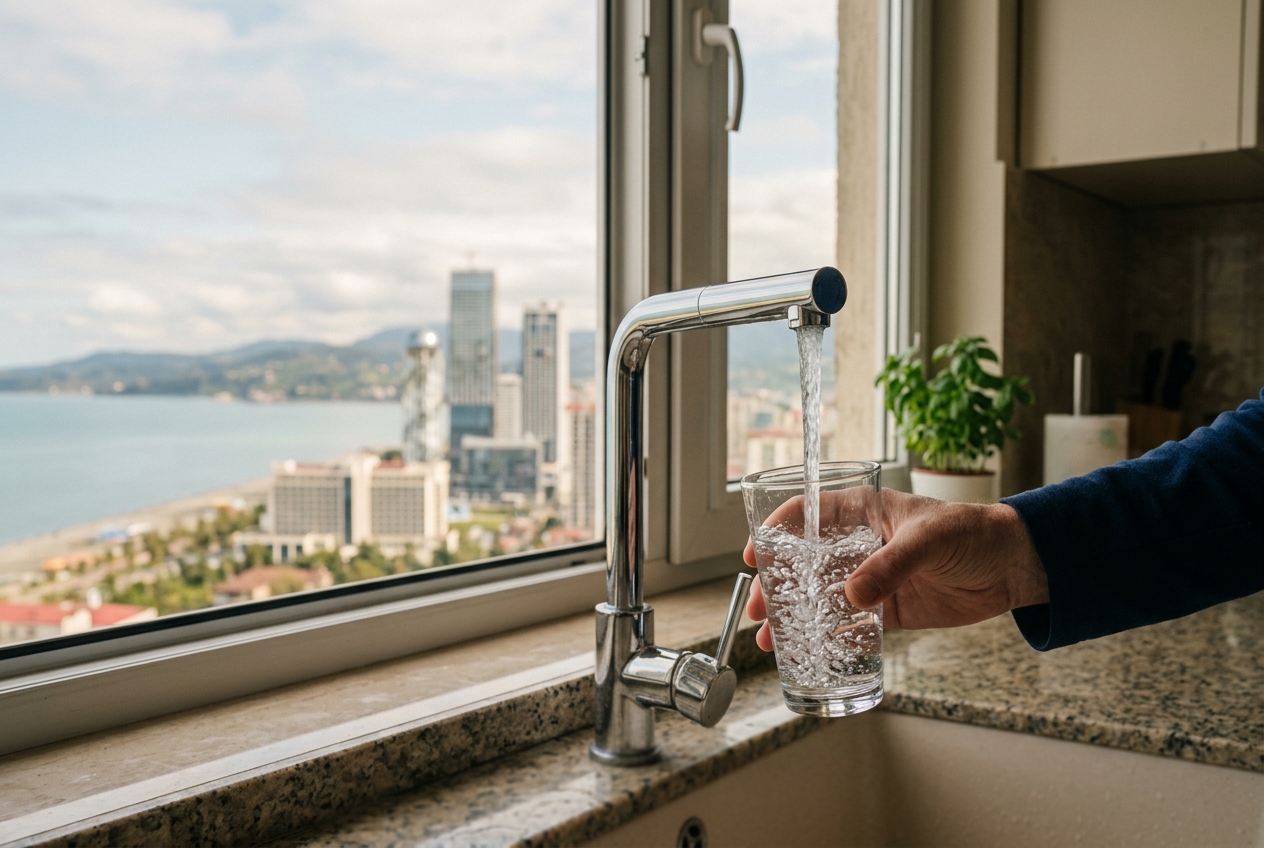
Georgia’s Black Sea coast and its second-largest city draw thousands of visitors every year, and one of the first practical questions people ask is whether tap water in Batumi and Kutaisi is safe to drink. The short answer is more nuanced than a simple yes or no. Both cities source their water from mountain-fed rivers and springs, but the journey from source to your glass involves treatment plants, aging Soviet-era pipes, and building-level plumbing that can vary wildly from one neighborhood to the next. Having spent extended time in both cities, I can tell you the reality on the ground doesn’t always match official reports or travel forum panic. This guide breaks down what you actually need to know: the quality of the municipal supply, where the real risks hide, and how to make smart choices whether you’re visiting for a week or settling in for months. If you’ve been Googling “can I drink the water in Georgia?” and getting contradictory answers, this should clear things up.

Current Safety Standards and Water Quality in Western Georgia
Georgia, the country (not the U.S. state, a distinction worth making since search results love to confuse the two), has been investing heavily in water infrastructure over the past decade. The national government, with support from international development banks, has poured money into treatment upgrades and distribution network repairs across the country. Drinking water quality aligns with federal and state regulations and is generally considered safe, though “generally” does a lot of heavy lifting in that sentence.
The country is actively working to maintain target indicators related to drinking water quality for 2025-2027, which signals both progress and the acknowledgment that there’s still work to be done. Western Georgia, where Batumi and Kutaisi sit, benefits from abundant freshwater resources flowing down from the Caucasus Mountains. The raw water quality is excellent by global standards: clean, cold, and mineral-rich. The challenge has always been what happens between the mountain source and your kitchen faucet.
Water Sources and Treatment Processes in Batumi
Batumi’s water supply is managed by “Batumis Tskali,” a utility company that serves approximately 100,000 customers across the city and surrounding areas. The city draws its water primarily from the Korolistskali River and underground springs in the foothills east of the city. These sources are fed by rainfall and snowmelt from the Lesser Caucasus range, which means the raw water arriving at treatment facilities is already relatively clean compared to lowland river sources you’d find in many other countries.
The treatment process includes standard coagulation, sedimentation, filtration, and chlorination. If you’ve noticed a faint chlorine smell from your hotel tap in Batumi, that’s actually a good sign: it means the disinfection process is working. The chlorine levels are kept within safe limits, though they can vary seasonally. During heavy rains in autumn and spring, the Korolistskali carries more sediment, which means the treatment plant works harder and occasionally bumps up chlorine dosing.
I’ve talked to locals in Batumi who have been drinking tap water their entire lives without issues. In fact, both tourists and locals in Batumi drink the tap water as a matter of routine. The newer parts of the city, particularly the boulevard area and recently constructed apartment buildings, tend to have the best water quality at the tap because the internal plumbing is modern.
The State of Kutaisi’s Municipal Water Infrastructure
Kutaisi tells a slightly different story. As Georgia’s second-largest city and the historical capital of the Colchis kingdom, Kutaisi has infrastructure that spans centuries of urban development. The municipal water system draws from the Rioni River and several artesian wells. The Rioni is one of Georgia’s major rivers, and its water quality upstream of Kutaisi is generally good, though agricultural runoff in the Imereti region can introduce seasonal contaminants.
The treatment facilities in Kutaisi have received upgrades in recent years, but the distribution network remains a patchwork. Some neighborhoods have relatively new polyethylene pipes installed during post-2010 rehabilitation projects, while others still rely on Soviet-era cast iron and steel mains that date back to the 1960s and 1970s. The result is inconsistency: water leaving the treatment plant meets safety standards, but what arrives at individual buildings can differ depending on the route it takes.
Kutaisi also experiences more pressure fluctuations than Batumi, partly because of the hilly terrain and partly because of the distribution system’s age. Low pressure periods can allow contaminants to enter the system through pipe joints, a problem that Batumi’s flatter coastal geography and newer infrastructure largely avoids.
Key Differences Between Tap Water in Batumi vs. Kutaisi
Understanding the differences between these two cities helps you make practical decisions about water consumption. Here’s a side-by-side comparison of the key factors:
| Factor | Batumi | Kutaisi |
|---|---|---|
| Primary Source | Korolistskali River, underground springs | Rioni River, artesian wells |
| Treatment Level | Modern, consistent chlorination | Upgraded but variable |
| Pipe Infrastructure | Mixed; newer in tourist zones | Older on average; patchy upgrades |
| Supply Reliability | Generally stable, rare interruptions | More frequent pressure drops |
| Taste | Mildly mineral, slight chlorine | Mineral-rich, occasionally earthy |
| Tourist Zone Quality | High | Moderate to high |
Mineral Content and Taste Profiles
One thing that surprises many visitors is how different Georgian tap water tastes compared to what they’re used to at home. Batumi’s water has a clean, slightly mineral character with occasional chlorine notes. It’s not unpleasant, and most people from European countries find it perfectly drinkable straight from the tap. If the chlorine bothers you, filling a pitcher and letting it sit uncovered for 30 minutes eliminates most of the taste.
Kutaisi’s water carries a heavier mineral signature. The Rioni River flows through limestone-rich terrain in the Imereti region, and the artesian wells tap into naturally mineralized aquifers. The calcium and magnesium content is noticeably higher, which gives the water a fuller mouthfeel but also means more limescale buildup in kettles and pipes. Some people actually prefer Kutaisi’s water for tea and coffee because the mineral content adds body. Others find it slightly earthy during the warmer months when the Rioni’s flow changes character.
Neither city’s water is “hard” by Northern European standards, but both are harder than what you’d find in Tbilisi, which draws from a different watershed.
Reliability of Supply and Scheduled Interruptions
Batumi’s water supply is fairly consistent year-round, with occasional planned maintenance shutdowns that are usually announced a day or two in advance. During peak summer tourist season (June through September), the system handles increased demand reasonably well, though some hilltop neighborhoods in the outskirts can experience lower pressure during hot afternoons.
Kutaisi faces more frequent interruptions. Scheduled maintenance on the aging pipe network happens regularly, and unscheduled breaks aren’t uncommon. During my time in Kutaisi, I experienced two unexpected water outages in a single month, each lasting four to six hours. Locals keep large bottles or containers filled as a matter of habit: a practical tip worth adopting if you’re staying for any length of time. The city government has been transparent about the need for continued infrastructure investment, and rehabilitation projects are ongoing, but the full overhaul will take years to complete.
Potential Risks: Old Pipes and Building Plumbing
Here’s where the conversation gets real. Even if the municipal water leaving the treatment plant is perfectly safe, the last hundred meters of its journey, through your building’s internal plumbing, can introduce problems that no city utility can control. This is the single biggest variable in whether your tap water is truly safe to drink in either city.
Buildings constructed during the Soviet era (roughly 1950s through 1980s) often have galvanized steel or even lead-soldered copper pipes that have been in service for 40 to 70 years. Corrosion, sediment buildup, and biofilm formation inside these pipes can add metals and particulates to otherwise clean water. Newer buildings, especially those built after 2010, typically use modern plastic piping that doesn’t pose the same risks.
The practical takeaway: the age and condition of your specific building matters more than which city you’re in. A Soviet-era apartment block in Batumi’s old town may deliver worse water quality than a renovated building in Kutaisi’s center.
Identifying Lead and Sediment Issues in Older Districts
If you’re renting an apartment in either city, there are a few telltale signs that building plumbing might be compromising your water quality:
- Brownish or yellowish tint when you first turn on the tap in the morning, which indicates rust from corroded iron pipes
- A metallic taste that wasn’t present in water from other locations in the same city
- Visible sediment or particles settling at the bottom of a glass of water left standing
- Staining on porcelain sinks or toilet bowls, particularly orange-brown streaks
In Batumi, the older districts around the bazaar area and parts of the old town are most likely to have aging internal plumbing. In Kutaisi, the central residential blocks near the Green Bazaar and the neighborhoods along the left bank of the Rioni tend to be the oldest.
A simple and cheap precaution: run the cold water tap for 30 to 60 seconds before filling a glass, especially first thing in the morning. This flushes out water that has been sitting in contact with old pipes overnight. It’s not a perfect solution, but it significantly reduces exposure to any metals that may have leached into standing water.
Practical Safety Tips for Residents and Tourists
Whether you’re passing through for a few days or setting up a home base, a few straightforward habits will keep you safe. The water in both cities is not dangerous in the way that tap water in some developing countries can be: you’re unlikely to get a serious waterborne illness from drinking it. The concerns are more about long-term exposure to pipe-related contaminants and personal comfort.
For short-term tourists, drinking tap water in Batumi is a perfectly reasonable choice, especially in hotels and newer buildings. In Kutaisi, exercising a bit more caution makes sense, particularly if you’re staying in older accommodation. For long-term residents, investing in filtration is a smart move regardless of which city you call home.
Recommended Water Filtration Systems for Long-term Stays
If you’re spending more than a month in either city, a water filter pays for itself quickly compared to buying bottled water daily. Here are the most practical options available locally:
- Pitcher filters (like Brita or the locally available Barrier brand) cost 25 to 40 GEL and handle chlorine, some heavy metals, and sediment. Replace cartridges every 4 to 6 weeks. These are the easiest entry point and available at any Goodwill or Nikora supermarket.
- Faucet-mounted filters offer slightly better filtration and don’t require counter space. They run 50 to 80 GEL and are available at hardware stores in both cities. Look for models with activated carbon and ceramic elements.
- Under-sink reverse osmosis systems are the gold standard for long-term stays. They remove virtually everything, including heavy metals, bacteria, and excess minerals. Installation costs around 300 to 500 GEL including the unit, and replacement filters run about 80 GEL per year. Several plumbing shops in both Batumi and Kutaisi sell and install these.
For the digital nomad crowd spending a season in Batumi, a simple pitcher filter is usually sufficient. For families settling in Kutaisi long-term, the under-sink RO system is worth the investment.
When to Choose Bottled Water Over Tap
There are specific situations where bottled water is the smarter call, even if the local tap water is technically safe:
- During and immediately after heavy rainstorms, when treatment plants handle higher sediment loads and chlorine levels spike
- In very old buildings where you notice any of the warning signs mentioned earlier (discoloration, metallic taste, sediment)
- For preparing infant formula, since babies are more sensitive to mineral content and trace contaminants
- When your accommodation has a rooftop water storage tank that looks poorly maintained, a common setup in older buildings in both cities
A 1.5-liter bottle of water costs about 0.80 to 1.20 GEL at any corner store, so the financial barrier is low. But buying bottled water daily for months generates a mountain of plastic waste, which is another reason filtration makes more sense for extended stays.
Georgia’s Famous Mineral Waters as an Alternative
Georgia has a deep cultural relationship with mineral water that goes far beyond simple hydration. The country sits on some of the most diverse mineral spring geology in the world, and Georgians have been drinking from these springs for centuries. The word “Borjomi” is practically synonymous with mineral water across the former Soviet Union, and for good reason: the Borjomi-Kharagauli springs produce naturally carbonated water with a distinctive mineral profile that’s genuinely unlike anything else.
Beyond Borjomi, look for Likani (milder, slightly sweet), Nabeghlavi (the main competitor to Borjomi, with a softer mineral profile), and Sairme (a lesser-known gem from the Imereti region near Kutaisi). Each has a distinct character shaped by the specific geology of its source. Nabeghlavi tends to be the everyday choice for most Georgians: less intense than Borjomi but more characterful than plain water.
In Kutaisi, you’re close to several natural spring sources, and some locals still collect water directly from public spring taps (called “tskharo”) scattered around the city and its outskirts. These springs are generally safe and often tested by local health authorities, but quality can vary seasonally. If a local friend takes you to fill bottles at a favorite spring, it’s usually a trustworthy recommendation: Georgians take their water sources seriously.
For visitors, Georgian mineral waters offer a delicious alternative to tap water and a genuine cultural experience. A meal in either city isn’t complete without a bottle of Borjomi or Nabeghlavi on the table, and trying the local springs is one of those small pleasures that connects you to the place in a way that tourist attractions can’t.
The safety of drinking water in Batumi and Kutaisi comes down to specifics rather than sweeping generalizations. Batumi’s supply is reliable and widely consumed by locals and visitors alike, while Kutaisi’s system is improving but still inconsistent in older neighborhoods. In both cities, the building you’re staying in matters as much as the municipal supply. Run your tap before drinking, invest in a basic filter if you’re staying long-term, and don’t hesitate to lean on Georgia’s world-class mineral waters when you want something special. Your stomach will be fine: it’s the country’s wine and khinkali that pose the real danger to your waistline.