
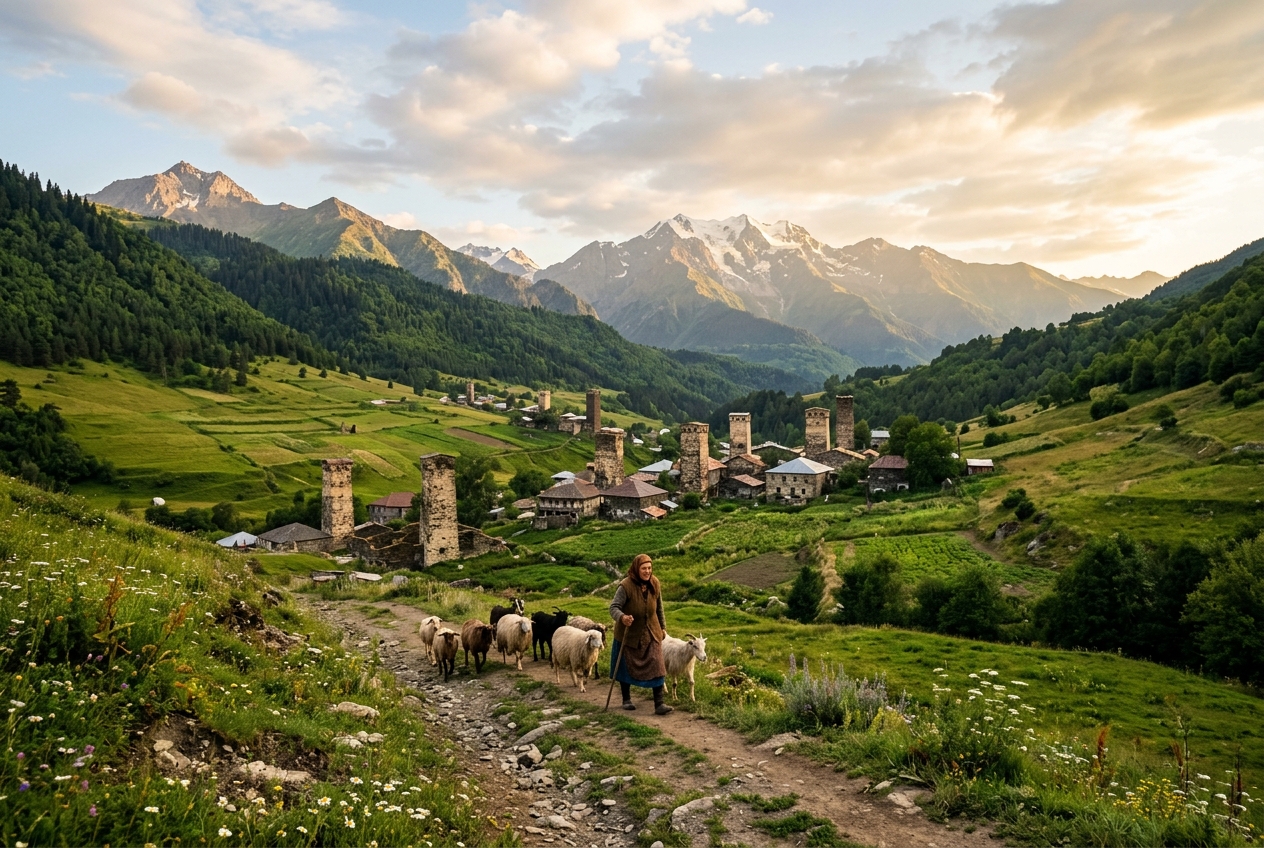
Georgia, the small Caucasus nation known locally as Sakartvelo, has long attracted visitors with its capital city’s eclectic architecture and vibrant nightlife. But the real magic of this country lives beyond Tbilisi’s cobblestone streets, in the terraced vineyards, stone watchtowers, and family-run homesteads scattered across its countryside. For travelers tired of sanitized resort experiences and looking for something that feels genuinely human, the Georgian village is where hospitality stops being a service and becomes a way of life. The phrase “stumari ghvtisaa” – the guest is a gift from God – isn’t a marketing slogan here. It’s a belief system that shapes every interaction, from the grandmother who insists you eat a third plate of khinkali to the farmer who drives you two hours to a trailhead just because you mentioned wanting to hike. This is rural tourism at its most honest, and Georgia happens to be one of the best places on Earth to experience it.
The Rise of Rural Tourism in the Georgian Countryside
The numbers tell a compelling story. Georgia’s tourism sector saw visitor spending reach $36.8 billion in 2024, a 3.8% increase over 2023, and a significant share of that growth is happening outside the cities. Rural destinations experienced a 1.1% growth in lodging GDP in 2024, while urban centers actually declined by 0.7%. That’s not a coincidence. Travelers are actively choosing villages over hotels, dirt roads over boulevards.
Part of what’s driving this shift is a global fatigue with over-touristed destinations. People who’ve done Barcelona and Bali are looking for places that haven’t been smoothed over by mass tourism. Georgia’s countryside, with its lack of chain hotels and abundance of genuine human connection, fits that desire perfectly.
The Appeal of Authentic Village Life
The rhythm of a Georgian village is radically different from anything most Western travelers know. Days start early, often with a rooster rather than an alarm. Breakfast is homemade cheese, fresh bread from a tone oven, and honey from hives kept in the backyard. There’s no menu and no bill – just a family feeding you what they’d feed themselves.
What strikes most visitors is the absence of transactional hospitality. In a Western hotel, every smile has a price tag. In a Georgian village, a host might refuse payment entirely, offended by the suggestion that their generosity was for sale. I’ve watched travelers struggle with this, trying to leave money on the table as they depart. The cultural gap is real, and it’s one of the most beautiful things about traveling here.
Village life also offers a pace that forces you to slow down. There’s no Wi-Fi in many mountain settlements, no Uber, no Google Maps route that makes sense. You learn to ask people for directions, to sit and wait, to watch clouds move across a valley. It sounds like a cliché until you actually do it.
Historical Roots and Cultural Heritage
Georgia’s rural hospitality isn’t a recent invention for tourist dollars. It’s rooted in centuries of cultural practice, shaped by the country’s position at the crossroads of empires. Persians, Ottomans, Mongols, and Russians all passed through, and Georgian villages developed a fierce tradition of welcoming strangers partly as a survival strategy: a guest well-treated today might be an ally tomorrow.
The country’s Orthodox Christian heritage also plays a role. Churches and monasteries dot even the most remote hillsides, and many rural festivals are tied to religious calendars. Attending a village saint’s day celebration, where the entire community gathers for food, prayer, and polyphonic singing, offers a window into traditions that predate most European nations.
Georgia has also expanded its network of national parks and protected areas to cover over 13% of the country’s territory, ensuring that these rural landscapes remain intact for future generations. This isn’t just conservation for its own sake: it’s a deliberate strategy to protect the cultural and natural assets that make the countryside worth visiting.
Iconic Regions for Agritourism and Nature
Georgia is roughly the size of Ireland, but its geographic diversity is staggering. You can move from subtropical coastline to alpine meadows in a few hours of driving. Each region has its own dialect, cuisine, and architectural style, which means rural travel here never feels repetitive.
The Wine Routes of Kakheti
Kakheti, in Georgia’s eastern lowlands, is the heartland of the world’s oldest winemaking tradition. Families here have been fermenting grapes in clay vessels called qvevri for roughly 8,000 years, a method now recognized by UNESCO. Visiting a Kakhetian winery isn’t like touring Napa Valley. There’s no tasting room with mood lighting. You’ll likely stand in a cellar next to a man who learned to make wine from his grandfather, sipping amber-colored Rkatsiteli straight from the qvevri.
The Kakheti wine route connects dozens of small villages, each with its own varietal specialties. Signagi, perched on a hilltop with views of the Alazani Valley, serves as a good base. But the real discoveries happen off the main road: in Tsinandali, Napareuli, or tiny Artana, where a family might produce only 500 bottles a year. In 2022, 742 farms across Georgia reported offering agritourism, generating $31 million in revenue, and a large portion of that activity is concentrated in this wine-rich region.
High Mountain Settlements in Svaneti and Tusheti
If Kakheti is about wine and warmth, Svaneti and Tusheti are about altitude and awe. Svaneti’s medieval stone towers, built by families as defensive fortifications centuries ago, still stand in villages like Mestia and Ushguli. Ushguli, one of the highest continuously inhabited settlements in Europe, feels like stepping into a different century. Cows wander cobblestone paths. Snowcapped peaks loom at every turn.
Tusheti is even more remote. Accessible only from June to October via a terrifying mountain road (seriously, it’s carved into a cliff with no guardrails), this region rewards the adventurous with some of the most pristine landscapes in the Caucasus. Shepherds still drive their flocks across high passes, and the few guesthouses that operate here are run by families who’ve lived in these valleys for generations. One travel expert’s advice about these areas: “go now” to experience the untouched environment before infrastructure improvements change its character.
Eco-Farms and Orchards in Imereti and Guria
Western Georgia’s Imereti and Guria regions offer a gentler version of rural travel. The climate is warmer and wetter, producing lush orchards of persimmons, figs, and hazelnuts. Imereti is famous for its cheese: Imeretian cheese is a staple across the country, and watching it being made in a farmhouse kitchen is a common visitor experience.
Guria, smaller and less visited, has a quirky cultural identity. Gurians are known across Georgia for their humor and their unique style of polyphonic singing, called krimanchuli, which involves a high-pitched yodeling technique. Staying on an eco-farm here often means helping with the hazelnut harvest in autumn or learning to make churchkhela, the candle-shaped walnut-and-grape candy that’s essentially Georgia’s national snack.
| Region | Best Season | Key Experience | Accessibility |
|---|---|---|---|
| Kakheti | September – October | Qvevri winemaking, grape harvest | Easy, paved roads from Tbilisi |
| Svaneti | June – September | Tower villages, alpine trekking | Moderate, flights or 8-hour drive |
| Tusheti | June – October | Shepherd culture, wilderness | Difficult, 4×4 only |
| Imereti | Year-round | Cheese-making, cave visits | Easy, near Kutaisi |
| Guria | August – November | Hazelnut harvest, churchkhela | Easy, near Batumi |
Authentic Rural Experiences and Activities
Traditional Culinary Workshops and Supra
The supra, Georgia’s traditional feast, is the centerpiece of the country’s social life. Led by a tamada (toastmaster), a supra involves dozens of elaborate toasts, each building on themes of friendship, family, homeland, and the deceased. It’s not casual dining: it’s a structured ritual that can last five or six hours.
Many rural guesthouses now offer cooking workshops where visitors learn to prepare dishes like khachapuri (cheese bread), pkhali (walnut-vegetable paste), and lobio (bean stew). These aren’t staged demonstrations. You’ll be in someone’s actual kitchen, using their grandmother’s recipe, with their kids running around underfoot. The food is inseparable from the context, and that context is a family home.
What makes Georgian culinary tourism different from, say, a cooking class in Tuscany is the lack of polish. Nobody’s wearing a branded apron. The kitchen might have a wood-burning stove. The wine is poured from a plastic jug. And somehow, that’s exactly what makes it memorable.
Hands-on Farming and Harvest Participation
Seasonal farming activities offer some of the most immersive rural experiences in Georgia. The grape harvest in Kakheti, known as rtveli, happens in September and October. Families welcome extra hands, and the work is followed by feasting and celebration. It’s physically demanding: you’re picking grapes under the sun for hours, but the communal spirit makes it feel more like a party than labor.
Beyond rtveli, visitors can participate in sheep shearing in Tusheti, tea harvesting in Guria (Georgia was once a major tea producer under the Soviet Union), or honey collection in the mountains of Adjara. These aren’t tourist attractions: they’re real agricultural activities that happen whether visitors show up or not. Your participation is genuinely helpful, which changes the dynamic entirely.
Sustainable Lodging: Guesthouses and Eco-Lodges
Accommodation in rural Georgia is overwhelmingly family-run. The typical setup is a guesthouse where a family converts spare rooms for visitors, with meals included. Expect clean but simple rooms, shared bathrooms in older houses, and more food than you can physically consume. A night in a village guesthouse typically costs between 50 and 100 Georgian Lari (roughly $18 to $37), including three meals.
Eco-lodges are a newer development, particularly in areas near national parks. These tend to be slightly more polished, with private bathrooms and sometimes heating, but they still prioritize local materials and low environmental impact. Some lodges in Svaneti and Tusheti operate entirely off-grid, using solar power and spring water.
The distinction between a guesthouse and a homestay can be blurry. In many cases, you’re sleeping in a room next to the family’s living quarters, eating at their table, and becoming a temporary member of their household. This closeness can feel uncomfortable for travelers used to privacy, but it’s also what makes the experience transformative. You don’t observe Georgian culture from a distance: you’re absorbed into it.
Booking platforms like Booking.com cover some rural properties, but many of the best guesthouses are found through local contacts, Facebook groups, or simply by showing up in a village and asking. The app Yandex Go can help with transportation in some areas, though in truly remote villages, hitchhiking or pre-arranged drivers are more reliable.
Economic Impact and Community Development
Empowering Local Families and Small Businesses
Rural tourism provides direct income to families who might otherwise depend entirely on subsistence farming. A guesthouse that hosts even a few visitors per week during the summer season can double a family’s annual income. This money stays local: it buys supplies from village shops, pays for home improvements, and funds children’s education.
The total visitation to Georgia’s state parks, lodges, and historic sites reached 14.1 million visits in 2024, and a growing percentage of those visitors are spending money in rural communities rather than just passing through. Small businesses like horseback riding guides, 4×4 tour operators, and craft workshops are emerging in villages that had almost no economic activity a decade ago.
Women, in particular, have benefited. In a country where rural gender roles remain traditional, running a guesthouse gives women economic independence and a public-facing role in their community. Several NGOs, including the Georgian Farmers’ Association, actively support women-led rural tourism initiatives.
Preservation of Endangered Craft and Traditions
Tourism creates economic incentives to maintain traditions that might otherwise disappear. Felt-making in Svaneti, carpet weaving in Tusheti, and qvevri pottery in Kakheti all survive partly because tourists are willing to pay for authentic handmade products. Without that market, younger generations would have little reason to learn these skills.
Polyphonic singing, recognized by UNESCO as an intangible cultural heritage, is another tradition sustained partly by tourist interest. Village ensembles that once performed only at local celebrations now also sing for visitors, generating income that supports rehearsals and the training of younger singers. The relationship between tourism and tradition preservation isn’t always simple: there’s always a risk of performance becoming performative. But in Georgia’s villages, the traditions are still lived, not staged.
Practical Tips for Navigating Rural Georgia
Getting around rural Georgia requires some planning. Here’s what actually works:
- Download offline maps on Google Maps before leaving Tbilisi. Cell service is spotty in mountain areas and nonexistent in parts of Tusheti.
- Learn a few Georgian phrases. English is widely spoken by younger Georgians in cities, but in villages, you’ll mostly encounter Russian or Georgian speakers. The post-2003 generation tends to know English; older residents often speak Russian. Google Translate’s offline Georgian pack is essential.
- Carry cash. Card payments are common in Tbilisi but rare in villages. ATMs exist in regional towns like Mestia, Telavi, and Kutaisi, but not in smaller settlements.
- Hire local drivers for mountain roads. The Tusheti road and some Svaneti passes are genuinely dangerous without experience. A local driver with a proper 4×4 costs around 200-300 GEL per day and knows every pothole.
- Respect the pace. Don’t try to rush through three regions in a week. Pick one or two and stay long enough to actually connect with people.
- Solo female travelers generally report feeling very safe in rural Georgia. Georgian hospitality culture is protective of guests, and police in rural areas are generally reliable and helpful.
- Avoid discussing politics around Abkhazia and South Ossetia. These are sensitive topics, especially in communities near the occupation lines.
The best time for a countryside visit is May through October, with September being ideal for wine regions and June through August for mountain areas. Winter travel is possible in lower-altitude regions like Kakheti but impractical in Svaneti and Tusheti, where snow closes mountain passes entirely.
Georgia’s countryside isn’t waiting for you to discover it: it’s been there for millennia, quietly sustaining traditions that most of the world has forgotten. The families who open their doors to travelers aren’t doing it to build a brand or collect five-star reviews. They’re doing it because hospitality is woven into their identity. If you’re considering a trip to Georgia, skip the all-inclusive packages and head for the villages. Bring an appetite, a willingness to be uncomfortable, and enough patience to let the country reveal itself on its own terms. You won’t come back the same person.