
Georgia’s Easter, known as Aghdgoma, is one of the most emotionally charged celebrations in the Caucasus. It blends centuries of Orthodox Christian faith with pre-Christian rituals that refuse to die, creating a patchwork of regional customs that look nothing like each other once you leave Tbilisi and head into the mountains or the western lowlands. I’ve watched families in Kakheti open clay wine vessels at dawn and seen entire villages in Guria turn a muddy field into a battleground over a ball weighing several kilograms. What strikes you most is that these aren’t performances for tourists: they’re living traditions passed down through families who would sooner skip a meal than skip a ritual. Celebrated according to the Julian calendar, typically a week or two after Western Easter, Georgian Aghdgoma falls on April 12 in 2026. The 40-day Lenten fast that precedes it shapes everything: the food, the mood, the anticipation. Understanding how Easter traditions vary across Georgia’s regions means understanding the country itself, because each valley and highland carries its own version of resurrection.
The Universal Foundations of Georgian Orthodox Easter
Before getting into regional differences, it helps to know the shared rituals that bind every Georgian household during Aghdgoma. Regardless of whether a family lives in a Tbilisi apartment or a stone tower in Svaneti, certain practices remain constant. These common threads form the spiritual backbone of the holiday, and every regional variation builds on top of them.
Red Eggs and Madder Root Traditions
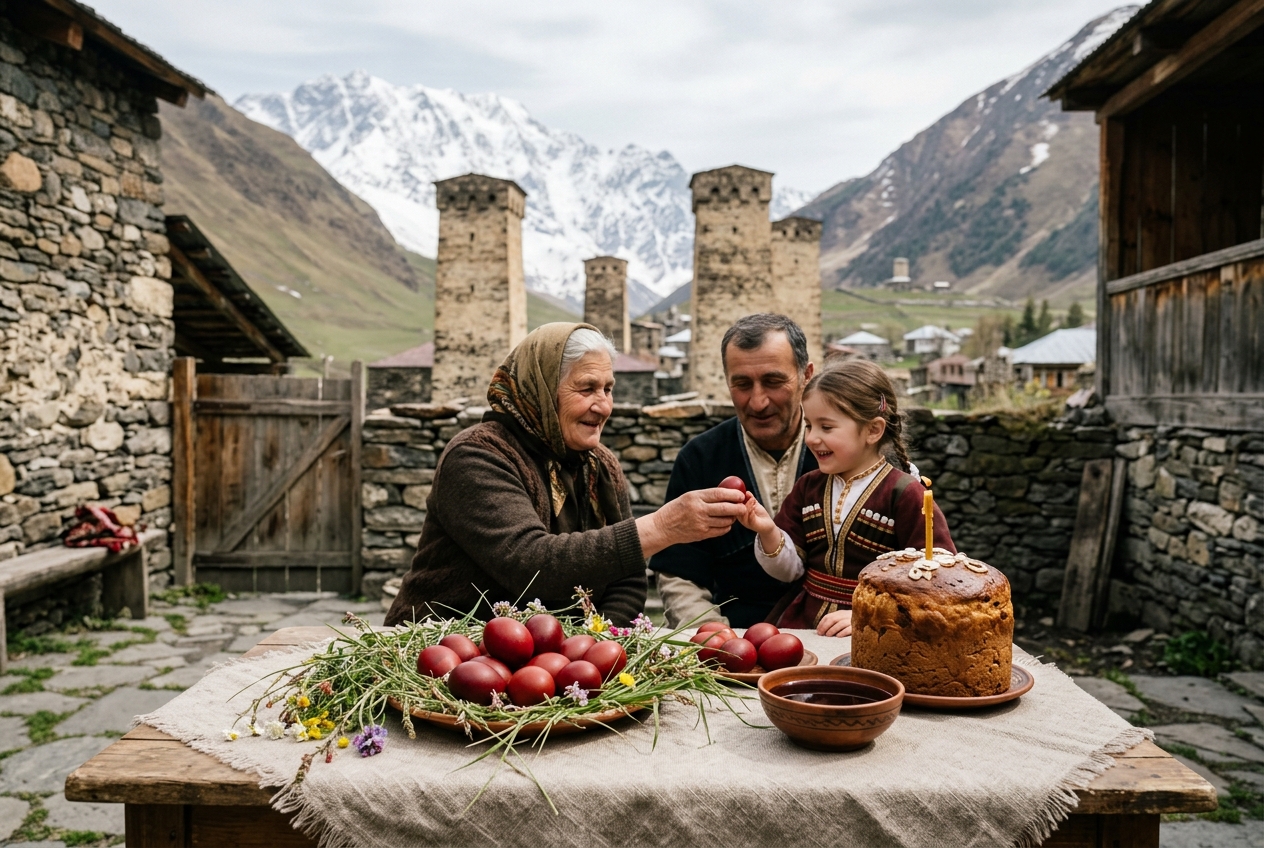
The single most recognizable symbol of Georgian Easter is the red egg. On Good Friday, which Georgians call “Red Friday” or Tsiteli Paraskevi, families across the country dye eggs red to symbolize Christ’s blood. The traditional dyeing agent is madder root, called “endro” in Georgian, a plant that grows wild in the Caucasus and produces a deep crimson when boiled.
Egg cracking is the centerpiece game of Easter Sunday. Two people tap their eggs together, and the one whose egg survives intact is said to enjoy good fortune for the year. The greeting exchanged during this ritual is “Kriste Aghdga!” (Christ has risen), answered with “Cheshmaritad!” (Truly He has risen). Children collect as many unbroken eggs as possible, turning it into a competitive sport. Some families keep the strongest egg from year to year, wrapping it in cloth and storing it in a cool place, believing it carries protective power.
Paska: The Sacred Easter Bread
Paska is the round, slightly sweet bread baked for Easter across Georgia. Its shape represents the tomb of Christ, and the cross often pressed into its top dough marks the resurrection. Every family has its own recipe, but the common ingredients are flour, eggs, sugar, butter, and yeast, all ingredients forbidden during Lent, making the bread itself a celebration of the fast’s end.
In rural households, baking paska is a communal event. Women gather in the kitchen on Holy Saturday, and the bread is blessed at church before being brought home for the feast. Some regions add raisins or candied fruit, while others keep it plain. The bread is always the first thing eaten after the midnight liturgy, broken and shared among family members before any other dish is touched.
The Ritual of Jegvili and Wheat Grass Sprouts
About two weeks before Easter, many Georgian families plant wheat seeds on a shallow tray lined with damp cotton. By Easter Sunday, the seeds have sprouted into bright green grass, called jegvili. This tray is placed at the center of the Easter table, and red eggs are nestled among the green shoots, creating a striking visual contrast.
The symbolism is straightforward: green wheat represents new life and resurrection. But the practice has older, pre-Christian roots tied to agricultural fertility rites. Farmers in Kartli and Kakheti historically viewed the quality of the jegvili sprouts as a forecast for the coming harvest. Thick, even growth meant a good year; patchy sprouts were a bad omen. Today, even urban families in Tbilisi grow jegvili on their windowsills, connecting to a tradition that predates Christianity in the region by centuries.
Western Georgia: Guria and Samegrelo Customs
Western Georgia’s Easter traditions carry a distinctly physical, communal energy. The humid lowlands of Guria and the Megrelian coast have developed customs that emphasize collective participation, competitive spirit, and a culinary tradition that diverges sharply from what you’d find east of the Surami Pass.
Lelo Burti: The Ancient Ball Game of Shukhuti
The village of Shukhuti in Guria hosts one of Georgia’s most spectacular Easter events: Lelo Burti, a rough, no-rules ball game played between two halves of the village. The ball, weighing around 16 kilograms and filled with sand and sawdust, is carried or thrown across fields, rivers, and ditches toward the opposing team’s goal. There are no boundaries, no referees, and essentially no rules beyond getting the ball to the other side.
Lelo Burti predates Christianity and was originally a ritual connected to the spring equinox and agricultural renewal. The game can last for hours, and injuries are common. After the match, the winning team traditionally carries the ball to a family gravesite, dedicating the victory to a recently deceased community member. This connection between sport, death, and resurrection gives the game a gravity that spectators feel immediately. It’s not entertainment: it’s a ritual that channels grief and hope into physical struggle.
Megrelian Culinary Specialties for the Feast
The Megrelian Easter table is a thing of excess. After 40 days of strict fasting, where many Georgians abstain from all animal products, the feast that follows is deliberately abundant. Megrelian cuisine is already Georgia’s spiciest and most intensely flavored regional kitchen, and Easter amplifies everything.
Expect to find gebzhalia (cheese rolls in mint sauce), elarji (a thick cornmeal-and-cheese porridge that stretches like mozzarella), and kupati (spiced pork sausages). The Megrelian version of satsivi, a walnut sauce served over poultry, tends to be richer and more heavily spiced with blue fenugreek and marigold petals than its eastern counterpart. Families prepare enough food to feed anyone who stops by, because in western Georgia, an Easter table without extra guests is considered incomplete. The phrase “stumari ghvtisaa” (a guest is from God) applies doubly during Aghdgoma.
Highland Rituals in Svaneti and Khevsureti
Georgia’s mountain communities preserved traditions that the lowlands lost during Soviet-era suppression of religion. In Svaneti and Khevsureti, Easter rituals blend Orthodox Christianity with animistic practices that scholars trace back thousands of years. The isolation of these valleys, accessible only by horseback or on foot until the mid-20th century, created a kind of cultural time capsule.
Commemorating Ancestors with Lamproba
Lamproba, the festival of torches, takes place on Easter night in Svaneti’s upper villages. Families climb to hilltops carrying torches made from birch bark and dried grass, lighting them as the church bells ring at midnight. The mountainsides glow with hundreds of moving flames, each one representing a prayer for a deceased family member.
The torches are carried to family cemeteries, where food and wine are left on graves. Svans believe that the boundary between the living and the dead thins during Easter, and the torchlight guides ancestral spirits back to their families for the night. This practice has no direct parallel in mainstream Georgian Orthodoxy, and some scholars consider it a survival of Zoroastrian fire worship filtered through centuries of Christian reinterpretation. Watching Lamproba from across a valley is one of the most unforgettable experiences Georgia offers.
Mountain Sacrifices and Community Shrines
In Khevsureti and parts of Tusheti, Easter involves animal sacrifices at community shrines called “jvari” (cross) or “khati.” These are not churches in the Orthodox sense but sacred sites, often located on hilltops, maintained by a hereditary shrine keeper called a “khevisberi.”
A bull or ram is sacrificed, and the meat is distributed equally among all families in the village. Beer brewed specifically for the occasion is consumed in a ritual sequence, with toasts following a strict order that mirrors the Georgian supra (feast) tradition but with distinctly pagan undertones. Women are typically excluded from the inner shrine area, a restriction that reflects the pre-Christian origins of these practices. The Georgian Orthodox Church has historically maintained an uneasy relationship with highland shrine worship, tolerating it as a regional variation rather than condemning it outright.
Easter in the Wine Heartland of Kakheti
Kakheti, Georgia’s eastern wine region, celebrates Easter with rituals deeply tied to viticulture. Wine is sacred here in both the Christian and cultural sense, and the resurrection is inseparable from the vineyard cycle.
Opening the Qvevri for the Resurrection
The qvevri, a large clay vessel buried underground for fermenting and aging wine, plays a central role in Kakhetian Easter. Many families time the opening of a qvevri to coincide with Easter Sunday, treating the first pour of the new vintage as a sacramental act. The wine has been aging since the previous autumn’s harvest, and its emergence from the earth mirrors the resurrection narrative.
The family patriarch draws the first cup and offers it with a prayer. This wine is then used throughout the Easter supra. In villages around Sighnaghi and Telavi, winemakers sometimes invite neighbors to taste the new vintage, turning Easter morning into an informal wine evaluation. The qvevri tradition was inscribed on UNESCO’s Intangible Cultural Heritage list in 2013, and Easter remains one of the key moments when this 8,000-year-old winemaking method is most visibly practiced.
Traditional Lamb Sacrifices and Mtsvadi
Kakhetian Easter is incomplete without mtsvadi, skewered meat grilled over grapevine cuttings. The preferred meat is lamb, and many families slaughter a lamb on Holy Saturday. The choice of grapevine wood for the fire is deliberate: it imparts a subtle, smoky sweetness and connects the meal to the vineyard.
The Easter supra in Kakheti is typically the longest and most elaborate of the year. A tamada (toastmaster) leads the table through a sequence of toasts that can last four or five hours. The first toast is always to God and the resurrection. Subsequent toasts honor ancestors, family, the homeland, and the future. Between toasts, dishes rotate: cheese-stuffed khachapuri, herb-laden salads, pickled vegetables, and of course, the red eggs. The Kakhetian table is a marathon, not a sprint.
| Region | Signature Easter Tradition | Key Food or Drink |
|---|---|---|
| Guria | Lelo Burti ball game | Kupati sausages |
| Samegrelo | Communal feasting with open doors | Elarji, gebzhalia |
| Svaneti | Lamproba torch procession | Beer and sacrificial meat |
| Khevsureti | Shrine sacrifices led by khevisberi | Ritual beer and ram |
| Kakheti | Qvevri opening ceremony | Amber wine and mtsvadi |
| Kartli | Church-centered observance | Paska and churchkhela |
| Meskheti | Archery and sport competitions | Lamb dishes |
Kartli and Meskheti: Unique Local Observances
Central Georgia’s Kartli region, which includes the old capital Mtskheta, tends toward more church-centered Easter observances. The proximity to major cathedrals like Svetitskhoveli and Jvari means that the religious ceremony itself takes precedence over folk customs. Families attend lengthy midnight services and process through the streets with candles, and boxwood branches called “bza” replace palm fronds for Palm Sunday decorations, a tradition rooted in the local flora.
Meskheti, the southernmost region bordering Turkey, has its own flavor. Historically a crossroads between Ottoman and Persian influence, Meskheti’s Easter customs carry traces of that cultural friction. The region was partially depopulated during Soviet deportations of the Meskhetian Turks in 1944, and the communities that remained doubled down on their Georgian Orthodox identity, making Easter celebrations particularly fervent.
The Role of Archery and Sports in Meskheti
Easter Monday in parts of Meskheti features archery competitions and horseback games that echo the region’s martial past. Young men compete in target shooting with traditional bows, and some villages organize horse races along riverbanks. These events serve a social function beyond entertainment: they’re opportunities for young people to demonstrate skill and earn community respect.
The archery tradition connects to Meskheti’s historical role as a frontier zone. For centuries, the region’s men needed to be ready for conflict, and spring festivals doubled as military training. The Christian overlay is thin here: the competitions happen after church services, but their roots are clearly pre-Christian. Prizes are modest, usually a ram or a quantity of wine, but the prestige of winning lasts much longer than the prize itself.
The Spiritual Significance of Bright Monday
The day after Easter Sunday, called Bright Monday or “Nateli Orshabati,” carries its own weight in Georgian tradition. While the Sunday feast is about family, Monday shifts the focus outward. Families visit cemeteries to share food and wine with their deceased relatives, spreading tablecloths directly on graves and eating a full meal in the company of the dead.
This practice, which might seem unusual to Western visitors, reflects a Georgian understanding of death as a continuation rather than an ending. The phrase “Christ has risen!” is exchanged even at gravesites, with mourners addressing the dead directly. Wine is poured onto the grave, bread is left, and red eggs are placed at the headstone. The atmosphere is not somber but warm, even celebratory, as if the resurrection promise extends literally to those buried beneath the spring grass.
Bright Monday is also when many Georgians visit relatives in distant villages, turning the day into a kind of national reunion. Roads fill with cars heading to the countryside, and villages that sit quiet for most of the year suddenly overflow with returning children and grandchildren. For travelers in Georgia during this period, the experience is transformative. You see a country that treats its dead as present members of the family and its past as something alive and worth feeding.
The Easter traditions found across Georgia’s regions reveal a country where faith, food, sport, and ancestor worship coexist without contradiction. From the torch-lit mountains of Svaneti to the wine-soaked tables of Kakheti, each region adds its own chapter to a story that has been told for millennia. If you’re planning a trip to Georgia during spring, timing your visit to coincide with Orthodox Easter will show you a side of the country that no museum or guidebook can replicate. Bring an appetite, wear comfortable shoes, and be ready to crack some eggs.