
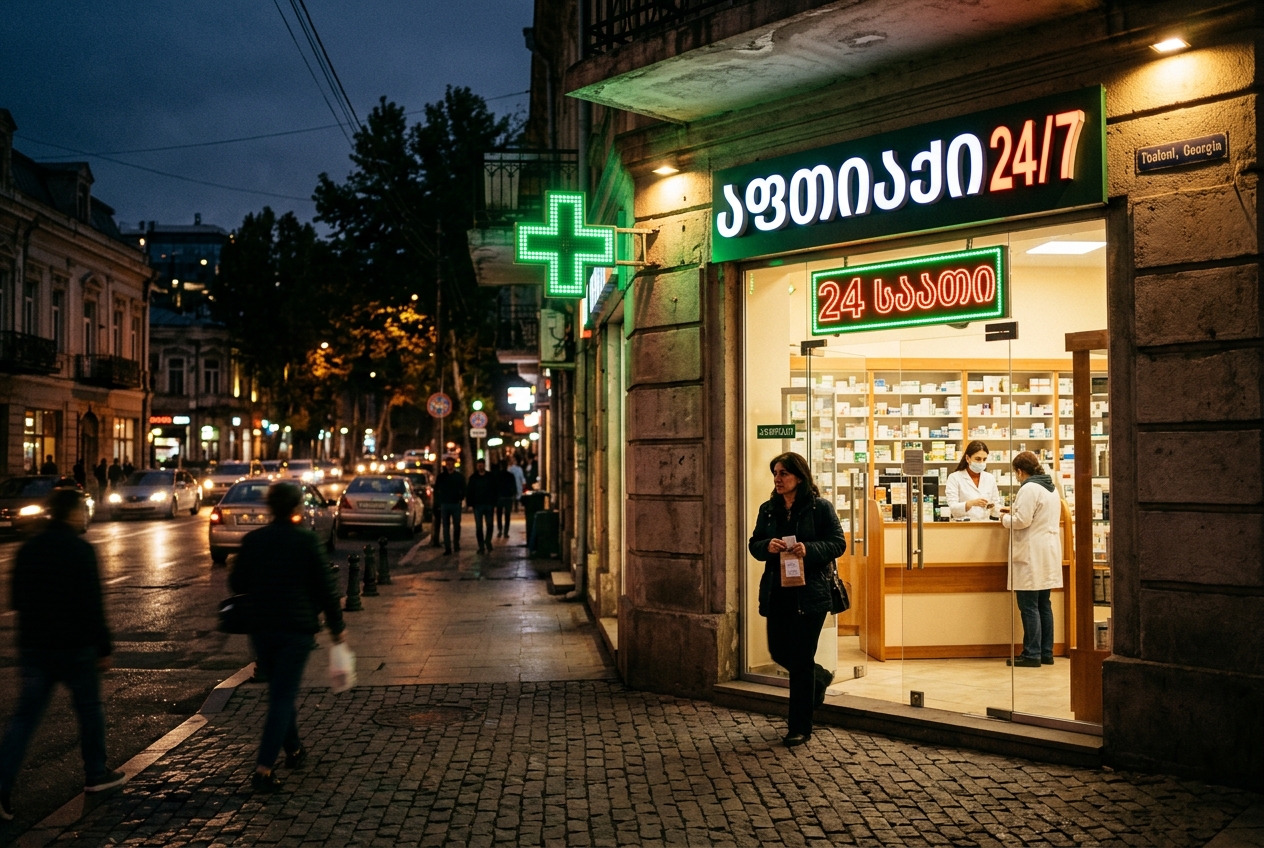
If you’ve ever gotten sick while traveling, you know the panic of trying to find the right medicine in a foreign country where you don’t speak the language. Georgia – the small Caucasus nation known for wine, khachapuri, and extraordinary hospitality – actually makes this experience surprisingly painless. Pharmacies here are plentiful, often open around the clock, and stock a wide range of medications that would require a prescription back home. But there are quirks to the system that catch newcomers off guard: a unique drug classification system, pricing structures that vary wildly between chains, and a communication gap that can make explaining your symptoms feel like a game of charades. Whether you’re an expat settling into Tbilisi life, a digital nomad passing through Batumi, or a tourist who picked up a nasty cold in the mountains, understanding how pharmacies in Georgia work will save you time, money, and a lot of unnecessary stress.

Overview of the Pharmaceutical Market in Georgia
Georgia’s pharmaceutical sector has grown rapidly since the country liberalized its economy in the mid-2000s. The market was worth more than GEL 4 billion in 2021, driven by a combination of growing domestic demand and a regulatory environment that favors accessibility over restriction. Walk through any neighborhood in Tbilisi, and you’ll likely spot two or three pharmacies within a single block. The density is remarkable, especially compared to Western European countries where pharmacies are more spread out and tightly regulated.
The split between over-the-counter and prescription medications tells an interesting story about how Georgia approaches healthcare access. The OTC and Rx split is approximately 40% to 60%, meaning a significant portion of drugs still require a prescription, but the OTC share is generous by international standards. Many antibiotics, painkillers, and anti-inflammatory drugs that require a doctor’s visit in the EU or US can be purchased directly from a pharmacist in Georgia. This accessibility is a double-edged sword: convenient for travelers, but it also means self-medication is common among locals.
Major Pharmacy Chains and Brand Reliability
Three pharmacy chains dominate the Georgian market: GPC (Georgian Pharmaceutical Company), PSP, and Aversi. Between them, they operate thousands of locations across the country, from downtown Tbilisi to smaller towns in Kakheti and Svaneti. Each chain has its own pricing strategy, loyalty program, and house-brand generics.
GPC tends to be the most budget-friendly option for common medications, while PSP positions itself as slightly more premium with a wider selection of imported brands. Aversi falls somewhere in between and has a strong presence in rural areas where the other two chains might not reach. All three are reliable in terms of product quality and storage conditions, so you won’t need to worry about counterfeit medications the way you might in some other developing markets.
A practical tip: prices for the same medication can differ by 15-30% between chains, so if you’re buying something expensive or need a recurring prescription filled, it’s worth checking two or three locations before committing.
Availability of International vs. Local Brands
Georgian pharmacies stock a mix of internationally recognized pharmaceutical brands and locally manufactured generics. You’ll find products from Bayer, Pfizer, Sanofi, and other global names alongside Georgian manufacturers like Aversi-Rational and GMP. The local generics are significantly cheaper and, for most common conditions, perfectly effective.
One thing that trips up foreigners: brand names often differ from what you’re used to at home. The active ingredient is the same, but the commercial name on the box might be completely unfamiliar. If you know the generic name of your medication (ibuprofen rather than Advil, omeprazole rather than Prilosec), you’ll have a much easier time. Pharmacists in Tbilisi generally understand generic drug names even if their English is limited.
Imported medications from Turkey, India, and Eastern Europe are also widely available. Indian generics in particular offer excellent value, often costing a fraction of their Western-branded equivalents while containing identical active ingredients.
Regulations for Buying Medicine and Prescriptions
Georgia’s approach to pharmaceutical regulation is notably more relaxed than what you’ll find in the EU or North America, but it’s not a free-for-all. The system has clear categories, and understanding them before you walk into a pharmacy will save you from confusion at the counter.
Understanding the Three-Group Drug Classification
Georgian law divides medications into three distinct groups, and knowing which group your medication falls into determines how easy it will be to purchase:
| Group | Description | Purchase Requirements |
|---|---|---|
| Group I | Over-the-counter medications | No prescription needed; freely available |
| Group II | Pharmacy-only medications | No prescription, but dispensed only by a pharmacist with verbal consultation |
| Group III | Prescription-only medications | Requires a valid prescription from a licensed physician |
Group I covers basics like vitamins, antacids, and mild pain relievers. Group II is where it gets interesting for travelers: this category includes many antibiotics, stronger painkillers, antihistamines, and some cardiovascular medications that would absolutely require a prescription in Western countries. A pharmacist can sell these after a brief consultation, which usually amounts to asking what your symptoms are and confirming you don’t have allergies.
Group III includes controlled substances, psychotropic medications, strong opioids, and certain hormonal treatments. For these, you’ll need a prescription from a Georgian doctor or a validated foreign prescription. No amount of explaining or persuading will get a pharmacist to bend this rule, and rightfully so.
How to Use Foreign Prescriptions in Georgian Pharmacies
Here’s where things get a bit murky. Georgia does not have a formal reciprocity agreement with most countries regarding prescription recognition. In practice, whether a foreign prescription works depends on the pharmacy, the pharmacist, and the medication in question.
For Group II medications, a foreign prescription is usually unnecessary since the pharmacist can dispense them anyway after a consultation. For Group III drugs, a foreign prescription might be accepted at some pharmacies, particularly the larger chain locations in Tbilisi, but it’s not guaranteed. The prescription should ideally be written in English or include the international nonproprietary name (INN) of the drug.
If your foreign prescription gets rejected, the workaround is straightforward: visit a local clinic. An appointment with a general practitioner in Tbilisi costs between 30 and 80 GEL (roughly $10-30 USD), and the doctor can issue a Georgian prescription on the spot. Clinics like MediClub, Evex, and the American Medical Center have English-speaking staff and can handle this quickly. Bring your foreign prescription or medication packaging so the doctor knows exactly what you need.
How to Find 24/7 Pharmacies in Major Cities
One of the genuine conveniences of living in or visiting Georgia is that round-the-clock pharmacies are common, not the exception. Unlike many European countries where finding an open pharmacy after 8 PM involves calling a hotline or checking a rotation schedule, Georgia’s major cities have dozens of 24-hour locations.
Locating Round-the-Clock Stores in Tbilisi and Batumi
In Tbilisi, all three major chains (GPC, PSP, and Aversi) operate 24/7 branches. You’ll find them concentrated along major avenues like Chavchavadze, Pekini, and Tsereteli, as well as near major metro stations. The Saburtalo and Vake districts, popular with expats, have multiple all-night options within walking distance.
Batumi’s 24-hour pharmacy coverage is slightly thinner but still adequate. The main strip along Chavchavadze Street and the area near the port have reliable overnight options. During summer tourist season, some pharmacies that normally close at midnight extend their hours.
Smaller cities like Kutaisi, Zugdidi, and Rustavi typically have at least one or two 24-hour pharmacies, usually operated by GPC or Aversi. In truly rural areas, you might be out of luck after dark, so stock up on essentials before heading into the mountains or countryside.
Using Mobile Apps and Online Maps for Real-Time Access
Google Maps is your best friend for finding pharmacies in Georgia. Search “pharmacy” or “აფთიაქი” (aptiaki, the Georgian word) and you’ll get results with hours, reviews, and directions. The opening hours listed are generally accurate for chain pharmacies, though independent shops sometimes have outdated information.
Each major chain also has its own app. The PSP app and GPC app both show store locations, hours, and even allow you to check medication availability at specific branches. The apps are primarily in Georgian, but the maps and search functions work well enough even without language skills.
Yandex Maps, still popular in the region, can also be useful, particularly for finding pharmacies in smaller towns where Google’s coverage might be less detailed. Bolt and Glovo, the ride-hailing and delivery apps widely used in Georgia, can get you to a pharmacy quickly if you’re not near one.
Pricing, Discounts, and Loyalty Programs
Medicine prices in Georgia are generally lower than in Western Europe or North America, but they’re not uniformly cheap. Imported brand-name medications can be surprisingly expensive relative to local salaries, which explains why 55% of Georgians report being worried about affording prescription drugs. For travelers and expats earning foreign currency, though, most common medications feel like a bargain.
Navigating Price Caps and State-Regulated Medications
The Georgian government has implemented price controls on certain essential medications, particularly those related to chronic conditions like diabetes, hypertension, and cardiovascular disease. These caps mean that prices for regulated drugs remain consistent across different pharmacy chains.
For non-regulated medications, prices float freely, and the variation between chains can be significant. A course of antibiotics might cost 8 GEL at one pharmacy and 14 GEL at another across the street. Generic alternatives are almost always available and typically cost 40-70% less than branded equivalents. Don’t hesitate to ask the pharmacist for a cheaper alternative: they’re usually happy to suggest one.
The state also runs several programs that provide free or subsidized medications to vulnerable populations, including the elderly, disabled individuals, and those with specific chronic conditions. These programs are primarily designed for Georgian citizens and residents, but they illustrate the government’s awareness that drug costs are a real burden. Georgians spend an average of $2,437 per year on prescription drugs, a substantial sum in a country where the average monthly salary hovers around $500-600.
How Expats and Tourists Can Access Pharmacy Discount Cards
All three major chains offer loyalty cards, and getting one is trivially easy: just ask at the register. GPC’s card gives you a standard 3-5% discount on most purchases, while PSP and Aversi offer tiered programs where your discount percentage increases with cumulative spending.
For expats planning to stay longer than a few months, these cards genuinely add up. If you’re spending 50-100 GEL per month on medications and supplements, a 5% discount saves you enough over a year to notice. Some chains also run periodic promotions where loyalty cardholders get 10-15% off specific product categories.
Tourists on shorter visits probably won’t benefit much from loyalty programs, but it’s still worth grabbing a card since there’s no cost and no personal information required beyond a phone number. Some pharmacies offer a small instant discount just for signing up.
Online Pharmacy Services and Home Delivery Options
Online pharmacy services are growing in Georgia but remain less developed than the physical retail network. PSP offers an online ordering platform where you can browse their catalog, check prices, and reserve medications for pickup at your nearest branch. GPC has a similar service, though the website is primarily in Georgian.
True home delivery of medications is available through Glovo and Wolt in Tbilisi and Batumi. You can order from partner pharmacies through these apps and have medications delivered to your door within 30-60 minutes. The selection is limited to OTC and Group II medications: you’ll still need to visit in person for anything requiring a prescription.
A few independent online pharmacies have emerged, but I’d recommend sticking with the established chains for online orders. The supply chain is more transparent, returns are easier, and you’re less likely to encounter expired or improperly stored products. The convenience factor is real, especially if you’re feeling too sick to leave your apartment, but for anything beyond basic medications, an in-person visit remains the better choice.
Practical Tips for Communicating with Pharmacists
Language is the biggest practical challenge when buying medicine in Georgia, but it’s far from insurmountable. In Tbilisi, pharmacists under 35 generally speak at least basic English, a reflection of the post-2003 generation that grew up with English-language education rather than the Soviet-era Russian curriculum. In smaller cities and rural areas, Russian is far more useful than English, and Georgian is obviously the safest bet if you’ve picked up some basics.
Here’s what actually works when you’re standing at the pharmacy counter with a headache and a language barrier:
- Write down the generic name of the medication you need. Pharmacists worldwide recognize international drug names, even if they can’t discuss your symptoms in English.
- Show a photo of the medication packaging from your home country. The active ingredient and dosage are usually printed in Latin script somewhere on the box.
- Use Google Translate’s camera feature to read Georgian-language packaging in real time. Download the Georgian language pack offline before you need it.
- Point to the affected body part and mime your symptoms. It sounds silly, but pharmacists are trained to interpret these signals and it works remarkably well.
- If the pharmacist doesn’t understand you, try a different pharmacy. Staff language skills vary enormously even within the same chain.
One cultural note: Georgian pharmacists tend to be more hands-on with recommendations than their Western counterparts. Don’t be surprised if they suggest a specific brand, offer unsolicited advice about dosage, or recommend a combination of medications. This isn’t a sales tactic: it reflects a genuine care-oriented approach that Georgians extend to guests. The concept of “stumari ghvtisaa” (a guest is from God) permeates even commercial interactions here.
For anything complex, bring a Georgian-speaking friend or call your hotel reception and ask them to translate over the phone. Most pharmacists are patient and willing to work through the communication barrier, especially if you show a little effort with basic Georgian pleasantries like “gamarjoba” (hello) and “madloba” (thank you).
Finding the Right Pharmacy: What to Remember
Georgia makes buying medicine easier than most countries you’ll visit, but a little preparation goes a long way. Know the generic names of your medications, download offline language tools before you arrive, and don’t assume that the first pharmacy you enter has the best price. The major chains are all reliable, 24-hour locations are plentiful in cities, and pharmacists are generally helpful even across a language divide.
If you take prescription medications regularly, bring enough supply for your entire trip plus a buffer, along with a copy of your prescription showing the INN drug name. For everything else, Georgian pharmacies will likely have what you need at a price that won’t break the bank. The system here rewards a bit of initiative and flexibility, but that’s true of Georgia in general: a country that consistently surprises visitors with how easy it makes the things that matter most.