
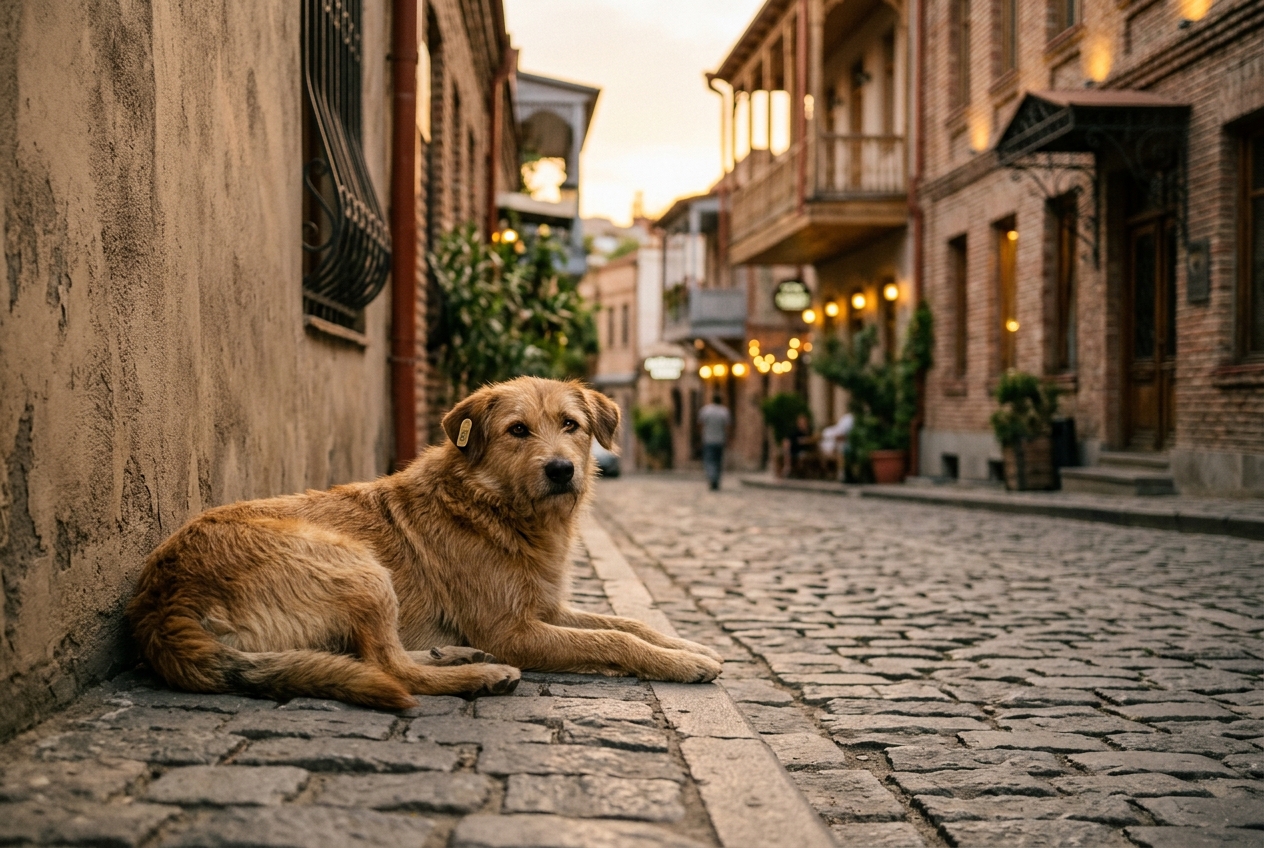
One of the first things travelers notice when they arrive in Tbilisi is the dogs. Not behind fences or on leashes, but sprawled across sidewalks, trotting alongside pedestrians, and dozing in the shade of old balconies in the Abanotubani district. For many visitors, the sight raises an immediate question: are there stray dogs in Georgia and are they safe to be around? The short answer is yes, there are a lot of them, and the vast majority pose no threat. But the full picture is more nuanced than a simple yes or no. Georgia’s relationship with its street dogs is deeply cultural, surprisingly organized, and worth understanding before you go. Whether you’re planning a trek through the Caucasus or a long weekend eating khinkali in the capital, this is what you actually need to know about sharing the streets with these animals.
The Prevalence of Community Dogs in Georgia
Georgia’s stray dog population is not a small or hidden issue. The country had an estimated 300,000 to 350,000 stray dogs as of June 2025, a staggering number for a nation of roughly 3.7 million people. That’s nearly one stray dog for every ten humans. You’ll encounter them in every city, every small town, and on most rural roads between villages.
These aren’t feral animals hiding in alleys. Many of them are what animal welfare organizations call “community dogs”: animals that live on the streets but are loosely cared for by local residents, shop owners, and restaurant staff. They have regular feeding spots, familiar territories, and often a name given by the neighborhood.
Why There Are So Many Strays in Cities Like Tbilisi
The root causes are straightforward but stubborn. Georgia lacks a widespread culture of spaying and neutering pets. Many dog owners, particularly in rural areas and smaller cities, allow their animals to roam freely and reproduce without intervention. When litters arrive and families can’t or won’t care for all the puppies, the surplus ends up on the streets.
Owner surrenders compound the problem. Over 36,000 stray dogs were housed in shelters across Georgia as of 2022, and those numbers have only climbed since. Shelters fill up quickly, and the infrastructure simply can’t keep pace with the intake. The math is grim: more dogs are born than the system can absorb, and the cycle repeats.
Economic factors play a role too. Veterinary care is relatively affordable in Tbilisi compared to Western Europe, but in rural Georgia, access to clinics is limited. A farmer in Kakheti or Svaneti may not have a vet within a reasonable distance, let alone the means to pay for sterilization procedures. The result is generational: puppies born on the street grow up on the street and have puppies of their own.
Cultural Attitudes Toward Street Animals
Here’s where Georgia genuinely differs from most European countries. The Georgian phrase “stumari ghvtisaa” – the guest is a gift from God – extends, in a looser sense, to the animals that share public spaces. There’s a deep-rooted tolerance, even affection, for street dogs that surprises many Western visitors accustomed to viewing strays as a problem to be removed.
In Tbilisi, you’ll see bakery owners leaving out bowls of water. Taxi drivers tossing scraps to familiar dogs. Grandmothers in Saburtalo or Vake feeding the same pack every evening. This isn’t neglect dressed up as kindness: it’s a genuine cultural norm. Georgians, by and large, don’t view street dogs with the alarm or disgust you might find in other countries. They’re part of the fabric of daily life.
That said, attitudes are shifting among younger, more urban Georgians. The post-2003 Rose Revolution generation, more connected to European norms and English-language media, increasingly advocates for formal animal welfare programs rather than informal street feeding. There’s a growing tension between the traditional “live and let live” approach and a newer push for systemic solutions like municipal sterilization campaigns and adoption drives.
Safety and Temperament of Georgian Street Dogs
The question most visitors really want answered is whether these dogs are dangerous. The honest answer: the overwhelming majority are not. Georgian street dogs are among the most socialized stray populations you’ll find anywhere. They’ve grown up around people, traffic, and noise. Most are calm, indifferent to tourists, and far more interested in their next meal than in confrontation.
That doesn’t mean every interaction is risk-free. Dogs are animals, and any animal can react unpredictably if startled, cornered, or protecting food. But the baseline temperament of Tbilisi’s street dogs is remarkably docile compared to stray populations in some other countries.
Understanding the Yellow Ear Tags
If you look closely, you’ll notice many of Georgia’s street dogs have bright yellow or green plastic tags clipped to their ears. These tags are not decorative. They indicate that the dog has been through a government or NGO-run program involving vaccination (typically against rabies), sterilization, and basic health screening before being returned to the streets.
This Trap-Neuter-Vaccinate-Return (TNVR) approach is the cornerstone of Georgia’s stray management strategy. A tagged dog is a dog that has been handled by veterinarians, received a rabies vaccine, and been deemed healthy enough to return to its territory. For travelers, the tag is a useful visual shorthand: a tagged dog is statistically much safer to be near than an untagged one.
| Ear Tag Color | Meaning | What It Tells You |
|---|---|---|
| Yellow | Vaccinated and sterilized through a municipal program | Lower risk; has been handled by vets |
| Green | Vaccinated and sterilized (some NGO programs use green) | Same protections as yellow-tagged dogs |
| No tag | Unknown vaccination/sterilization status | Exercise more caution; avoid close contact |
Not every dog has been tagged, though. Coverage is incomplete, especially outside Tbilisi. In rural areas and smaller cities like Kutaisi, Batumi, or Zugdidi, you’ll encounter plenty of untagged dogs. These animals may still be perfectly safe, but you have less information to go on.
Common Behaviors and Socialization with Tourists
Georgian street dogs have developed a behavioral repertoire that’s almost comically human. They wait at crosswalks. They follow hikers on mountain trails for hours, seemingly appointed as unofficial guides. They sleep in the doorways of churches and cafes with the serene confidence of paying customers.
Most dogs you encounter in tourist areas like Rustaveli Avenue, the Old Town, or the Dry Bridge Market are habituated to crowds. They won’t approach you aggressively. The most common behavior is a lazy tail wag or a hopeful glance if you’re carrying food. Some dogs in popular trekking areas, like the Kazbegi region, will follow hikers for kilometers. They’re not threatening: they’re opportunistic and social.
Pack behavior is the one area where caution is warranted. Dogs in groups of three or more can be more territorial, especially at night and especially in quieter neighborhoods or on the outskirts of towns. A solo dog sleeping on a sidewalk is almost certainly harmless. A group of dogs barking at 2 a.m. near a construction site is a different situation, and one worth giving a wide berth.
Health Concerns and Rabies Prevention
Rabies is the health concern that gets the most attention, and rightly so. Georgia is not classified as rabies-free. Cases occur in animals each year, primarily in rural areas and primarily in dogs and foxes. The risk to tourists is low but not zero, and it’s worth taking seriously.
The Effectiveness of Local Vaccination Programs
Georgia’s TNVR programs have made real progress in urban areas. Tbilisi’s municipal government has invested in mass vaccination campaigns, and the ear-tag system provides visible evidence of coverage. The Georgian government requires animal shelters to submit monthly reports to the Department of Agriculture regarding intakes and outcomes, which creates at least a baseline of accountability.
But coverage gaps remain significant. Rural areas lag far behind cities in vaccination rates. Stray dogs in mountain villages, along highways, and in agricultural regions are far less likely to have been vaccinated. If you’re trekking in remote areas of Tusheti, Svaneti, or Racha, assume the dogs you encounter have not been through any program unless you can see a tag.
The World Health Organization recommends pre-exposure rabies vaccination for travelers spending significant time outdoors in countries where rabies is present. If you’re planning extensive hiking or rural travel in Georgia, this vaccine is worth getting before your trip. It doesn’t eliminate the need for post-exposure treatment if bitten, but it simplifies and shortens the treatment protocol significantly.
What to Do if You Are Bitten or Scratched
If a dog bites or scratches you in Georgia, treat it as a medical priority regardless of the dog’s apparent health. Rabies is nearly 100% fatal once symptoms appear, but nearly 100% preventable with prompt treatment.
- Wash the wound immediately with soap and running water for at least 15 minutes. This alone significantly reduces infection risk.
- Apply an antiseptic like iodine or alcohol if available.
- Go to the nearest hospital or clinic. In Tbilisi, the Infectious Diseases Hospital on Kakheti Highway is the primary facility for rabies post-exposure prophylaxis (PEP). Clinics in Batumi and Kutaisi also stock PEP.
- Begin the post-exposure vaccination series as soon as possible, ideally within 24 hours.
Dog bite claims in the US state of Georgia (not the country, but a useful reference point) average a settlement value close to $48,000, which gives you a sense of how seriously bite injuries are treated medically and legally. In the country of Georgia, treatment costs are far lower, but the medical urgency is identical.
Do not wait to see if symptoms develop. Do not assume the dog was healthy because it looked fine. Get treated.
Best Practices for Interacting with Strays
Most travelers will interact with Georgian street dogs whether they intend to or not. A dog will approach your outdoor restaurant table. One will follow you on a hike. Another will plop down next to you on a park bench. Knowing how to handle these encounters makes the experience enjoyable rather than stressful.
Dos and Don’ts of Feeding Street Dogs
Feeding street dogs is a personal choice, and locals do it constantly. But there are smart ways and counterproductive ways to go about it.
- Do feed a dog away from restaurant entrances and other people’s outdoor seating. Owners get frustrated when dogs linger and bother customers.
- Do offer plain food: bread, rice, meat scraps. Avoid anything with onions, garlic, chocolate, or cooked bones, all of which are harmful to dogs.
- Don’t feed a dog that’s in a pack of three or more. Food creates competition, and competition can escalate into snapping or fighting.
- Don’t hand-feed an unfamiliar dog. Place food on the ground and step back.
- Don’t establish a feeding routine you can’t maintain. A dog that learns to expect food at a specific time and place will wait there long after you’ve flown home.
Reading Canine Body Language in a Pack
Understanding basic dog body language goes a long way, especially if you encounter a group of dogs in a quieter area.
A relaxed dog has a loose, wiggly body, soft eyes, and a tail that wags in wide sweeps. This dog is safe to be near. A stiff dog, one standing tall with ears forward, tail raised and rigid, and a fixed stare, is alert and potentially defensive. Don’t approach, and don’t make direct eye contact, which dogs can interpret as a challenge.
If a dog growls or barks at you, stop moving. Don’t run, which triggers a chase instinct. Stand still, avoid eye contact, and slowly back away. In nearly every case, the dog is defending a perceived territory and will lose interest once you’ve moved on. Carry a walking stick if you’re hiking in rural areas: not to hit a dog, but to create distance if needed. The visual barrier alone is usually enough to discourage an approach.
Supporting Georgia’s Animal Welfare Initiatives
If Georgia’s street dogs tug at your heart, and for many travelers they do, there are concrete ways to help beyond tossing a few scraps.
Reputable Shelters and NGOs in the Region
Several organizations are doing serious, sustained work on the ground. The Georgian Society for the Protection of Animals (GSPA) runs a shelter outside Tbilisi and coordinates TNVR campaigns. The Tbilisi Adoption Center is another well-regarded facility. International organizations like FOUR PAWS have also conducted large-scale sterilization and vaccination drives in partnership with the Georgian government.
Planned PEThood of Georgia is advocating for coordinated action to address the animal overpopulation crisis, with a focus on prevention, coordination, and expanded access to affordable spay and neuter programs. Their emphasis on systemic change rather than just rescue reflects a maturing approach to the problem.
If you want to donate, prioritize organizations that focus on sterilization and vaccination over those that only run shelters. Shelters save individual dogs, but sterilization programs reduce the population over time. Both matter, but prevention has a multiplier effect that rescue alone cannot match.
The Process of Adopting and Exporting a Georgian Dog
Many travelers fall in love with a specific dog and want to bring it home. This is possible but requires planning. The process typically involves working with a local shelter or rescue organization to handle veterinary checks, vaccinations (including a rabies titer test), microchipping, and the paperwork required by your destination country.
For EU countries, the dog needs an EU pet passport, a rabies antibody titer test taken at least 30 days after vaccination and three months before travel, and a health certificate from a Georgian veterinarian. For the US, requirements vary but generally include proof of rabies vaccination and a health certificate. Processing times range from a few weeks to several months depending on the titer test timeline.
Expect to spend between $300 and $800 on veterinary costs, paperwork, and transport, not including the flight. Organizations like GSPA and several Tbilisi-based rescue groups can walk you through the process and connect you with pet transport services that handle the logistics.
A Country That Lives Alongside Its Dogs
Georgia’s street dogs are not a crisis hidden from tourists or a danger lurking around every corner. They’re a visible, complex, and deeply cultural part of life in this country. The stray dogs in Georgia are, for the most part, safe, socialized, and surprisingly well integrated into daily life. But they’re also a population in need of better systemic support: more sterilization, wider vaccination coverage, and stronger adoption infrastructure.
As a visitor, your best approach is a mix of awareness and common sense. Appreciate the dogs, respect their space, get your rabies pre-exposure vaccine if you’re heading into rural areas, and consider supporting the organizations working to make life better for both the dogs and the communities they share space with. Georgia is one of those rare places where the relationship between humans and street animals feels less like a problem and more like an ongoing, imperfect negotiation. And honestly, the dogs sprawled across Tbilisi’s sun-warmed sidewalks are part of what makes this country feel so unmistakably alive.