
Table of Contents
- Riding the Kukushka: Georgia’s Iconic Winter Narrow-Gauge Train
- History of the Borjomi-Bakuriani Railway
- The Route: 37 km Through Tsagveri and Tsemi
- Crossing the Eiffel-Designed Tsemi Bridge
- Journey Time, Schedule, and Tickets
- Planning Your Trip: Train vs Car
- Combining with a Car: One-Way Rides and Gorge Road Logistics
- Best Seats and Photography Tips
- Frequently Asked Questions About the Borjomi to Bakuriani Train
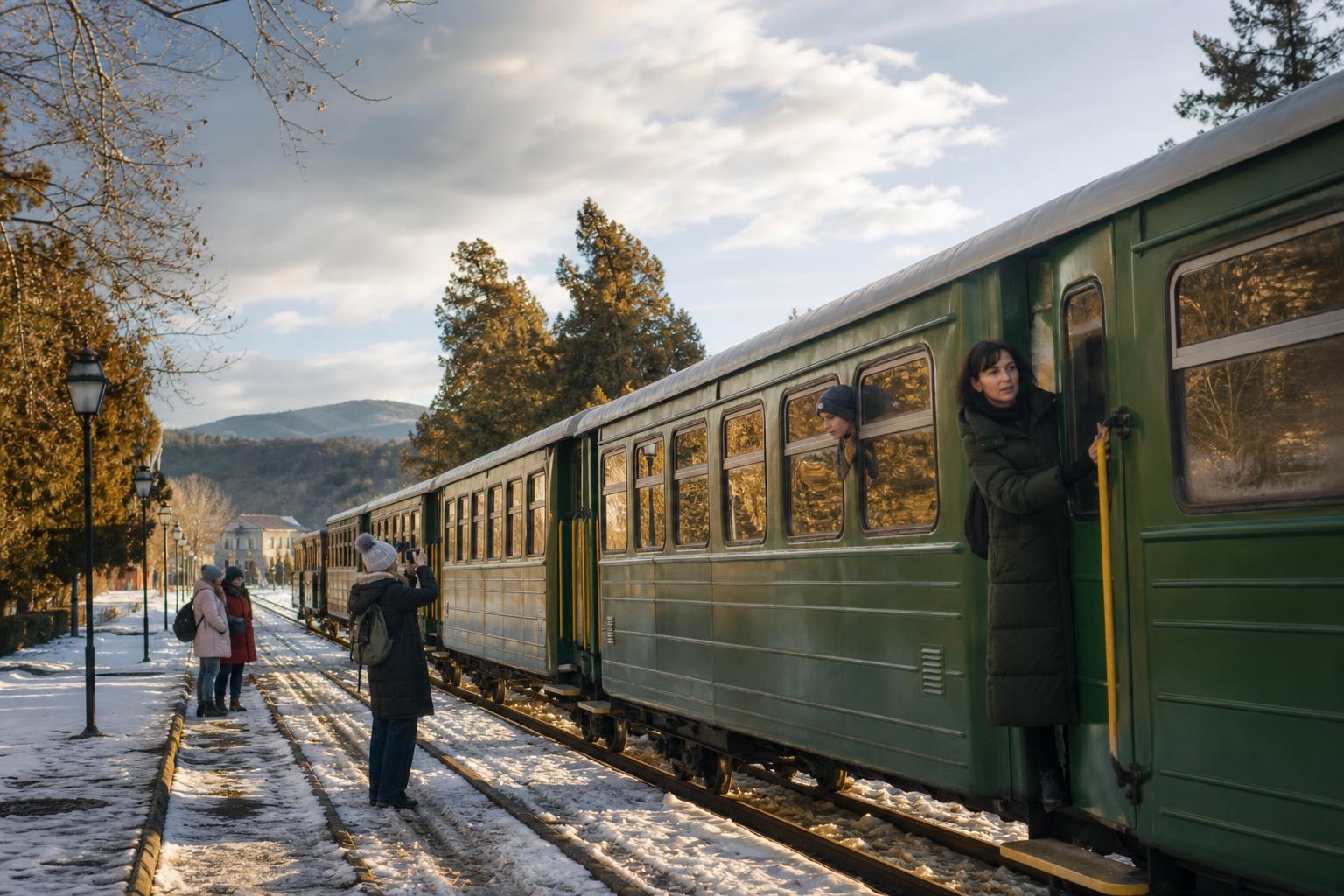
The Kukushka is a small narrow-gauge train that climbs about 37 km from Borjomi to the ski resort of Bakuriani. It has been closed for rehabilitation, and Georgian officials say it is scheduled to resume running in December 2026. If you are planning a winter 2026-27 trip, this is the year the toy train should be back in service.
This guide is written for travellers exploring Georgia by car. The ride is slow, the carriages are small, and the views of snowy pine forest are what you are paying for. Most visitors combine the ride with driving: they take the train in one direction and the car in the other.
Below you’ll find the history, the route through Tsagveri and Tsemi, the Eiffel-designed bridge, schedule and ticket advice, a comparison of train versus car, and practical tips for seats, photos and travelling with kids.
Riding the Kukushka: Georgia’s Iconic Winter Narrow-Gauge Train
“Kukushka” means “cuckoo” in Russian. The nickname is affectionate and has stuck for generations. Georgians from Tbilisi grew up riding it to Bakuriani for ski holidays, so for many locals it is closer to a childhood memory than a tourist attraction.
The kukushka train is not fast transport. It is a slow, rattling ride along a mountain gorge. On a clear winter day you get snow on the firs, frozen streams and small village stations.
Here is what to expect:
- Length: roughly 37 km (officially about 37.2 km) between Borjomi and Bakuriani
- Gauge: narrow, with compact carriages and tight curves
- Character: slow climb, frequent stops, forest and gorge scenery
- Status for 2026-27: reopening planned for December 2026 after rehabilitation
The relaunch is more than a quick repaint. New carriages were chosen to suit the mountain setting, and stations along the line have been restored. The aim is to keep the old-world feel rather than turn the line into a modern shuttle.
Note: In Georgia you’ll hear the line called the Borjomi-Bakuriani railway, the “Kukushka,” or simply “the little train.” Locals and taxi drivers will know all three names.
History of the Borjomi-Bakuriani Railway
The line dates to the early 1900s. At that time Borjomi was a fashionable spa town, and the Romanov family kept an estate in the valley. Bakuriani, higher up the mountain, was being developed as a cool summer retreat.
The narrow gauge was a practical choice. A standard-gauge line could not have handled the tight curves and steep sides of the gorge without enormous engineering costs. Small trains, slow speeds and modest bridges made the route possible.
In Soviet times Bakuriani grew into one of the USSR’s main winter sports centres. The Kukushka became the ski train for families arriving from Tbilisi and beyond. Many Georgians in their 40s and 50s still talk about riding it with skis stacked between the seats.
The post-Soviet decades were harder. Service became irregular and the infrastructure aged. The line kept running in reduced form for years, mostly as a tourist novelty, until the recent decision to restore it properly.
That restoration includes a 4.8 million lari investment to renovate five historic stations: Bakuriani, Dabi, Tsemi, Libani and Tsagveri. For travellers, this should mean the stops feel like real places again rather than crumbling platforms.
The Route: 37 km Through Tsagveri and Tsemi
The journey starts in Borjomi, at around 800 m above sea level, and climbs to Bakuriani at roughly 1,700 m. That is a vertical gain of nearly a kilometre over about 37 km. The train handles it with a lot of slow curves rather than steep pulls.
The first stretch leaves the town and follows the valley into mixed forest. The trees thicken quickly. In winter you’re soon looking at snow-loaded spruce and fir, with occasional glimpses of the river below.
Tsagveri
Tsagveri is the first notable stop. It is a small mountain village known for fresh air and summer cottages. In winter it is quiet, and the station is a short pause rather than a destination, but it marks the point where the gorge starts to feel properly alpine.
Tsemi
Further up, the train reaches Tsemi. This village sits higher in the gorge and has a long history as a resort for children’s health stays. Near Tsemi the line crosses its most famous structure, the Eiffel bridge, covered in the next section.
After Tsemi the line passes Libani and Dabi before rolling into Bakuriani. The forest opens up, the snow gets deeper, and you start seeing ski slopes and guesthouses. Over this stretch the change from spa-valley Borjomi to mountain-resort Bakuriani is complete.
Tip: The scenery is generally best on the second half of the climb, from Tsemi onward. If you can only ride part of the line, choose that section.
Crossing the Eiffel-Designed Tsemi Bridge
The bridge near Tsemi, known locally as Tsemistskaro, is the highlight of the route. It was designed by Gustave Eiffel’s engineering firm and brought to Georgia in 1902, around the time the line was being built. Yes, it is the same Eiffel as the Paris tower.
Eiffel’s company exported prefabricated iron bridges all over the world in that era. Parts were made in France, shipped, and bolted together on site. That is how a French-engineered iron truss ended up spanning a Caucasus gorge above a small Georgian village.
Visually it is a lattice of riveted iron with the latticework typical of Eiffel’s designs. In winter, with snow on the beams and dark forest behind, it photographs well. The narrow-gauge carriages look tiny crossing it.
There are two ways to see the bridge:
- From the train: you feel the crossing and look down into the gorge, but you can’t see the structure itself.
- From the road or a viewpoint: this is the classic photo, with the train on the bridge. It requires a car and some timing.
If you have a car and want that shot, ride the train one way and catch the bridge from outside on your drive. This is one of the best arguments for combining the two.
Important: Don’t walk onto the tracks or the bridge deck for photos. The line is active, the iron is icy in winter, and there is very little clearance.
Journey Time, Schedule, and Tickets
Historically, the Kukushka took around 2.5 hours to cover the 37 km. That works out to an average speed slower than a brisk cyclist. The restored service may run differently, so treat that figure as a guide, not a promise.
Schedules for 2026-27 had not been published at the time of writing. The line has traditionally been seasonal, with fewer departures outside the ski and summer peaks, and timetables have changed from year to year. Even the reopening date is an official target, not a guarantee.
Before you build a day around the ride, do this:
- Check the current timetable with Georgian Railway or at Borjomi station a few days before your trip
- Confirm on the day if the weather is poor, because heavy snow can disrupt service
- Ask your guesthouse host in Borjomi or Bakuriani, who usually knows whether the train is actually running that week
- Arrive early on weekends and Georgian holidays, when Tbilisi families fill the carriages
On tickets: verified 2026-27 prices for the restored service were not available when this guide was written. Older fares were very cheap by European standards, but don’t assume they’ll carry over to new carriages and renovated stations. Check locally and bring some cash in lari in case card payment isn’t available at the station.
Note: Organised day tours from Tbilisi that include the train ride typically last 11 to 12 hours. Reopening schedules affect those tours too, so confirm the train is included before booking.
Planning Your Trip: Train vs Car
Most visitors don’t need to choose between them. Comparing the two still helps you decide which direction to ride and how much time to set aside.
| Factor | Kukushka train | Driving the gorge road |
|---|---|---|
| Duration | Around 2.5 hours (historic figure; check 2026-27 schedule) | Roughly 45-60 minutes in good winter conditions |
| Views | Deep forest, gorge, Eiffel bridge crossing, village stations | Wider valley views, chance to photograph the train and bridge from outside |
| Flexibility | Fixed departures, seasonal timetable | Leave when you like, stop where you like |
| Winter driving stress | None | Snow and ice possible; winter tyres essential |
| Experience | Slow, nostalgic, social | Practical, faster, more control |
| Luggage and skis | Limited space in small carriages | Easy |
| Best for | The ride itself, families, photographers | Getting there, then exploring further |
The train wins on atmosphere. The car wins on everything practical. That is why the one-way combination works so well.
Getting there by car
- Starting city: Tbilisi is the usual starting point, about 160 km to Borjomi via the main east-west highway and then the turn at Khashuri. Plan for around 2.5-3 hours.
- Borjomi to Bakuriani: about 30 km by road, climbing the gorge on a paved mountain road.
- Road condition: paved throughout and regularly cleared in winter, but expect packed snow and ice on the upper section after storms.
- 4×4: not strictly required when the road is cleared, but strongly recommended in December-February. Winter tyres matter more than drivetrain.
- Parking: available near Borjomi station and in Bakuriani, though Bakuriani gets crowded on ski weekends.
- Seasonal closures: the road is rarely closed for long, but heavy snowfall can cause short delays.
Renting a car in Tbilisi and asking for winter tyres is the simplest setup. For a fuller breakdown of the drive, see our Bakuriani by car guide on Triproadwayplanner.
Combining with a Car: One-Way Rides and Gorge Road Logistics
This is how most independent travellers do it. You get the slow, scenic ride without spending five hours on the train going up and back down.
Option one is to park in Borjomi and ride up. Leave your car near Borjomi station, take the Kukushka to Bakuriani, and spend a few hours there skiing, walking or eating. Then return to Borjomi by taxi. A Bolt or local taxi between the two towns is easy to arrange, and Bakuriani has plenty of drivers waiting near the centre in season.
Option two is to park in Bakuriani and ride down. If you’re already staying up the mountain, drive to Bakuriani station, ride down to Borjomi, explore the mineral water park and the old spa town, then taxi back up. The descent gives slightly different light on the gorge, and you finish in the warmer valley.
Option three is the split-group approach. One person drives the gorge road while the others ride the train, and you meet at the other end. This also lets the driver stop near Tsemi and photograph the train on the Eiffel bridge, which you can’t do from inside.
Driving the gorge road gives you a different view of the same landscape. From the train you’re in the forest. From the road you see the valley’s shape, the villages clinging to slopes and the line threading through below.
Tip: Save offline Google Maps for the Borjomi district before you leave Tbilisi. Mobile signal in the gorge is mostly fine but drops in places, and you don’t want to lose navigation on an icy bend.
Best Seats and Photography Tips
The carriages are small, so where you sit makes a real difference.
Going up from Borjomi, the gorge views generally open more on one side as the line climbs. Ask a conductor or local which side is best on the day, because they’ll know. If you can’t tell, grab a window seat near a door, where you’ll have more chance to shift sides.
Practical photography tips for winter:
- Clean the window with a cloth when you board, since condensation builds quickly in heated carriages
- Shoot with your lens close to the glass to cut reflections
- Use a faster shutter speed because the train rocks more than you’d expect
- Keep spare batteries warm in an inside pocket, as cold drains them fast
- Photograph station stops at Tsagveri and Tsemi, where you have a few still moments
- Get the bridge shot from outside if you’re combining with a car
Morning departures give softer light on the snow. Overcast days are fine too, since flat light makes the forest look moody and hides harsh shadows.
Riding the Kukushka with Kids
The slow pace is exactly why the Kukushka works for families. Kids get the novelty of a “toy train,” frequent stops, and something new to see out of the window every few minutes. There’s no airport-style stress, and the ride feels like an adventure without being demanding.
Winter adds a few things to plan for:
- Layers: the carriages may be heated but stations and platforms are cold; dress kids in layers you can peel off
- Snacks and water: don’t count on food being sold on board
- Toilets: facilities on the train may be limited, so use station facilities before departure
- Entertainment for the slow bits: a book or a “spot the bridge” game helps on a 2.5-hour ride
- One-way only for small children: a full return trip is too long for most under-6s
For younger kids, the down-and-taxi-back option is usually easiest. You end in Borjomi, where the park has open space and the famous mineral water springs to visit.
Frequently Asked Questions About the Borjomi to Bakuriani Train
Is the Kukushka running in winter 2026-27?
It is scheduled to resume in December 2026 after rehabilitation. Confirm current operations locally before travelling, as reopening dates can slip.
Can I take skis on the Kukushka?
Historically, yes, and skiers used the train for decades. Space in the small carriages is tight, though, so check rules for the restored service. With a car, it’s simpler to drive your gear up and ride the train without it.
Is the Kukushka worth it if I already have a rental car?
Yes, for the experience rather than the transport. Ride one direction and drive the other, and you see the gorge from both angles.
Can I visit Borjomi and Bakuriani as a day trip from Tbilisi?
It’s possible but long, since organised tours run about 11-12 hours. With a car, staying overnight in Borjomi or Bakuriani makes the day much more relaxed.
The Kukushka is slow, a little old-fashioned, and has history in every rivet. That is the appeal. Check the timetable, pick your direction, and let the car handle the practical side. Ride up through the snow at the train’s pace, then drive back down the gorge.