
Table of Contents
- Georgia or Armenia: Quick Comparison and Travel Verdict
- Landscapes and Nature: Green Peaks vs. Volcanic Plateaus
- Food and Wine: Supra Traditions vs. Ancient Cognac Heritage
- History and Monasteries: UNESCO Sites and Ancient Roots
- Road Quality and Driving: Navigating the South Caucasus
- Winter Options: Skiing and Seasonal Accessibility
- Georgia and Armenia Itinerary: How to Combine Both
- Getting there by car: Tbilisi to Yerevan
- The Final Verdict: Which Country Should You Choose?
- Frequently Asked Questions
Short answer: Georgia is the better pick if you want big mountains, alpine hiking, wine country and a Black Sea coast. Armenia wins for ancient history, stark volcanic landscapes and monasteries that feel older and quieter than almost anything else in the Caucasus. If you have ten days or more, you don’t have to choose, because the two capitals sit only a day’s drive apart.
Most people asking about Georgia vs Armenia are planning a first trip to the South Caucasus and trying to decide where to spend limited time. The two neighbours share a border, a long Christian history and a love of feeding guests until they surrender. They feel very different on the ground, though: different alphabets, different churches, different drinks on the table and different moods once you leave the capital.
The question has even been settled on the football pitch recently, at least for now. In the March 2025 Nations League play-offs, Georgia beat Armenia 9-1 on aggregate, winning 3-0 in Yerevan and 6-1 in Tbilisi. For travellers, the contest is far closer. What follows is a fair comparison of both countries, written for independent travellers, especially those exploring by car.
Georgia or Armenia: Quick Comparison and Travel Verdict
Pick Georgia for mountain scenery, variety and a coastline. Pick Armenia for deep history, raw high plateaus and a slower, more contemplative trip. Both are welcoming, relatively affordable by European standards and easy to explore independently.
| Criteria | Georgia | Armenia |
|---|---|---|
| Landscapes | Lush Greater Caucasus peaks, glaciers, forests, Black Sea coast | High volcanic plateaus, canyons, Lake Sevan, Mount Ararat views |
| Food | Very varied: khachapuri, khinkali, walnut sauces, regional dishes | Lavash, khorovats (BBQ), dolma, herb-heavy home cooking |
| Drinks | Wine, including qvevri-fermented wine, plus chacha | Brandy (often called cognac locally), apricot vodka, growing wine scene |
| History | Medieval churches, cave towns, fortress towns | Some of the world’s oldest Christian monasteries, Garni Temple |
| Relative costs | Affordable, though Tbilisi and Batumi have risen in recent years | Similar overall, often slightly cheaper outside Yerevan |
| Visas | Long visa-free stays for many nationalities | Visa-free for many nationalities, e-visa for others |
| Safety | Generally safe for travellers | Generally safe, but avoid the Azerbaijan border zones |
| Roads | Main highways well developed, mountain roads vary | Main routes paved, rural roads often rougher |
| Winter | Strong ski scene: Gudauri, Bakuriani | One main resort: Tsaghkadzor |
| Tourist crowds | Busier, especially in summer | Quieter outside Yerevan and headline sites |
Note: Visa rules and safety advice change. Check your own government’s travel advisory and the official visa portals of both countries before booking, as of 2026.
Costs deserve a line on their own. Neither country publishes a tidy “traveller price index,” and prices have moved quickly in both capitals since 2022, so treat any figure you read online with care and compare on arrival. In practice, many travellers find the two roughly comparable, with Armenian regions slightly gentler on the wallet.
Landscapes and Nature: Green Peaks vs. Volcanic Plateaus
Georgia is the greener, wetter, more dramatic of the two. The Greater Caucasus runs along its northern edge, giving you places like Kazbegi, where the Gergeti Trinity Church sits under the glaciated cone of Mount Kazbek. Further west, Svaneti’s stone towers and Tusheti’s remote valleys deliver the kind of hiking that pulls people back year after year.
Then there’s the coast. Batumi and the Adjara region give Georgia a Black Sea summer option that Armenia, being landlocked, simply can’t match. You can wake up in subtropical humidity near the sea and be in alpine meadows a long drive later.
Armenia feels higher, drier and starker. Much of the country sits on a volcanic plateau, so you get wide, open landscapes, basalt gorges and rust-coloured rock rather than dense forest. The scenery hits differently: less postcard, more raw.
A few Armenian highlights stand out:
- Lake Sevan: a huge high-altitude lake with Sevanavank monastery on its peninsula, popular for summer swimming
- Garni Gorge: the “Symphony of Stones,” columnar basalt walls beside a river
- Mount Aragats: Armenia’s highest peak, with a crater lake and accessible summer hikes
- Dilijan and Lori: the greener north, with forests that feel almost Georgian
Mount Ararat is the visual anchor of Armenia. It technically lies in Turkey, but on clear days it towers over Yerevan and Khor Virap monastery, and seeing it in person explains a lot about Armenian identity.
Food and Wine: Supra Traditions vs. Ancient Cognac Heritage
Georgian food is the more famous of the two, and for good reason. The range is wide: cheesy khachapuri in its regional forms (the boat-shaped Adjarian version is the showpiece), soup-filled khinkali dumplings, walnut-based sauces, pkhali vegetable pastes and slow-cooked stews like chakapuli. Every region has its own twist.
Wine sits at the centre of all of it. Georgia lays claim to one of the oldest winemaking traditions on earth, and qvevri wine, fermented in clay vessels buried underground, is recognised by UNESCO as intangible heritage. Kakheti is the heartland, with family cellars where you’ll often be poured a glass before you’ve asked a single question.
The full expression of this is the supra, a traditional feast led by the tamada, or toastmaster. Toasts come in a set order, to God, to peace, to the dead, to the guests, and they can stretch late into the night. The old saying “stumari ghvtisaa,” a guest is a gift from God, explains why hosts keep refilling your plate.
Armenia’s table is simpler but deeply rooted. Lavash, the thin flatbread baked against the walls of a tonir oven, is also UNESCO-listed. Khorovats, Armenian barbecue, is a near-religious weekend ritual: pork, lamb or vegetables grilled over coals and served with heaps of fresh herbs.
The signature drink is brandy, which locals often call cognac. Yerevan’s brandy factories run tastings, and apricot vodka makes an appearance at most celebrations. Armenian wine is also improving fast, particularly from the Areni area in Vayots Dzor.
Tip: In both countries, village guesthouses often serve the best home cooking you’ll eat on the trip. Book at least one stay with dinner included.
History and Monasteries: UNESCO Sites and Ancient Roots
Both nations adopted Christianity early in the fourth century, and both remain intensely proud of it. Armenia is widely credited as the first country to make Christianity its state religion, with Georgia following a few decades later. That shared history produced two distinct architectural styles.
Georgian Orthodox churches tend to be taller and more decorated. Think of Svetitskhoveli Cathedral in Mtskheta, with its frescoes and carved facades, or Gelati Monastery near Kutaisi with its mosaics. Inside, you’ll often find candlelit icons, painted walls and an atmosphere that’s warm and busy with worshippers.
Armenian Apostolic monasteries feel older and more austere. Built from local tuff and basalt, they rely on geometry, shadow and stone rather than colour. Interiors are often bare, with light falling through small openings onto plain walls, and outside you’ll find khachkars, the intricately carved cross-stones unique to Armenia.
Headline sites to compare:
- Georgia: Mtskheta (UNESCO), Gelati (UNESCO), Upper Svaneti (UNESCO), Vardzia cave monastery, Uplistsikhe cave town
- Armenia: Geghard and Upper Azat Valley (UNESCO), Haghpat and Sanahin (UNESCO), Etchmiadzin (UNESCO), Tatev, Noravank, Garni Temple
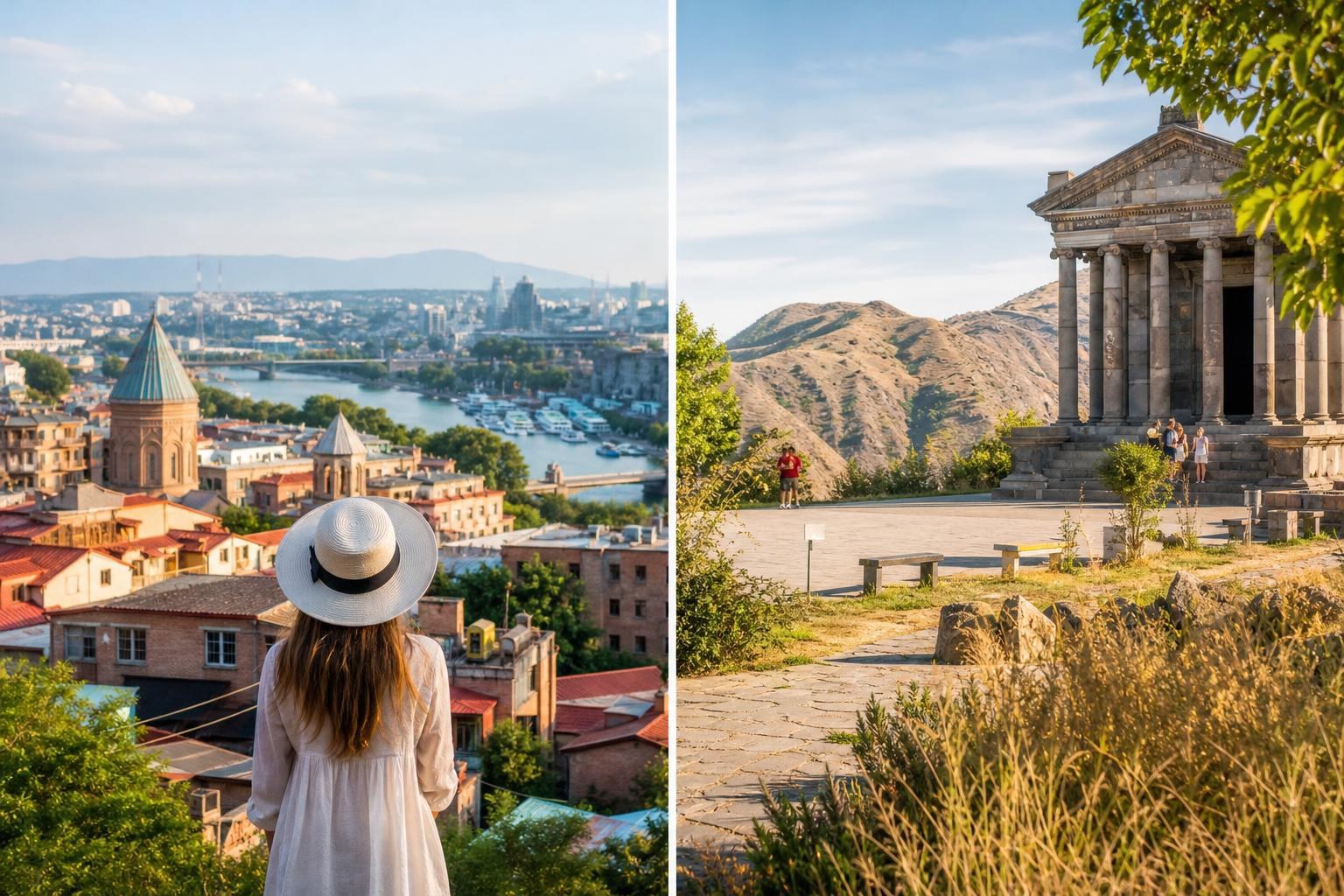
Garni deserves its own mention: it’s a Greco-Roman style temple, the only one of its kind standing in the former Soviet space. If ancient roots are your main reason for travelling, Armenia has a slight edge.
Road Quality and Driving: Navigating the South Caucasus
Georgia’s main highways are generally more developed than Armenia’s rural routes. The East-West highway linking Tbilisi with Kutaisi and the west has seen major upgrades, including new tunnels and dual carriageway sections. The Georgian Military Highway to Kazbegi is fully paved, though it climbs steeply and gets heavy truck traffic.
Once you leave the main corridors, conditions vary in both countries. Georgian mountain roads can be narrow and potholed, and a few routes, like the road to Tusheti, genuinely require a 4×4 and nerve. Armenian rural roads more often show their age, with patched asphalt, missing markings and sections of gravel even on routes to well-known monasteries.
Driving culture is assertive in both places. Expect overtaking on blind bends, livestock on the road and minibuses stopping without warning.
A few habits make life easier:
- Download offline maps (Google Maps or Maps.me) before leaving the capitals, as signal drops in mountains and gorges.
- Budget extra time: average speeds on rural roads are much lower than map estimates suggest.
- Avoid driving rural roads after dark, when animals and unlit trucks become a real hazard.
- Fill up whenever you see a station in remote areas.
Important: In Armenia, some roads in the south run close to the border with Azerbaijan. Check current advice before planning routes through Syunik and Tavush.
Winter Options: Skiing and Seasonal Accessibility
Georgia is the stronger winter destination. Gudauri, about two hours north of Tbilisi on the Military Highway, is the main draw: high-altitude slopes, good snow reliability and a growing reputation for freeride and heli-skiing. Bakuriani, in the Borjomi area, is gentler and more family-oriented, with a classic Soviet-era resort feel.
Svaneti’s Tetnuldi and Hatsvali add more options for those willing to travel further west. Access is the catch: the road to Gudauri and Kazbegi can close during heavy snowfall or avalanche risk, sometimes for a day or more.
Armenia’s main resort is Tsaghkadzor, roughly an hour from Yerevan. It’s compact, easy to reach and pleasant for a few days on the slopes, but the terrain and resort infrastructure are smaller than Gudauri’s. Many visitors combine it with sightseeing in Yerevan rather than building a full ski holiday around it.
Beyond skiing, winter shifts the experience in both countries. High mountain passes and some remote monasteries become hard or impossible to reach, while capitals stay lively. Tbilisi’s sulphur baths and Yerevan’s café culture are at their best in cold months.
Tip: For winter driving to ski resorts, check road status the morning you leave and carry chains or use a car with proper winter tyres, which rental companies should confirm on request.
Georgia and Armenia Itinerary: How to Combine Both
Combining the two is easier than most first-timers expect. Multi-country Caucasus trips typically run 9 to 17 days, often taking in Tbilisi’s Narikala Fortress, Lake Sevan and Garni Temple. The Tbilisi to Yerevan corridor is the natural spine.
A balanced 12-day plan looks something like this:
- Days 1-3: Tbilisi, with a day trip to Mtskheta
- Days 4-5: Kazbegi via the Military Highway, then back south
- Day 6: Kakheti wine country, or straight to the border
- Day 7: Cross into Armenia, stop at Haghpat and Sanahin in Lori
- Day 8: Dilijan and Lake Sevan
- Days 9-10: Yerevan, Garni and Geghard
- Days 11-12: Khor Virap, Areni and Noravank, or Tatev if time allows
Many travellers fly into Tbilisi and out of Yerevan, or the reverse, to avoid backtracking. Open-jaw flights are worth pricing out.
Crossing at Sadakhlo/Bagratashen
Sadakhlo on the Georgian side and Bagratashen on the Armenian side form the main crossing between the two capitals. It’s the most direct option and handles cars, marshrutkas, taxis and trucks. The crossing operates around the clock, though it’s best to confirm current status before travelling.
On foot or in a shared vehicle, you’ll exit Georgian control, walk or drive across the bridge and enter Armenian control. Waiting times depend on traffic: quiet mornings can be quick, while summer weekends and holidays bring queues.
Bring your passport, any required visa or e-visa, and, if driving, all vehicle documents. Customs officers may ask where you’re staying.
Taking a Rental Car Across the Border
Yes, you can drive a Georgian rental car into Armenia, but only if the rental company explicitly permits it and provides the right paperwork. Not all companies allow cross-border trips, and those that do usually charge extra.
We’ve covered the paperwork in detail in our guide to border permits and in our article on taking a rental car to Armenia, so check those before booking rather than assuming it will be fine at the counter.
Getting there by car: Tbilisi to Yerevan
- Starting city: Tbilisi
- Distance: about 290 km
- Drive time: 5-6 hours, plus border time
- Road condition: Paved but mountainous, with winding sections through the Debed Canyon
- 4×4 needed: No
- Parking: Plentiful in Yerevan, though central streets get busy
- Seasonal closures: Rare on this route
The route heads south from Tbilisi to Sadakhlo, then follows the Debed River gorge through Alaverdi before climbing toward Vanadzor and dropping to Yerevan. The gorge section is slow but scenic, and it passes right by Haghpat and Sanahin monasteries.
Break the drive in Lori if you can. Doing it in one push works, but you’ll miss some of the best monasteries in Armenia.
Note: Bolt and Yandex Go work in both capitals, which helps once you’ve returned the car or parked for the night.
The Final Verdict: Which Country Should You Choose?
There’s no universal winner in this matchup. It comes down to what you want from the trip.
Choose Georgia if you are:
- A hiker or mountain lover: Kazbegi, Svaneti and Tusheti are hard to beat in the region
- A wine and food traveller: Kakheti and the supra culture are reason enough to go
- A beach-and-mountains combiner: Batumi adds a coast Armenia lacks
- A skier: Gudauri and Bakuriani offer more terrain and resort choice
Choose Armenia if you are:
- A history buff: the monasteries, khachkars and Garni Temple run deep
- Someone after quieter sites: fewer crowds outside Yerevan
- A photographer drawn to stark scenery: volcanic plateaus, gorges and Ararat views
- A brandy enthusiast: Yerevan’s distillery tastings are a highlight
The cultural feel differs too. Tbilisi is cosmopolitan and fast-changing, while Georgian villages run on old rhythms and fierce hospitality. Yerevan is warm, café-filled and evening-oriented, while Armenian villages feel quieter and more reserved at first, before the coffee and fruit appear.
If you have ten days or more, combine both. For trips centred on driving Georgia, Triproadwayplanner’s route guides can help you plan the Georgian leg before heading south.
Frequently Asked Questions
Is it better to visit Georgia or Armenia first?
Start with whichever has the cheaper flight in. Georgia often has more direct connections, making Tbilisi a common entry point.
How many days do you need for both countries?
Ten days covers the highlights at a reasonable pace. Two weeks lets you add Svaneti or southern Armenia without rushing.
Can you take a bus from Tbilisi to Yerevan?
Yes. Marshrutkas and shared taxis run daily from Tbilisi, usually from the Ortachala area. Schedules change, so check locally.
Is the Georgia-Armenia border crossing safe?
Yes, the Sadakhlo-Bagratashen crossing is a routine, busy tourist and trade route.
Do Georgia and Armenia speak the same language?
No. Georgian and Armenian are unrelated languages with their own alphabets. Russian is widely understood in both, and English is common among younger people in the capitals.