
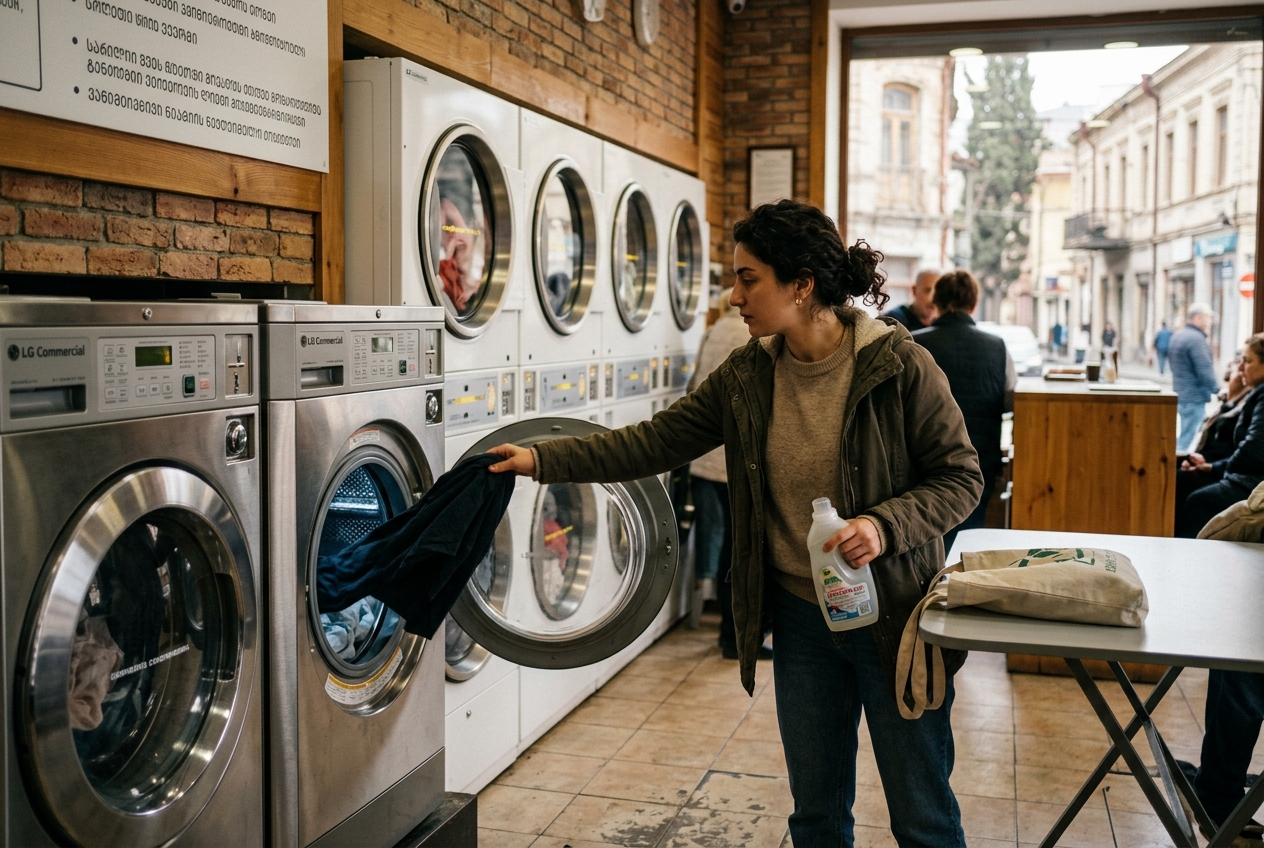
Georgia, the country tucked between the Caucasus Mountains and the Black Sea, has a reputation for incredible food, ancient wine culture, and hospitality so deep it’s practically a spiritual practice. But nobody warns you about the laundry situation. After a few days hiking in Kazbegi or sweating through Tbilisi’s summer humidity, you’ll need clean clothes, and your guesthouse sink just won’t cut it. Knowing how to find and use public washing machines and laundromats in Georgia can save you real time and frustration, whether you’re a backpacker on a budget or a digital nomad settling in for a few months.
The good news: Georgia’s laundromat scene has been growing, especially in Tbilisi and Batumi. The less good news: it’s still not as straightforward as walking into a coin-op in Brooklyn. Machines may have instructions in Georgian script (Mkhedruli) or Russian, payment methods vary wildly, and the cultural norms around shared laundry spaces are different from what you might expect. This guide covers everything from locating a facility to decoding cycle settings, so you can get your clothes clean without accidentally shrinking your favorite wool socks.
Finding Reliable Laundromats in Major Georgian Cities
Tbilisi is where you’ll find the most options, concentrated in neighborhoods popular with expats and tourists: Vera, Vake, Saburtalo, and the Old Town area. Batumi has a smaller but growing number of facilities, particularly near the boulevard and university district. Outside these two cities, your options thin out considerably. In smaller towns like Kutaisi, Mestia, or Sighnaghi, you’re more likely to rely on guesthouse washing machines or hand-washing.
The laundromat industry has been expanding modestly, and while specific Georgian data is limited, the broader regional trend shows steady growth. In Tbilisi, new self-service laundry spots have popped up in the last few years, many catering specifically to the influx of remote workers who arrived post-2020. If you’re staying in a residential neighborhood away from the tourist core, ask your landlord or neighbors: the Georgian word for laundry service is “samreckhao” (სამრეცხაო), and most locals will point you in the right direction.
Self-Service vs. Full-Service Options in Tbilisi and Batumi
Self-service laundromats in Tbilisi typically charge between 5 and 15 GEL per load, depending on machine size and location. You load the machine yourself, add your own detergent (or buy it on-site), and wait. These are most common in expat-heavy areas and near hostels.
Full-service options, sometimes called “wash and fold” or simply “laundry service,” are actually more widespread in Georgia than self-service spots. You drop off a bag of clothes, and someone washes, dries, and folds everything for you. Prices usually run 2-4 GEL per kilogram, with most places requiring a minimum of 3-5 kg. Turnaround is typically same-day if you drop off in the morning, or next-day for afternoon drop-offs. In Batumi, full-service is especially common near the tourist strip along Batumi Boulevard, where small shops cater to seasonal visitors.
The choice depends on your budget and patience. Self-service is cheaper per load but requires you to hang around for 60-90 minutes. Full-service costs a bit more but frees up your afternoon for exploring Narikala Fortress or eating khachapuri.
Using Google Maps and Local Apps to Locate Facilities
Google Maps is your best starting tool. Search for “laundromat” or “self-service laundry” in English, and you’ll get results in Tbilisi and Batumi. But here’s the trick: also search in Georgian. Type “თვითმომსახურების სამრეცხაო” (self-service laundry) or simply “სამრეცხაო” to find places that haven’t bothered with English-language listings.
Check the reviews carefully. Georgian Google Maps reviews are surprisingly detailed, and many are written in English by other travelers. Look for recent reviews from the last 3-6 months, since laundromats in Tbilisi open and close with some regularity. The app Tbilisi Guide (available on iOS and Android) occasionally lists laundry services, though it’s not comprehensive. For Batumi, the local Facebook groups for expats are goldmines: search “Batumi Expats” or “Batumi Digital Nomads” and use the group search function.
Bolt and Yandex Go, the ride-hailing apps dominant in Georgia, can get you to any laundromat quickly and cheaply. A ride across central Tbilisi rarely costs more than 5-8 GEL.
Understanding the Payment Systems and Costs
Money matters, and Georgian laundromats handle payment in ways that might surprise you. The systems range from old-school coin slots to modern app-based payments, sometimes within the same facility. Knowing what to expect before you walk in with a bag of dirty clothes and no cash will save you a headache.
Here’s a quick cost comparison to give you a sense of pricing. While these figures come from U.S.-based facilities, they illustrate how machine size affects price, a principle that holds true in Georgia as well, though Georgian prices are significantly lower:
| Machine Size | Cost (Douglasville, GA area) | Cost (Atlanta, GA area) |
|---|---|---|
| 20 lb washer | $3.50 | $5.00 |
| 80-90 lb washer | $14.00 | $14.00 |
| Wash & fold (per lb) | $1.39 (10 lb min) | Varies |
In Georgia the country, expect to pay roughly 5-10 GEL ($2-4 USD) for a standard self-service wash cycle and 3-7 GEL for a dryer cycle. Full-service wash and fold runs about 2-4 GEL per kilogram.
Navigating Coin-Operated Machines and Token Exchanges
Some older laundromats in Tbilisi still use coin-operated or token-based systems. These machines typically accept 1 GEL or 2 GEL coins. The problem: Georgia is increasingly cashless, and you might not have coins handy. A few facilities sell tokens at a front desk or from a vending-style machine near the entrance.
My advice: keep a small stash of 1 GEL and 2 GEL coins whenever you’re planning a laundry day. Break larger bills at a nearby grocery store or pharmacy before heading to the laundromat. Some older machines won’t give change, so having exact amounts ready matters.
Digital Payment Trends: QR Codes and Card Readers
Newer self-service laundromats in Tbilisi, particularly those opened after 2021, increasingly accept card payments and mobile transfers. The Bank of Georgia and TBC Bank apps both support QR code payments, which some machines now display. If you have a Georgian bank account (easy to open as a foreigner with a passport), this is the most convenient option.
International cards work at some locations but not all. Visa and Mastercard are more widely accepted than Amex. A few modern facilities have integrated with apps where you can start and pay for your wash cycle from your phone. Google Translate’s camera feature, with an offline Georgian language pack downloaded beforehand, is invaluable for reading payment instructions displayed only in Georgian.
Step-by-Step Guide to Operating Georgian Washing Machines
Walking up to a washing machine covered in Georgian script can feel intimidating, but the machines themselves are mostly standard European brands: Bosch, Samsung, LG, and Beko are the most common. If you’ve used a front-loading washer anywhere in Europe, you already know the basics. The challenge is purely linguistic.
Translating Common Laundry Terms from Georgian and Russian
Many machines in Georgian laundromats display controls in Georgian, Russian, or both. Here are the terms you’ll encounter most:
- რეცხვა (retskva) – Wash
- გამოწურვა (gamots’urva) – Spin
- გარეცხვა (garetskva) – Rinse
- ტემპერატურა (t’emp’erat’ura) – Temperature
- ბამბა (bamba) – Cotton
- სინთეტიკა (sintetika) – Synthetics
- შერეული (shereuli) – Mixed
Russian labels are also common, a legacy of the Soviet era. The older generation in Georgia is fluent in Russian, and many commercial machines were imported from Russian-speaking markets. Key Russian terms: стирка (stirka, wash), отжим (otzhim, spin), полоскание (poloskaniye, rinse). Download Google Translate’s offline packs for both Georgian and Russian before your laundry trip. The camera translation feature works remarkably well on machine labels.
Standard Cycle Settings and Temperature Controls
Most machines offer three to five main cycle options. For everyday clothes, the cotton or mixed cycle at 30-40°C works perfectly. Georgian tap water is relatively soft, which is actually great for laundry: your detergent will lather well and rinse clean.
Sorting your clothes by color and fabric before you arrive saves significant time and prevents the classic laundromat mistake of running three separate loads when one or two would have sufficed. A standard wash cycle runs 45-60 minutes. Spin speeds are usually adjustable: 800 RPM is fine for most clothing, while 1200 RPM works for towels and jeans but can damage delicates. If you’re unsure, choose the lower spin speed. It’s always safer to under-spin and air dry a bit longer than to pull a mangled sweater out of the drum.
Laundry Supplies and Etiquette in Public Spaces
Showing up prepared makes the whole experience smoother. Georgian laundromats aren’t always stocked with supplies the way some Western facilities are, and the social dynamics of shared spaces here carry their own expectations.
Where to Buy Detergent and Fabric Softeners Locally
You don’t need to pack detergent from home. Georgian supermarkets carry all the major brands. Spar, Carrefour, and Goodwill (a local chain, not the American thrift store) stock Persil, Ariel, Tide, and local alternatives. Single-use detergent pods are available and ideal for laundromat visits since you won’t need to haul a big bottle around.
For budget-conscious travelers, small sachets of powdered detergent are sold at corner shops (called “mini markets” locally) for 1-2 GEL. Fabric softener is optional but popular: Lenor and Vernel are the most common brands. Some self-service laundromats sell single-dose detergent packets at the counter for 1-3 GEL, though the markup is steep compared to buying at a grocery store.
Unwritten Rules for Sharing Machines in Busy Neighborhoods
Georgian culture places enormous value on respect and courtesy: the concept of “stumari ghvtisaa” (the guest is from God) extends into everyday public interactions. In a shared laundromat, this means a few things.
Don’t leave your clothes sitting in a finished machine for long. In busy Tbilisi neighborhoods like Saburtalo, machines are in demand, and leaving your load for 30 minutes after the cycle ends will frustrate other users. Set a timer on your phone and come back promptly. If someone else’s clothes are done and blocking a machine, the local custom is to wait a few minutes, then neatly place the items on a clean surface nearby: never on the floor.
Conversations happen easily in Georgian laundromats. Don’t be surprised if an older Georgian woman strikes up a chat (likely in Russian or Georgian, with enthusiastic hand gestures). This is normal and genuinely friendly. A smile and a “gamarjoba” (hello) go a long way.
Drying and Finishing Your Laundry
Getting your clothes washed is only half the battle. Drying in Georgia presents its own set of choices, shaped by climate, cost, and local habits.
Using Industrial Dryers vs. Traditional Drying Racks
Industrial dryers are available in most self-service laundromats and typically cost 3-7 GEL per cycle (usually 30-45 minutes). They work well for towels, jeans, and cotton basics. For anything delicate, synthetic, or wool, skip the dryer entirely.
The traditional Georgian approach to drying clothes is simple: hang them up. Walk through any residential neighborhood in Tbilisi, and you’ll see laundry strung across balconies and between buildings on lines. If you’re staying in an apartment, your balcony is your dryer. Tbilisi’s dry summer heat can have clothes bone-dry in 2-3 hours. Winter is trickier: temperatures drop and humidity rises, so indoor drying racks near a radiator become essential. Many guesthouses and Airbnbs provide drying racks, but if yours doesn’t, you can buy a foldable one at a household goods store for 15-25 GEL. The chain store “Zoommer” often carries them.
Batumi is a different story. The coastal humidity means air-drying takes significantly longer, especially from October through April. If you’re in Batumi during the rainy season, a dryer cycle at the laundromat is worth the extra few lari.
Alternative Solutions: Hotel Services and Guesthouse Facilities
Not every laundry situation requires a trip to a laundromat. Georgia’s hospitality infrastructure offers several alternatives that might suit your needs better, depending on where you’re staying and how long you’re in the country.
Hotels in Tbilisi and Batumi almost universally offer laundry services, though pricing varies dramatically. Budget hotels charge 10-20 GEL for a bag of laundry, while upscale spots like the Rooms Hotel or Radisson Blu can charge 5-10 GEL per individual item. Always ask for the price list before handing over your clothes.
Guesthouses, especially in rural areas like Svaneti, Tusheti, or Kakheti, often have a washing machine available for guest use. In many cases, the host will simply offer to wash your clothes for you: this is classic Georgian hospitality in action, not a business transaction. Offering to pay is polite, and most hosts will accept a small amount (5-10 GEL) or appreciate a small gift instead. In villages, where the nearest laundromat might be a two-hour drive away, this is often your only realistic option.
For digital nomads staying in Tbilisi long-term, some co-living spaces include laundry facilities in their monthly rent. Spaces like Terminal and Lokal in Tbilisi offer washing machines as part of their amenities, which eliminates the laundromat question entirely.
One more option worth mentioning: dry cleaning. Tbilisi has numerous dry cleaners, locally called “khimchistka” (from the Russian химчистка). These are ideal for suits, coats, and anything you wouldn’t trust to a standard machine. Prices start around 10 GEL per item, and turnaround is typically 1-3 days.
Doing laundry in Georgia is one of those small logistical challenges that becomes completely manageable once you know the system. Stick to Tbilisi or Batumi for self-service options, carry coins or set up a Georgian bank app for payments, download offline translation packs, and don’t overthink the machines: they’re the same brands you’d find anywhere in Europe. Full-service wash and fold remains the easiest path if you’d rather spend your time exploring the country than watching a spin cycle. Whether you’re scrubbing hiking mud out of your pants after Tusheti or refreshing your wardrobe mid-way through a month in Tbilisi, clean clothes are never more than a short Bolt ride away. Pack a few detergent pods in your bag, learn the word “samreckhao,” and you’re set.