
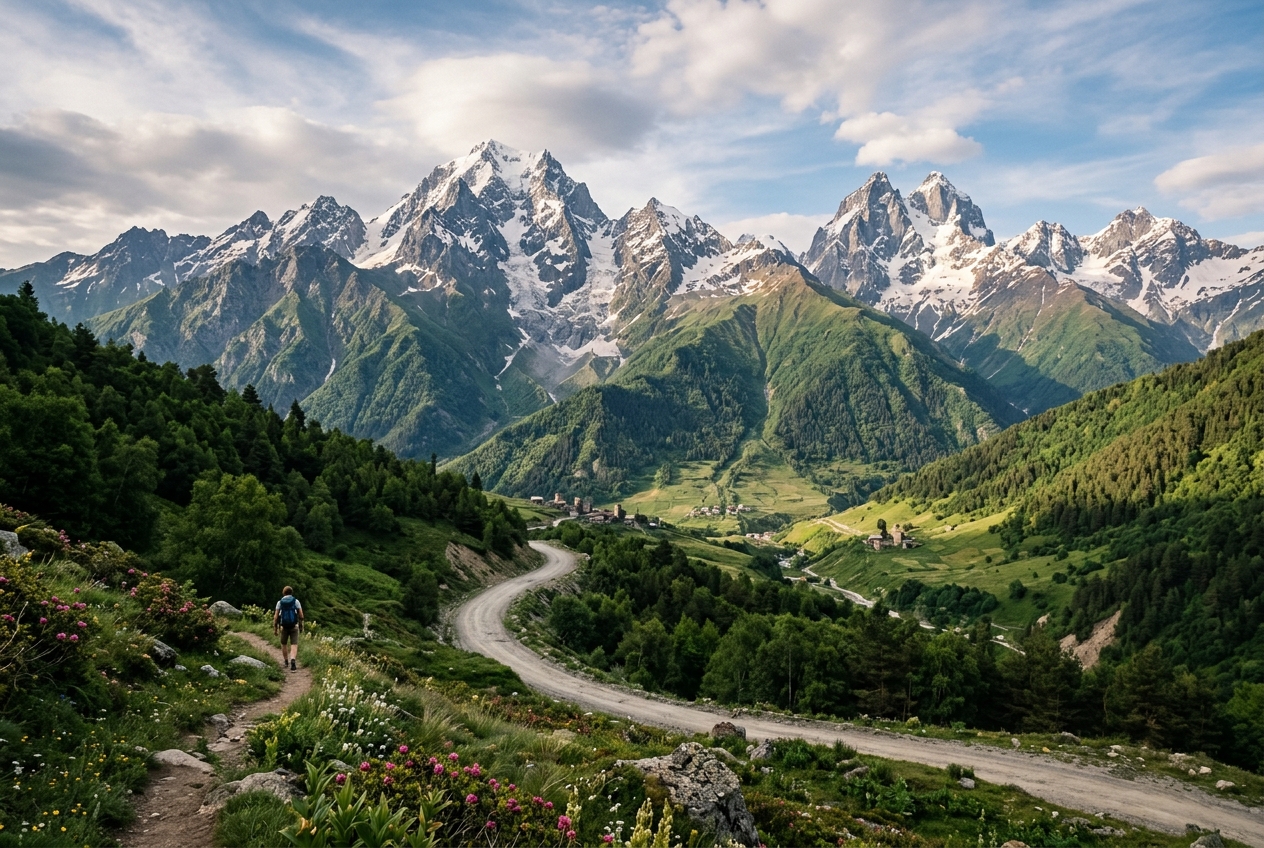
Georgia sits at the crossroads of Europe and Asia, a country where ancient civilizations clashed and traded beneath some of the most dramatic terrain on Earth. The Greater and Lesser Caucasus ranges frame this small nation like a crown, with summits that rival anything in the Alps and valleys that have sheltered distinct cultures for millennia. From the snow-capped giants along the Russian border to the rolling green ridges of the south, the mountains and peaks of Georgia define the country’s identity, its economy, and its future. In 2024, the country welcomed 13.92 million overnight visitors, with a significant portion drawn specifically to the highland regions. Whether you are a serious mountaineer eyeing a 5,000-meter summit or a casual hiker looking for wildflower meadows and medieval watchtowers, this country delivers an experience that feels both ancient and startlingly alive. I have spent time trekking through several of these regions, and the thing that strikes you most is the scale: these are not gentle hills. They are serious mountains with serious weather, and they demand respect.
Geological Foundations of the Blue Ridge Mountains
The Appalachian Chain in North Georgia
While the country of Georgia (Sakartvelo, as Georgians call it) is often confused with the U.S. state, the geological story here is entirely different and far older in terms of active mountain building. The Greater Caucasus range, which forms Georgia’s northern border, is one of the youngest and most tectonically active mountain chains in the world. These mountains began forming roughly 25 million years ago as the Arabian Plate collided with the Eurasian Plate, and they are still rising today at a rate of several millimeters per year.
The Greater Caucasus stretches approximately 1,200 kilometers from the Black Sea to the Caspian Sea, with Georgia claiming some of the highest and most glaciated sections. Unlike the ancient, weathered Appalachians, the Caucasus features sharp ridgelines, deep gorges, and active glaciers that continue to carve the terrain. The Lesser Caucasus, running through southern Georgia, is older and lower, with a more volcanic character that has produced fertile highland plateaus.
This tectonic activity means Georgia experiences regular seismic events. The country sits in a zone of ongoing compression, and the interplay between the two mountain systems creates a complex geological puzzle that geologists are still working to fully understand.
Distinctive Rock Formations and Terrain
The rock types across Georgia’s mountains vary dramatically. The Greater Caucasus is built primarily from Jurassic and Cretaceous-era sedimentary and metamorphic rocks: limestone, slate, schist, and granite. In the highest zones, crystalline basement rocks are exposed, forming the jagged peaks that define summits like Shkhara and Kazbegi.
The Lesser Caucasus tells a different story, dominated by volcanic and volcaniclastic formations. Obsidian deposits, basalt flows, and ancient lava fields are common in the southern highlands near Javakheti. This volcanic heritage has created some of Georgia’s most unusual terrain, including the high-altitude lakes and flat plateaus that feel more like Central Asia than the Caucasus.
Karst formations are another defining feature, particularly in western Georgia. The limestone bedrock has produced enormous cave systems, including Krubera Cave (Voronya), which held the record as the deepest cave on Earth at over 2,197 meters. These formations create dramatic gorges, underground rivers, and sinkholes that punctuate the mountain terrain.
Iconic High Points and Summits
Brasstown Bald: Georgia’s Highest Peak
Georgia’s true crown jewel is Mount Shkhara, which stands at 5,193 meters above sea level. Located in the Svaneti region along the border with Russia, Shkhara is not only Georgia’s highest point but also one of the most technically demanding climbs in the Caucasus. Its south face presents a massive wall of rock and ice that has challenged alpinists since the first recorded ascent in 1888.
| Peak | Elevation (m) | Region | Notable Feature |
|---|---|---|---|
| Mount Shkhara | 5,193 | Svaneti | Georgia’s highest; massive ice wall |
| Janga (Jangi-Tau) | 5,074 | Svaneti | Part of the Bezingi Wall |
| Mount Kazbegi (Mkinvartsveri) | 5,033 | Mtskheta-Mtianeti | Most accessible 5,000m peak |
| Shota Rustaveli Peak | 4,860 | Svaneti | Named after national poet |
| Tetnuldi | 4,858 | Svaneti | Popular ski mountaineering destination |
The top three highest peaks in Georgia all exceed 5,000 meters, placing them among the most significant summits in Europe, depending on where you draw the continental boundary. Shkhara is not a casual undertaking: it requires technical climbing skills, proper acclimatization, and experienced local guides.
Rabun Bald and the Eastern Continental Divide
Mount Kazbegi, known locally as Mkinvartsveri (“ice peak” in Georgian), holds a special place in the national imagination. At 5,033 meters, it is the third-highest peak in the country, but it is by far the most culturally significant. In Georgian mythology, Prometheus was chained to this mountain as punishment for giving fire to humanity. The Gergeti Trinity Church, perched at 2,170 meters on its slopes, is one of the most photographed sites in the entire Caucasus.
Kazbegi is also the most accessible of Georgia’s high peaks. The town of Stepantsminda sits at its base, connected to Tbilisi by the Georgian Military Highway, a spectacular drive that takes about three hours. From Stepantsminda, experienced climbers can summit Kazbegi in two to three days, though altitude sickness and unpredictable weather remain serious concerns. Several guiding companies operate from the town, and a meteorological station at 3,675 meters serves as a common base camp.
Blood Mountain and the Appalachian Trail
Tetnuldi, at 4,858 meters, has gained attention in recent years as a ski mountaineering destination. A modern ski resort opened on its lower slopes in 2016, bringing infrastructure to a region that was previously accessible only to serious trekkers. The mountain offers long descents through untouched powder, and the resort is still small enough to avoid the crowds that plague Alpine destinations.
Blood Mountain’s Caucasian equivalent in terms of trail culture might be the peaks along the Mestia to Ushguli trek in Svaneti. This multi-day route passes beneath several of Georgia’s highest summits and through villages that have been continuously inhabited for over a thousand years. The Svan towers, medieval defensive structures that dot these settlements, are UNESCO World Heritage Sites and give the trek a historical dimension that few mountain walks anywhere can match.
Outdoor Recreation and Trail Systems
Hiking the Benton MacKaye and Appalachian Trails
Georgia’s trail infrastructure has improved dramatically over the past decade, driven partly by tourism revenue: in 2019, tourism’s gross value added amounted to 8.1% of Georgia’s GDP, making it a serious economic priority. The Transcaucasian Trail (TCT) is the most ambitious project, aiming to create a long-distance hiking route spanning the entire Greater and Lesser Caucasus through Georgia and Armenia.
Currently, the best-established sections of the TCT run through Svaneti and Tusheti. The Mestia-to-Ushguli trek covers roughly 60 kilometers over four days and is the most popular multi-day hike in the country. Tusheti, in the northeast, offers a wilder and more remote experience, with trails connecting isolated villages across high passes that are snow-free only from June through September.
For day hikers, the areas around Kazbegi, Borjomi, and Lagodekhi offer well-marked trails ranging from easy riverside walks to strenuous ridge climbs. The Lagodekhi Protected Areas in the far east are particularly underrated, with trails leading to alpine lakes and waterfalls through dense primeval forest.
Waterfalls and Gorge Exploration
Georgia’s gorges are some of the most spectacular in the Caucasus. The Okatse Canyon in Imereti features a suspended walkway that hangs over a 140-meter drop, offering views into a narrow limestone gorge draped in ferns and moss. Martvili Canyon, nearby, can be explored by boat through turquoise pools beneath overhanging cliffs.
In the mountains proper, waterfalls are everywhere during the spring snowmelt. The Abudelauri Lakes trail near Juta village passes several cascades before reaching three high-altitude lakes, each a different color depending on the minerals in the surrounding rock. Kinchkha Waterfall, at roughly 100 meters, is one of the tallest in the country and was only made accessible to visitors in recent years after a viewing platform was constructed.
The Truso Valley, accessible from the Kazbegi region, offers a different kind of gorge experience: a wide glacial valley with travertine mineral deposits, abandoned villages, and carbonated mineral springs that bubble directly from the ground.
Biodiversity of the High Elevations
Unique Flora: From Mountain Laurels to Hardwoods
Georgia’s mountains contain one of the highest concentrations of plant biodiversity in the temperate world. The country hosts roughly 4,100 vascular plant species, with about 21% of them endemic, meaning they grow nowhere else on Earth. This richness exists because the Caucasus served as a refugium during the Ice Ages: species that were wiped out elsewhere in Europe survived in these sheltered valleys.
The vegetation zones shift dramatically with altitude. Lowland forests of beech and chestnut give way to subalpine birch and rhododendron thickets around 2,000 meters. Above the treeline, alpine meadows explode with wildflowers from June through August: gentians, primulas, campanulas, and dozens of species that botanists are still cataloging. The Colchic forests of western Georgia, named after the ancient kingdom of Colchis, contain relict species dating back millions of years, including the Colchic box tree and the wingnut tree.
Wildlife Habitats in the Chattahoochee National Forest
The Caucasus is a global biodiversity hotspot, and Georgia’s protected mountain areas shelter species that have disappeared from much of Europe. The East Caucasian tur, a wild goat found only in the Caucasus, inhabits the highest rocky zones above 3,000 meters. Brown bears, wolves, and lynx roam the forested slopes, though sightings require patience and luck.
The bearded vulture, or lammergeier, soars above the alpine zones with a wingspan exceeding 2.5 meters. Caucasian grouse, another endemic species, lives in the rhododendron thickets of the subalpine belt. The Vashlovani and Tusheti protected areas in the east are particularly rich in raptor species, while the western mountains host the Caucasian salamander, a species found in only a handful of mountain streams.
Georgia has established a network of national parks, strict nature reserves, and managed reserves covering roughly 10% of the country’s territory, with ongoing efforts to expand protections in critical corridors between existing reserves.
Cultural Heritage and Mountain Communities
History of the Cherokee Nation
Georgia’s mountain communities have histories stretching back thousands of years, with distinct cultures that developed in relative isolation due to the terrain. The Svans of Upper Svaneti speak their own language (Svan, related to but not mutually intelligible with Georgian) and maintained effective independence from lowland kingdoms for centuries. Their defensive towers, some dating to the 9th century, were built to protect against both invaders and feuding neighbors.
Tusheti, in the northeast, was historically home to the Tushetians, who practiced a syncretic blend of Christianity and pre-Christian mountain religions. Their annual migration with sheep flocks from the high summer pastures down to the Alazani Valley remains one of the last great pastoral transhumance traditions in Europe. The road into Tusheti, the Abano Pass at 2,926 meters, is considered one of the most dangerous roads in the world and is passable only from late June to mid-October.
The Khevsur people of the Khevsureti region preserved medieval customs, including chain mail armor and ritual sword fighting, well into the 20th century. Their villages, now largely depopulated, are among the most hauntingly beautiful abandoned settlements you will find anywhere.
Modern Gateway Towns and Tourism
Stepantsminda (formerly Kazbegi), Mestia, and Borjomi serve as the primary gateway towns for Georgia’s mountain tourism. Mestia has seen the most dramatic transformation, with a new airport, modern hotels, and the Tetnuldi ski resort bringing year-round visitors to a town that was nearly inaccessible 15 years ago.
Stepantsminda remains smaller and more intimate, with guesthouses run by local families where you will be fed khinkali (Georgian dumplings) and chacha (grape brandy) whether you want them or not. This is the Georgian concept of stumari ghvtisaa: the guest is a gift from God. Hospitality here is not transactional. It is deeply personal and occasionally overwhelming.
Borjomi, famous for its mineral water, serves as a gateway to the Borjomi-Kharagauli National Park, one of the largest in Europe. The town has a faded spa-era charm and makes a good base for families or those seeking gentler mountain experiences.
Practical tip: download Bolt for taxis and Google Translate offline packs for Georgian before heading into the mountains. English is widely spoken by younger Georgians in Tbilisi and Mestia, but in remote villages, you will need either basic Georgian, Russian, or a good translation app.
Conservation and the Future of Georgia’s Peaks
Georgia’s mountains face real threats: illegal logging, overgrazing, unregulated tourism development, and climate change are all pressing concerns. Glaciers in the Greater Caucasus have retreated significantly over the past century, affecting water supplies for downstream communities and altering alpine ecosystems.
The good news is that conservation funding has increased substantially. Since its establishment in 2019, the Georgia Outdoor Stewardship Program has allocated over $117 million to 62 conservation and outdoor recreation projects across the country, targeting both habitat protection and sustainable trail development. International organizations, including the WWF and the Caucasus Nature Fund, are active partners in these efforts.
The Transcaucasian Trail project represents a model for conservation-minded tourism: by creating economic incentives for mountain communities to protect their environment, it aims to make conservation and livelihoods mutually reinforcing rather than opposed. Local guesthouses, certified guides, and community-managed campsites are central to this vision.
Georgia’s peaks are not a museum. They are a living system of geology, ecology, and human culture that has been evolving for millennia. The challenge now is ensuring that the surge in tourism, which brings both money and pressure, strengthens rather than erodes what makes these mountains extraordinary. If you are planning a trip, consider hiring local guides, staying in family-run guesthouses, and spending your money in the communities that have been stewards of these landscapes for generations. That is the best way to ensure these mountains remain as wild and welcoming as they are today.