
Table of Contents
- The Georgian Lari (GEL): Tbilisi’s Official Currency
- When to Use Cash vs Card in Tbilisi
- Quick Reference: Payment Methods by Location
- Exchanging Money and Using ATMs
- Digital Payments and Mobile Wallets
- Practical Tips for Managing Your Travel Budget
Every traveler heading to Georgia’s capital eventually asks the same question: what currency will I need, and should I rely on cash or cards? It’s a fair thing to wonder, because Tbilisi sits at an interesting crossroads. The city has modernized rapidly over the past few years, with contactless terminals popping up in wine bars and boutique hotels, yet a grandmother selling churchkhela from a folding table on Dry Bridge still expects coins pressed into her palm. That tension between old and new makes the payment question more nuanced than a simple yes-or-no answer.
I’ve spent enough time fumbling through my wallet at Tbilisi marshrutkas and confidently tapping my phone at Fabrika to know that the real answer is: you need both. But the ratio matters, and it shifts depending on where you go, what you eat, and how deep into the city’s soul you want to wander. The Georgian lari is your ticket to everything here, and understanding how it works, where cards shine, and where cash is king will save you real money and real frustration. This guide breaks it all down with current rates, specific costs, and practical strategies that actually hold up on the ground in 2026.
The Georgian Lari (GEL): Tbilisi’s Official Currency
Georgia’s national currency is the lari, abbreviated GEL and symbolized by ₾. The National Bank of Georgia has issued and regulated the lari since 1995, replacing the Soviet-era coupon system that had caused hyperinflation in the early 1990s. The word “lari” itself comes from an old Georgian term meaning “hoard” or “property,” which feels fitting for a currency that’s become surprisingly stable for a small Caucasus nation.
Each lari divides into 100 tetri. You’ll encounter both coins and banknotes in daily transactions, and having a feel for what each denomination looks like will speed things up considerably. Tbilisi vendors are generally patient with tourists sorting through unfamiliar money, but knowing your 50 tetri from your 2 lari coin keeps the line moving at the Carrefour checkout.
One thing that catches people off guard: you cannot use US dollars, euros, or rubles to pay for goods in Tbilisi. Some tourist-heavy hotels might quote prices in dollars, but the actual transaction happens in lari. Always carry local currency.
Understanding Banknotes and Tetri Coins
Georgian banknotes come in denominations of 5, 10, 20, 50, 100, and 200 lari. Each features a prominent Georgian cultural figure: the 5 lari note shows the painter Niko Pirosmani, while the 50 lari note honors Queen Tamar. The notes are color-coded and reasonably distinct, so telling them apart isn’t difficult even in dim restaurant lighting.
Coins circulate in 1, 2, 5, 10, 20, and 50 tetri, plus 1 and 2 lari coins. The smaller tetri coins (1 and 2) are nearly useless for purchases and tend to accumulate in pockets. Most prices round to the nearest 5 or 10 tetri in practice. Keep a handful of 50 tetri and 1 lari coins for public transport, small tips, and vending machines. The 2 lari coin is your workhorse for metro tokens and small purchases at street kiosks.
Current Exchange Rates and Purchasing Power
As of early 2026, the lari trades at roughly 2.75-2.85 GEL per 1 USD and around 2.95-3.05 GEL per 1 EUR. These rates fluctuate, so check the National Bank of Georgia’s daily rates before your trip for the most current figures.
What does that mean for your wallet on the ground? Tbilisi remains remarkably affordable by European standards. A metro ride costs 1 lari (about $0.36). A solid khinkali lunch at a local spot runs 15-25 lari ($5-9). A glass of excellent Georgian wine at a mid-range restaurant is 8-15 lari. A taxi across the city center via Bolt rarely exceeds 8-10 lari. Your daily budget for food, transport, and activities can comfortably sit between 80-150 lari ($29-54) if you eat where locals eat and skip the tourist markup on Rustaveli Avenue.
When to Use Cash vs Card in Tbilisi
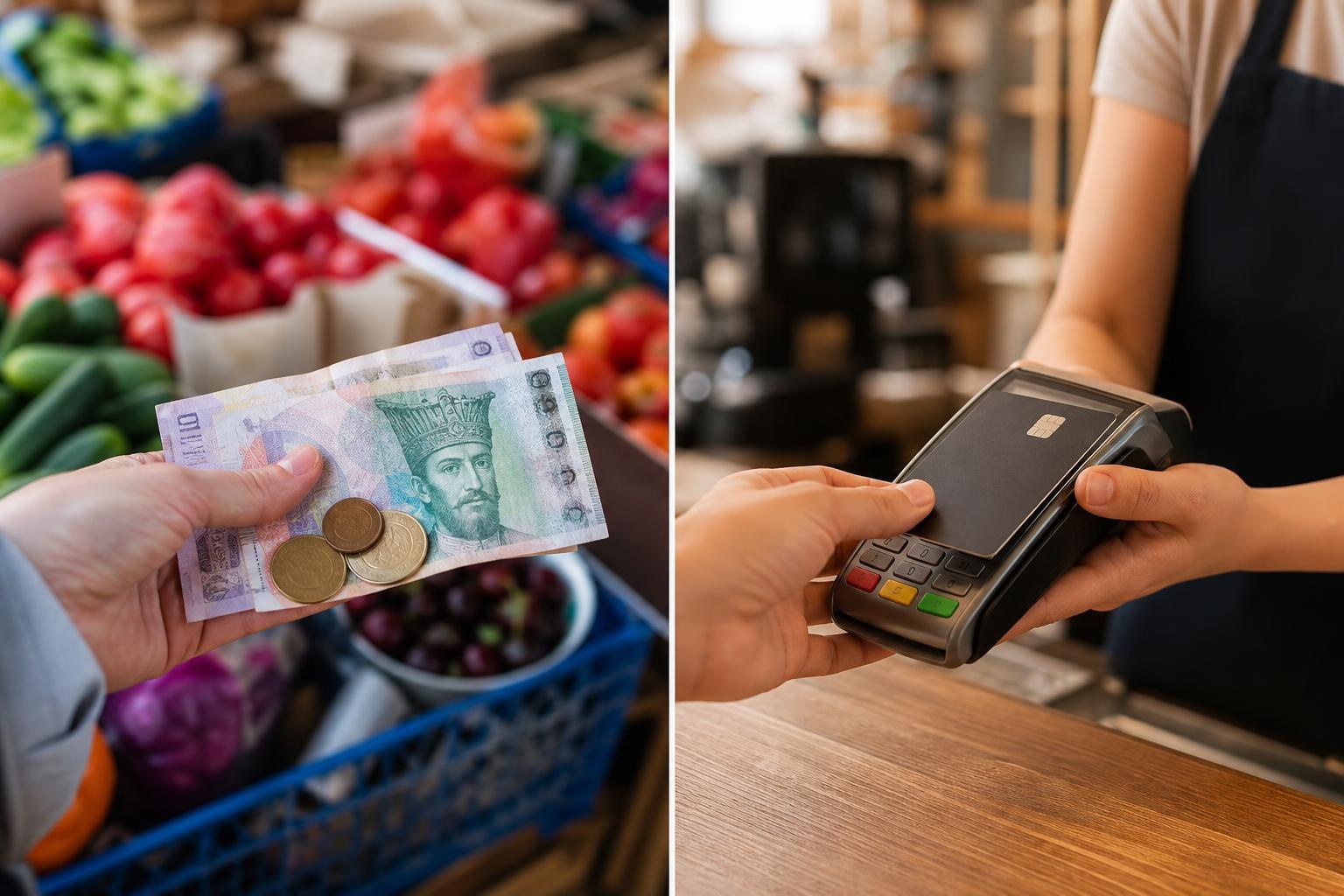
The cash-versus-card question in Tbilisi isn’t binary. It’s geographic and situational. The city’s payment infrastructure has grown fast: non-resident cashless spending in Georgian hotels and restaurants surged by 40% in December 2025 alone, reflecting both increased tourism and wider terminal adoption. But coverage isn’t uniform. Your experience paying in Vake or the Old Town tourist corridor will differ sharply from what happens in Didube market or a family-run dukani in Sololaki’s back streets.
A reasonable rule of thumb: carry 50-80 lari in cash daily as a baseline, and use your card wherever it’s accepted. This hybrid approach covers you for the unexpected taxi driver whose terminal is “broken” and the spontaneous churchkhela purchase, while letting you earn travel rewards on bigger restaurant bills and hotel stays.
Acceptance in Restaurants and Major Retailers
Cards work reliably at sit-down restaurants throughout central Tbilisi. Chains like Dunkin’ Georgia, Wendy’s, and local favorites like Machakhela and Shavi Lomi all accept Visa and Mastercard without issues. Supermarkets like Carrefour, Goodwill, and Nikora have had card terminals for years. Shopping malls, pharmacies, and most coffee shops are fully equipped.
Mastercard holds a strong position in the Georgian market, with more than 10.3 million debit cards in circulation across the country. Visa is equally well accepted. American Express, however, remains rare: don’t count on it outside international hotel chains.
Contactless payments (tap-to-pay) have become standard at most terminals. If your card supports it, you’ll rarely need to insert the chip or enter a PIN for transactions under 100 lari.
Why You Still Need Cash for Markets and Transport
Tbilisi’s character lives in its cash-only corners. The Dezerter Bazaar, the city’s largest food market, operates almost entirely on cash. Vendors selling spices, cheese, fruit, and tklapi (dried fruit leather) don’t carry terminals. The same goes for Dry Bridge flea market, where you’ll haggle over Soviet memorabilia and handmade jewelry with paper lari.
Public marshrutkas (minibuses) are cash-only. While the Tbilisi metro uses rechargeable Metromoney cards, you’ll need cash to load them at station kiosks. Street food vendors, small bakeries selling tone bread, and neighborhood corner shops often lack card readers. Taxis booked through Bolt accept in-app payment, but if you hail one on the street, expect to pay cash.
A practical list of common cash-only situations:
- Marshrutka rides (0.80 lari per trip)
- Dezerter Bazaar and Dry Bridge flea market purchases
- Street food: lobiani, khachapuri from a window bakery, corn on the cob
- Loading Metromoney transport cards
- Small tips at restaurants (even if you pay the bill by card)
- Roadside fruit sellers and churchkhela vendors
Quick Reference: Payment Methods by Location
This table gives you a snapshot of what to expect across common Tbilisi locations:
| Location | Card Accepted? | Cash Needed? | Notes |
|---|---|---|---|
| Mid-range restaurants | Yes | Optional for tips | Contactless widely available |
| Supermarkets (Carrefour, Nikora) | Yes | No | Self-checkout accepts cards |
| Dezerter Bazaar | No | Yes | Bring small bills |
| Dry Bridge flea market | No | Yes | Haggling expected |
| Metro | Metromoney card | Cash to load card | 1 lari per ride |
| Marshrutkas | No | Yes | Exact change preferred |
| Bolt/Yandex Go taxis | In-app payment | No | Add card in the app |
| Street taxis | No | Yes | Agree on price first |
| Wine bars and cafés | Yes | No | Tip in cash if you wish |
| Hotels and guesthouses | Usually yes | Small guesthouses vary | Confirm before booking |
| Pharmacies | Yes | No | GPC and Aversi chains |
| Street vendors | No | Yes | Coins and small bills |
Exchanging Money and Using ATMs
Getting lari into your hands is straightforward in Tbilisi, but the method you choose can cost you anywhere from nothing to a surprising chunk of your budget. The city has hundreds of exchange booths and ATMs, particularly concentrated around Freedom Square, Rustaveli Avenue, and Marjanishvili.
Best Practices for Currency Exchange Booths
Tbilisi’s exchange booths are a genuine advantage over most European capitals. Competition is fierce, rates are posted clearly, and commissions are rare. The best rates cluster along Kote Abkhazi Street and Leselidze Street in the Old Town. Compare two or three booths before committing: differences of 0.03-0.05 GEL per dollar add up on larger exchanges.
A few ground rules: always count your money before leaving the booth window. Avoid exchanging at the airport, where rates are consistently 5-8% worse than city center booths. Bring clean, undamaged bills: torn or heavily marked notes may be refused. USD and EUR get the best rates; GBP and other currencies are accepted but at less favorable spreads.
Don’t exchange everything at once. Convert enough for two or three days at a time. This protects you against rate fluctuations and limits your exposure if cash is lost or stolen.
Avoiding High ATM Fees and DCC Scams
ATMs from TBC Bank and Bank of Georgia are everywhere and accept international Visa and Mastercard. TBC Bank, one of Georgia’s largest financial institutions with strong quarterly results, operates a massive ATM network that’s generally reliable.
The biggest trap is Dynamic Currency Conversion (DCC). When an ATM asks if you’d like to be charged in your home currency, always say no. Choose to be charged in Georgian lari instead. DCC applies the bank’s own exchange rate, which typically includes a 3-5% markup over the interbank rate. It’s designed to look convenient, but it’s a terrible deal every single time.
Your home bank may also charge foreign ATM withdrawal fees of $2-5 per transaction. Minimize this by withdrawing larger amounts less frequently, or use a travel-friendly bank card (Wise, Revolut, or Charles Schwab) that reimburses ATM fees. Withdraw from bank-branded ATMs rather than independent machines, which sometimes add their own surcharge.
Digital Payments and Mobile Wallets
Georgia’s fintech sector has grown considerably, and Tbilisi reflects that shift. Apple Pay and Google Pay work at most contactless terminals, provided your linked card is Visa or Mastercard. Visa recently launched its Tap to Add Card feature in Georgia, making it even easier for travelers to load cards into digital wallets on the spot.
Local payment apps like TBC’s Space and Bank of Georgia’s BOG app dominate among residents, but these require a Georgian bank account and phone number, making them impractical for short-term visitors. The exception is if you’re a digital nomad staying longer than a month: opening a Georgian bank account is relatively simple with a passport, and the mobile banking apps are genuinely excellent.
For most tourists, the practical digital toolkit looks like this: Bolt for taxis (card payment in-app), Glovo for food delivery (card payment), and your phone’s native wallet for tap-to-pay at restaurants and shops. Download Google Translate’s offline Georgian language pack before you arrive. It won’t help you pay for anything, but it’ll help you read the menu at places where the staff doesn’t speak English.
The broader fintech trend in Georgia shows strong structural growth, with mobile and digital payment volumes climbing year over year. For travelers, this means the card-friendly footprint in Tbilisi will only keep expanding.
Practical Tips for Managing Your Travel Budget
Knowing the currency and payment options is half the equation. The other half is spending smart. Here are strategies that actually make a difference on the ground in Tbilisi.
Start by setting a daily budget in lari, not your home currency. Thinking in lari forces you to evaluate prices locally rather than constantly converting and thinking “that’s cheap” about everything. A 30 lari dinner feels different when you’ve mentally allocated 120 lari for the day versus thinking “oh, that’s only $11.”
Keep your cash in two places. A small amount in your pocket for daily purchases and the rest secured in your accommodation. Tbilisi is a safe city by most standards, but pickpocketing happens in crowded metro cars and tourist areas like any other capital.
Use the Wise or Revolut multi-currency card as your primary spending card. These fintech cards offer interbank exchange rates with minimal fees, saving you 2-4% compared to traditional bank cards on every transaction. Load them with GEL before you arrive or let them auto-convert at the point of sale.
Tipping in Tbilisi is appreciated but not obligatory. Most restaurants include a 10% service charge on the bill. If they don’t, leaving 10-15% in cash on the table is generous. For taxi drivers and small services, rounding up to the nearest lari is sufficient. Don’t tip at the Dezerter Bazaar: that’s not how it works there.
Track your spending with a simple notes app or a budgeting tool like Trail Wallet. Tbilisi’s affordability can create a false sense of unlimited budget, and wine-fueled dinners in Mtatsminda add up faster than you’d expect.
The best approach to managing currency in Tbilisi comes down to flexibility. Carry enough cash to feel comfortable in markets and on transit, use your card everywhere else, decline DCC at every ATM, and exchange money at competitive city-center booths rather than the airport. This combination keeps fees low, convenience high, and lets you focus on what you actually came here for: the food, the wine, the crumbling balconies, and the warmth of a culture where stumari ghvtisaa, the guest is a gift from God, isn’t just a saying but a lived reality you’ll feel from your first hour in the city.