
Table of Contents
- Discovering Tbilisi: A Quick Overview of Georgia’s Capital
- Ranked: The Top 10 Must-Visit Attractions in Tbilisi
- Historic Landmarks and Ancient Fortifications
- Cultural Hubs and Modern Architectural Marvels
- Scenic Viewpoints and Nature Escapes
- Practical Travel Tips for Navigating the City
Tbilisi has a way of catching travelers off guard. You arrive expecting a small post-Soviet capital and instead find a city where fourth-century churches sit beneath a hilltop fortress, where sulfur baths steam next to art nouveau facades, and where a glass bridge glows over the Mtkvari River at night. The city ranked second among the world’s top trending travel destinations for 2026, and the surge of interest is well-earned. Having walked these streets across multiple seasons, I can tell you the best places to visit in Tbilisi aren’t always the ones that top generic travel lists. Some are, sure, but others are the kind of spots you stumble into on a side street and remember for years. This ranking reflects a mix of historical weight, visual impact, cultural relevance, and the simple question: would I bring a friend here? If you’re planning a trip to Georgia’s capital, this is the honest breakdown of where your time is best spent.
Discovering Tbilisi: A Quick Overview of Georgia’s Capital
Tbilisi, or “Tpilisi” in Georgian, takes its name from the word “tbili,” meaning warm, a nod to the natural hot springs that first drew settlers here in the fifth century. The city sits in a valley along the Mtkvari River, hemmed in by the foothills of the Caucasus Mountains. That geography gives it a dramatic vertical quality: neighborhoods climb hillsides, cable cars cross gorges, and viewpoints appear around unexpected corners.
Georgia, or Sakartvelo as Georgians call their country, has spent centuries at the crossroads of empires: Persian, Ottoman, Russian, Soviet. That layered history is visible everywhere in Tbilisi, from the carved wooden balconies of the Old Town to the brutalist apartment blocks on the outskirts. The population hovers around 1.2 million, and the city functions as the country’s political, economic, and cultural center.
What strikes most first-time visitors is the cost. A metro ride costs 1 GEL (about $0.35 USD), a plate of khinkali at a solid local restaurant runs 8-12 GEL, and a night in a well-reviewed guesthouse in the Old Town can be had for $30-50 USD. That affordability, combined with Georgia’s visa-free policy for citizens of over 90 countries, has made Tbilisi one of the most accessible capitals in Europe. The city has also seen significant infrastructure upgrades and new cultural projects launching in 2026, making this a particularly good year to visit.
Ranked: The Top 10 Must-Visit Attractions in Tbilisi
Ranking Tbilisi’s best spots requires weighing different kinds of experiences against each other. A fortress isn’t competing with a creative hub on the same terms, so I’ve tried to balance historical significance, visual payoff, uniqueness, and accessibility. Here’s my ranked list:
- Narikala Fortress: unmatched views, deep history, free entry
- Abanotubani Sulfur Baths: a genuinely unique cultural experience
- Holy Trinity Cathedral (Sameba): the most visually commanding structure in the city
- The Old Town: the soul of Tbilisi, walkable and endlessly interesting
- The Bridge of Peace and Rike Park: modern Tbilisi at its most photogenic
- Mtatsminda Park and Funicular: the best panoramic views
- Fabrika: the creative pulse of the city
- Chronicle of Georgia: hauntingly beautiful and almost never crowded
- Rustaveli Avenue: the cultural spine of the capital
- Dry Bridge Market: the most character-filled flea market in the Caucasus
Comparison of Top Sites by Experience Type
| Attraction | Experience Type | Time Needed | Cost | Best For |
|---|---|---|---|---|
| Narikala Fortress | History / Views | 1-2 hours | Free (cable car 2.50 GEL) | Photographers, history lovers |
| Abanotubani Baths | Wellness / Culture | 1-3 hours | 30-150 GEL per room | Couples, solo relaxers |
| Holy Trinity Cathedral | Architecture / Spirituality | 45-90 min | Free | Anyone |
| Old Town | Walking / Exploration | Half day | Free | Everyone |
| Bridge of Peace / Rike Park | Modern Design / Leisure | 30-60 min | Free | Evening strolls |
| Mtatsminda Park | Views / Family Fun | 2-3 hours | Funicular 15 GEL round trip | Families, sunset seekers |
| Fabrika | Nightlife / Art | 1-3 hours | Free entry | Creatives, younger travelers |
| Chronicle of Georgia | Monument / Views | 1 hour | Free | History buffs, off-the-beaten-path seekers |
Historic Landmarks and Ancient Fortifications
Tbilisi’s identity is inseparable from its fortifications and ancient quarters. The city has been conquered, burned, and rebuilt at least 29 times throughout its history, and the structures that survived tell that story better than any museum placard. Walking through the oldest parts of the city, you’re tracing the footsteps of Persian governors, Georgian kings, and Soviet planners who each left their mark on the stone.
What makes Tbilisi’s historic sites special compared to, say, Prague or Rome is their rawness. Restoration work has been careful but not sanitized. Walls crumble in places. Vines grow through medieval masonry. The city doesn’t feel like it’s performing its history for tourists; it’s simply living inside it.
Narikala Fortress and the Mother of Georgia
Narikala Fortress has overlooked Tbilisi since the fourth century, making it older than the city’s official founding date. The original structure was a Persian citadel, expanded by Arab emirs in the seventh century and later reinforced by the Mongols and Ottomans. What remains today are mostly the walls and towers from the seventh and eighth centuries, plus the restored St. Nicholas Church inside the complex, rebuilt in the 1990s using original plans.
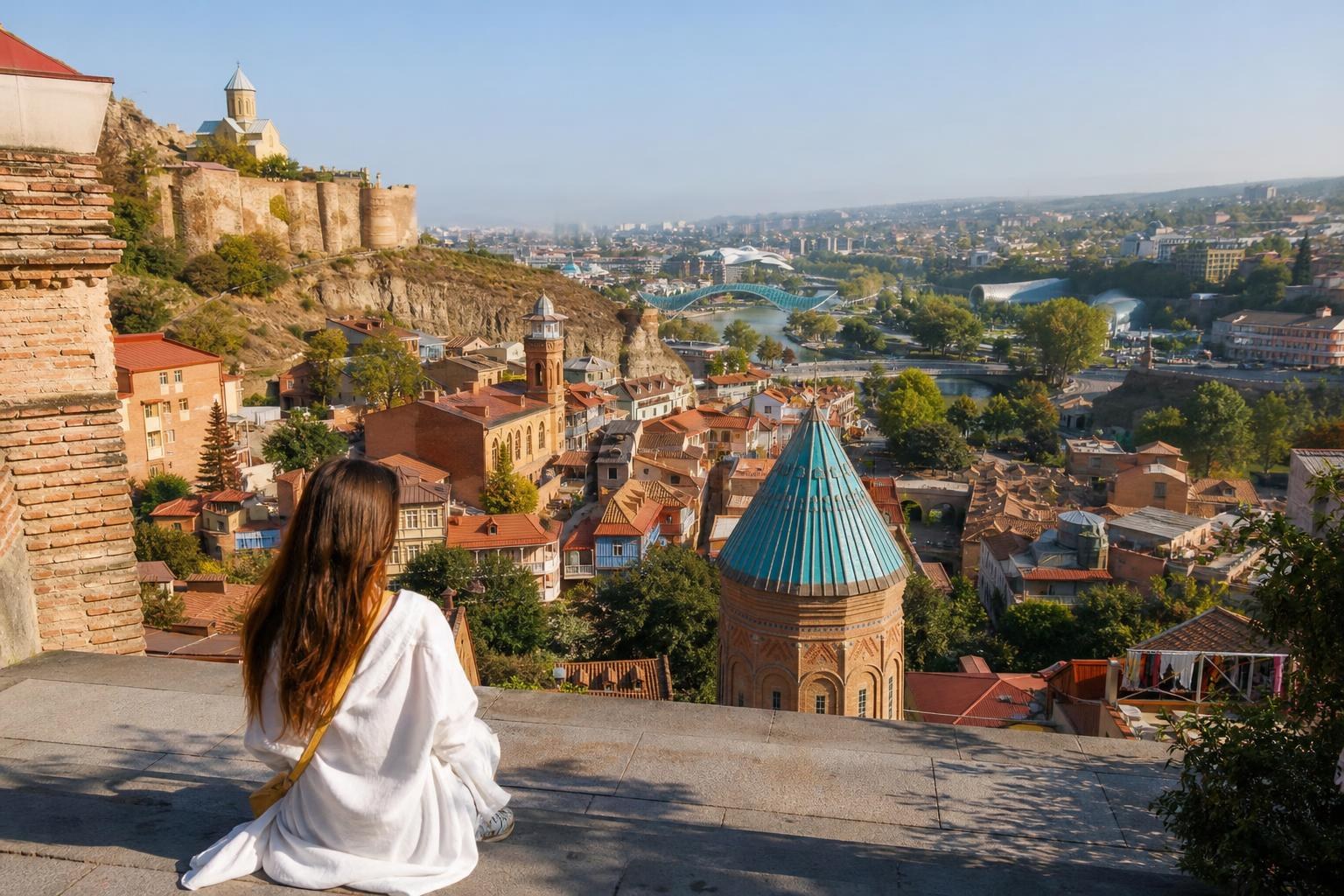
The fastest way up is the cable car from Rike Park, which costs 2.50 GEL and takes about two minutes. I’d recommend walking down rather than riding back: the trail descends through the Botanical Garden (entry 4 GEL), which is one of the most peaceful spots in the city. Standing on the fortress walls at sunset, with the Old Town spreading below and the Mtkvari cutting through the valley, is the single best visual experience Tbilisi offers.
The 20-meter aluminum Mother of Georgia statue (Kartlis Deda) stands on the ridge near the fortress. She holds a sword in one hand and a bowl of wine in the other: a symbol of the Georgian ethos that you fight enemies but welcome guests. The Georgian phrase “stumari ghvtisaa,” meaning “a guest is a gift from God,” is more than a saying here. I’ve had taxi drivers refuse payment after long conversations, and village grandmothers press jars of homemade tkemali into my hands at bus stops.
The Old Town (Altstadt) and Abanotubani Sulfur Baths
The Old Town, centered around the Shardeni and Erekle II streets, is where Tbilisi’s character concentrates most densely. Carved wooden balconies hang over narrow lanes, wine bars occupy former caravanserais, and street musicians play on corners where traders once haggled in Persian, Armenian, and Georgian simultaneously. The neighborhood is compact enough to explore in a few hours but rich enough to reward multiple visits.
Abanotubani, the bath district, sits at the eastern edge of the Old Town along the Tsavkisis-Tskali River. The domed brick bathhouses have operated continuously since the thirteenth century, fed by naturally heated sulfur springs that emerge at around 40-46 degrees Celsius. A private room at Orbeliani Baths (the blue-tiled facade you’ve seen in every photo) runs 80-150 GEL depending on the hour, while the public sections at Bath No. 5 cost as little as 5 GEL. The experience is less spa and more ritual: you soak in the mineral water, get scrubbed raw by a kisi-wielding attendant, and emerge feeling like a new person. It’s one of the few travel experiences I’d call genuinely irreplaceable.
Cultural Hubs and Modern Architectural Marvels
Tbilisi isn’t stuck in its past. The city has invested heavily in contemporary architecture and creative spaces over the past decade, and the contrast between ancient and modern is part of what makes it visually compelling. International media have taken notice: Condé Nast Traveler has recommended Georgia as a destination for its unique blend of tradition and emerging cultural energy.
Holy Trinity Cathedral (Sameba)
Sameba is hard to miss. Completed in 2004, it’s the largest religious building in the South Caucasus, standing 87 meters tall on St. Ilia Hill. The cathedral was built to mark 2,000 years of Christianity and 1,500 years of the Georgian Orthodox Church’s autocephaly. It’s a relatively new structure, but it was designed using traditional Georgian ecclesiastical architecture, and the interior frescoes were painted by hand over several years.
Visiting Sameba is free. Women should bring a headscarf (they’re available at the entrance), and both men and women need to cover their knees. The interior is vast and dimly lit, with golden iconography covering the walls. Even if you’re not religious, the scale and craftsmanship are worth the 20-minute walk uphill from the Old Town. Sunday morning services, when the polyphonic chanting fills the space, are particularly powerful.
The Bridge of Peace and Rike Park
The Bridge of Peace, designed by Italian architect Michele De Lucchi and completed in 2010, is a 150-meter pedestrian bridge made of steel and glass that spans the Mtkvari River. At night, 30,000 LED lights animate its canopy in shifting patterns. It connects the Old Town to Rike Park, a green space on the left bank that includes playgrounds, a concert venue, and the starting point of the Narikala cable car.
The bridge polarized locals when it was built. Some called it a giant sanitary pad. Others saw it as a symbol of Georgia’s European aspirations. Whatever your aesthetic opinion, it photographs beautifully at dusk and serves as a useful pedestrian connection between the old and new parts of the city. Rike Park itself is a good place to sit with a 2 GEL coffee from a nearby kiosk and watch the fortress glow above the city.
Fabrika: The Heart of Tbilisi’s Creative Scene
Fabrika is a former Soviet sewing factory in the Marjanishvili neighborhood, converted into a hostel, co-working space, and creative hub. The courtyard fills with artists, digital nomads, and local students most evenings. There are pop-up shops, a tattoo studio, several bars, and rotating art exhibitions. Rooms at the hostel start at around $10-15 USD per night for a dorm bed.
What makes Fabrika worth visiting even if you’re not staying there is the atmosphere. It’s the closest thing Tbilisi has to a cultural commons: a place where the city’s young creative class actually hangs out. On any given evening, you might catch a DJ set, a documentary screening, or just a group of Georgian and international twenty-somethings arguing about wine versus beer. The courtyard murals change regularly, and the energy shifts with the seasons.
Scenic Viewpoints and Nature Escapes
One of the things I appreciate most about Tbilisi is that you’re never more than 15 minutes from a viewpoint or a green space. The city’s topography guarantees it. Hills ring the valley on all sides, and several of them are accessible by public transit or a short hike.
Mtatsminda Park and the Funicular Railway
Mtatsminda Park sits atop the mountain of the same name, 770 meters above sea level. The funicular railway that climbs to it was originally built in 1905, making it one of the oldest in the former Soviet Union. The current cars were modernized, and a round trip costs 15 GEL. The ride itself takes about five minutes and offers increasingly dramatic views of the city as you ascend.
The park at the top is a mix of amusement rides, restaurants, and walking paths. The Ferris wheel provides 360-degree views of Tbilisi and the surrounding mountains. On clear days, you can see the snow-capped peaks of the Greater Caucasus to the north. I’d recommend going up about an hour before sunset, walking the trails, and then riding the Ferris wheel as the city lights come on below. The restaurant at the upper funicular station serves decent Georgian food at only slightly inflated prices (mains 18-30 GEL).
Chronicle of Georgia: The Stonehenge of Tbilisi
This is the most underrated site in the city, and it frustrates me that most travel guides barely mention it. The Chronicle of Georgia is a cluster of 16 massive stone pillars, each standing 35 meters tall, located on a hill overlooking the Tbilisi Sea (actually a reservoir). Georgian sculptor Zurab Tsereteli designed them in 1985, but the monument was never officially completed.
The pillars are carved with scenes from Georgian history and biblical narratives. The lower sections depict historical figures: kings, queens, and warriors. The upper portions show scenes from the life of Christ. The craftsmanship is extraordinary, and the setting, on a windswept hill with the reservoir below and the city in the distance, gives the whole place a solemn, almost mystical quality. Getting there requires a taxi (about 10-15 GEL from the center) since public transport connections are limited. Go in the late afternoon when the light hits the carvings at an angle.
Practical Travel Tips for Navigating the City
Getting around Tbilisi is straightforward once you understand the system. The metro has two lines and covers the main corridor from the train station through the center to Saburtalo. A single ride costs 1 GEL using a refillable Metromoney card, which also works on buses and cable cars. For areas the metro doesn’t reach, Bolt is the go-to ride-hailing app, and most rides within the city cost 5-12 GEL.
Download Google Translate with the Georgian offline pack before you arrive. While younger Tbilisians often speak English, older residents and those outside the tourist center typically speak Georgian and Russian. Georgia’s EF English Proficiency Index score remains in the “low” category, so having a translation tool saves real headaches at pharmacies, markets, and marshrutka stations.
Tbilisi is remarkably safe for a capital city. Solo female travelers consistently report feeling comfortable walking alone at night in the central neighborhoods. The tourist police are responsive and generally helpful. A few things to be aware of: avoid discussing the Russia-Georgia conflict or the status of Abkhazia and South Ossetia with strangers unless they bring it up first. These are sensitive topics. Also, dress modestly when visiting churches: this is a deeply Orthodox Christian country, and locals appreciate the respect.
The best months to visit are May, June, September, and October. July and August bring temperatures above 35°C, and the Old Town becomes uncomfortably hot. Spring and early autumn offer warm days, manageable crowds, and lower hotel prices. The city continues to see growing international attention, so booking accommodation a few weeks in advance during peak months is smart.
For currency, ATMs are everywhere and dispense Georgian Lari (GEL). Most restaurants and shops accept card payments, but carry cash for taxis, markets, and smaller establishments. A reasonable daily budget for a mid-range traveler is $40-60 USD, covering accommodation, meals, transport, and a couple of attractions.
Tbilisi rewards the traveler who wanders without a rigid itinerary, but having a ranked list of priorities helps when your time is limited. Whether you spend three days or three weeks, the city has a way of rearranging your expectations about what a European capital can be: ancient and modern, affordable and sophisticated, proudly Georgian and genuinely welcoming to outsiders. Start at Narikala, soak in the sulfur baths, eat until you can’t move, and let the city do the rest.