
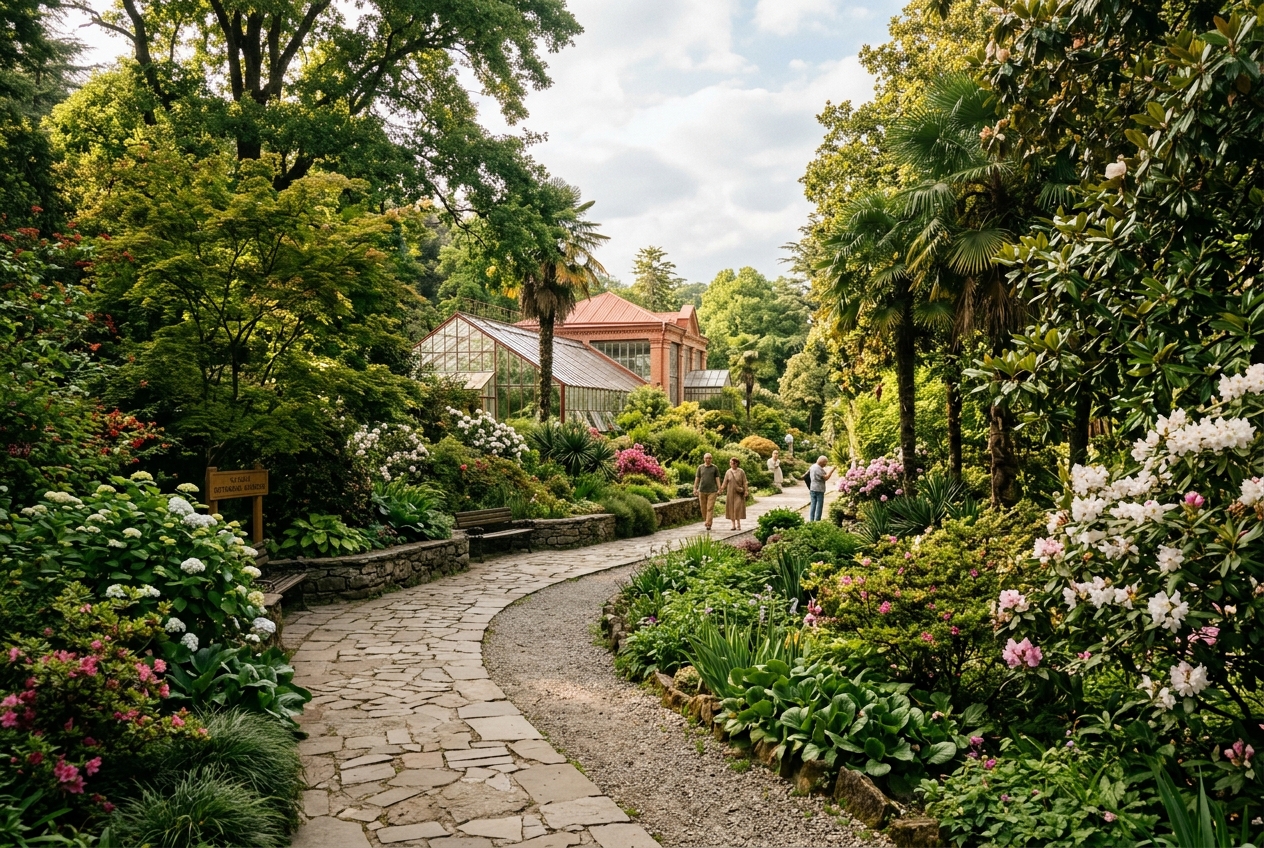
Tucked into the hills above Georgia’s second-largest city, a seven-hectare green space has been quietly growing for well over a century. The Kutaisi Botanical Garden doesn’t compete with the flashier attractions of Tbilisi or the coastal energy of Batumi. It doesn’t need to. This is a place where 400-year-old oaks dwarf everything around them, where rare Colchic species grow alongside imports from East Asia, and where a tiny chapel built inside a living tree draws visitors who can’t quite believe what they’re seeing. For a country that welcomed 6.4 million international visitor trips in 2024, a 4.6% annual increase, Kutaisi is becoming a serious destination in its own right. The botanical garden sits at the heart of that shift, offering something that no museum or restaurant can: a living, breathing record of the region’s extraordinary biodiversity. Whether you’re a plant enthusiast, a history nerd, or just someone looking for a peaceful afternoon away from the city center, this place deserves a spot on your itinerary.
Origins and History of the Garden
Establishment in the 19th Century
The garden’s roots stretch back to the mid-1800s, when the Russian Empire still governed much of the South Caucasus. During this period, botanical gardens were being established across the empire’s territories, partly for scientific study and partly as symbols of imperial ambition. Kutaisi, as a regional administrative center in western Georgia, was a natural candidate for such a project.
The original plot was modest, but its location on a hillside above the Rioni River gave it a microclimate well suited for diverse plantings. Early curators focused on cataloging the native flora of the Colchis lowlands and the surrounding Imeretian hills, a region already recognized by European botanists as unusually rich in endemic species. The garden grew slowly through the late 19th century, accumulating specimens from across the Caucasus and beyond.
What makes this origin story interesting is how different it is from the grand imperial gardens of St. Petersburg or Moscow. This wasn’t a showcase for aristocratic leisure. It was a working collection, built by people who were genuinely fascinated by what grew in these hills. That practical, scientific spirit has shaped the garden’s character ever since.
The Legacy of the ‘Farm Garden’
Locals sometimes refer to the site by an older name that roughly translates to “farm garden,” a nod to its early function as a place where agricultural and horticultural experiments took place alongside pure botanical research. During the Soviet era, the garden served dual purposes: it was both a public park and a research station where agronomists tested crop varieties suited to western Georgia’s humid subtropical climate.
This agricultural legacy is still visible in certain sections of the garden, where fruit trees and medicinal plants grow alongside purely ornamental species. The Soviet period also brought expansion. New sections were added, pathways were formalized, and the collection grew to include species from Central Asia, the Far East, and the Mediterranean.
After Georgian independence in 1991, the garden went through a rough patch, as did most public institutions. Funding dried up, maintenance suffered, and some sections fell into disrepair. But the core collection survived, and in recent years, renewed interest in Kutaisi’s cultural and natural heritage has brought fresh attention and resources to the site. The garden today is a palimpsest of all these eras: imperial ambition, Soviet pragmatism, post-independence neglect, and contemporary revival.
Geographic Layout and Diverse Flora
Exotic Species and Global Collections
Spread across its seven hectares, the garden houses approximately 700 species of plants, trees, and shrubs. That number might not rival the tens of thousands at Kew or the New York Botanical Garden, but for a regional collection in a small country, it’s impressive, and the density of interesting species per square meter is genuinely high.
The exotic collections are organized loosely by geographic origin. You’ll find Japanese maples alongside Chinese magnolias, North American conifers near Mediterranean cypresses. Some of the most striking specimens are the bamboo groves, which thrive in Kutaisi’s warm, humid climate and give certain corners of the garden a distinctly East Asian feel.
One section that catches most visitors off guard is the palm collection. Western Georgia’s climate, influenced by the Black Sea and protected by the Greater Caucasus mountains, is mild enough to support several palm species outdoors year-round. Walking through a palm-lined path in a country most people associate with mountain villages and ancient churches creates a pleasant cognitive dissonance.
| Collection Area | Notable Species | Origin Region |
|---|---|---|
| East Asian Grove | Japanese maple, Chinese magnolia, bamboo | Japan, China |
| Mediterranean Section | Cypress, laurel, olive | Southern Europe |
| North American Conifers | Sequoia variants, Douglas fir | Western North America |
| Subtropical Palms | Trachycarpus, Chamaerops | Southeast Asia, Mediterranean |
| Medicinal Plants | Chamomile, valerian, mint varieties | Caucasus, Central Asia |
Native Georgian Plants and Endemic Trees
The garden’s most scientifically valuable sections are those dedicated to the native flora of the Colchis region. This area of western Georgia is a recognized biodiversity hotspot, home to plant species that have survived since the Tertiary period, essentially living fossils that disappeared from the rest of Europe during the ice ages but persisted in the sheltered valleys of the Caucasus.
Among the most notable endemic trees are the Colchic box (Buxus colchica) and the Imeretian oak. The garden maintains healthy specimens of both, along with several varieties of wild grape, which carry special significance in a country that claims to be the birthplace of winemaking. Georgian viticulturists have identified over 500 native grape varieties, and a few of the rarer ones can be found growing here.
The native plant section also includes species used in traditional Georgian medicine and cooking. Wild herbs like pennyroyal and mountain thyme grow in designated beds, and the garden occasionally hosts educational events focused on ethnobotany, the study of how local cultures use plants. For visitors interested in the deeper roots of Georgian food culture, this section offers context that no restaurant menu can provide.
The Famous Chapel in the Oak Tree
If the botanical garden in Kutaisi has a single must-see attraction, it’s the chapel built inside a centuries-old oak tree. The tree itself is estimated to be around 400 years old, with a trunk so massive that its hollow interior was large enough to be converted into a functioning place of worship. The chapel opened in January 2014 and can accommodate about three people at a time, making it one of the smallest churches in the world.
The concept isn’t entirely unique to Georgia: tree chapels exist in a few other European countries, most notably in France. But the Kutaisi version carries particular weight in a country where Orthodox Christianity is deeply woven into daily life and national identity. Georgia adopted Christianity as a state religion in 337 AD, making it one of the oldest Christian nations on earth, and the idea of a sacred space growing organically from a living tree resonates with a culture that sees the divine in nature.
Inside, the chapel is sparse: a few small icons, candles, and just enough room to stand and pray. There’s no formal service schedule, and visitors of any faith (or none) are welcome to step inside. The experience is intimate in a way that Georgia’s grand cathedrals, beautiful as they are, simply can’t replicate. I’ve heard travelers describe it as one of the most unexpectedly moving moments of their trip, and I understand why. There’s something about ducking into the heart of a living tree and finding a sacred space that short-circuits your expectations.
The oak itself is worth admiring from the outside, too. Its canopy is enormous, and the gnarled bark tells a story of centuries of growth, storm damage, and resilience. Photographers tend to linger here, and the light filtering through the branches in late afternoon is particularly good.
Visitor Experience and Amenities
Walking Paths and Scenic Viewpoints
The garden’s hillside location means the terrain is uneven, which is both a challenge and a reward. The walking paths wind uphill and downhill through different sections, and the elevation changes create natural viewpoints where you can look out over the Rioni River valley and the city below. On a clear day, the foothills of the Lesser Caucasus are visible in the distance.
The paths themselves vary in condition. Main routes are well-maintained and manageable for most visitors, though I’d recommend sturdy shoes over sandals, especially after rain when some sections get slippery. There are benches at regular intervals, which is a relief on warmer days. The garden isn’t enormous, so a thorough visit takes about 90 minutes to two hours, but it’s easy to spend longer if you’re inclined to sit and read or sketch.
For those using navigation apps, Yandex Go and Bolt both work well in Kutaisi for getting to the garden entrance. Google Maps is reliable for walking directions once you’re in the area, though some of the smaller internal paths aren’t mapped. Downloading an offline language pack for Georgian in Google Translate is a smart move, as signage within the garden is sometimes only in Georgian and Russian.
Seasonal Highlights and Best Times to Visit
Western Georgia’s climate means the garden is green for most of the year, but each season offers something different.
- Spring (April-May): The magnolias and flowering trees are at their peak. Wildflowers carpet the less-maintained sections. Temperatures are comfortable, typically 18-24°C.
- Summer (June-August): Lush and full, but also hot and humid. Mornings are the best time to visit. The bamboo groves provide welcome shade.
- Autumn (September-November): The maples and oaks turn brilliant shades of gold and red. October is arguably the most photogenic month.
- Winter (December-February): Quieter and cooler, but the evergreen collections and the chapel oak remain striking. Occasional frost adds a different kind of beauty.
The garden sees fewer crowds than Kutaisi’s other major attractions, like the Gelati Monastery or Prometheus Cave, so even during peak tourist season you’re unlikely to feel rushed. Weekday mornings are the quietest times if you prefer near-solitude.
Location and Practical Information
How to Reach the Garden from Central Kutaisi
The garden sits on the right bank of the Rioni River, roughly a 15-minute walk from the city center. From the central market area or the White Bridge, head south along the river and follow signs toward the hillside. The walk itself is pleasant, passing through older residential neighborhoods where you might catch glimpses of traditional Imeretian balconies draped in grapevines.
If walking isn’t your preference, a Bolt or Yandex Go ride from central Kutaisi costs around 3-5 GEL (roughly $1-2 USD), making it one of the cheapest taxi rides you’ll take in Georgia. Marshrutkas (shared minivans) run along nearby routes, but for a first visit, a taxi or rideshare is simpler since you can be dropped at the entrance gate.
For travelers arriving from Tbilisi, the train takes about five and a half hours, while the bus is slightly faster. Kutaisi’s international airport, served by several budget carriers, is about 20 kilometers west of the city. Georgia’s tourism sector generated USD 4.4 billion in revenue from foreign travel in 2024, a 7.3% annual increase, and improved transport links to Kutaisi are part of that growth story.
Entrance Fees and Opening Hours
One of the best things about the garden is its accessibility. Entrance fees are minimal, typically just a few lari, making it one of the most affordable attractions in the city. Exact prices can vary slightly from year to year, so it’s worth checking locally when you arrive.
| Detail | Information |
|---|---|
| Entrance Fee | Approximately 1-3 GEL (subject to change) |
| Opening Hours | Generally 9:00 AM – 6:00 PM (extended in summer) |
| Closed | Rarely; occasional closures for maintenance |
| Time Needed | 1.5 – 2.5 hours |
| Accessibility | Main paths are walkable; steep sections may challenge mobility-limited visitors |
| Facilities | Benches, some signage; no café on-site |
There’s no café within the garden itself, so bring water and snacks if you plan a longer visit. The nearest restaurants and cafes are a short walk back toward the city center, where you can find excellent khachapuri and lobiani for very little money.
Conservation and Scientific Significance
The Kutaisi Botanical Garden isn’t just a pretty place to walk. It plays a quiet but meaningful role in preserving plant species that are under pressure from habitat loss, climate change, and urban expansion across the Caucasus region. The Colchic lowlands, once covered in dense subtropical forest, have been significantly reduced by agriculture and development over the past century. Gardens like this one serve as living seed banks, maintaining populations of species that might otherwise disappear from the wild.
The garden’s collection of roughly 700 plant species includes several that are listed on Georgia’s Red List of threatened plants. Maintaining these specimens requires ongoing expertise, and the garden collaborates with Georgian universities and international botanical networks to share knowledge and genetic material. This work doesn’t generate headlines, but it’s the kind of slow, patient effort that keeps ecosystems viable over generations.
For Georgia as a whole, botanical conservation connects to broader questions about national identity and cultural heritage. Georgians call their country Sakartvelo, and their relationship with the land, its vines, its forests, its medicinal herbs, runs deep. The garden in Kutaisi is a physical expression of that relationship: a place where the country’s extraordinary natural diversity is cataloged, protected, and shared with anyone willing to walk through the gate.
If you’re planning a trip to Kutaisi, carve out a morning or afternoon for this place. Skip it and you’ll miss one of the city’s most genuine, unpretentious attractions. The chapel in the oak tree alone is worth the detour, but the real gift is the garden itself: a calm, green, deeply rooted space in a country that increasingly deserves the world’s attention.