
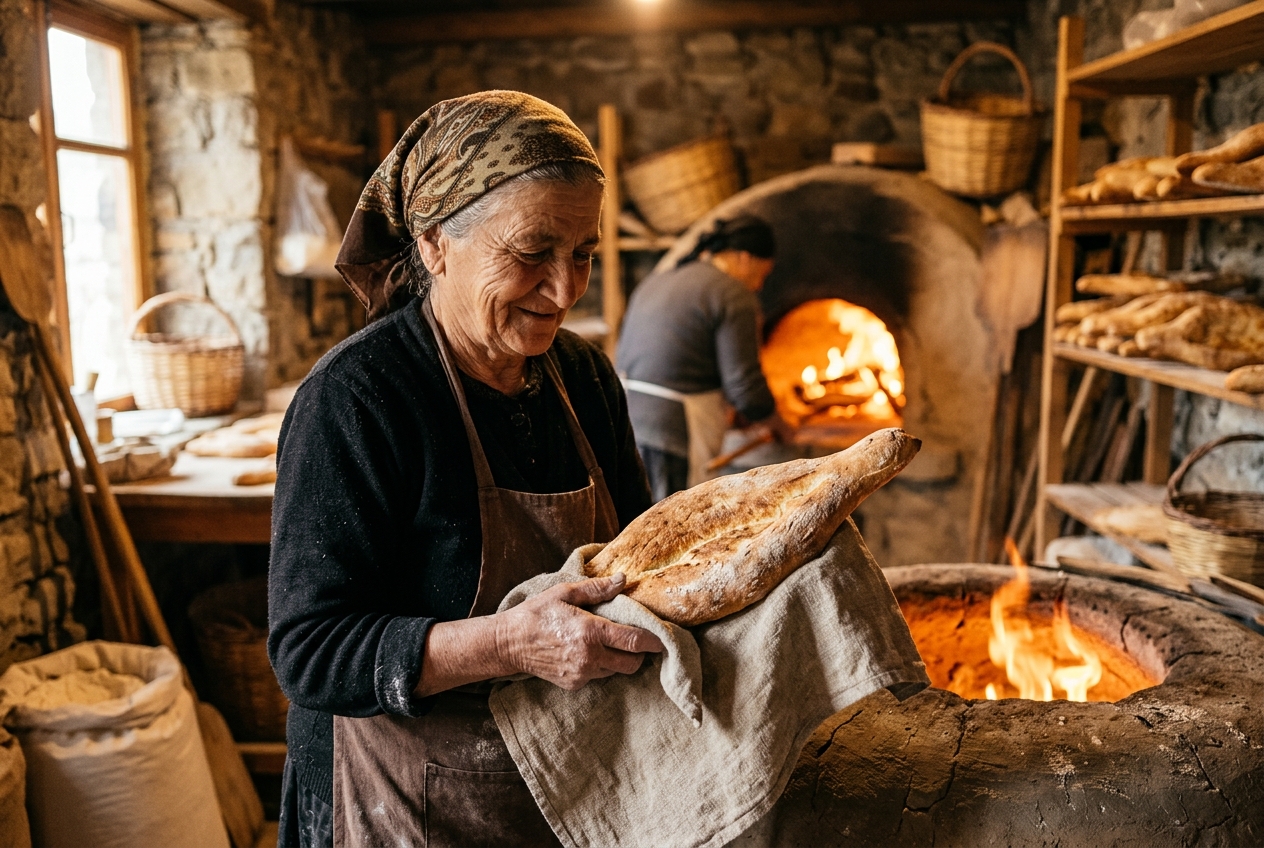
Few things tell you more about a country’s soul than its bread. In Georgia, a small nation tucked between the Caucasus Mountains and the Black Sea, bread is not just sustenance: it is identity, ritual, and a daily act of love. Walk through any neighborhood in Tbilisi at dawn, and you will smell it before you see it. The warm, slightly smoky aroma drifting from basement bakeries draws you in like a gravitational pull. There, in a space barely larger than a closet, a baker leans over a clay oven sunk into the floor, slapping elongated crescents of dough against scorching walls. This is shoti, Georgia’s most iconic bread, and it carries a weight far beyond its 300 to 400 grams. Known affectionately as “dedas puri” or “mother’s bread,” shoti is woven into the country’s collective memory. It shows up at every table, every celebration, every roadside stop. I have traveled through Georgia multiple times, and no matter where I ended up, from a wine cellar in Kakheti to a mountain guesthouse in Svaneti, someone was always tearing off a piece of warm shoti and handing it to me before anything else was served. That gesture says everything about what this bread means.
The Cultural Significance of Shoti in Georgia
Bread occupies a sacred space in Georgian culture, one that goes back thousands of years. Georgia is one of the oldest wheat-cultivating regions on Earth, and the relationship between Georgians and their grain runs so deep that the country’s wheat culture was inscribed on UNESCO’s Representative List of the Intangible Cultural Heritage of Humanity in 2020. That recognition was not just about farming techniques or recipes. It acknowledged an entire ecosystem of knowledge, belief, and social practice centered on bread.
In Georgian, the word “puri” simply means bread. But puri is never just bread. It appears in blessings, proverbs, and oaths. To swear on bread is to swear on something holy. Wasting it is considered deeply disrespectful: even stale bread is repurposed, never thrown away. This reverence shapes how Georgians bake, serve, and eat their bread every single day.
Why Shoti is Called Mother’s Bread
The term “dedas puri” translates directly to “mother’s bread,” and the name carries real emotional resonance. In Georgian households, bread-making was traditionally the domain of the mother or grandmother. She was the one who kneaded the dough, tended the oven, and ensured the family was fed. The bread itself became inseparable from her care.
There is also a symbolic dimension. The elongated, canoe-like shape of shoti has been compared to a cradle, linking it visually to motherhood and nurturing. Some Georgians I have spoken with describe it more poetically: the bread is shaped like an open embrace, ready to receive whatever you place on it, cheese, herbs, grilled meat. That openness mirrors the Georgian concept of the mother as the center of the home, always giving, always welcoming.
The Role of Bread in Georgian Hospitality
Georgian hospitality is famously intense, and bread sits at its foundation. The phrase “stumari ghvtisaa,” meaning “a guest is a gift from God,” is not a quaint saying: it is a lived principle. When you enter a Georgian home, the first thing placed before you is bread. Not appetizers, not wine (though that follows quickly), but bread. It signals that you are welcome and that you will be cared for.
This is not the transactional hospitality of a hotel lobby. In rural Georgia especially, a family will pull out their best food for an unexpected visitor, and the freshest bread will always be at the center of the table. The supra, Georgia’s legendary feast, revolves around a tamada (toastmaster) who leads elaborate toasts, but the physical anchor of the table is always bread. Without it, the supra cannot begin.
| Aspect | Shoti (Shotis Puri) | Tonis Puri |
|---|---|---|
| Shape | Elongated, canoe or sword-like | Round or oval |
| Oven | Tone (clay oven) | Tone (clay oven) |
| Crust | Crispy exterior, soft interior | Thicker, chewier crust |
| Regional variation | Shorter in Kartli, longer in Kakheti | More uniform across regions |
| Common name | Dedas puri (mother’s bread) | Tonis puri (oven bread) |
| Typical price | 0.80-1 lari (~30-40 cents) | 0.80-1 lari (~30-40 cents) |
Distinctive Shape and Traditional Ingredients
What makes shoti immediately recognizable is its shape. Unlike the round loaves common across much of Europe and the Middle East, shoti is long, tapered at both ends, and curved like a canoe or a crescent moon. This is not decorative whimsy: the shape is a direct result of how the bread is baked, pressed against the curved interior wall of a cylindrical clay oven.
The Canoe-Like Geometry of the Dough
The baker shapes each piece of dough by hand, stretching it into an elongated oval and then curving it slightly. The result is a form that clings naturally to the oven wall without falling off. The thinner edges bake faster, becoming deeply crispy, while the thicker center stays pillowy and soft. This contrast between crust and crumb is one of the defining pleasures of eating shoti fresh.
Regional differences in shape are notable. In Kartli, the central region around Tbilisi, shorter shoti are baked, while in Kakheti, they are longer and sword-shaped. A Kakhetian shoti can stretch to nearly a meter in length, resembling the blade of a traditional Georgian sword. This regional pride in bread shape is taken seriously: ask a Kakhetian baker about Kartlian shoti and you might get a polite but firm opinion about whose version is superior.
Simple Components: Flour, Water, Yeast, and Salt
The ingredient list for shoti is almost comically short: wheat flour, water, yeast, and salt. That is it. No oil, no sugar, no eggs, no milk. This simplicity is the point. The flavor comes not from enrichments but from the baking process itself, from the high heat of the clay oven and the slight char that develops where the dough meets the wall.
The flour used is typically a medium-strength wheat flour, nothing exotic. The yeast can be commercial or, in some traditional bakeries, a sourdough-style starter maintained over days or weeks. The dough is mixed, kneaded briefly, and left to rise. There is no laminating, no folding, no elaborate technique. The magic happens in the oven.
The Art of Baking in the Tone Oven
The tone (pronounced “toh-neh”) is the heart of Georgian bread-making. It is a large, beehive-shaped clay oven sunk into the ground, heated by a wood or gas fire at the bottom. Temperatures inside can exceed 300 degrees Celsius (about 570 degrees Fahrenheit). The oven stays hot for hours, and a skilled baker can produce dozens of loaves in a single session.
How the Clay Tone Creates Unique Texture
Clay is a remarkable baking medium. It absorbs and radiates heat evenly, creating an environment that is simultaneously dry and intensely hot. The bread bakes from the outside in: the side pressed against the wall gets a blistered, slightly charred crust, while the exposed side develops a golden-brown surface from radiant heat. Steam from the dough itself gets trapped briefly, puffing the interior into an airy crumb.
You cannot replicate this in a conventional oven. Home bakers who try to make shoti on a baking sheet get a decent flatbread, but it lacks the signature contrast: that shattering crust on one side, the soft pull-apart texture on the other. The tone is not just a cooking vessel; it is an instrument, and the bread it produces is its music.
The Physical Skill of Slapping Dough on Oven Walls
Watching a tone baker work is genuinely impressive. The baker stretches the dough over a round cushion called a “lapati” or directly over their forearm, leans deep into the oven’s mouth, and slaps the dough against the interior wall in one confident motion. The oven is blisteringly hot: a hesitant hand means a burn, and poorly placed dough means a loaf that falls into the fire below.
This is physically demanding work. Bakers often work shirtless because of the heat, leaning repeatedly into an oven that radiates enough warmth to make bystanders step back. The skill is passed down through apprenticeship, not textbooks. A new baker might spend weeks just learning the motion, the angle, the pressure needed to get the dough to stick. Get it right and the bread holds perfectly, baking in about eight to ten minutes. Get it wrong and you lose the loaf.
I once watched a baker in a Tbilisi basement bakery produce about forty loaves in under an hour. His rhythm was mesmerizing: shape, stretch, lean, slap, pull back. Each loaf identical. When I asked how long he had been doing this, he shrugged and said, “Since I was fifteen.” He was in his sixties.
The Sensory Experience: From Oven to Table
The moment a loaf of shoti comes out of the tone is when it is at its absolute best. The baker hooks it off the wall with a long metal rod, and it emerges steaming, its crust crackling audibly as it hits the cooler air. The aroma is extraordinary: toasted wheat, a hint of smoke, and that unmistakable scent of fresh bread that seems hardwired into human pleasure centers.
Eating shoti within the first ten minutes of baking is an experience that ruins you for lesser breads. The crust is so crisp it almost shatters between your teeth, giving way to a soft, slightly chewy interior that is still warm enough to melt butter on contact. The flavor is clean and wheaty with a faint smokiness from the oven. There is no need for toppings, though they are always welcome.
A single loaf typically weighs around 300-400 grams and costs 0.80 to 1 lari, roughly 30 to 40 cents. For that price, you get what might be the best bread on the planet. Bakeries in Georgia sell shoti all day long, but the morning and late afternoon batches draw the longest lines. Regulars time their visits to catch bread straight from the oven, and many bakeries have a small window or counter facing the street where loaves are handed out still warm.
The shelf life of shoti is short, maybe a day before it starts to harden. But this is by design. Georgians buy bread daily, sometimes twice daily. The ritual of walking to the bakery, exchanging a few words with the baker, and carrying home a warm loaf tucked under your arm is as much a part of daily life as morning coffee is elsewhere.
Perfect Pairings for Shoti Puri
Shoti is versatile enough to accompany almost anything, but certain combinations have been perfected over centuries of Georgian cooking. The bread’s neutral, wheaty flavor and contrasting textures make it an ideal vehicle for bold, salty, and acidic foods.
Traditional Accompaniments: Cheese, Wine, and Mtsvadi
The most classic pairing is shoti with sulguni cheese, a briny, stretchy cheese similar to mozzarella but with more tang. Tear off a piece of warm bread, lay a slice of sulguni on top, and the cheese begins to soften. Add a few leaves of fresh tarragon or purple basil, and you have a snack that could easily be a meal.
Wine is the natural drink alongside bread in Georgia, and the country’s amber-colored qvevri wines, made in clay vessels buried underground, share a philosophical kinship with shoti. Both are ancient techniques, both rely on simple ingredients transformed by clay, and both taste of the earth they come from. A glass of Rkatsiteli or Saperavi alongside fresh shoti and cheese is one of those combinations where everything just clicks.
Mtsvadi, Georgia’s version of grilled meat skewers, is another essential companion. The charred, juicy pork or beef wrapped in a piece of shoti creates something close to a Georgian sandwich. At roadside restaurants along the highway between Tbilisi and Kakheti, you will see families gathered around tables piled with mtsvadi, bread, tomato-cucumber salads, and bottles of wine. The bread is always the first thing to disappear.
Other pairings worth seeking out:
- Lobio (stewed kidney beans) scooped up with torn pieces of shoti
- Pkhali (walnut and vegetable pâté) spread across the bread’s soft interior
- Churchkhela (walnut and grape candy) eaten alongside bread as a trail snack during hikes
- Tkemali (sour plum sauce) drizzled over bread as a tangy counterpoint
Preserving the Heritage of Georgian Bread-Making
Georgia’s bread traditions face the same pressures as artisan food cultures everywhere. Industrial bakeries produce cheaper bread faster. Younger generations in cities sometimes opt for convenience over craft. The number of traditional tone bakeries has declined in Tbilisi over the past two decades, replaced in some neighborhoods by shops selling factory-produced loaves.
But the tradition is far from dying. The UNESCO recognition of Georgia’s wheat culture in 2020 brought renewed attention and pride. Small bakeries continue to operate in nearly every neighborhood, and in rural areas, home baking in family-owned tone ovens remains common. Organizations and cultural groups have begun documenting traditional baking methods, and several bakeries now offer workshops for tourists and locals alike.
The generational dynamic matters here. Older Georgians, the Soviet-educated generation, remember a time when every household baked its own bread. The post-independence generation, especially those born after the Rose Revolution of 2003, grew up with more options but also with a growing awareness of what makes Georgian culture distinct. Many young Georgians I have met express genuine pride in traditions like shoti baking, even if they buy their bread from the corner bakery rather than making it themselves.
If you visit Georgia, make a point of finding a working tone bakery. Stand and watch. Feel the heat. Buy a loaf straight from the wall. Tear it open while it is still too hot to hold comfortably. That moment, steam rising, crust crackling, the smell filling your lungs, is worth the entire trip. Shoti is not just bread. It is a country’s love language, baked into every single loaf.