
Tucked between the Greater Caucasus mountains and the eastern Black Sea coast, Georgia occupies a geographic crossroads that has shaped empires, trade routes, and mythologies for millennia. The Greeks called it Colchis, the land where Jason sailed to claim a magical fleece of gold. That myth wasn’t pure fantasy: it was rooted in real practices, real landscapes, and a culture so ancient it predates most of European civilization. Today, this small nation of roughly 3.7 million people is experiencing a remarkable resurgence. The country welcomed 7.8 million international visitors in 2025, a 6% increase from the previous year, and its economy continues to outperform expectations. Yet Georgia, the country of the Golden Fleece, remains deeply misunderstood by most Western travelers who confuse it with the American state or assume it’s just another post-Soviet backwater. Nothing could be further from the truth. What you’ll find here is a civilization that has been making wine for 8,000 years, singing polyphonic harmonies that UNESCO protects, and carving cave cities into cliff faces since the twelfth century. The fleece wasn’t just a myth: it was a promise. And Georgia delivers on it.
The Legend of Colchis and the Golden Fleece
The story of Jason and the Argonauts is one of the oldest adventure tales in Western literature, but for Georgians, it’s not just a story. It’s a founding narrative, a piece of cultural DNA that connects the modern nation to the ancient kingdom of Colchis, which occupied roughly the same territory as western Georgia today. The myth tells of a magical ram’s fleece, golden and divine, guarded by a sleepless dragon in a grove sacred to the war god Ares. What most people don’t realize is that this legend almost certainly originated from observations of real Georgian gold-extraction techniques that astonished ancient Greek travelers.
Jason and the Argonauts’ Mythic Journey
The Greek poet Apollonius of Rhodes composed the most complete version of the Argonautica in the third century BCE, though the tale itself is far older. Jason, prince of Iolcus, assembles a crew of heroes including Heracles, Orpheus, and Castor and Pollux aboard the ship Argo. They sail east across the Black Sea to Colchis, where King Aeëtes sets impossible tasks: yoking fire-breathing bulls, sowing dragon’s teeth, and finally seizing the fleece itself. Jason succeeds with the help of Aeëtes’ daughter Medea, a powerful sorceress who betrays her father for love.
For Georgians, the story carries a different weight than it does for classicists in Oxford or Athens. Medea is not simply a tragic figure from Euripides: she is a Colchian woman, and her knowledge of herbs and medicine reflects the real botanical richness of the Caucasus region. The kingdom of Colchis was a genuine political entity, mentioned by Herodotus and other historians. Archaeological sites in western Georgia, particularly around the modern city of Kutaisi (ancient Aia, Aeëtes’ capital), have yielded gold artifacts dating to the second millennium BCE that corroborate the region’s reputation for extraordinary wealth.
The Ancient Tradition of Gold Panning with Sheepskins
Here’s where myth meets metallurgy. The rivers flowing down from the Caucasus mountains in Svaneti and Lechkhumi carried alluvial gold, and the local Colchians developed a technique of submerging sheepskins in the riverbeds to trap gold particles in the wool fibers. After the fleece was saturated, it was hung to dry and then shaken or combed to collect the gold dust. A sheepskin heavy with gold flakes, glinting in the Caucasian sun: that’s your Golden Fleece.
The Greek geographer Strabo, writing in the first century BCE, explicitly described this practice. Appian of Alexandria confirmed it centuries later. This wasn’t magic; it was ingenious engineering adapted to local geology. Some families in the Svaneti region continued variations of this technique into the nineteenth century. The connection between Georgia and the Golden Fleece isn’t a branding exercise or a tourism gimmick: it’s a 3,000-year-old thread connecting ancient metallurgy to modern national identity.
Cradle of Wine: An 8,000-Year Heritage
If the Golden Fleece made Georgia legendary, wine made it eternal. Archaeological evidence from the village of Gadachrili Gora, south of Tbilisi, dates Georgian winemaking to approximately 6000 BCE, making it the oldest known wine-producing culture on Earth. That’s roughly 3,000 years before the Egyptians and 5,000 years before the Romans got serious about viticulture. Wine here isn’t an industry: it’s a spiritual practice, a social glue, and a living artifact.
The Qvevri Winemaking Method
The qvevri (pronounced “kvev-ree”) is a large, egg-shaped clay vessel buried underground and used for fermenting, aging, and storing wine. UNESCO inscribed the qvevri winemaking method on its Intangible Cultural Heritage list in 2013, recognizing it as a tradition with no parallel anywhere else. The process is deceptively simple: grapes, including skins, seeds, and sometimes stems (called chacha), are placed in the qvevri, sealed with a stone lid and beeswax, and left to ferment for five to six months using only natural yeasts.
The result is what the wine world calls “amber wine” or “orange wine,” though Georgians simply call it wine. The extended skin contact gives white varieties like Rkatsiteli and Mtsvane a deep amber color and a tannic structure more commonly associated with reds. I’ve sat in family cellars in Kakheti where a grandfather uncorks a qvevri with a ceremony that feels half-scientific, half-sacred. The wine tastes like nothing you’ve had from a bottle at your local shop: earthy, complex, alive. Georgia’s 525 indigenous grape varieties (more than France, Italy, and Spain combined) mean that the diversity of flavors is staggering.
The Supra: Rituals of the Georgian Feast
No discussion of Georgian wine is complete without the supra, the traditional feast that is the beating heart of Georgian social life. A supra is not just a dinner party. It’s a structured ritual led by a tamada (toastmaster) who guides the evening through a sequence of toasts: to God, to Georgia, to ancestors, to family, to peace, to the departed, and eventually to whatever spontaneous themes emerge as the evening deepens.
Each toast requires every guest to drink, usually from a kantsi (a drinking horn) or a clay cup. The food arrives in waves: khinkali (soup dumplings), khachapuri (cheese-filled bread), pkhali (walnut-herb spreads), grilled meats, fresh herbs by the handful. A proper supra can last four to six hours. The Georgian phrase “stumari ghvtisaa” means “a guest is from God,” and at a supra, you feel it. This isn’t transactional hospitality like a resort buffet. It’s an ancient covenant between host and guest, and it will ruin you for ordinary dinner parties forever.
Architectural Marvels from the Caucasus to the Black Sea
Georgia’s geography is extreme: alpine peaks above 5,000 meters in the north, subtropical coastline in the west, semi-arid plains in the east. This diversity produced radically different architectural traditions, each adapted to its environment and shaped by centuries of invasion, faith, and isolation.
Medieval Towers of Svaneti
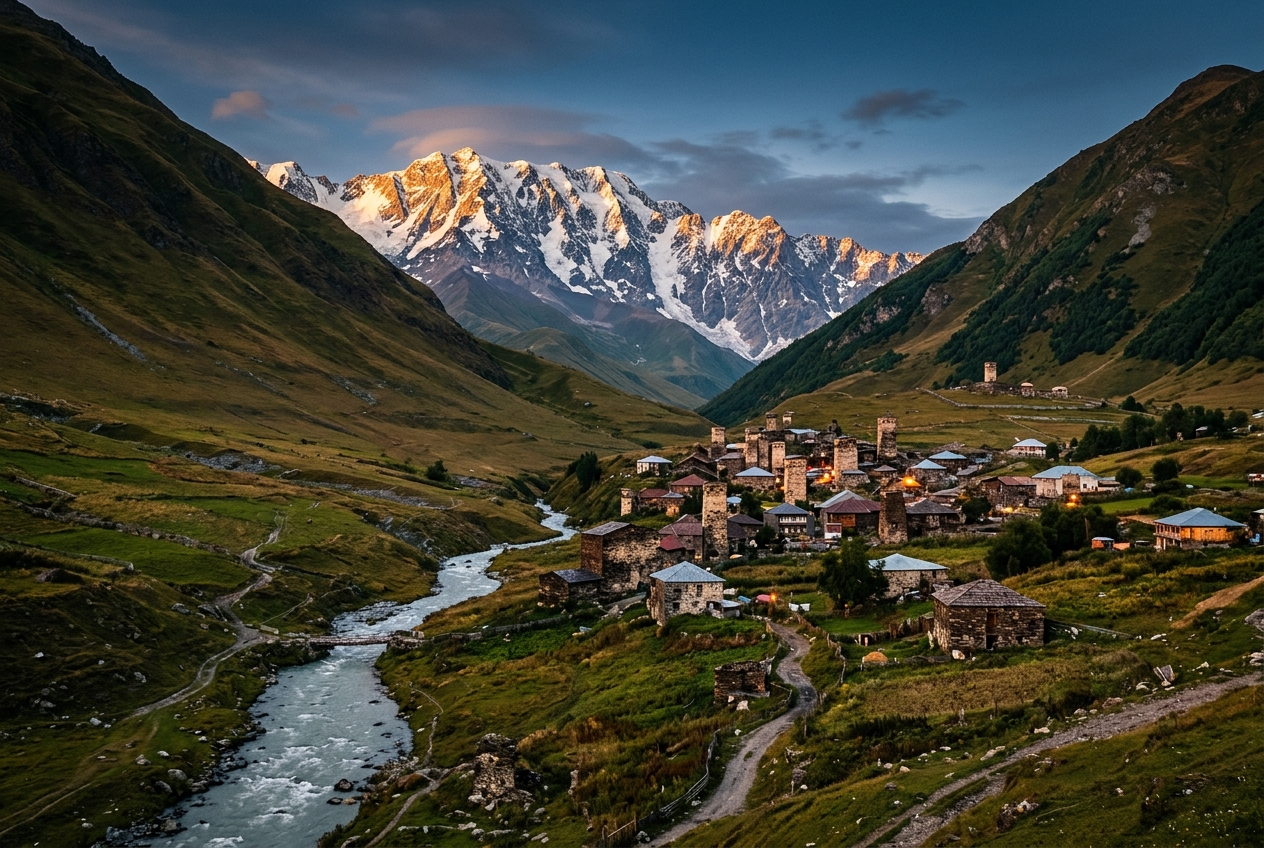
Upper Svaneti, a UNESCO World Heritage Site since 1996, is home to roughly 175 medieval stone towers that rise like sentinels from the valley floor. These koshkebi (defensive towers) date primarily from the ninth through twelfth centuries and served dual purposes: protection against invaders and rival clans, and storage for community treasures, including icons and manuscripts that might otherwise have been destroyed during Mongol or Timurid invasions.
The towers stand 20 to 25 meters tall, built without mortar using precisely cut stone blocks. Each Svan family compound typically included a residential building, a tower, and a church. What makes Svaneti extraordinary isn’t just the architecture but the fact that these towers are still standing, still inhabited in some cases, in villages accessible only by winding mountain roads. The town of Mestia has become the gateway for trekkers, but venture to Ushguli, one of the highest continuously inhabited settlements in Europe at 2,200 meters, and you’ll feel like you’ve stepped into a medieval painting.
Vardzia: The Golden Age Cave City
Queen Tamar, Georgia’s most celebrated monarch, expanded the cave monastery of Vardzia in the late twelfth century into a complex of over 6,000 rooms carved into a sheer cliff face along the Mtkvari River. At its peak, Vardzia housed 2,000 monks and functioned as a self-contained city with a church, a throne room, libraries, pharmacies, and an irrigation system that channeled water through the rock.
A devastating earthquake in 1283 sheared away much of the cliff face, exposing the honeycomb of rooms that had previously been hidden behind the rock. What remains is still breathtaking: thirteen stories of chambers connected by tunnels, with the Church of the Assumption preserving frescoes that include a portrait of Queen Tamar herself. Vardzia represents the zenith of Georgia’s medieval Golden Age, a period when the kingdom stretched from the Black Sea to the Caspian and Georgian culture, literature, and architecture flourished.
Tbilisi: Where Silk Road History Meets Modernity
Tbilisi has been Georgia’s capital since the fifth century, founded by King Vakhtang Gorgasali, who allegedly discovered the natural hot springs while hunting. The city’s name comes from “tbili,” meaning “warm” in Georgian. Today it’s a city of roughly 1.2 million people where crumbling Art Nouveau balconies lean over streets filled with craft coffee shops and tech startups. Georgia’s economy is expected to grow 6% to 7% in 2026, and much of that dynamism is visible in Tbilisi’s rapid transformation.
Old Town and the Abanotubani Sulfur Baths
The Old Town district clusters beneath the Narikala Fortress, a fourth-century citadel that has been rebuilt by Persians, Arabs, Mongols, and Ottomans. Walking its narrow streets is a sensory education: the smell of fresh shotis puri (bread baked in a tone oven), the sound of church bells mixing with the call to prayer from the nearby mosque, the sight of carved wooden balconies draped in grapevines.
The Abanotubani sulfur bath district sits at the heart of Old Town. The brick-domed bathhouses, fed by natural sulfur springs, have operated continuously for centuries. A private room at the ornate Orbeliani Bathhouse (the blue-tiled facade you’ve seen in every Tbilisi photo) costs around 80-150 GEL per hour. The experience is part spa, part time travel. You soak in mineral-rich water heated to 40-45°C while a tellak (bath attendant) scrubs you with a rough kisi mitt. Pushkin wrote about these baths. Dumas visited them. They remain one of the most authentic and affordable thermal experiences in Europe.
| Georgia at a Glance (2024-2026) | Data |
|---|---|
| International Visitors (2025) | 7.8 million |
| GDP Growth Forecast (2026) | 6%-7% |
| Foreign Direct Investment (2025) | $1.688 billion |
| Top Export Partner (Jan-Feb 2026) | China ($147.1M) |
| Agriculture as % of GDP (2024) | 5.42% |
Spiritual Landmarks and Orthodox Traditions
Christianity arrived in Georgia in 337 CE, making it one of the first nations to adopt the faith as a state religion. The Georgian Orthodox Church has been the spiritual backbone of national identity through Persian, Ottoman, Mongol, and Soviet occupations. When everything else was stripped away, the church and its traditions remained.
Mtskheta: The Holy City and UNESCO Sites
Mtskheta, just 20 kilometers from Tbilisi, served as Georgia’s capital for nearly a thousand years and remains its spiritual center. The Svetitskhoveli Cathedral, built in the eleventh century on the site where Georgia’s Christianizing saint, Nino, erected the first wooden church, is believed to house the robe of Christ. The Jvari Monastery, perched on a hilltop overlooking the confluence of the Mtkvari and Aragvi rivers, dates to the sixth century and inspired the great Georgian poet Lermontov.
Both sites are UNESCO World Heritage landmarks, and visiting them on a Sunday morning during a liturgy is an experience that transcends tourism. The incense, the chanting, the golden iconostasis lit by beeswax candles: it’s a direct connection to a form of worship that has changed remarkably little in 1,700 years. Agriculture, forestry, and fishing still account for about 5.4% of Georgia’s GDP, and much of the rural economy around Mtskheta remains tied to the rhythms of the Orthodox calendar.
Polyphonic Singing and Sacred Music
Georgian polyphonic singing, recognized by UNESCO as a Masterpiece of Intangible Heritage, is unlike any vocal tradition in Europe. Three-part harmonies built on dissonant intervals create a sound that is simultaneously ancient and startlingly modern. The tradition predates Christianity in Georgia, with roots in pagan harvest and work songs, but the church adopted and transformed it into one of the most powerful forms of sacred music on Earth.
Regional styles vary dramatically. Svan funeral songs are raw and haunting. Gurian krimanchuli features a yodeling technique that seems physically impossible. Kakhetian table songs accompany the supra with rich, resonant harmonies. In 1977, a Georgian polyphonic song, “Chakrulo,” was included on the Voyager Golden Record sent into space as a representative example of human musical achievement. If aliens ever find that record, their first impression of humanity will be Georgian.
Preserving the Legacy of the Golden Fleece Today
Georgia’s ancient heritage is not a museum exhibit: it’s a living, evolving culture meeting the pressures and opportunities of the twenty-first century. Foreign direct investment reached $1.688 billion in 2025, a 7.6% increase over the previous year, signaling growing global confidence in the country’s economic trajectory. China has emerged as the top export partner, with $147.1 million in trade during just the first two months of 2026.
Yet challenges remain. Geopolitical tensions with Russia, questions about EU accession, and the balancing act between development and cultural preservation all loom large. The real treasure of Georgia, its golden fleece in the truest sense, is the irreplaceable combination of ancient winemaking, polyphonic music, sacred architecture, and a hospitality tradition that treats every stranger as a gift from God. Protecting that inheritance while building a modern economy is the defining task of this generation. If you visit, and you should, come not as a consumer but as a guest. Learn the word “gaumarjos” (cheers), accept every glass that’s offered, and understand that you’re participating in a tradition older than Rome, older than Athens, older than almost anything.