
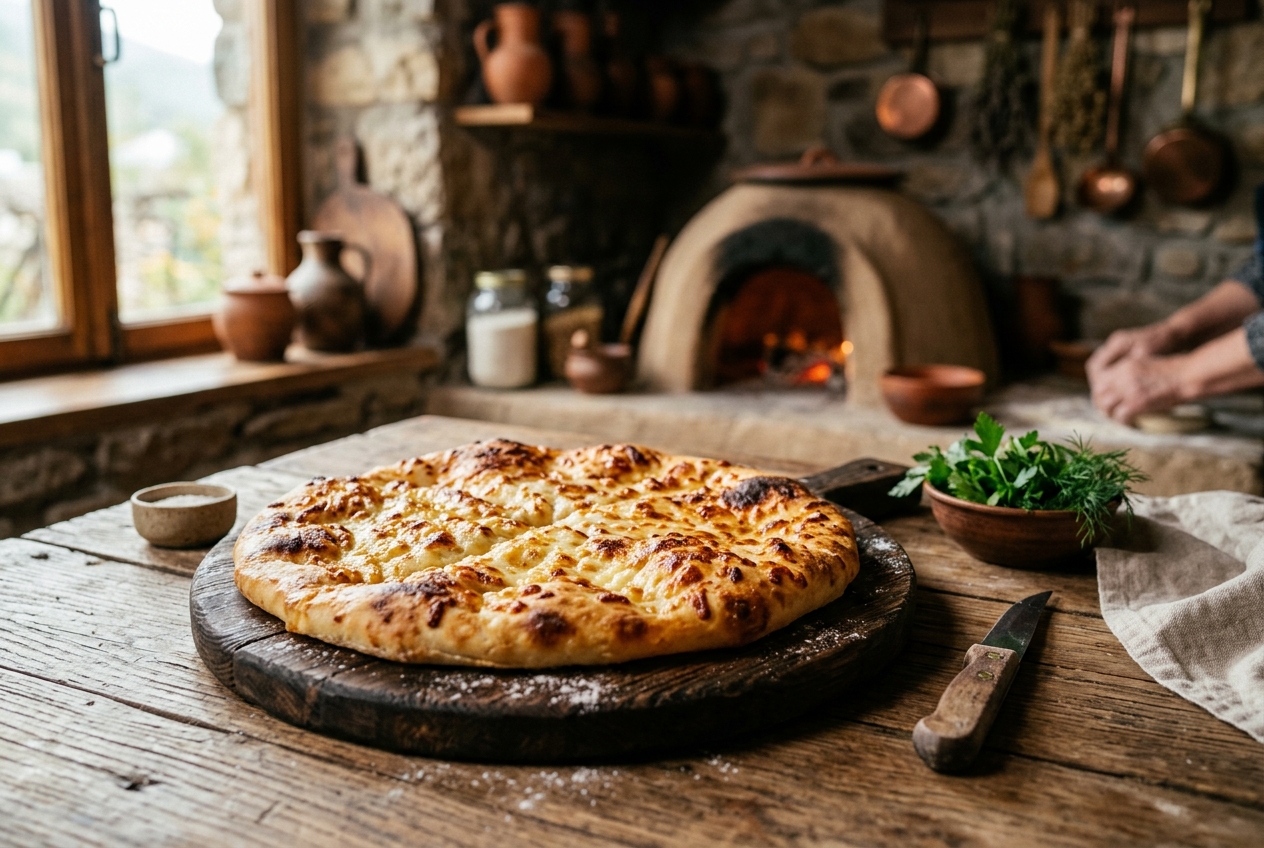
Few dishes carry the weight of an entire nation’s identity quite like a round, golden bread stuffed with melted cheese. If you’ve ever broken one open at a Georgian table, watching the steam rise as tangy, stretchy cheese spills out, you already understand why Imeretian khachapuri is considered the calling card of Georgian cuisine. This isn’t just comfort food. It’s a cultural artifact, an economic indicator, and a point of fierce regional pride all baked into one deceptively simple package. Whether you’ve tasted it in a Tbilisi bakery, a village home in Kutaisi, or a trendy Georgian restaurant in Brooklyn, the experience tends to stick with you. What makes this particular version so special among the many regional variations? And why has a cheese-filled bread from a small Caucasus nation captured the attention of food lovers worldwide? The answers lie in the details: the cheese, the dough, the technique, and centuries of tradition that refuse to be simplified.
The Cultural Legacy of Imeretian Khachapuri
Historical Roots in the Imereti Region
The Imereti region sits in western Georgia, a lush, green area fed by the Rioni River and surrounded by the foothills of the Greater Caucasus. This is where khachapuri as most Georgians know it was born. The word itself breaks down neatly: “khacho” refers to curds or cheese, and “puri” means bread. Cheese bread, essentially, though calling it that feels like calling the Mona Lisa a painting of a woman.
Imeretian khachapuri is also called ketsi khachapuri because it was traditionally baked on a clay pan called “ketsi” placed on hot embers, long before modern ovens arrived in Georgian kitchens. This method gave the bread its characteristic golden-brown crust with a slightly smoky flavor that’s hard to replicate with modern equipment. The dish dates back centuries, rooted in a pastoral culture where fresh cheese and wheat flour were everyday staples. Farmers’ wives would prepare it as a filling midday meal, and the recipe passed from mother to daughter with the kind of precision that no written cookbook could capture.
What makes the Imeretian version foundational is its simplicity. It’s considered the simplest and most traditional form of khachapuri, a baseline from which all other regional variations evolved. Think of it as the original template: a round, sealed bread with a generous cheese filling, baked until the crust turns golden and the inside becomes molten.
A Symbol of Georgian Hospitality and Identity
In Georgia, the phrase “stumari ghvtisaa” translates roughly to “a guest is a gift from God.” Hospitality isn’t a nicety here; it’s a deeply held spiritual and cultural obligation with roots in Orthodox Christianity and even older traditions. Khachapuri sits at the center of this ethos. It’s the dish that appears first on the table when guests arrive, the one that signals generosity and welcome before any wine is poured or toasts are made.
The dish is so culturally significant that Georgia celebrates National Khachapuri Day on February 28th each year. This isn’t some obscure food holiday either: it’s a genuine point of national celebration, with bakeries, restaurants, and families across the country preparing their best versions.
Georgian economists have even created the “Khachapuri Index,” modeled after The Economist’s Big Mac Index, which tracks the cost of making a standard portion of Imeretian khachapuri as a measure of inflation and purchasing power. The index reveals real economic pressures: in February 2026, the average cost of preparing a standard portion was 8.05 GEL, a 1.6% increase from January 2026. That a cheese bread serves as a serious economic barometer tells you everything about its place in Georgian life.
Anatomy of the Perfect Imeruli Khachapuri
The Essential Imeretian Cheese (Chkinti-Kveli)
The soul of this dish is the cheese, and not just any cheese will do. Authentic Imeretian khachapuri calls for Imeretian cheese, known locally as chkinti-kveli or imeruli kveli. It’s a fresh, brined cheese with a crumbly-yet-creamy texture, a mild tanginess, and a salt level that’s assertive but not overwhelming. If you’ve tasted feta, you’re in the neighborhood, but Imeretian cheese is softer, less sharp, and melts into a stretchy, cohesive mass that feta simply can’t achieve.
The cheese is made from cow’s milk, curdled and then aged briefly in brine. The quality varies enormously depending on the producer. In rural Imereti, families still make it by hand from their own cows’ milk, and the difference between artisanal and factory-produced versions is immediately obvious. The homemade stuff has a complexity: a slight grassiness, a subtle sweetness beneath the salt, that mass-produced versions lack entirely.
For the filling, the cheese is typically crumbled by hand and mixed with a beaten egg, which acts as a binder and adds richness. Some cooks add a pinch of fresh herbs or adjust the salt, but purists keep it simple. The cheese should speak for itself. If you’re outside Georgia and can’t find Imeretian cheese, a combination of mozzarella and feta (roughly 70/30) gets you closer than either one alone, though it’s admittedly an approximation.
The price of this essential ingredient has been climbing. Cheese prices saw a 12.3% increase over the year 2024, putting pressure on both households and commercial bakeries. For a dish that’s roughly 60% cheese by weight, that kind of price jump matters.
Secrets of the Soft, Yeast-Leavened Dough
The dough for Imeretian khachapuri is a simple yeast dough, but “simple” doesn’t mean “careless.” It uses warm milk or a milk-water blend, active dry yeast, a touch of sugar to feed the yeast, salt, a small amount of oil or melted butter, and all-purpose flour. The goal is a soft, pliable dough that’s easy to stretch but strong enough to contain the cheese without tearing.
The key detail most recipes underemphasize is the resting time. After the initial knead, the dough needs at least an hour to rise, sometimes longer in cooler kitchens. A properly risen dough will be pillowy and slightly tacky. If it feels stiff or elastic, it needs more time. Some experienced Georgian cooks let the dough rise twice, punching it down after the first rise for a finer crumb structure.
Thickness matters enormously. The dough should be rolled or stretched thin enough that you can almost see through it at the edges, but thick enough at the seams to hold. A common mistake among beginners is making the dough too thick, which results in a bready, heavy khachapuri where the crust overpowers the cheese. The ideal ratio is roughly one part dough to two parts cheese filling by weight.
Traditional Preparation and Baking Techniques
The Art of Folding and Sealing the Dough
Shaping Imeretian khachapuri is where technique separates the good from the great. The process looks straightforward but requires a practiced hand:
- Divide the dough into portions (typically 250-300g each for a standard serving)
- Roll each portion into a circle roughly 20-25cm in diameter
- Place a generous mound of the cheese-egg mixture in the center
- Gather the edges of the dough up and over the filling, pleating them together at the top like a dumpling
- Pinch the gathered dough firmly to seal, then twist off any excess
- Flip the sealed ball seam-side down and gently flatten it with your palms into a disc about 2-3cm thick
That flip is critical. By placing the seam on the bottom, you create a smooth, even top surface that bakes beautifully. The flattening should be gentle and gradual: press too hard and the cheese bursts through. Some cooks use a rolling pin very lightly at this stage, but hands give you better control and feedback. You can feel if the dough is getting too thin in any spot.
Stovetop vs. Oven: Achieving the Golden Crust
Traditional ketsi baking over embers is rare now, even in Georgian villages. The two common modern methods are stovetop and oven, and each produces a slightly different result.
The stovetop method uses a dry, heavy skillet (cast iron is ideal) over medium heat. The khachapuri cooks for about 3-4 minutes per side until golden brown spots appear. This method produces a slightly chewier crust with beautiful leopard-spotted charring. It’s faster and gives you more control, which is why many Georgian home cooks prefer it.
Oven baking at 200-220°C (around 400-425°F) for 15-20 minutes yields a more evenly golden crust with a slightly crispier texture. Some cooks brush the top with an egg wash or melted butter before baking for extra color and shine. The oven method is more forgiving for beginners since there’s less risk of burning.
A hybrid approach works beautifully: start on the stovetop to set the bottom crust, then transfer to a hot oven to finish. This gives you the best of both worlds: a firm, slightly charred base with an evenly baked, golden top.
Imeretian vs. Other Regional Varieties
Georgia has at least a dozen regional khachapuri variations. Understanding the differences helps appreciate why the Imeretian version holds its special status.
Distinguishing Features from Adjarian Khachapuri
Adjarian khachapuri, from the Black Sea coastal region of Adjara, is the version most foreigners recognize: boat-shaped, with an open center filled with molten cheese, a raw egg cracked on top, and a pat of butter melting into the mix. It’s dramatic, photogenic, and undeniably delicious, but it’s fundamentally different from the Imeretian original.
| Feature | Imeretian Khachapuri | Adjarian Khachapuri |
|---|---|---|
| Shape | Round, fully sealed | Boat-shaped, open center |
| Cheese | Imeretian cheese only | Imeretian + sulguni blend |
| Egg | Mixed into filling | Cracked raw on top |
| Butter | Optional, on crust | Added to the center |
| Eating style | Sliced like a pie | Tear bread, stir center |
| Difficulty | Moderate | Higher |
The Adjarian version gets more Instagram attention, but the Imeretian is what Georgians eat daily. It’s the weeknight dinner, the school lunch, the quick breakfast grabbed from a street bakery. Its sealed construction makes it portable and practical in ways the open-topped Adjarian version simply isn’t.
The Double-Cheese Megrelian Variation
Megrelian khachapuri, from the Samegrelo region, takes the Imeretian template and adds an extra layer of cheese on top. The base is essentially the same: round, sealed, filled with cheese. But before baking, a generous layer of sulguni cheese is spread or placed over the surface, where it melts into a bubbly, golden cheese crust.
The result is richer and more intensely cheesy, almost decadent. Megrelians are known throughout Georgia for their love of bold, heavily seasoned food, and their khachapuri reflects that personality. Where the Imeretian version balances bread and cheese in harmony, the Megrelian tips the scales firmly toward cheese. It’s heavier and best shared, while an Imeretian khachapuri is perfectly portioned for one person.
Modern Influence and Global Popularity
Georgian cuisine has experienced a remarkable surge in international recognition over the past decade, and khachapuri has been leading the charge. Restaurants specializing in Georgian food have opened in New York, London, Berlin, Paris, and dozens of other cities. The Imeretian version, as the most accessible and recognizable form, has become an ambassador for the entire cuisine.
Social media has played an obvious role. The visual appeal of cheese pulling from a freshly cut khachapuri translates perfectly to short-form video. But the trend has substance behind it: food writers and critics have consistently praised Georgian cuisine for its depth, its reliance on fresh ingredients, and its distinctiveness from neighboring culinary traditions.
Tourism to Georgia has also fueled the spread. Travelers who visit Tbilisi, Kutaisi, or Batumi inevitably fall in love with khachapuri and seek it out when they return home. This demand has created a market for Georgian bakeries and restaurants abroad, many run by Georgian immigrants who bring authentic recipes and techniques with them.
The younger generation of Georgian chefs is experimenting too. You’ll find khachapuri made with truffle oil, wild mushrooms, or smoked cheese in Tbilisi’s trendier restaurants. Some purists grumble, but innovation and tradition have always coexisted in Georgian cooking. The classic Imeretian version remains the benchmark against which all variations are measured.
Serving Etiquette and Traditional Pairings
Imeretian khachapuri is best eaten hot, within minutes of leaving the pan or oven, when the cheese is still molten and the crust is at its crispiest. Letting it cool too long causes the cheese to solidify and the texture to shift from extraordinary to merely good. In Georgian homes and bakeries, timing the khachapuri to arrive at the table at the right moment is considered a point of pride.
The traditional way to serve it is whole, placed in the center of the table, and cut into wedges like a pie. In more casual settings, individual portions are common, especially from street bakeries where they’re wrapped in paper and eaten on the go. There’s no wrong way to eat it, but tearing it by hand rather than using a knife carries a certain rustic authenticity that Georgians appreciate.
Pairing-wise, khachapuri belongs alongside fresh herbs (tarragon, basil, cilantro), sliced tomatoes and cucumbers, and a bowl of tkemali, the sour plum sauce that cuts through the richness of the cheese. A glass of cold Georgian lemonade, made from tarragon or pear, is the classic non-alcoholic companion. For wine, a chilled white from the same Imereti region, perhaps a Tsolikouri or Tsitska, creates a beautiful regional pairing.
The Georgian table, or supra, is never about a single dish. But if you had to choose one item that captures the spirit of Georgian food: generous, unpretentious, made with care, and meant to be shared, Imeretian khachapuri would be it. If you ever find yourself in Georgia, skip the tourist-oriented restaurants and find a family bakery where the dough is made that morning and the cheese comes from a local farmer. That’s where you’ll taste the real thing, and you’ll understand why an entire country built a holiday and an economic index around a cheese bread.