
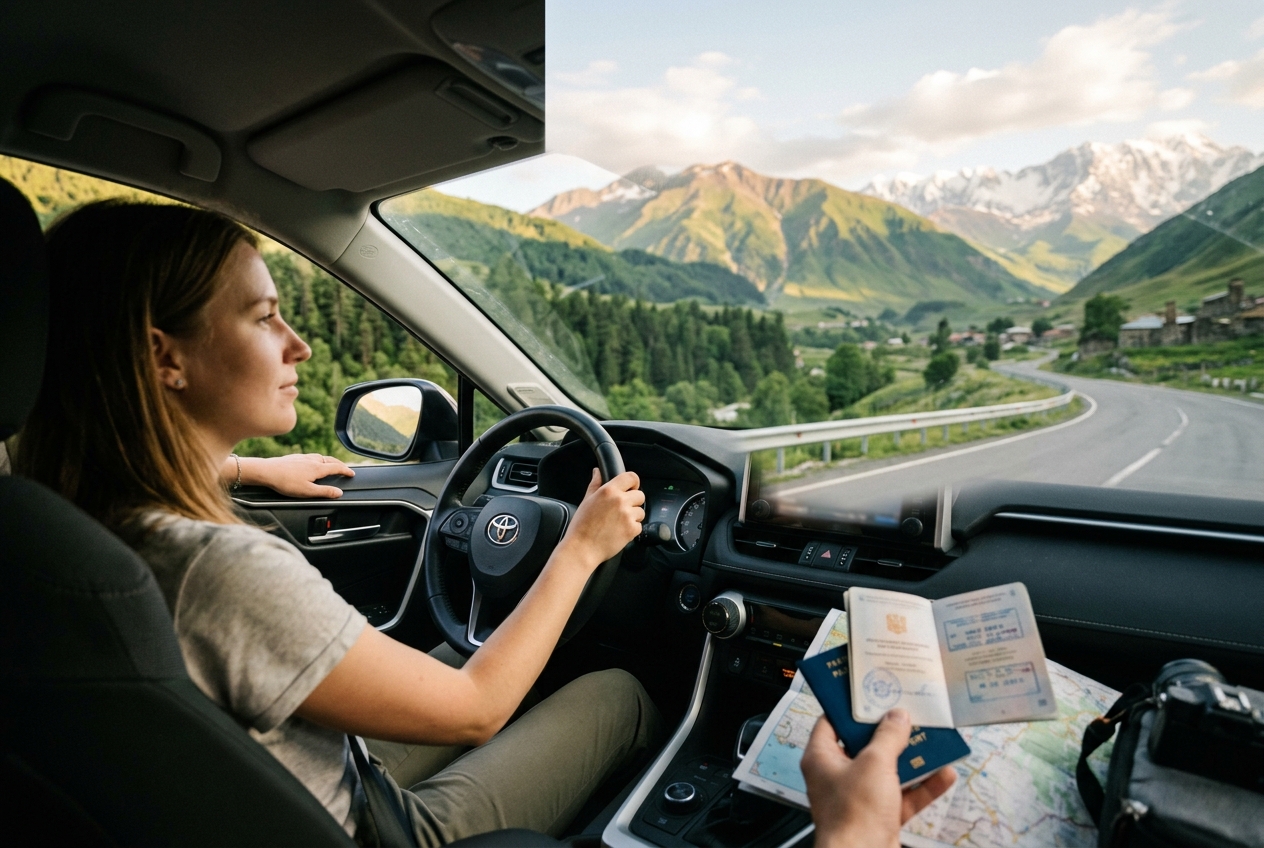
Planning a road trip through the Caucasus is one of those travel decisions that rewards you ten times over. The winding roads from Tbilisi to Kazbegi, the ancient cave cities of Uplistsikhe, the vineyard-dotted hills of Kakheti: Georgia (or Sakartvelo, as Georgians call their country) is built for driving. But before you get behind the wheel, there’s a practical question that trips up a surprising number of travelers: do you actually need an International Driving Permit for Georgia? The answer isn’t a simple yes or no. It depends on where your license was issued, what script it’s printed in, how long you plan to stay, and whether you’re renting a car or driving your own. I’ve seen travelers breeze through with nothing but their home license, and I’ve seen others get turned away at rental counters for lacking the right paperwork. This guide breaks down the legal reality, the practical complications, and everything you need to sort out before your trip so you can focus on the scenery instead of the bureaucracy.
Legal Requirements for Driving in Georgia
Georgia has a relatively welcoming approach to foreign drivers, but the rules have specific conditions that catch people off guard. The country recognizes foreign driving licenses, but that recognition comes with time limits and format requirements that vary depending on your situation.
The core legal framework is straightforward: if you’re a tourist visiting Georgia for a short stay, your valid foreign driving license generally allows you to drive. Georgia’s traffic police, known locally as the Patrol Police, are accustomed to seeing international visitors behind the wheel. However, the specifics of what “valid” means and how long your license remains recognized matter enormously.
When a Foreign License is Sufficient
A foreign driver’s license is valid for one year from the date of your last entry into Georgia. This is generous compared to many countries, which often impose 90-day or even 30-day limits. For most tourists spending a few weeks exploring the country, your home license alone will cover you legally.
There’s a critical caveat, though. If you’ve been present in Georgia for 30 or more days, you are considered a resident and must obtain a Georgian driver’s license. This catches digital nomads and long-term visitors by surprise. Georgia’s liberal visa policy allows citizens of many countries to stay for up to a year without a visa, which creates a false sense of security. Just because you can stay legally for 12 months doesn’t mean your foreign license remains valid the entire time without additional steps.
For short-term visitors from countries that issue licenses in Latin script with clear categories (think most of Europe, the Americas, and Australia), your license alone is usually enough for both the police and rental agencies.
The Role of the 1968 Vienna Convention
Georgia is a signatory to the 1968 Vienna Convention on Road Traffic, which standardizes driving license recognition between member countries. If your country also signed this convention, your domestic license should be recognized in Georgia without any additional documentation, provided it meets the convention’s format requirements.
The convention specifies that licenses should be readable and include standardized vehicle category codes. Most modern licenses from signatory countries comply. But here’s where it gets interesting: the United States, Canada, and several other major countries never ratified the 1968 Vienna Convention. They signed the earlier 1949 Geneva Convention instead, which Georgia also recognizes but with less clarity in practice.
This creates a gray area. Technically, a U.S. or Canadian license should work. In practice, whether it does depends on the individual officer or rental agent you encounter. The 1968 convention provides stronger legal footing, and if your country is a signatory, you have a more bulletproof position if questioned.
| Convention | Key Signatories | Georgia’s Recognition |
|---|---|---|
| 1968 Vienna Convention | Most of Europe, Russia, Brazil, Iran | Fully recognized |
| 1949 Geneva Convention | USA, Canada, Australia, Japan | Recognized, but less explicit |
| Neither | China, some African/Asian nations | IDP strongly recommended |
When an International Driving Permit (IDP) is Mandatory
While Georgia doesn’t explicitly require an IDP from all foreign drivers, there are situations where not having one creates real problems. An IDP isn’t a standalone document: it’s a translation of your existing license into multiple languages, including Georgian and Russian, both of which are useful in this part of the world.
Non-Latin Script and Translation Issues
If your driving license is printed in a non-Latin script (Arabic, Chinese, Japanese, Korean, Thai, Cyrillic from certain countries), an IDP becomes practically mandatory. Georgian traffic officers need to be able to read your license, and if they can’t, you’re at their discretion. That’s not a position you want to be in, even though Georgian police are generally professional and fair.
Even for licenses printed in Latin script, there can be issues. Some licenses from smaller countries use formats that aren’t immediately recognizable. I’ve heard from travelers with perfectly valid licenses from countries like Sri Lanka or Vietnam who were questioned simply because the officer hadn’t seen that format before. An IDP eliminates this friction entirely because it’s a universally recognized document format.
The penalties for driving without proper documentation in Georgia aren’t trivial. A first conviction for driving without a valid license can result in at least 2 days but no more than 12 months in jail and a fine of $500 to $1,000. While tourists are unlikely to face the harshest penalties for a documentation misunderstanding, why risk it?
Rental Agency Policies and Insurance Requirements
Here’s where theory meets reality. Even if Georgian law technically allows you to drive on your foreign license alone, rental agencies often have their own rules. Many car rental companies in Tbilisi and Batumi require an IDP alongside your domestic license, particularly for drivers from non-EU countries.
The insurance angle is even more important. If you’re involved in an accident and your rental insurance provider determines you weren’t carrying the proper documentation, they may deny your claim. This isn’t a hypothetical: it happens. The IDP costs almost nothing compared to an uninsured accident in a foreign country.
Some agencies are flexible, especially smaller local operators. But the major international chains operating in Georgia (Europcar, Hertz, local affiliate offices) tend to enforce the IDP requirement strictly. My advice: don’t gamble on finding a lenient agency. Get the IDP and remove the variable entirely.
How to Obtain an IDP for Your Trip
Getting an IDP is one of the easiest pieces of travel admin you’ll ever handle. The process is quick, cheap, and can often be done without leaving your house.
Application Process and Required Documents
In the United States, you can obtain an IDP from AAA for a $20 permit fee. You don’t need to be a AAA member. You’ll need a completed application form, two passport-sized photos, and a photocopy of both sides of your valid U.S. driver’s license. You can apply in person at a AAA branch or by mail.
For travelers from other countries, the issuing authority varies. In the UK, it’s the Post Office. In Australia, it’s your state automobile association. In most countries, the process is similar: fill out a form, provide photos, pay a small fee, and receive your IDP within days.
Online services have also emerged. Some providers claim application processing takes as little as eight minutes, though you should verify that any online provider is issuing permits recognized under the relevant international conventions. Stick with your country’s official automobile association if you want zero risk of complications.
You’ll need to bring the following:
- Your valid domestic driving license (the IDP is useless without it)
- Two recent passport-sized photographs
- A completed application form
- The applicable fee (varies by country, typically $15-$30)
Validity Periods and Renewals
An IDP is typically valid for one year from the date of issue. It cannot extend beyond the expiration date of your underlying domestic license, so make sure your home license has enough remaining validity to cover your trip.
You cannot renew an IDP: you simply apply for a new one. Since the cost is minimal, many frequent travelers just get a fresh IDP before each major trip. Keep in mind that the IDP must always be carried alongside your original license. It’s a translation document, not a replacement. If a police officer asks for your license in Georgia, hand over both documents together.
Essential Road Rules and Driving Conditions in Georgia
Georgia’s roads offer some of the most spectacular driving in the Caucasus region, but they also demand respect. The conditions vary wildly between Tbilisi’s busy boulevards and the mountain passes leading to Svaneti or Tusheti.
Navigating Mountainous Terrain and Rural Roads
The main highways connecting Tbilisi to Kutaisi, Batumi, and other major cities are generally well-maintained and clearly marked. The E60 highway across the country is a reasonable two-lane road for most of its length. But once you turn off the main routes, conditions change fast.
Mountain roads to destinations like Ushguli (one of the highest continuously inhabited settlements in Europe) or the Tusheti region are unpaved, narrow, and sometimes terrifying. The road to Tusheti, in particular, is widely considered one of the most dangerous in the world: single-lane dirt tracks carved into cliffsides with no guardrails and 1,000-meter drops. These roads are typically only passable from June to October, and a 4×4 vehicle is non-negotiable.
Rural roads outside the mountains can also surprise you. Livestock on the road is common: cows, sheep, and dogs treat the asphalt as their personal territory. Drive defensively, especially at dawn and dusk.
Local Traffic Laws and Enforcement
Georgia drives on the right side of the road. Speed limits are 60 km/h in urban areas, 80 km/h on rural roads, and 110 km/h on highways, though these are often poorly marked. Speed cameras are widespread, and fines arrive by mail to rental agencies, who will charge your credit card.
Blood alcohol limits are strict: 0.0% for drivers with less than two years of experience and 0.03% for everyone else. That’s essentially zero tolerance. Seatbelts are mandatory for all passengers, and children under 12 must sit in the back seat.
Georgian driving culture is, to put it diplomatically, assertive. Lane discipline is a suggestion rather than a rule in Tbilisi. Overtaking on blind corners happens regularly on mountain roads. Don’t assume other drivers will follow the rules just because you are. Stay alert, drive conservatively, and use your horn liberally: it’s expected.
Practical Tips for Renting a Car in Tbilisi and Beyond
Renting a car in Tbilisi is straightforward, with dozens of agencies clustered around the airport and the city center. Prices are reasonable by European standards, typically ranging from $25 to $60 per day depending on the vehicle class.
Book a 4×4 if you plan to venture into the mountains. A standard sedan handles the main highways fine, but it won’t survive the road to Juta or Tusheti. Suzuki Vitaras and Mitsubishi Pajeros are popular choices among the local agencies and are well-suited to Georgian conditions.
Check your insurance coverage carefully. The basic coverage included with most rentals has a high deductible (sometimes $500 to $1,000). Consider purchasing full coverage or checking whether your travel insurance or credit card provides rental car protection in Georgia specifically. Some credit cards exclude certain countries or vehicle types.
A few practical notes that save headaches:
- Download offline maps on Google Maps or Maps.me before you leave Tbilisi: cellular coverage drops in the mountains
- Use the Bolt app for ride-hailing in cities as a backup to driving yourself
- Carry cash for fuel outside major cities: some rural stations don’t accept cards
- Keep your license, IDP, passport, and rental agreement in the car at all times
- Photograph any existing damage on the rental car before driving off the lot
The post-2003 Rose Revolution generation of Georgians often speaks solid English, especially in Tbilisi and tourist areas. But in rural villages, you’ll encounter older residents who speak Georgian and Russian only. Having Google Translate’s offline Georgian pack installed on your phone is genuinely useful for roadside interactions.
Summary of Documentation Checklist for Travelers
Whether you need an International Driving Permit for your Georgia trip depends on your specific circumstances, but carrying one is always the safer bet. The cost is negligible, the process is fast, and it eliminates potential friction with police and rental agencies alike.
Here’s your pre-trip documentation checklist:
- Valid domestic driving license (check expiration date covers your entire trip)
- International Driving Permit (especially if your license uses non-Latin script or you’re from a non-Vienna Convention country)
- Passport (always carry it while driving)
- Rental agreement and insurance documents (keep originals in the vehicle)
- Printed copy of your travel insurance policy (including rental car coverage details)
- Emergency contact numbers (Georgian Patrol Police: 112, your embassy’s local number)
Georgia rewards drivers who come prepared. Sort the paperwork before you go, pack your sense of adventure, and let the country’s extraordinary roads do the rest. The Caucasus Mountains, the Black Sea coast, and the warmth of Georgian hospitality: all of it is best experienced at your own pace, behind the wheel, with every document in order.