
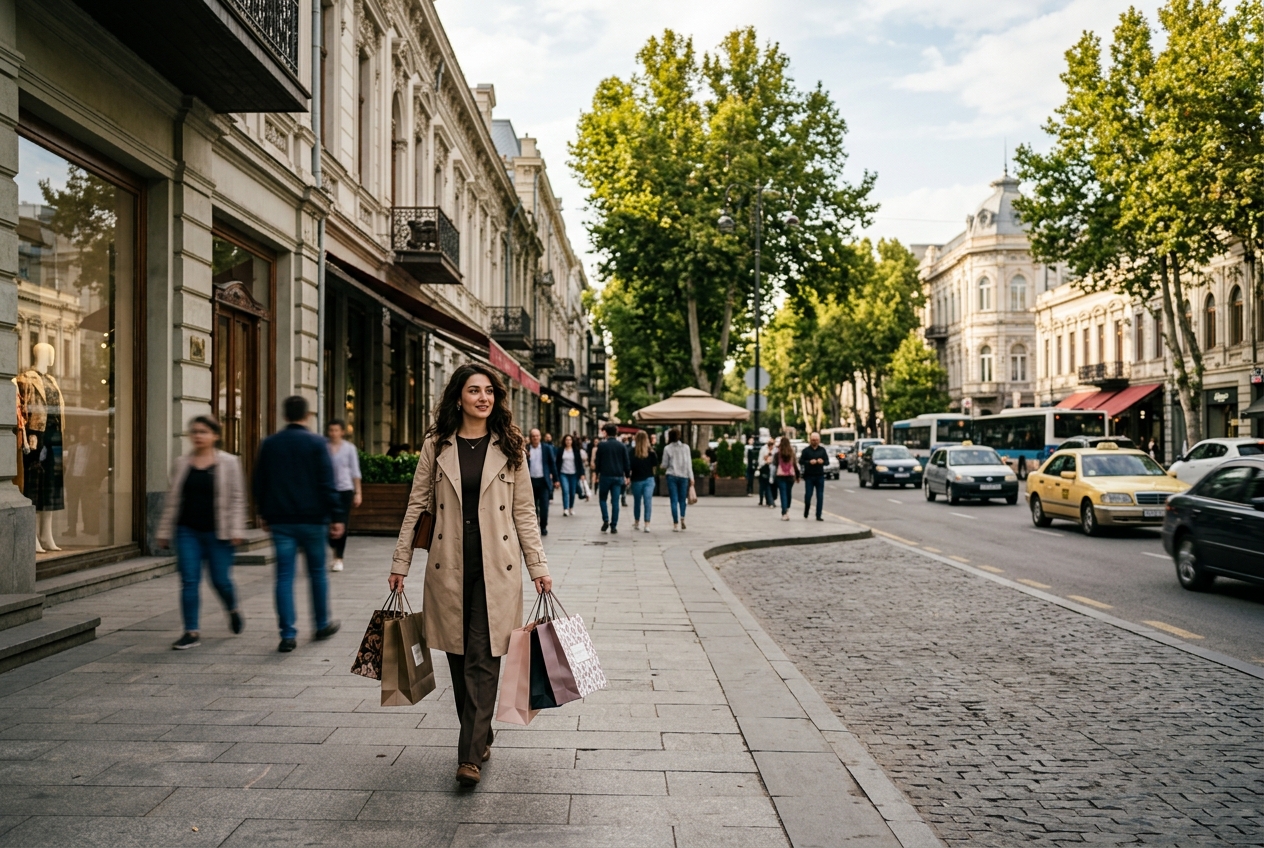
Tbilisi’s main boulevard is one of those rare streets where a single afternoon can take you from Soviet-era bookshops to sleek European fashion outlets, with detours through handmade enamel jewelry stalls and antique map dealers along the way. Named after the medieval Georgian poet Shota Rustaveli, this 1.5-kilometer stretch has been the cultural and commercial heart of the capital since the 19th century. If you’re planning a shopping trip along Rustaveli Avenue, you should know that it’s not a typical high street. The mix here is distinctly Georgian: a collision of old-world craftsmanship, post-Soviet nostalgia, and a rapidly growing appetite for international brands. Whether you’re hunting for a one-of-a-kind cloisonné pendant or a pair of Adidas sneakers, this avenue delivers. I’ve walked it dozens of times, and I still find something new on nearly every visit. This guide breaks down exactly where to spend your money, what to skip, and how to make the most of your time.
The Allure of Tbilisi’s Premier Shopping Boulevard
Rustaveli Avenue has earned its reputation as the Champs-Élysées of Tbilisi, and while that comparison might sound generous, it captures something real about the street’s ambition. This is where Georgia’s parliament building sits alongside the national opera house, the national museum, and a growing roster of retail destinations. The foot traffic alone tells the story: on any given Saturday, you’ll see families strolling past art galleries, tourists photographing the plane trees, and young Tbilisians ducking into concept stores.
What makes shopping here different from, say, a mall experience is the layering. You’re not sealed inside a climate-controlled box. You’re moving between a 19th-century building housing a jeweler and a glass-fronted modern mall, with street vendors selling churchkhela (Georgian candle-shaped candy made from grape must and walnuts) in between. The sensory experience is part of the draw.
The avenue has also become a barometer for Georgia’s retail economy. Consumer spending on clothing and accessories in Georgia has increased by 15% year-over-year, and much of that growth is visible right here. New storefronts open regularly, and the mix of local and international brands keeps shifting. For visitors, this means the Rustaveli you see today may look noticeably different from the one you’d have seen two years ago. That dynamism is part of its charm.
The generational split is visible too. Older Tbilisians remember Rustaveli as the boulevard of Soviet department stores and political demonstrations. The post-2003 generation, raised after the Rose Revolution, treats it as their main retail and social corridor. Both groups coexist on the same sidewalk, which gives the avenue a texture you won’t find in purpose-built shopping districts.
Galleria Tbilisi: Modern Brands and Entertainment
Galleria Tbilisi is the anchor of modern retail on the avenue. Sitting at the eastern end near Freedom Square, this multi-level shopping center is the most conventional retail space on Rustaveli, and that’s not a criticism. Sometimes you just want air conditioning, an escalator, and a predictable layout. The mall’s turnover increased by 5% in the summer of 2024, a sign that both locals and tourists are spending more time and money here.
International Fashion Retailers
The brand lineup at Galleria skews toward accessible international names. You’ll find Zara, H&M, Massimo Dutti, and LC Waikiki occupying large floor spaces. For sneaker culture, there are dedicated shops carrying Nike and New Balance. The pricing is roughly comparable to European retail, though certain items carry a slight markup due to import logistics.
What catches some visitors off guard is the quality of the local alternatives tucked between the global chains. Georgian brands like Materia and Kopala have small presences here, offering pieces that reflect local design sensibilities at prices well below their international neighbors. If you’re looking for something you couldn’t buy at home, these are worth a stop.
The mall also carries a decent range of cosmetics and skincare. Sephora has a presence, and there are several Georgian pharmacies on the ground floor selling locally produced skincare lines that use ingredients like Georgian rose oil and mineral water from Borjomi.
The Food Court and Cinema Experience
The top floors of Galleria house a food court that’s genuinely useful for refueling mid-shop. Options range from Georgian fast food (khachapuri and khinkali served quickly) to sushi, burgers, and Italian. Prices are reasonable: expect to spend 15-25 GEL for a full meal, which is roughly $5-9 USD.
The cinema on the upper level screens both Georgian and international films, with Hollywood releases often shown in English with Georgian subtitles. It’s a practical option if you’re traveling with kids or need a break from the heat during summer months. Ticket prices hover around 15-20 GEL.
Luxury Boutiques and Designer Concept Stores
Step outside Galleria and walk west along the avenue, and the retail character shifts. Here, independent boutiques and designer concept stores occupy the ground floors of ornate 19th-century buildings. The ceilings are high, the lighting is deliberate, and the price tags reflect it.
High-End Georgian Fashion Designers
Georgia’s fashion scene has been gaining international attention, and Rustaveli Avenue is where several prominent designers maintain their flagship stores. Avtandil, one of Georgia’s most recognized fashion houses, operates a boutique here with collections that blend Georgian textile traditions with contemporary European silhouettes. Pieces typically range from 300 to 2,000 GEL.
Datuna Sulikashvili is another name to know. His menswear combines structured tailoring with unexpected fabrics, and his Rustaveli location draws a loyal local clientele. For women’s fashion, look for Lako Bukia’s store, where handwoven elements meet modern cuts. These aren’t tourist shops. They’re where Tbilisi’s creative class actually buys clothes.
The interesting thing about Georgian designers is that many of them trained in Europe (Paris, Antwerp, Milan) and returned to Tbilisi specifically because the cost of production and studio space made it viable to build a brand here. That translates into surprisingly high quality at prices that would be impossible in Western European capitals.
Premium International Labels
The arrival of premium international brands has accelerated in recent years. Several notable names, including Sandro, Maje, and Adidas, entered the Georgian market on Rustaveli Avenue in 2025, signaling growing confidence in Tbilisi as a retail destination. These sit alongside existing presences from brands like Tommy Hilfiger and Calvin Klein.
Non-resident shoppers tend to spend significantly more per transaction than locals. The average clothing purchase by a non-resident was approximately 2,020 GEL per transaction, compared to about 93 GEL for residents. That gap reflects the avenue’s growing appeal to international visitors who see Georgian retail prices as competitive compared to their home markets.
Artistic Treasures and Georgian Souvenirs
This is where Rustaveli Avenue truly distinguishes itself. Between the fashion retailers and the cafés, you’ll find a constellation of small shops and gallery-stores selling handmade goods that you genuinely cannot find anywhere else.
Handmade Jewelry and Enamel Art
Georgian cloisonné enamel, known locally as “minankari,” is one of the country’s oldest and most distinctive art forms. Several shops along the avenue specialize in it, selling rings, pendants, earrings, and decorative crosses featuring the characteristic vivid blues, greens, and reds set in gold or silver wire. Prices vary dramatically based on craftsmanship: a simple pendant might cost 50 GEL, while an intricate necklace from a master artisan can run above 1,000 GEL.
I’d specifically recommend looking for pieces by artisans associated with the Tbilisi Academy of Arts, as these tend to maintain traditional techniques rather than cutting corners for mass production. Ask shopkeepers about the maker. In my experience, the ones who can tell you the artisan’s name and background are selling the real thing.
Gold jewelry is another strong category. Georgian goldsmithing has a history stretching back to the Colchian civilization (yes, the same Colchis from the Golden Fleece myth), and modern jewelers draw on those ancient motifs. Filigree work is particularly beautiful and relatively affordable compared to equivalent craftsmanship in Western Europe.
Traditional Textiles and Blue Tablecloths
Georgian textiles deserve their own section because they’re so often overlooked by visitors focused on wine and food. The famous blue tablecloths, sometimes called “Tbilisi blue,” feature intricate patterns printed or embroidered on cotton or linen. They make excellent gifts and pack flat in a suitcase.
| Item | Typical Price Range (GEL) | Best For |
|---|---|---|
| Blue tablecloth (cotton) | 40-120 | Home décor gift |
| Handwoven scarf | 60-200 | Personal accessory |
| Embroidered pillow cover | 30-80 | Lightweight souvenir |
| Felt slippers (traditional) | 20-50 | Quirky, practical gift |
| Silk shawl (Kakheti region) | 150-400 | Luxury gift |
Beyond tablecloths, look for handwoven scarves and shawls from the Kakheti and Tusheti regions. These are often sold by small cooperatives that work directly with rural weavers, so your purchase supports traditional craft communities. The quality of the wool and silk varies, so feel the fabric before buying and don’t hesitate to ask where it was made.
Literary Stops and Antique Discoveries
Rustaveli Avenue has a bookish soul. The street is named after a poet, after all, and that literary identity persists in the bookshops and antique dealers scattered along its length.
Historical Bookstores and English Editions
Prospero’s Books, located just off the avenue on a side street near the Rustaveli Theatre, is the best-known English-language bookshop in Tbilisi. It stocks a well-curated selection of fiction, Georgian history, travel writing, and translated Georgian literature. If you’ve never read “The Knight in the Panther’s Skin” by Shota Rustaveli himself, this is the place to pick up an English translation.
The avenue also hosts several antiquarian book dealers, some operating from tiny storefronts and others from open-air stalls near the Dry Bridge flea market area (a short walk from the avenue’s eastern end). Soviet-era maps, vintage Georgian postcards, and old editions of Caucasus travel guides are common finds. Prices are negotiable, and most dealers expect a bit of friendly haggling.
For antiques beyond books, keep an eye out for Soviet memorabilia, old Georgian coins, and vintage enamelwork. The quality varies enormously, so unless you’re knowledgeable about a category, stick to items you find beautiful rather than items you think might be valuable. The joy here is in the hunt, not the investment.
Practical Tips for Navigating Rustaveli Avenue
A few logistics can make or break your shopping experience on the avenue. The street is walkable end to end in about 20 minutes if you don’t stop, but realistically, plan for two to four hours if you want to browse properly.
Operating Hours and Best Times to Visit
Most shops along the avenue open between 10:00 and 11:00 AM and close by 8:00 or 9:00 PM. Galleria Tbilisi keeps longer hours, typically 10:00 AM to 10:00 PM daily. Smaller boutiques and jewelry shops sometimes close for a break between 2:00 and 3:00 PM, especially in summer.
The best time to shop is weekday mornings. Saturday afternoons bring the heaviest foot traffic, and the avenue can feel genuinely crowded during holiday periods like New Year (which Georgians celebrate with particular enthusiasm). If you’re visiting in summer, mornings are also cooler: afternoon temperatures in July and August regularly exceed 35°C, and much of the avenue is exposed to direct sun.
Sunday is quieter, but some smaller shops close entirely. Galleria and the chain stores remain open.
Currency Exchange and Payment Methods
The Georgian lari (GEL) is the local currency, and exchange offices are plentiful along the avenue. Rates are generally fair, but avoid the ones directly inside Galleria, which tend to offer slightly worse rates than the independent exchange offices a block or two away on side streets.
Card payments are widely accepted at established shops and the mall. Visa and Mastercard work everywhere. Smaller artisan shops and antique dealers may prefer cash, so carry some lari for those purchases. Download the Bolt app for getting to and from the avenue: it’s Tbilisi’s dominant ride-hailing service, cheaper and more reliable than hailing a taxi on the street. For language, most shop staff in international stores speak English. In smaller Georgian-owned shops, the younger generation (under 35) usually speaks conversational English, while older shopkeepers may speak Russian as a second language. Having Google Translate downloaded with the Georgian offline pack is a practical backup.
Shopping on Rustaveli Avenue rewards patience and curiosity more than a rigid plan. The best finds, whether it’s a hand-painted enamel brooch from a third-generation artisan or a first-edition Soviet-era poetry collection, tend to appear when you wander into the shops that don’t have English signage out front. Budget at least one full morning, wear comfortable shoes, and leave room in your suitcase. The avenue has a way of filling it.