
Table of Contents
- The Best Tbilisi Sulfur Baths: Quick Guide to Choosing Your Bathhouse
- History of the Abanotubani District
- How the Baths Work: Public vs. Private Rooms
- Comparing the Top Bathhouses in Abanotubani
- Bathhouse Comparison Table and 2026 Price Ranges
- Essential Etiquette: What to Bring and How to Behave
- Booking Your Session and Health Cautions
- Getting There by Car and Parking
- Why the Sulfur Baths are the Ultimate Winter Activity
- Frequently Asked Questions About Tbilisi Sulfur Baths
The Tbilisi sulfur baths sit in Abanotubani, the old bath district below Narikala Fortress. For most first-timers, the choice comes down to three things:
- Chreli Abano (the Orbeliani Baths) if you want the famous blue mosaic building and a polished private room.
- A public hall if you want the cheapest, most local experience.
- Gulo’s or one of the smaller private houses if you mainly care about cleanliness and a quieter soak.
Book a private room for an hour, add a kisi scrub, and bring flip-flops. That covers most of what you need to know. The rest of this guide explains how the baths work, what they cost in 2026, how to behave inside, and where to leave your car.
The Best Tbilisi Sulfur Baths: Quick Guide to Choosing Your Bathhouse
Every bathhouse in Abanotubani draws on the same natural springs. A cheap public hall and a luxury suite use identical water. One price guide puts it bluntly: “The water is identical at both ends of that range. What the money buys is the room around it: whether the door locks, how old the grouting is, whether anyone at the desk speaks English.”
That changes how you should choose. Don’t hunt for “better water.” Pick based on these factors:
- Privacy. Do you want a room to yourself, or are you comfortable sharing a hall with locals?
- Group size. Private rooms are priced per room, so splitting one between four people often costs less per person than you’d expect.
- Comfort level. Older houses feel more atmospheric. Newer or refurbished rooms feel cleaner and more spa-like.
- Language. Staff at the tourist-facing houses usually speak some English. In a public hall, you’ll rely on gestures and a translation app.
My short recommendation: couples and families should book a private room at a mid-range house. Solo travellers on a budget who want to see Tbilisi as locals do should try a public hall.
Bathhouse names and management change more often than you’d think. Some places trade under a brand name as well as their historic number. Check current names and reviews on Google Maps before you go.
History of the Abanotubani District
Tbilisi exists because of these springs. The founding legend says King Vakhtang Gorgasali was hunting in the forested valley in the 5th century. His falcon caught a pheasant, and both birds fell into a hot spring. When the king’s men found them, the pheasant was already cooked, or at least scalded, depending on who tells it.
Impressed by the warm water, Vakhtang ordered a city built on the spot. The name comes from the Georgian word “tbili,” meaning warm. Tbilisi is quite literally “the warm place.” A statue of the king on horseback stands above the river near Metekhi Church, looking down over the district.
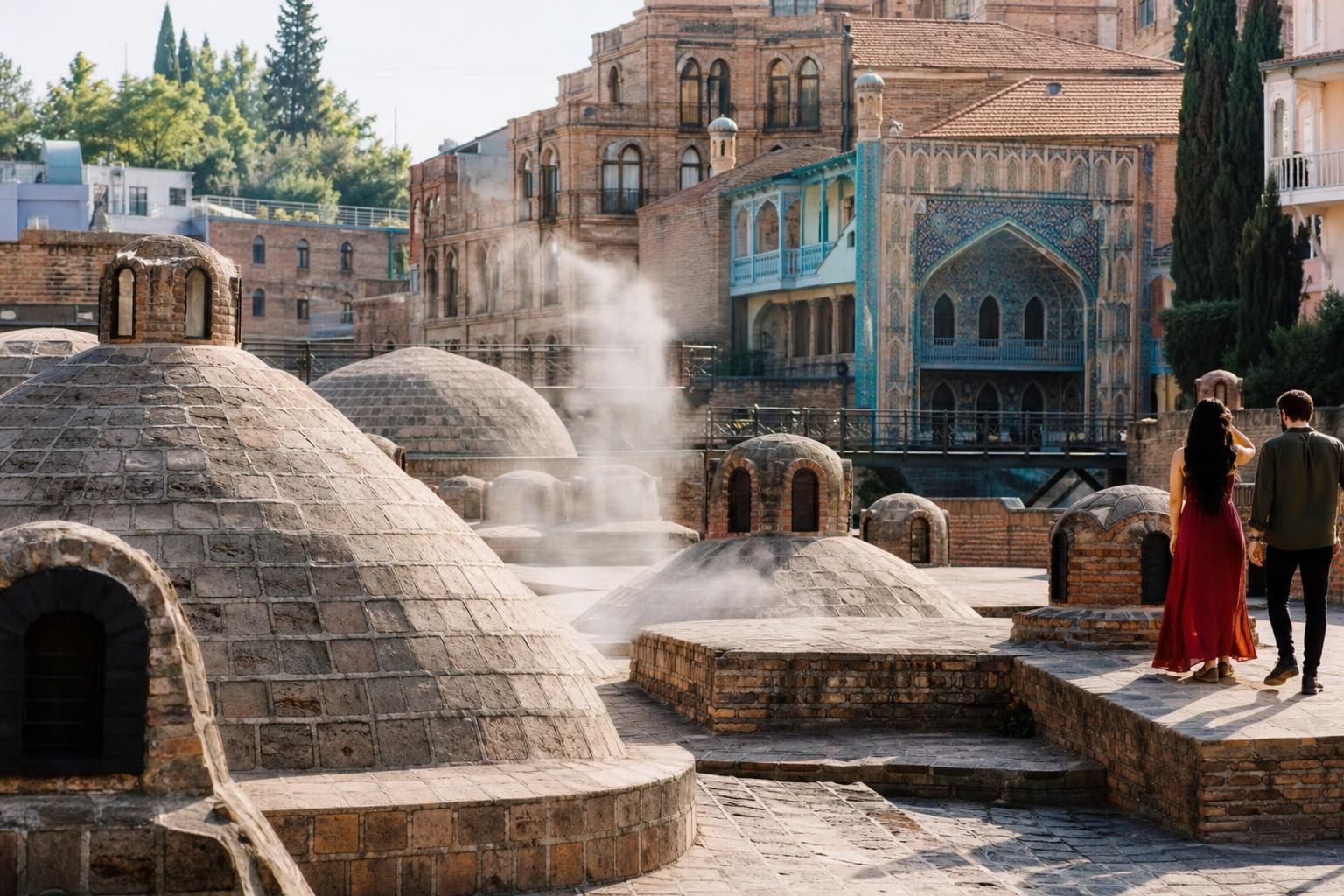
“Abanotubani” means “bath district,” from “abano” (bath). Over the centuries, the springs drew Persian, Arab and Ottoman influence. You can see it in the brick domes rising from street level, which work as skylights and vents for the underground chambers below.
The baths were never only about washing. For centuries they served as places to socialise, negotiate and gossip. Brides were traditionally brought to the baths before their weddings. Alexander Pushkin visited the Orbeliani bath in the 1820s and later wrote that he had never encountered anything more luxurious than the Tbilisi baths. That quote is still repeated proudly at the door.
The domes you walk across today are mostly 17th to 19th century. The springs below them are far older than the city.
How the Baths Work: Public vs. Private Rooms
Each bathhouse offers two very different experiences, and it helps to know which one you’re paying for.
Public halls are separated by gender. You undress in a changing area and share a large hot pool and showers with whoever is there, usually older Tbilisi residents who have been coming for decades. It’s loud, social and unpretentious. Public entry in 2026 runs roughly 5₾ to 10₾ per person, though some houses charge up to around 20 GEL. Not every bathhouse has a working public section, so check before you go.
Private rooms are what most visitors book. You rent the room by the hour, usually for one hour minimum. A standard room includes:
- A changing or lounge area, often with a table for tea or beer
- A hot sulfur pool, typically tiled stone, big enough for two to six people
- A cold plunge pool or cold shower
- At most houses, a sauna or steam room
- Showers and basic toiletries
The basic rhythm is hot pool, cold plunge, rest, repeat. The water smells of sulfur (think boiled eggs), and the smell clings to skin and hair for a day. That’s normal.
Rooms vary a lot in size and finish. A basic room might fit a couple. Larger suites with a sauna and a seating area suit groups. If you’re travelling with family or friends, a bigger room shared four ways is usually the best value in the district.
Tip: Ask to see the room before paying if you’re walking in. Grouting, ventilation and water clarity vary even within the same building.
The Kisi Scrub and Traditional Massage
The kisi is the part people remember. A “mekise,” the bath attendant, scrubs you down with a coarse mitt called a kisi. Dead skin rolls off in grey strings that are faintly alarming to see. It’s vigorous but not painful. Tell the mekise if you want it gentler.
Then comes the soap massage. The attendant fills a cloth bag with soapy water and squeezes it over you, burying you under a mound of foam before kneading your back, shoulders and legs. It isn’t a deep-tissue spa massage. Think of it as a brisk, old-fashioned wash by someone who has done it thousands of times. You come out with skin like a baby’s.
The scrub and soap massage are a separate add-on, generally 15 to 30 GEL in 2026. Book it when you reserve your room. Attendants are often busy at peak times. In private rooms, the mekise comes to you. Women can usually request a female attendant, but ask in advance.
Comparing the Top Bathhouses in Abanotubani
The houses below are the ones most travellers end up choosing between. Quality can shift with management changes, so treat recent reviews as the tiebreaker.
Chreli Abano (Orbeliani Baths)
You’ll recognise it immediately: a facade of turquoise and blue mosaic tiles with a pointed, Persian-style portal at the end of the bath street. It’s the most photographed building in Abanotubani and the default choice for first-time visitors. “Chreli abano” means “colourful bath.”
Inside, it leans upmarket. Private rooms are well maintained, with stone pools, saunas and lounge areas. Private rooms at Chreli Abano at 14 Abano Street cost 100 to 150 GEL (about $37 – $56) per hour, and the house keeps long hours, from 8:00 AM to 2:00 AM daily. Hours and prices can change, so confirm before you go.
The downside of fame is demand. Evening slots and weekends fill up days ahead, and the lobby can feel busy. You’re paying partly for the setting. Still, if this is your one sulfur bath visit in Georgia, the building alone makes a strong case.
Gulo’s Thermal Spa
Gulo’s has built its reputation on one thing travellers care about more than history: cleanliness. Reviews consistently praise fresh-feeling rooms, attentive staff and pools that look properly looked after. That counts for a lot in a district where some houses show their age.
It has also hosted well-known guests. Sting is the name most often mentioned, and the spa’s place on celebrity itineraries has helped its profile. In practice, the experience is quieter and more private than at Chreli. It suits couples who want a calm hour more than a photo opportunity. Prices sit in the mid-to-upper range, so check current rates when booking.
Royal Bath and Sulfur Bath No. 5
These two show the district’s full range.
Sulfur Bath No. 5 represents the older, numbered tradition. Many of Tbilisi’s bathhouses were known simply by number during the Soviet era. Expect a no-frills, local feel: public sections, practical private rooms, worn tiles and regulars who have been coming for decades. It’s the place for an authentic experience at a lower price, not for a spa day. Some numbered houses now operate under newer brand names, so verify the current name and whether a public section is open.
The Royal Bath goes the other way. Its private rooms are more upscale, with nicer finishes, saunas and lounge areas built for groups. It’s a good alternative when Chreli is fully booked and you still want comfort.
Of the two, I’d pick No. 5 for curiosity and the Royal Bath for comfort.
Bathhouse Comparison Table and 2026 Price Ranges
Across the district in 2026, private rooms range from about 15₾ to 400₾ per hour depending on luxury level, with most mid-range rooms falling between roughly 50 and 200 GEL. Public halls stay cheap. Only Chreli Abano’s figures below come from a single verified source. For the others, treat the ranges as guidance and check current prices directly.
| Bathhouse | Room types | Booking needed? | 2026 price estimate | Notes |
|---|---|---|---|---|
| Chreli Abano (Orbeliani) | Private rooms | Yes, days ahead for evenings/weekends | 100-150 GEL/hour | Blue mosaic facade, open 8 AM – 2 AM |
| Gulo’s Thermal Spa | Private rooms | Recommended | Mid-to-upper range, check | Known for cleanliness |
| Royal Bath | Private rooms, larger suites | Recommended | Upper range, check | Upscale finishes, good for groups |
| Sulfur Bath No. 5 | Public hall + basic private | Usually walk-in for public | Public ~5-20 GEL; private check | Local, historic, verify current name |
| Public halls (various) | Shared, gender-separated | No | 5-10₾ typical | Bring your own towel |
| Kisi scrub + soap massage | Add-on | Book with room | 15-30 GEL | Separate from room price |
For a couple, a realistic 2026 budget at a mid-range house is one hour’s room rent plus two kisi scrubs plus a small tip. That usually comes to somewhere between 150 and 250 GEL in total.
Essential Etiquette: What to Bring and How to Behave
Most bathhouses rent towels and sell slippers, but quality varies. Bring your own:
- Flip-flops. Floors are wet stone and can be slippery.
- A towel or two, especially for public halls.
- Shampoo and conditioner. The sulfur smell lingers, so a strong-scented wash helps.
- Moisturiser. Sulfur water and a kisi scrub dry your skin.
- A hair tie and a bag for wet things.
- Cash in GEL for tips and smaller houses.
- Water, though most houses sell drinks.
Remove jewellery before getting in, since sulfur tarnishes silver quickly.
Nudity rules depend on the room. In gender-separated public halls, locals bathe naked, and that’s the norm. In a private room it’s entirely your call: some couples wear swimsuits, some don’t. Expect the mekise to work around underwear or a swimsuit if you prefer to keep one on.
Behaviour is mostly common sense. Shower before getting into the pool. Keep your voice down in public halls. Don’t take photos where other bathers are present. Watch the clock in private rooms, because staff will knock when your hour ends, and overtime is usually charged.
Tipping isn’t mandatory, but leaving a few lari for your mekise is appreciated. Around 10% of the service, or 5-10 GEL, is typical. Hand it to them directly.
Note: Georgian hospitality is famously warm, but bathhouses run like a business. Being friendly with the desk staff gets you further than haggling.
Booking Your Session and Health Cautions
For Chreli Abano and the other popular houses, book several days ahead for evenings, weekends and holiday periods. Walk-ins work best on weekday mornings. Many houses take WhatsApp messages or phone bookings. If you don’t speak Georgian or Russian, a short message in English with your date, time, group size and whether you want a kisi scrub works well. Google Translate is handy for confirming details.
How long should you stay? One hour is the standard booking and enough for most people. Two hours suits groups who want to linger with tea between soaks. Inside the pool, keep each session short: 10 to 15 minutes in the hot water, then cool down.
The heat is real, and sulfur water isn’t for everyone. Talk to your doctor before visiting if you:
- Have a heart condition or high or low blood pressure
- Are pregnant
- Have open wounds, skin conditions or recent tattoos
- Feel lightheaded easily in saunas
Important: Don’t drink heavily before or during a session. Alcohol and high heat together raise the risk of fainting. Stay hydrated and step out at the first sign of dizziness.
Children are generally welcome in private rooms, but keep their dips short and supervise them closely.
Getting There by Car and Parking
Abanotubani is in the heart of Old Tbilisi, on the right bank of the Mtkvari River below Narikala Fortress, near Meidan Square and the Metekhi Bridge. If you’re driving from elsewhere in Georgia, you’ll enter the city on major highways, then thread through central Tbilisi. The roads are paved throughout, and no 4×4 is needed.
The last stretch is the tricky part. Old Town streets are narrow, steep and partly pedestrianised, and traffic around Meidan backs up in the evenings. Many travellers who rent a car for exploring the regions find it easier to park once and walk. Set your navigation app to the bath district itself, and avoid trying to drive onto Abano Street.
Parking options:
- Street parking on the surrounding roads, which is paid and regulated
- Paid lots and garages near Meidan and along the riverside roads
- Your accommodation’s parking, followed by a short Bolt or Yandex Go ride, often the least stressful option
Tbilisi parking rules and payment methods change, and fines are enforced. See our Tbilisi parking guide for current zones, how to pay and how to avoid tickets.
Tip: The baths are open late, so an after-dinner soak means easier parking once the evening rush fades. Just plan for darker, narrower lanes on foot.
Why the Sulfur Baths are the Ultimate Winter Activity
Tbilisi winters aren’t brutal, but the damp cold seeps in, especially in the evenings. Walk through Abanotubani on a January night and you’ll see steam drifting from the brick domes into the frosty air. It’s one of the city’s best winter sights.
The contrast is the point. You come in from the cold with numb fingers, sink into the hot mineral water, and feel your shoulders drop within minutes. Then the cold plunge jolts everything awake, and the hot pool feels even better the second time. Steam, stone and the low murmur of other bathers make the outside world feel very far away.
Winter is also a smart season for road-trippers. Mountain passes can close, and some highland routes become difficult, so Tbilisi makes a natural base for a few days. A late-afternoon bath after a day trip, followed by khinkali and a glass of wine nearby (with someone else doing the driving), is about as good as a Georgian winter evening gets.
Book ahead, though. Locals know this too, and the Tbilisi sulfur baths are busiest in the cold months.
Frequently Asked Questions About Tbilisi Sulfur Baths
Can I visit without booking?
Yes, especially on weekday mornings or in public halls. For evening private rooms at popular houses, reserve in advance.
Is the sulfur water good for your skin?
Many people visit for skin conditions and joint aches, and the water has a long folk reputation for healing. It can also dry skin out, so moisturise afterwards. Anyone with a medical condition should ask a doctor first.
Can couples share a public hall?
No. Public halls are separated by gender. Couples and mixed groups need a private room.
Do bathhouses accept cards?
Larger houses usually do. Smaller ones and tips are easier with cash in GEL, so carry some.
What’s the best time of day to go?
Weekday mornings are quietest. Late evenings are more atmospheric and often have easier parking nearby.
Abanotubani rewards a little planning. The water is the same everywhere, so choose on privacy, comfort and budget: Chreli Abano for the setting, Gulo’s for cleanliness, the Royal Bath for comfort, and No. 5 or a public hall for the local experience. Book popular slots a few days ahead, add a kisi scrub, pack flip-flops and moisturiser, and check 2026 prices before you go. If you’re touring Georgia by car, park once and walk the last stretch. Triproadwayplanner has more route and city guides to help you plan the rest of your trip.