
Table of Contents
- Exploring the Tsinandali Estate and Chavchavadze House Museum
- Tsinandali Wine: The Historic Cellar and Tasting
- The English-Style Park and Tsinandali Festival
- Planning Your Visit to Tsinandali
- Frequently Asked Questions about Tsinandali
Tsinandali is a 19th-century princely estate in Kakheti, eastern Georgia, about a 15-minute hop from Telavi. It combines a house museum, a historic wine cellar, and a landscaped park in one walkable site. For drivers it makes an easy half-day stop, and it works best as part of a longer loop through the wine region.
Below you’ll find what to see, how the tasting works, and how to fit the estate into a day of driving.
Exploring the Tsinandali Estate and Chavchavadze House Museum
The Tsinandali estate was the family seat of Prince Alexander Chavchavadze (1786-1846). He was a poet, a general in the Russian imperial army and one of the best-connected Georgians of his day.
He turned his ancestral property into a European-style manor. It became a salon where Georgian writers, Russian exiles and foreign visitors met, argued and read poetry. Alexander Griboyedov, who married the prince’s daughter Nino, is the name most visitors recognise.
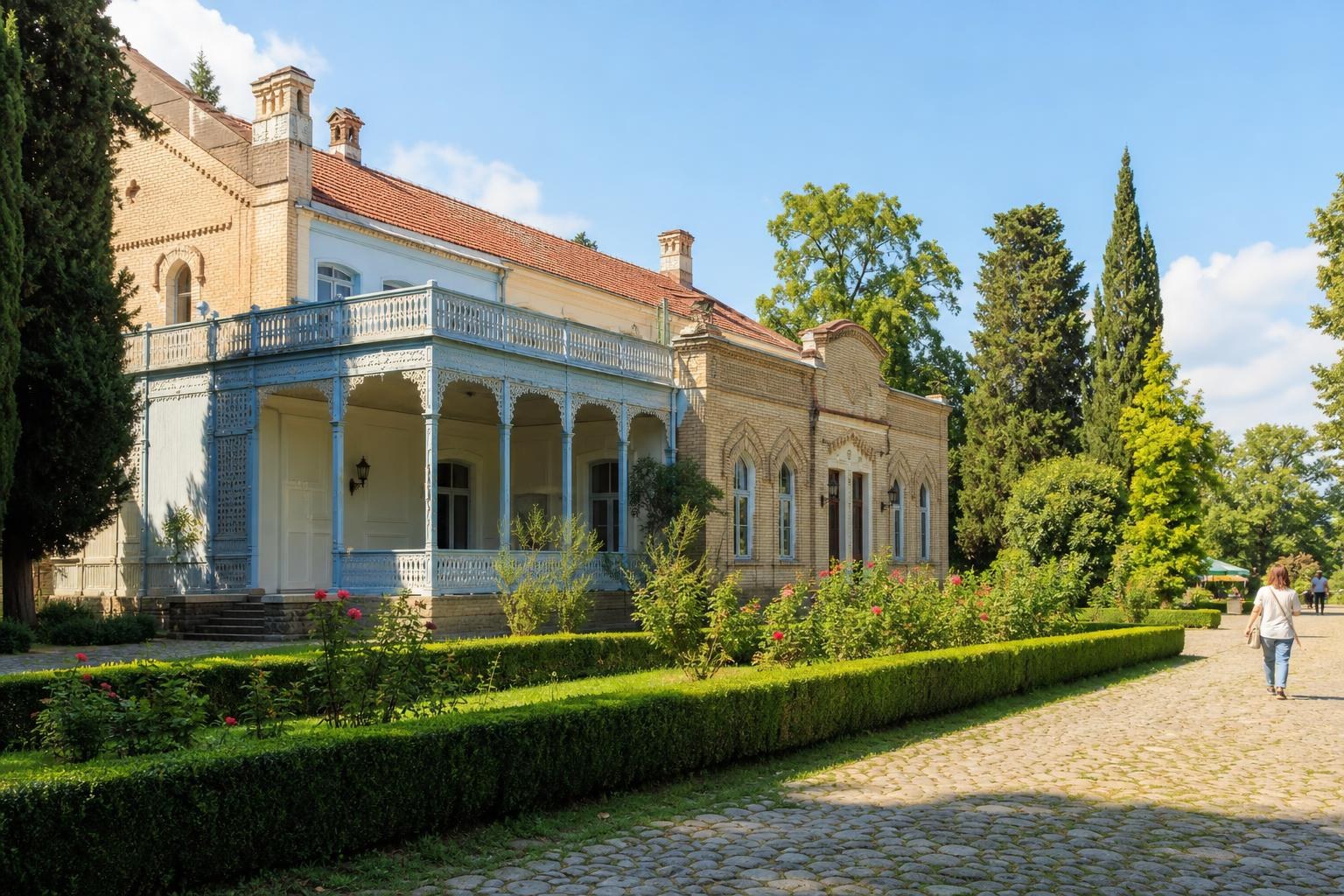
The two-storey house mixes Georgian and Italianate features, with an arcaded veranda facing the garden. In 1854 Dagestani raiders sacked the estate and took family members hostage. That episode still shapes how guides tell the story.
Inside, the Chavchavadze house museum displays:
- Family furniture and portraits from the 19th century
- Personal items and manuscripts connected to the prince and his circle
- Reconstructed reception rooms that show how the salon worked
Since 2007 the house has gone through major restoration. Expect polished, well-lit rooms rather than a dusty provincial museum.
Note: Most guided tours start on a set schedule. Arrive a little early so you aren’t waiting 30-40 minutes for the next group.
Tsinandali Wine: The Historic Cellar and Tasting
Chavchavadze is credited with bringing European winemaking methods to Georgia. Before his time, Kakheti wine was fermented almost entirely in clay qvevri buried in the ground. At Tsinandali he bottled and aged wine the European way, and that approach became a model for later Georgian wineries.
The highlight is the Oenotheque, the prince’s private collection. The historic oenotheque holds more than 16,500 bottles, including a 1841 Saperavi that is considered the oldest bottled wine in Georgia. You can’t taste that one, but standing in the cool, dim cellar among dusty racks is the most memorable part of the visit.
The modern tasting happens separately and usually includes a few estate wines. One is the dry white blend that carries the Tsinandali name. Staff explain the grapes and styles in English, so it’s a relaxed introduction if Georgian wine is new to you.
Important: Don’t drink and drive in Georgia. If you plan to taste, have a designated driver. The other option is to stay overnight at the Radisson Collection hotel on the estate grounds and drive on the next morning.
The English-Style Park and Tsinandali Festival
Many visitors leave the park for last, which is a mistake. It covers 18 hectares and was Georgia’s first European-style landscape garden, with over 1,600 plant species.
The layout is deliberately informal, in the English manner:
- Winding paths instead of straight avenues
- Old plane trees and conifers giving deep shade
- Open lawns, ponds and sightlines back to the house
In July or August the shade is a real relief from the Alazani Valley heat. Allow at least 45 minutes to wander.
In summer the estate hosts the Tsinandali Festival, a classical music festival held in a modern amphitheatre in the grounds. Accommodation nearby fills up fast during festival weeks. Check the dates before booking if you want to attend, or if you’d rather avoid the crowds.
Planning Your Visit to Tsinandali
Tsinandali works well as a self-drive stop because the region’s sights are spread out and public transport between them is thin. Renting a car in Tbilisi gives you the flexibility to link several places in a day.
Getting there by car:
- From Tbilisi: there are two main routes. One goes over the Gombori Pass, which is shorter but winding. The other runs through Sagarejo and Gurjaani, which is longer but has easier roads. Check current drive times in your navigation app.
- From Telavi: a short, flat drive southeast along the main road.
- Road condition: paved the whole way. No 4×4 is needed.
- Seasonal note: the Gombori Pass can be affected by snow in winter. Check conditions locally before you set off.
- Parking: there is visitor parking at the estate. Confirm on arrival which lot serves the museum.
Tickets (2026, check locally because prices change):
| Option | Price (2026) |
|---|---|
| Museum entry | 10 GEL |
| Full tour (palace, cellar, park) | 20 GEL |
| Wine tasting add-on | 15 GEL |
Opening hours change by season, so confirm them before you go.
Nearby stops for a day trip:
| Stop | What it is | Why pair it |
|---|---|---|
| Telavi | Kakheti’s main town | Lunch, fuel, ATMs |
| Alaverdi Monastery | 11th-century cathedral with monastic winery | Striking architecture, short drive |
| Gremi | 16th-century royal citadel on a hill | Views and history, on the way back |
Tip: Visit Tsinandali in the morning, have lunch in Telavi, then see Alaverdi and Gremi in the afternoon light.
Combining Tsinandali with the Kakheti Wine Road
If you’re spending more than a day in the region, Tsinandali is one stop on a much bigger route of wineries, family marani and qvevri cellars. Our Kakheti wine road guide on Triproadwayplanner covers that route and the winery picks in detail. Use it to plan the rest of your loop.
Frequently Asked Questions about Tsinandali
How long do I need at Tsinandali?
Plan on two to three hours for the guided tour, the cellar and a walk in the park. Add an hour if you’re doing a tasting.
Can I visit without a guide?
You can walk the park on your own. The house and the Oenotheque are usually visited on a guided tour.
Is Tsinandali good for kids?
Yes, mostly because of the park. Younger children may get restless in the museum rooms.
What’s the best time of year to go?
Late spring and September to October bring mild weather and harvest season. Summer is hot but has the festival.
The estate rewards visitors who slow down. See the house for the history, the cellar for the 1841 bottle, and the park for a shady break before the next leg of the drive.