
If you’ve ever spent a winter holiday season in Georgia, you already know the country doesn’t do anything halfway. The feasting, the toasting, the singing: it all goes on for weeks. And there’s a good reason for that. Georgians ring in the new year not once but twice, first on January 1st alongside much of the world, and then again on January 14th for what’s known as the “Old New Year” or Kalanda. The double celebration isn’t just an excuse to extend the party (though it certainly does that). It’s rooted in a calendar conflict that dates back centuries, intertwined with the deep influence of the Georgian Orthodox Church and a fierce commitment to preserving cultural identity. For travelers and curious outsiders, the question of why Georgians celebrate two New Years opens a fascinating window into a country where modernity and ancient tradition coexist with remarkable ease. The January 1st festivities feel familiar: fireworks, champagne, city squares lit up in Tbilisi. But the January 14th celebration is something else entirely, quieter and more spiritual, steeped in rituals that connect families to their ancestors and to the land itself. Understanding both holidays means understanding Georgia.
The Calendar Shift: Why Two New Years Exist
The existence of two New Year celebrations in Georgia isn’t a quirky cultural accident. It’s the direct result of a centuries-old disagreement about how to measure time. When much of the Western world adopted the Gregorian calendar in 1582, not everyone followed suit. The Eastern Orthodox world, including Georgia, continued using the Julian calendar, which had been the standard since Julius Caesar introduced it in 45 BC. That split created a 13-day gap between the two systems, and that gap is the entire reason Georgians have a second New Year on January 14th.
The Georgian state eventually adopted the Gregorian calendar for civil purposes, aligning government, commerce, and public life with the international standard. But religious life didn’t follow. The church held firm, and because religion and culture are so tightly braided together in Georgia, the old date never faded away. It simply became a second holiday.
The Gregorian vs. Julian Calendar Conflict
The Julian calendar, introduced in 45 BC, was a remarkable achievement for its time, but it had a flaw. It overestimated the length of the solar year by about 11 minutes. Over centuries, those 11 minutes compounded. By the 1500s, the calendar had drifted roughly 10 days out of sync with the astronomical seasons. Pope Gregory XIII addressed this in 1582 by introducing the Gregorian calendar, which corrected the drift and added a more precise leap year system.
Catholic and Protestant nations gradually adopted the Gregorian system, but the Orthodox world largely rejected it, viewing it as a papal imposition. Georgia, as a deeply Orthodox Christian nation, was no exception. The Julian calendar remained the standard for both civil and religious life for centuries. Even after the Gregorian calendar was adopted for everyday governance, the 13-day discrepancy persisted in church observances. That’s why January 1st on the Julian calendar falls on January 14th in the Gregorian system, giving Georgians their beloved Old New Year.
| Calendar | Introduced | New Year’s Day | Used By |
|---|---|---|---|
| Julian | 45 BC | January 14th (Gregorian equivalent) | Georgian Orthodox Church, some Orthodox nations |
| Gregorian | 1582 AD | January 1st | Most of the world, Georgian civil life |
The Role of the Georgian Orthodox Church
The Georgian Orthodox Church is one of the oldest Christian institutions on earth, tracing its roots to the 4th century AD. Its influence on daily life in Georgia is hard to overstate. The church still uses the Julian calendar for religious observances, which is 13 days behind the Gregorian calendar, and this isn’t a minor footnote. It shapes the entire holiday calendar, including Christmas (celebrated on January 7th) and the Old New Year on January 14th.
For many Georgians, especially in rural areas and among the older, Soviet-educated generation, the church calendar carries more weight than the civil one. The Old New Year isn’t just a leftover from a different era: it’s a living expression of faith. Priests bless homes, families attend services, and the celebration takes on a contemplative quality that the fireworks-and-champagne energy of January 1st doesn’t quite capture. The church’s steadfast commitment to the Julian calendar ensures that this second New Year remains spiritually anchored, not just a nostalgic tradition.
January 1st: The Modern and Secular Celebration
January 1st in Georgia looks a lot like New Year’s Eve anywhere else in Europe, but louder and with significantly more food. Tbilisi’s central squares fill with crowds, fireworks light up the sky over the Mtkvari River, and families gather around tables that practically groan under the weight of Georgian dishes. It’s the secular, public-facing celebration, the one that aligns Georgia with the rest of the world.
But even the “modern” celebration carries distinctly Georgian flavors. You won’t find a generic Santa Claus here. The gift-giving figure has his own name, his own look, and his own mythology. And the Christmas tree? In many Georgian homes, it’s not a pine tree at all.
Tovlis Babua: Georgia’s Snow Grandfather
Forget Santa Claus. In Georgia, the figure who brings gifts and joy to children during the New Year season is Tovlis Babua, which translates to “Snow Grandfather.” He’s a tall figure dressed in a white robe, often accompanied by a Snow Maiden, and he embodies the Georgian winter rather than the commercial Western Christmas aesthetic. Tovlis Babua shows up at public celebrations, in shopping centers, and at family gatherings, and Georgian children write him letters just as kids elsewhere write to Santa.
The character has roots in both Georgian folklore and Soviet-era tradition, when Ded Moroz (the Russian “Grandfather Frost”) was promoted as a secular alternative to religious Christmas figures. After independence, Georgia reclaimed the tradition with its own cultural spin. Tovlis Babua is distinctly Georgian, tied to the snowy peaks of the Caucasus and to a New Year celebration that, while modern in many ways, still feels local.
The Tradition of the Chichilaki Tree
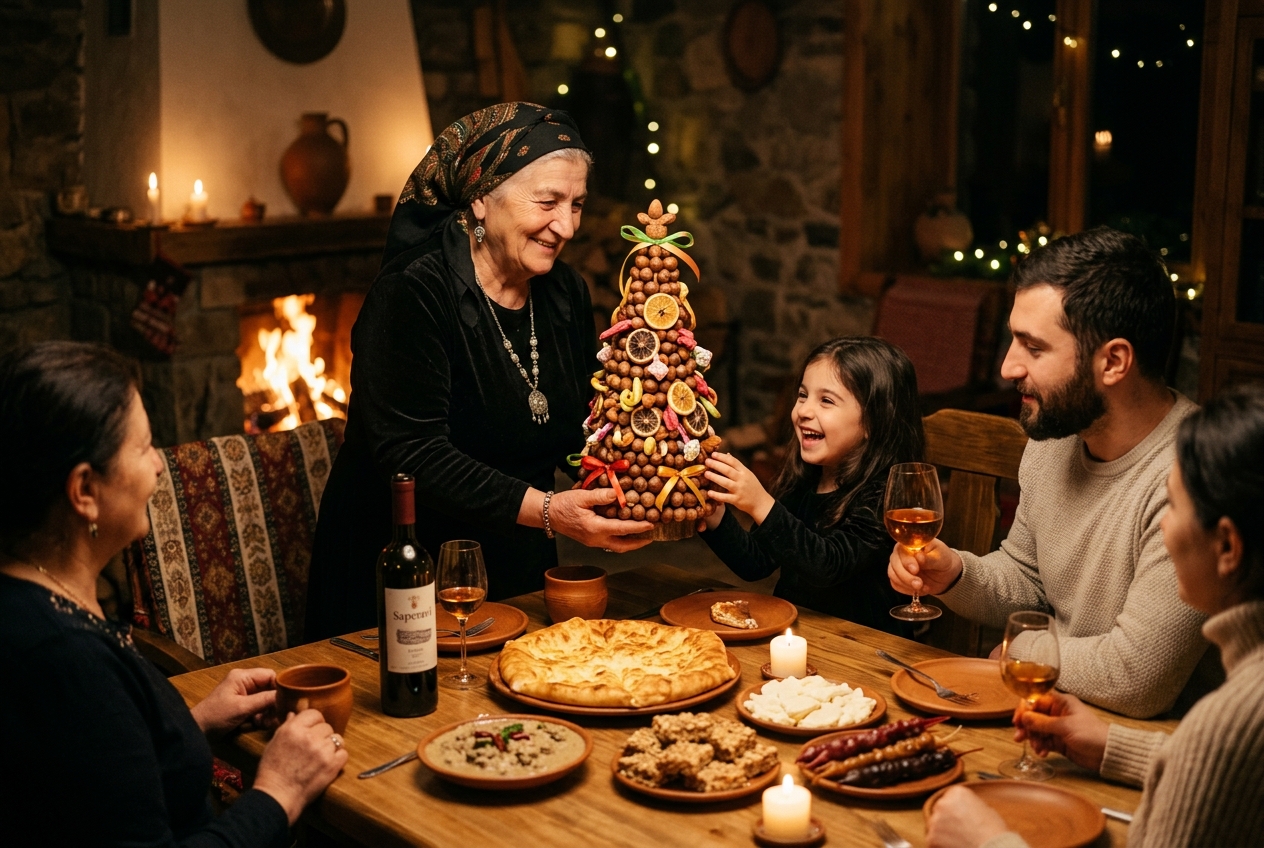
One of the most visually striking Georgian New Year traditions is the Chichilaki, a handmade “Christmas tree” crafted from dried hazelnut or walnut branches. The branches are shaved into thin, curling strips that cascade downward, creating a shape that resembles a small white tree or a beard. Chichilakis have been part of Georgian celebrations for centuries, and they carry deep symbolic meaning: the white curls represent the beard of an elder, symbolizing wisdom and the passage of time.
In western Georgia, particularly in the regions of Guria and Samegrelo, the Chichilaki is still the primary holiday decoration. Families make them by hand, and the process itself is a communal activity. After the holiday season ends, traditionally on the Epiphany (January 19th), the Chichilaki is burned, symbolizing the release of the past year’s troubles. It’s a ritual that connects the modern celebration to pre-Christian Georgian customs, and it’s one of the things that makes a Georgian New Year unlike anything you’ll experience elsewhere.
The Old New Year: Celebrating on January 14th
If January 1st is the big, loud party, January 14th is the quieter, deeper one. The Old New Year, or Kalanda, is celebrated across Georgia but holds particular significance in certain regions. In Guria, for instance, Kalanda is arguably a bigger deal than the January 1st celebration, with its own specific songs, rituals, and community gatherings.
The name “Kalanda” itself likely derives from the Latin “Calendae,” referring to the first day of the month in the Roman calendar, a linguistic thread connecting Georgia’s celebration to ancient timekeeping traditions. On this night, families come together again, tables are set with fresh food, and the atmosphere shifts from festive exuberance to something more reflective.
Intimate Family Gatherings and Spiritual Roots
Where January 1st might involve large parties and public events, the Old New Year tends to be a more intimate affair. Families gather at home, often with multiple generations around the table. The tone is warmer and more personal. Elders share stories, children stay up late, and the conversation turns to hopes for the coming year and memories of those who are no longer present.
Celebrating the Old New Year is seen as a way of honoring ancestors and preserving Georgian cultural identity amidst foreign influences. This isn’t empty sentimentality. For a country that spent decades under Soviet rule and continues to balance Western integration with its own traditions, the Old New Year is an act of cultural self-preservation. Younger Georgians, the post-2003 “Rose Revolution” generation that tends to be English-speaking and globally connected, still participate in these gatherings. The tradition bridges generational divides in a way that few other holidays manage to do.
Mekvle: The Importance of the First Guest
One of the most fascinating Georgian New Year customs is the tradition of the Mekvle, the first person to step across a household’s threshold after midnight. The Mekvle is believed to bring fortune, joy, and luck for the entire year, so choosing the right person matters enormously.
Families don’t leave this to chance. The ideal Mekvle is someone considered lucky, kind-hearted, and prosperous: a person whose energy you’d want setting the tone for your household’s year. In some families, the same person serves as the Mekvle year after year. If a family had a good year, they’ll often invite the same first guest back, crediting their presence with the household’s fortune.
The Mekvle tradition extends to Bedoba, January 2nd, which is another critical day in the Georgian New Year cycle. How Georgians spend this day is believed to determine their luck for the entire year. People avoid arguments, debts, and negativity on Bedoba, treating it as a kind of blueprint for the months ahead. If you’re visiting Georgia during this period, don’t be surprised if your Georgian hosts are very particular about who walks through the door first: it’s not superstition to them, it’s tradition with real weight.
Culinary Staples of the Georgian Supra
No Georgian celebration is complete without a supra, the traditional feast that is as much a social ritual as it is a meal. A New Year’s supra is among the most elaborate of the year, with dishes covering every inch of the table. The tamada, or toastmaster, guides the evening through a series of toasts: to family, to the departed, to Georgia, to the future. Each toast is followed by wine, often homemade from the family’s own qvevri (clay vessels buried underground for fermentation).
The food at a New Year’s supra isn’t random. Specific dishes carry symbolic meaning, and their presence on the table is non-negotiable. You’ll find khachapuri (cheese-filled bread), pkhali (walnut-vegetable pâté), and an abundance of pickled vegetables. But two dishes in particular define the holiday season.
Satsivi and Gozinaki: Essential Holiday Flavors
Satsivi is a cold turkey or chicken dish served in a rich walnut sauce spiced with cinnamon, cloves, fenugreek, and saffron. It’s prepared in large quantities, often a day before the celebration, and it’s served cold, which makes it perfect for a table that needs to stay loaded for hours. The walnut sauce is thick and fragrant, and every family has their own version. Ask five Georgian grandmothers for their satsivi recipe and you’ll get five different answers, each delivered with absolute conviction that theirs is the correct one.
Gozinaki is the essential New Year’s sweet: a confection made from caramelized honey and toasted walnuts, cut into diamond shapes and left to harden. It’s crunchy, sticky, and impossible to eat just one piece of. Gozinaki is traditionally prepared on New Year’s Eve, and the process of making it, stirring the honey and nuts together over heat, is often a family affair. These two dishes, one savory and one sweet, anchor the holiday table and appear at both the January 1st and January 14th celebrations.
- Satsivi: Cold poultry in walnut sauce, seasoned with Georgian spices
- Gozinaki: Honey-walnut candy, prepared on New Year’s Eve
- Khachapuri: Cheese-filled bread, present at every supra
- Churchkhela: Grape-must candy with walnuts, often gifted during the holidays
The Cultural Significance of Double Celebrations Today
Georgia’s two New Year celebrations aren’t just about dates on a calendar. They represent something larger: a country that refuses to choose between its past and its present. The January 1st celebration connects Georgia to the global community, to modernity, to the international rhythms of commerce and culture. The January 14th celebration pulls in the opposite direction, toward ancestry, faith, and a sense of identity that predates any calendar system.
For visitors, experiencing both celebrations offers a rare chance to see two sides of the same country. Spend January 1st in Tbilisi and you’ll feel the cosmopolitan energy of a capital city that’s rapidly modernizing, full of young people who speak English, use Bolt to get around, and celebrate with the same enthusiasm as their peers in Berlin or Barcelona. Then travel to a village in Guria or Kakheti for January 14th, and you’ll encounter a Georgia that moves at a different pace: slower, more deliberate, anchored by church bells and family recipes passed down through generations.
The fact that both celebrations thrive, side by side, says something important about Georgia. This is a country that doesn’t see tradition and modernity as contradictions. The double New Year is a perfect expression of that philosophy: two celebrations, two calendars, one culture that holds them both with equal conviction. If you’re planning a winter trip to Georgia, try to overlap with both dates. The contrast between them will tell you more about this country than any guidebook can.