
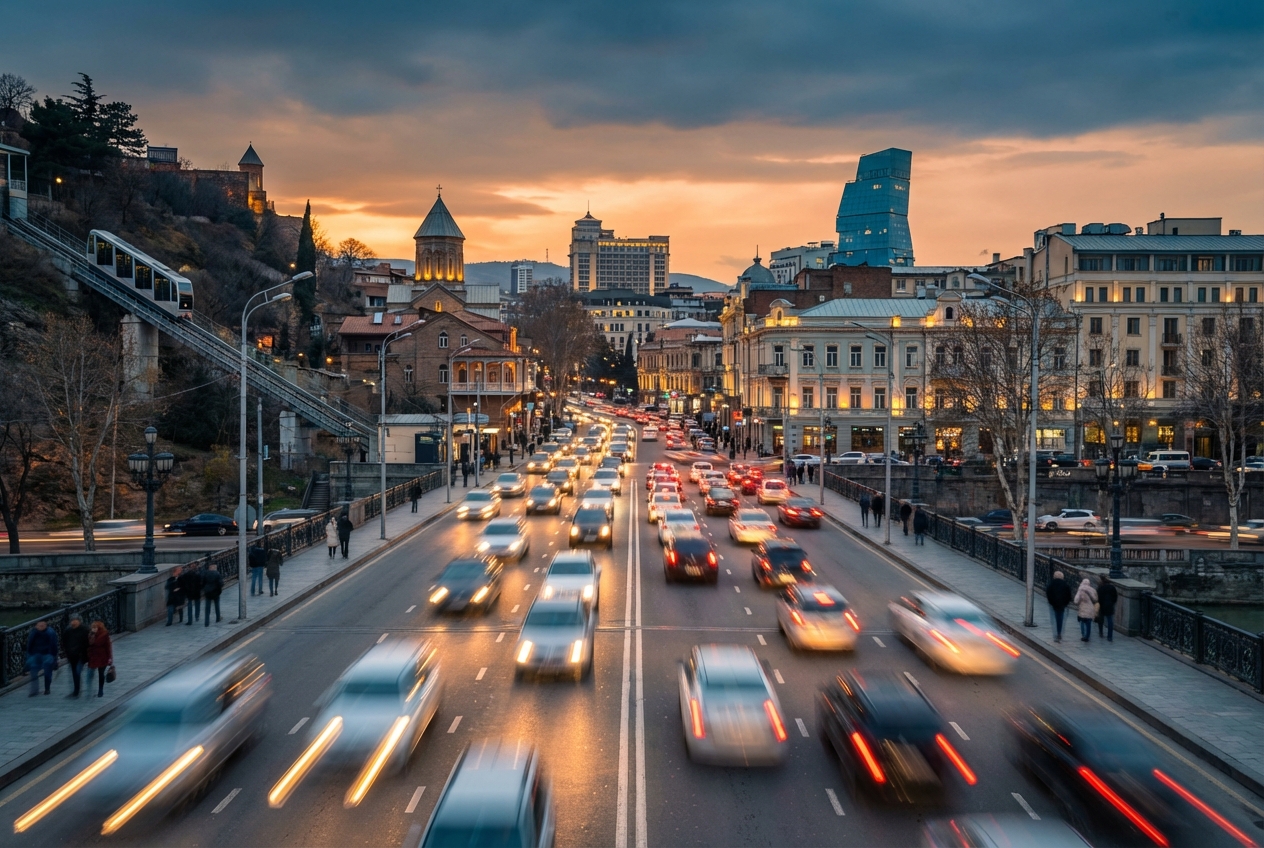
Tbilisi traffic has a reputation that precedes itself. Anyone who has spent more than a few days in Georgia’s capital knows the frustration of watching minutes tick by while stuck behind a wall of cars on Rustaveli Avenue. The question of what time rush hour hits in Tbilisi isn’t academic: it determines whether your 20-minute trip takes 20 minutes or an hour and a half. According to BTU AI research, an average driver in Tbilisi spends approximately 1 to 1.5 hours per day sitting in traffic. That’s time you could spend at a café in Sololaki, hiking Mtatsminda, or simply arriving at work without a stress headache. The city’s traffic situation has grown dramatically worse in recent years. The number of registered vehicles in Tbilisi surpassed 600,000 by 2023, representing a 25% increase over just five years, according to the Asian Transport Observatory. More recently, Kakha Kaladze reported that on September 19, 2025, there were 841,000 cars moving through the city, compared to 586,000 on the same day in 2022. That’s a staggering 43% increase in just three years. Understanding the rhythm of Tbilisi’s traffic patterns can save you significant time and frustration.
Peak Traffic Hours in Tbilisi
The general rule for Tbilisi traffic follows a familiar urban pattern, but with some Georgian twists. According to Wander-Lush, rush hour typically occurs around 8:00-10:00 AM and 6:00-8:00 PM on weekdays. However, those ranges tell only part of the story. The actual intensity varies significantly depending on the specific hour, location, and even the day of the week.
The Morning Commute: 8:30 AM to 10:30 AM
The morning rush in Tbilisi builds gradually. Around 7:30 AM, traffic starts picking up as early risers head to work. By 8:30 AM, the city’s main arteries are approaching capacity. The peak intensity hits between 9:00 and 10:00 AM, which might seem late compared to other European capitals, but reflects Georgian work culture and school schedules.
Schools typically start between 9:00 and 9:30 AM, meaning parents dropping off children contribute significantly to the morning congestion. This school traffic concentrates around residential neighborhoods like Saburtalo, Vake, and Didi Dighomi. If you’re traveling through these areas during morning peak hours, expect delays of 20-40 minutes beyond normal travel times.
The morning rush tends to dissipate more quickly than the evening one. By 10:30 AM, most routes return to manageable flow levels. If you have flexibility in your schedule, leaving before 8:00 AM or after 10:30 AM makes a substantial difference. Many expats and remote workers in Tbilisi have adapted by shifting their schedules accordingly.
The Evening Rush: 5:30 PM to 8:00 PM
The evening rush is longer, more intense, and more unpredictable than its morning counterpart. It begins around 5:00 PM as office workers start leaving, builds to full intensity by 6:00 PM, and often doesn’t subside until 8:00 PM or later.
Several factors make evening traffic worse. Workers don’t leave at uniform times, spreading the congestion over a longer period. Shopping trips, errands, and social activities add vehicles that weren’t present during the morning commute. Restaurant-goers heading to dinner in popular districts like Vera and Old Town contribute additional volume.
Friday evenings deserve special mention. The combination of weekend departures, social plans, and general end-of-week exhaustion creates the worst traffic conditions of the entire week. Traveling across Tbilisi on a Friday between 5:00 and 8:00 PM can easily take twice as long as the same journey on a Tuesday morning.
| Time Period | Congestion Level | Best Strategy |
|---|---|---|
| 7:00-8:00 AM | Moderate | Travel freely |
| 8:30-10:30 AM | Heavy | Use metro or delay travel |
| 10:30 AM-5:00 PM | Light to moderate | Optimal travel window |
| 5:30-8:00 PM | Very heavy | Avoid driving if possible |
| After 8:30 PM | Light | Travel freely |
Tbilisi’s Most Congested Areas and Routes
Not all parts of Tbilisi suffer equally during peak hours. Certain districts and routes consistently experience the worst congestion, while others remain relatively manageable. Knowing these patterns helps you plan routes and set realistic expectations.
Choke Points: Saburtalo and Vake Districts
Saburtalo and Vake represent the heart of Tbilisi’s traffic problems. These densely populated residential districts sit between the city center and the outer suburbs, meaning virtually everyone traveling downtown passes through them. The main thoroughfares, including Pekini Avenue, Vazha-Pshavela Avenue, and Chavchavadze Avenue, become parking lots during peak hours.
Saburtalo’s layout compounds the problem. The district developed rapidly during the Soviet era with limited consideration for future traffic volumes. Streets are narrow, parking spills onto roadways, and intersections lack adequate capacity. The area around Delisi metro station is particularly notorious, with traffic backing up in all directions during rush periods.
Vake presents similar challenges. Chavchavadze Avenue, the main route connecting Vake to the city center, handles far more vehicles than its design intended. The stretch between Vake Park and Rustaveli Avenue regularly experiences stop-and-go conditions throughout the evening rush. Side streets offer limited relief since they eventually funnel back onto the same congested arteries.
The Left and Right Banks of the Mtkvari River
The Mtkvari River divides Tbilisi into distinct halves, and crossing between them creates predictable bottlenecks. The city has a limited number of bridges, each serving as a critical link between the left and right banks. During rush hours, these bridges become choke points where traffic from multiple directions converges.
The Dry Bridge and Baratashvili Bridge, connecting the city center to the left bank, experience the heaviest loads. Traffic approaching these crossings backs up along Aghmashenebeli Avenue and the riverfront roads. The newer bridges in the Ortachala area handle less volume but still experience significant delays during peak periods.
The Heroes Square area represents another major convergence point. Traffic from Saburtalo, Vake, and the western suburbs all funnels through this interchange, creating complex merging situations. The underground passages help somewhat, but capacity remains insufficient for current vehicle volumes.
Factors Influencing Traffic Fluctuations
Tbilisi’s traffic isn’t static. Various factors cause significant day-to-day and seasonal variations that can catch unprepared travelers off guard. Understanding these patterns helps you anticipate particularly bad days and take advantage of quieter periods.
Seasonal Changes and School Terms
The school calendar dramatically affects Tbilisi’s traffic patterns. When schools are in session from September through June, morning and afternoon rush hours intensify considerably. The September return to school is particularly brutal, as families readjust to commuting routines after summer break.
Summer months bring noticeable relief. With schools closed and many families vacationing outside the city, traffic volumes drop by an estimated 20-30% during July and August. This makes summer an ideal time for visitors who want to explore the city by car or taxi without excessive delays.

Weather also plays a role. Rainy days consistently produce worse traffic as more people choose to drive rather than walk or use public transport. Snow, though rare in Tbilisi, causes near-gridlock conditions when it occurs. Georgian drivers have limited experience with winter conditions, leading to accidents and slowdowns that ripple across the entire network.
The Impact of Weekend Leisure Travel
Weekends follow entirely different patterns than weekdays. Saturday mornings start slowly, with traffic building only after 10:00 or 11:00 AM as people head to markets, shopping centers, and leisure destinations. The areas around East Point Mall, Tbilisi Mall, and the Dry Bridge flea market become congested by early afternoon.
Sunday traffic is generally the lightest of the week, though this changes dramatically on holiday weekends. When Georgians head to the mountains or countryside, the routes leading out of Tbilisi, particularly toward Mtskheta, Kazbegi, and Kakheti, experience heavy outbound traffic on Friday evenings and Saturday mornings, with corresponding inbound congestion on Sunday evenings.
If you’re planning your own weekend trip with a rental car from Tbilisi, leave before 8 AM on Saturday — you’ll be past the city limits before the outbound traffic builds up.
Major holidays create their own patterns. Georgian Orthodox Christmas and Easter see many residents leaving the city to visit family, temporarily reducing urban traffic while clogging intercity routes. National holidays like Independence Day can cause localized congestion around celebration venues and parade routes.
Navigating the City During Rush Hour
Avoiding rush hour entirely isn’t always possible. Work schedules, appointments, and flight times don’t always align with optimal travel windows. When you must travel during peak hours, alternative transportation options can save significant time and frustration.
Using the Tbilisi Metro as an Alternative
The Tbilisi Metro remains the most reliable way to travel during rush hour. According to the Asian Transport Observatory, the metro facilitates 450,000 passenger trips daily, accounting for approximately 13% of total trips in the city. During rush hour, the metro maintains consistent travel times regardless of surface traffic conditions.
The system has two lines that intersect at Station Square. The Akhmeteli-Varketili line runs roughly north-south, serving Saburtalo, the city center, and the left bank neighborhoods. The Saburtalo line extends from Station Square toward the western districts. Trains run every 3-5 minutes during peak hours, making the system efficient for covered routes.
The metro’s main limitation is coverage. Large portions of Tbilisi, including Vake, Vera, and most of the left bank residential areas, lack metro stations. However, combining metro travel with short taxi rides or walks can still be faster than driving the entire route during heavy traffic. A trip from Saburtalo to Old Town that might take 45 minutes by car during rush hour takes about 15 minutes by metro.
Bus Lanes and Public Transport Efficiency
Tbilisi has implemented dedicated bus lanes on several major corridors, though enforcement remains inconsistent. When functioning properly, these lanes allow buses to bypass car traffic, making public transport competitive with private vehicles even during peak hours.
The most effective bus lanes run along Rustaveli Avenue and portions of Aghmashenebeli Avenue. Buses using these corridors maintain relatively consistent schedules even during rush hour. The yellow city buses and marshrutkas (minibuses) both use these lanes, though marshrutkas tend to make more frequent stops.
Payment for public transport uses the Metromoney card system, which works on buses, marshrutkas, and the metro. Loading credit onto a card at metro stations or kiosks simplifies transfers between modes. A single ride costs 1 GEL (about $0.35), making public transport extremely affordable compared to taxis or rideshares.
Practical Tips for Commuters and Visitors
Surviving Tbilisi’s rush hour requires a combination of planning, flexibility, and local knowledge. These practical strategies can help you minimize time lost to traffic and reduce the stress of navigating the city.
Planning your travel around traffic patterns makes the biggest difference. If you have an important meeting or flight, build in substantial buffer time during peak hours. A journey that Google Maps estimates at 25 minutes might take 50-60 minutes during heavy traffic. For airport trips, leaving three hours before an evening flight provides adequate margin.
Ride-sharing apps like Bolt and Yandex Go show estimated arrival times that account for current traffic conditions. These estimates are generally accurate and update in real-time. Watching how estimates change over 10-15 minutes can help you decide whether to leave immediately or wait for conditions to improve.
Consider your accommodation location carefully if you’re visiting Tbilisi. Staying in the Old Town or near a metro station provides options for avoiding traffic entirely. Neighborhoods like Avlabari and Marjanishvili offer good metro access while remaining close to tourist attractions. Staying in Vake or Saburtalo means relying more heavily on surface transport.
Walking remains underrated as a transportation option in Tbilisi. The city center is compact enough that many destinations are within 20-30 minutes on foot. During rush hour, walking from Rustaveli to Fabrika in Marjanishvili often takes less time than sitting in a taxi. The city’s improving pedestrian infrastructure makes walking increasingly pleasant, especially along the riverfront and in the Old Town.
For those who must drive, avoiding the main arteries helps somewhat. Apps like Waze suggest alternative routes that can shave time off congested journeys. However, Tbilisi’s geography limits options: the river, hills, and railway lines create natural barriers that funnel traffic onto the same major roads.
The traffic situation in Tbilisi is likely to remain challenging for the foreseeable future. Vehicle numbers continue growing faster than infrastructure improvements can accommodate. Until the city develops more comprehensive public transport options or implements congestion pricing, rush hour gridlock will remain a daily reality. Your best defense is understanding the patterns, planning accordingly, and keeping alternatives in mind when traffic inevitably slows to a crawl.