
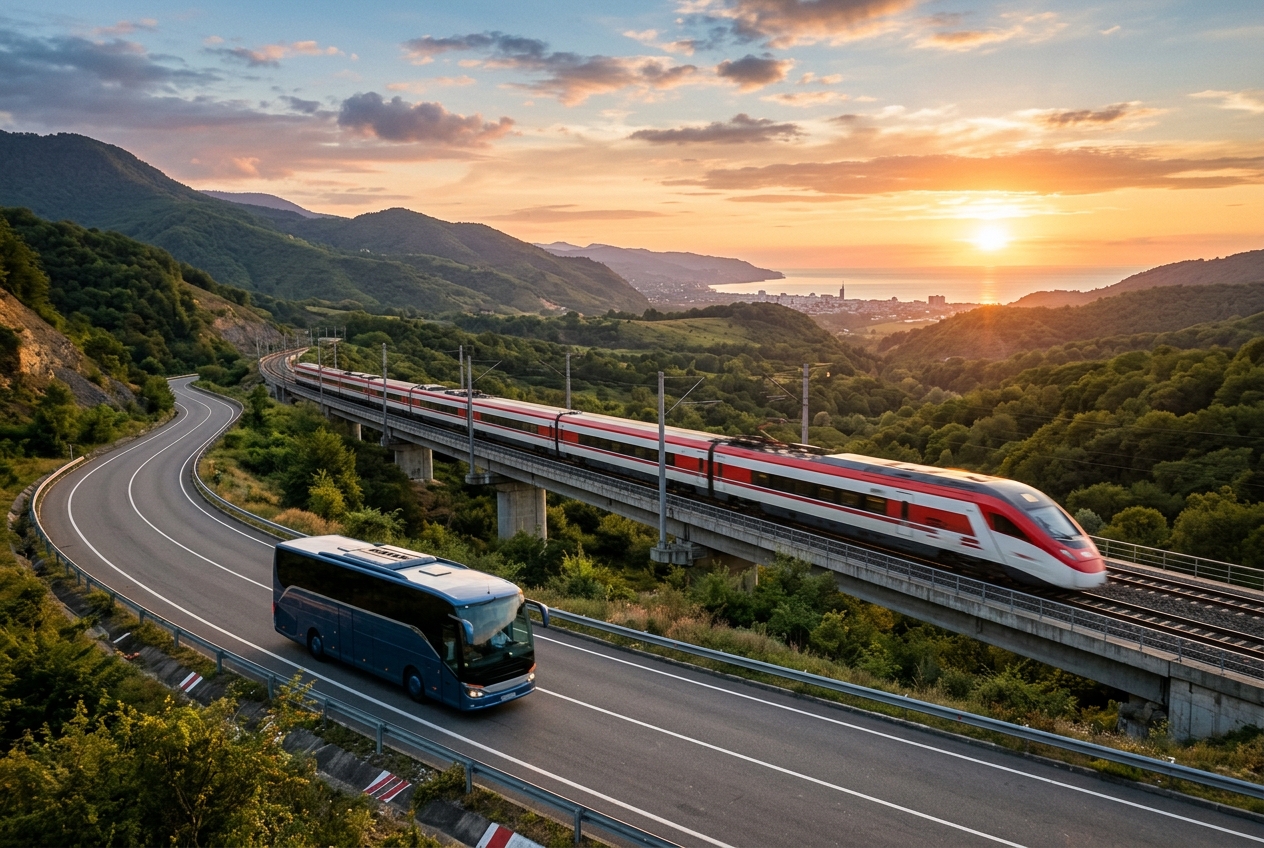
The 370-kilometer stretch between Georgia’s capital and its Black Sea resort city is one of the most popular domestic routes in the country. Whether you’re heading to Batumi for a beach weekend, a night out on the boulevard, or a gateway to Adjara’s mountain villages, the first real decision you’ll face is how to get there. I’ve made this trip more times than I can count, in every season and by every method short of hitchhiking, and the honest answer about the best way to travel from Tbilisi to Batumi depends entirely on what you value most: speed, comfort, price, or flexibility. Trains and buses each have genuine advantages, and the “wrong” choice can turn a pleasant journey into a frustrating one. This guide breaks down both options with real prices, schedules, and the kind of practical detail that actually helps you decide.
The Fast Track: Traveling by High-Speed Train
Georgian Railway introduced its modern fleet on this route several years ago, and it fundamentally changed the experience of cross-country travel. The train is widely considered the most comfortable and scenic way to cover the distance, and for good reason: it avoids highway traffic entirely, runs on a fixed schedule, and passes through some genuinely beautiful countryside between the Kartli plains and the Adjaran coast.
The journey from Tbilisi to Batumi by train takes approximately 5 to 5.5 hours, depending on the specific service and the number of intermediate stops. During summer, Georgian Railway typically adds extra departures to handle tourist demand, but the core schedule usually includes a morning and an afternoon train. The route passes through Khashuri, Zestaponi, and Kutaisi before curving south toward the coast, and the final hour along the Adjaran coastline is genuinely spectacular if you’re sitting on the right side of the train.
Stadler Kiss Trains: Comfort and Classes
The trains running this route are Swiss-made Stadler Kiss double-decker units, and they’re a significant upgrade from the old Soviet-era rolling stock that still operates on some Georgian routes. The carriages are air-conditioned, relatively quiet, and have large windows that make the scenery easy to enjoy.
There are two classes available. Second class offers comfortable reclining seats arranged in a 2+2 configuration, with decent legroom and power outlets at most seats. First class provides wider seats with more recline, a quieter cabin, and slightly more personal space. For most travelers, second class is perfectly fine, and the price difference doesn’t justify upgrading unless you really value the extra quiet. Both classes have access to a small café car selling sandwiches, coffee, and snacks, though bringing your own food from Tbilisi is a smart move since the onboard selection is limited and overpriced.
One thing I appreciate about these trains: they’re clean. The restrooms are maintained throughout the journey, and the overall atmosphere feels modern. If you’re traveling with kids, the stability of rail travel compared to winding mountain highways is a real advantage.
Booking Tickets via Railway.ge and TKT.ge
You can purchase train tickets through two main platforms. The official Georgian Railway website, railway.ge, is the primary source, and it allows you to book and pay online with a foreign credit card. The interface is functional if a bit clunky, and it’s available in English. The alternative platform, tkt.ge, is a third-party ticketing site that sometimes has a smoother user experience and also sells tickets for concerts and events across Georgia.
Booking in advance matters, especially between June and September. Summer trains to Batumi sell out days ahead, particularly for morning departures. If you’re traveling during peak season, try to book at least three to five days in advance. Off-season, you can often buy tickets the day before or even at the station, but I wouldn’t gamble on same-day availability for a Friday afternoon train.
Tickets are tied to your passport number, so have that handy when booking. You’ll receive an e-ticket that you can show on your phone, though printing a copy isn’t a bad idea given that mobile signal can be spotty in some stations.
Departure at Tbilisi Central and Arrival in Batumi
Trains depart from Tbilisi Central Station, known locally as “Sadguris Moedani,” which is easily reachable by metro (Station Square stop on the red line). The station itself has been renovated and has a small waiting area, a few shops, and ATMs. Arrive at least 20 to 30 minutes before departure, as platform assignments sometimes change and the signage isn’t always obvious to non-Georgian speakers.
In Batumi, trains arrive at Batumi Central Station, located about a 10-minute walk from the seaside boulevard or a quick ride via Bolt, which is the dominant ride-hailing app in Georgia. The station is small and straightforward, and you won’t have trouble finding your way out. If you’re heading to the old town or the Batumi Botanical Garden area, a taxi from the station should cost no more than 5-8 GEL.
The Scenic Route: Taking the Bus or Marshrutka
Road transport between Tbilisi and Batumi comes in two distinct flavors: modern coach services and traditional marshrutkas. Both follow the same highway, but the experience couldn’t be more different. The road itself is mostly well-maintained, passing through the Rikoti tunnel and along the western Georgian lowlands before climbing into Adjara. Traffic conditions vary wildly depending on the season and time of day.
The average bus trip from Tbilisi to Batumi takes around 5 hours and 55 minutes, though this can stretch to seven hours or more during summer weekends when the highway between Kobuleti and Batumi turns into a parking lot. That variability is the biggest downside of road travel on this route: you simply can’t guarantee your arrival time.
Metro Georgia: The Premium Coach Experience
Metro Georgia is the closest thing to a Western-style intercity bus service in the country. Their coaches are modern, air-conditioned, and equipped with Wi-Fi (which works intermittently, but it’s there). Seats are comfortable enough for a six-hour ride, and the buses make one or two rest stops along the way at roadside restaurants where you can grab khachapuri or use proper restrooms.
Bus tickets from Tbilisi to Batumi cost around 44 GEL, which is actually more expensive than a second-class train ticket. This surprises most travelers, who assume the bus would be the budget option. Metro Georgia buses depart from the Ortachala Bus Station in Tbilisi, which is south of the city center and reachable by taxi or city bus. Departures run throughout the day, with the most frequent service during morning and early afternoon hours.
One genuine advantage of the bus: more flexible scheduling. While the train has two or three daily departures, buses leave every hour or two, giving you more options if your plans change. You can book Metro Georgia tickets online through their website or app, or simply buy them at the station.
Local Marshrutkas from Didube Station
Marshrutkas are the old-school Georgian travel experience: minivans packed with passengers, luggage, and occasionally livestock. For the Batumi route, marshrutkas depart from Didube Station in northern Tbilisi, which is accessible via the Didube metro stop. They leave when full, which usually means every 30 to 45 minutes during busy periods.
The price is the main draw: marshrutka fares are typically cheaper than both the train and the premium bus, often running around 30-35 GEL. The trade-off is comfort. Seats are cramped, legroom is minimal, air conditioning is unreliable, and the driving style can be, let’s say, assertive. If you’re prone to motion sickness, the winding sections of highway will test you.
Marshrutkas don’t have fixed schedules posted online, so you essentially show up and wait. For solo travelers or backpackers who are flexible with time and comfortable with a rougher ride, they work fine. For families or anyone with significant luggage, I’d steer toward the train or Metro Georgia.
Comparative Analysis: Price, Speed, and Reliability
Choosing between train and bus for this route isn’t as straightforward as picking the cheapest or fastest option. Each mode has trade-offs that matter differently depending on your travel style.
| Factor | Train (Stadler Kiss) | Bus (Metro Georgia) | Marshrutka |
|---|---|---|---|
| Travel Time | 5 – 5.5 hours | 5.5 – 7+ hours | 5.5 – 7+ hours |
| Price | ~35-36 GEL (2nd class) | ~44 GEL | ~30-35 GEL |
| Comfort | High | Moderate | Low |
| Schedule Reliability | Very high | Variable (traffic) | Unpredictable |
| Departure Frequency | 2-3 daily | Every 1-2 hours | When full |
| Booking | Online required in summer | Online or at station | At station only |
Travel Times and Traffic Factors
The train wins on reliability every time. A 5-hour train journey is a 5-hour train journey regardless of whether it’s a Tuesday in February or a Saturday in August. The track doesn’t have traffic jams. The high-speed Stadler train is often considered the top choice for comfort, speed, and scenery, bypassing road traffic entirely.
Buses, on the other hand, are at the mercy of Georgia’s highway system. The Rikoti Pass section, while improved by recent tunnel construction, still creates bottlenecks. And the coastal road approaching Batumi during summer is notorious for delays. I’ve personally sat in traffic for over an hour just between Kobuleti and Batumi on a July Saturday. If you’re traveling during peak season and have a dinner reservation or a connecting transfer, the bus is a gamble.
Cost Comparison for Budget Travelers
Here’s what catches people off guard: second-class train tickets cost around 35-36 GEL, making the train cheaper than the Metro Georgia bus at 44 GEL. The marshrutka is the true budget option at 30-35 GEL, but the savings of 5-10 GEL come at a significant comfort cost.
For environmentally conscious travelers, it’s worth knowing that a bus trip on this route generates an estimated 6.57 kg of CO2, while rail travel generally produces lower emissions per passenger-kilometer. The train is both the cheaper and greener option here, which is an unusual combination.
Practical Logistics for Your Journey
Getting the logistics right can make the difference between a smooth trip and a stressful one. A few details that guidebooks often skip.
Best Times of Day to Travel
Morning trains are the most popular and sell out first. If you can, grab the earliest departure: you’ll arrive in Batumi by early afternoon with the whole day ahead of you. The afternoon train gets you there in the evening, which works if you’re not in a rush.
For buses, avoid Friday afternoon and Saturday morning departures during summer at all costs. The highway congestion during these windows is brutal. Midweek travel is noticeably smoother on the road. If you must take a bus on a weekend, leave as early as possible: the 7 or 8 AM departures face far less traffic than anything after 10 AM.
Returning from Batumi to Tbilisi, Sunday evenings are the worst for road traffic as the entire beach crowd heads home simultaneously. Book the train for your return leg even if you took the bus outbound.
Luggage Restrictions and Onboard Amenities
Trains are generous with luggage. There are overhead racks and space between seats for bags, and nobody is going to weigh your suitcase. If you’re traveling with a large backpack or multiple bags, the train is far more accommodating than a marshrutka, where storage space is a free-for-all.
Metro Georgia buses have undercarriage storage for larger bags, similar to European coach services. You won’t have problems with a standard suitcase and a daypack. Marshrutkas are tighter: if you have more than a single backpack, you might end up with it on your lap.
Onboard amenities differ significantly. Trains have restrooms, a café car, power outlets, and reasonably stable cell signal for most of the journey. Buses have air conditioning and occasional Wi-Fi. Marshrutkas have whatever the driver decides to play on the radio. Download offline maps on Google Maps and an offline Georgian language pack on Google Translate before any of these journeys, since connectivity gaps are real, especially through the mountain sections.
Final Verdict: Which Option Should You Choose?
The train is the best choice for most travelers on this route, and it’s not particularly close. It’s cheaper than the premium bus, faster and more reliable than any road option, more comfortable than a marshrutka, and the scenery along the Adjaran coast is a genuine highlight. Book through railway.ge or tkt.ge as early as possible during summer, grab a window seat on the left side heading to Batumi for the best coastal views, and bring snacks from one of Tbilisi’s bakeries.
The bus makes sense in two specific scenarios: you need schedule flexibility that the train’s limited departures can’t offer, or trains are sold out. Metro Georgia is a decent backup, and the extra cost over the train is worth it compared to a cramped marshrutka. Marshrutkas are for the adventurous, the spontaneous, and those watching every lari.
Whatever you choose, the trip between Tbilisi and Batumi is one of Georgia’s great domestic journeys. The landscape shifts from dry eastern plains to lush subtropical coastline in a matter of hours, and arriving in Batumi with the salt air hitting your face is one of those small travel moments that sticks with you. Just book the train.