
Table of Contents
- The Magic of Georgia’s High-Altitude Summer Resort
- Chasing the Sea of Clouds: Best Time to Visit
- Bakhmaro vs Gomis-Mta: Choosing Your Mountain Escape
- Essential Logistics for Your Trip
- Top Things to Do Above the Clouds
- What to Pack for the Guria Mountains
- Your Morning Above the Clouds
Most people who visit Georgia’s mountains head straight for Kazbegi or Svaneti. A smaller crowd discovers Bakhmaro. But there’s a place even fewer travelers know about: a ridge in the Guria highlands where, on the right morning, you stand above a white ocean of clouds that stretches to the horizon. Gomis-Mta is not a resort. It has no hotels, no restaurants, and barely any phone signal. What it does have is one of the most surreal natural spectacles in the Caucasus: a sea of clouds that forms beneath you while you sip tea from a thermos at 2,100 meters. I first heard about it from a marshrutka driver in Ozurgeti who described it as “the place where God hides the valleys.” That’s not far off. If you’re the kind of traveler who gets excited about raw, undeveloped mountain destinations with zero tourist infrastructure, this is your spot. Here’s everything you need to plan a visit.
The Magic of Georgia’s High-Altitude Summer Resort
Gomis-Mta sits in the Guria region of western Georgia, perched on a ridge at roughly 2,000 to 2,100 meters above sea level. Unlike its more famous neighbor Bakhmaro, which has been attracting visitors since the Soviet era, this highland settlement remains almost entirely off the radar for international tourists. Even most Georgians haven’t been there.
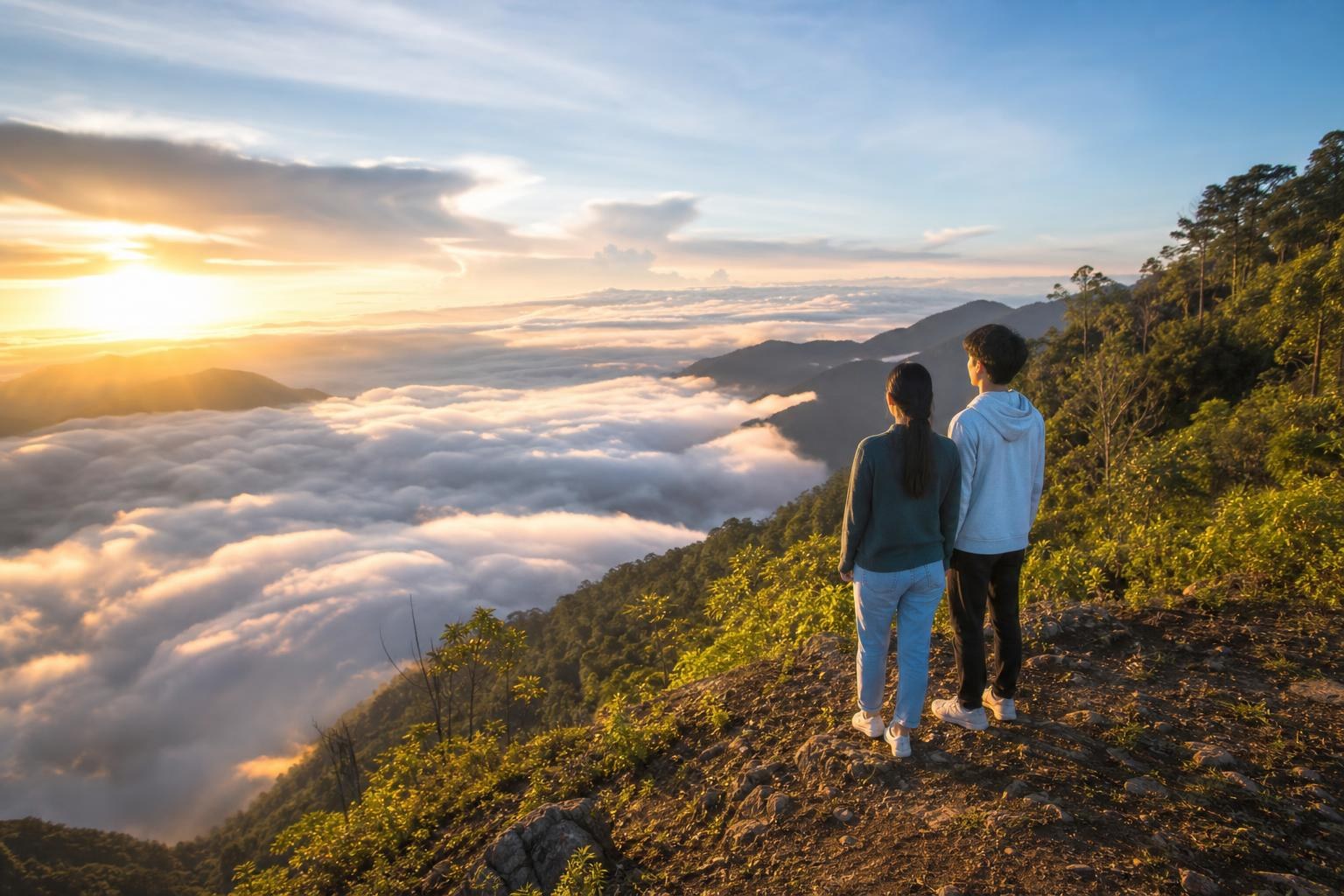
The magic here is meteorological. Warm, humid air from the Black Sea, only about 50 kilometers to the west, pushes inland and collides with the cooler mountain air of the Meskheti Range. The result is a thick blanket of clouds that fills the valleys below while the ridgeline remains bathed in sunlight. Standing on the grassy slopes at dawn, you’re looking down at what genuinely resembles a white sea, with distant peaks poking through like islands. Locals call it “ghrublebi zghva,” the sea of clouds.
The settlement itself is seasonal. Families from lowland Guria bring their cattle up in late May or early June and stay through September. Small wooden huts, called “bina” locally, dot the hillsides. There’s no running water, no electricity grid, and no paved roads once you leave the main access route. The Georgian government has invested in improving road access to the broader region: the road rehabilitation connecting Ozurgeti to Bakhmaro was a GEL 18.8 million infrastructure project that improved the 21-kilometer stretch significantly. But Gomis-Mta itself remains a place where you bring everything you need with you.
That’s precisely the appeal. You won’t find souvenir shops or Instagram-ready cafés here. What you will find is a silence so complete it almost rings in your ears, broken only by cowbells and the occasional hawk overhead. The air smells like wild herbs, pine resin, and damp earth. For anyone tired of polished mountain “experiences,” this is the antidote.
Chasing the Sea of Clouds: Best Time to Visit
The cloud formations are the main draw, and timing your visit correctly makes all the difference between a transcendent morning and staring into gray fog.
Ideal Weather Conditions for Cloud Formations
The sea of clouds forms when specific atmospheric conditions align. You need warm, moisture-laden air rising from the Black Sea lowlands, a temperature inversion layer that traps clouds at a specific altitude (usually between 1,200 and 1,800 meters), and clear skies above the inversion. This combination is most common during stable high-pressure weather systems.
The best time to see the sea of clouds is typically during periods of settled weather following a rainy spell. A day or two of rain saturates the lower atmosphere with moisture, and when high pressure moves in, that moisture gets trapped below the ridgeline as a dense cloud layer. If you check weather forecasts and see rain followed by a clear, calm morning, that’s your window.
Wind is the enemy. Strong winds break up the inversion layer and scatter the clouds. You want calm or very light winds at ridge level. Mornings are almost always better than afternoons because thermal convection during the day lifts the cloud layer and eventually dissipates it or pushes it above your elevation.
Seasonal and Daily Timing for the Best Views
June through mid-August offers the highest probability of catching the phenomenon. July is the sweet spot: the lowlands are hot and humid, the Black Sea is warm, and moisture production is at its peak. Early June can be excellent too, though the access road may still be muddy from spring melt.
Your alarm should be set for 5:00 AM. The best cloud formations occur between first light and about 8:30 AM, before the sun heats the slopes enough to disrupt the inversion. I’ve seen mornings where the cloud sea was perfect at 6:00 AM and completely gone by 9:30. Bring your coffee in a thermos and be on the ridge before sunrise. Late afternoon, around 6:00 to 7:00 PM, occasionally produces a second show as temperatures drop and clouds reform, but this is less reliable.
September visits are possible but riskier. The seasonal families start heading back to the lowlands, and weather becomes more unpredictable. If you’re flexible with dates and can wait for the right forecast window, July remains your best bet.
Bakhmaro vs Gomis-Mta: Choosing Your Mountain Escape
Both destinations sit in the Guria highlands and share the same basic appeal: high-altitude meadows with cloud formations. But the experience at each is fundamentally different, and choosing between them depends on what kind of trip you want.
Infrastructure and Accessibility Comparison
Bakhmaro is a proper resort settlement, at least by Georgian mountain standards. It has guesthouses, small shops, a few cafés, and mobile phone coverage in some areas. During peak summer season, you’ll find families, children, and a social atmosphere. The road from Ozurgeti to Bakhmaro, while still a mountain road, has been significantly improved and is passable for most vehicles from June through September. Shared minivans run the route during summer months, and you can arrange a taxi from Ozurgeti for roughly 80 to 120 GEL one way.
Gomis-Mta is a different story entirely. The final stretch of road requires a 4×4 vehicle, and even then it can be impassable after heavy rain. There are no guesthouses in the traditional sense: you either camp, arrange to stay in a local family’s seasonal hut (which requires personal connections or a very good guide), or bring your own shelter. There’s no mobile coverage from any Georgian carrier. If something goes wrong, you’re relying on yourself and whoever happens to be nearby.
Bakhmaro gives you the cloud experience with a safety net. Gomis-Mta gives you the cloud experience with solitude and a healthy dose of self-reliance. Neither is objectively better: it depends entirely on your comfort level and what you’re after.
Comparison Data Table: Altitude, Facilities, and Vibes
| Feature | Bakhmaro | Gomis-Mta |
|---|---|---|
| Elevation | ~2,000 m | ~2,000-2,100 m |
| Road condition | Improved gravel, most vehicles OK | 4×4 required for final stretch |
| Accommodation | Guesthouses, rental cottages | Seasonal huts (by arrangement), camping |
| Mobile coverage | Partial (Magti, Geocell) | None |
| Shops/restaurants | Small shops, basic cafés | None |
| Typical crowd | Georgian families, some tourists | Herders, occasional hikers |
| Cloud sea frequency | Common (July-August) | Common (July-August) |
| Best for | Families, first-time visitors | Experienced hikers, solitude seekers |
| Cost per night | 60-150 GEL (guesthouse) | Free (camping) or 30-50 GEL (hut) |
The Bakhmaro vs Gomis-Mta comparison really comes down to one question: do you want comfort or wilderness? If you’ve never been to the Guria highlands, Bakhmaro is the logical first visit. If you’ve done Bakhmaro and want something wilder, the ridge at Gomis-Mta is calling.
Essential Logistics for Your Trip
Getting to the Guria highlands requires some planning, and getting to the most remote parts of the ridge requires even more. Here’s the practical breakdown.
Navigating the Road from Ozurgeti
Ozurgeti is your staging point. It’s the capital of the Guria region and reachable by marshrutka from Tbilisi (about 5 to 6 hours, roughly 25 GEL) or from Batumi (about 1.5 hours, around 7 GEL). I’d recommend spending a night in Ozurgeti to stock up on supplies and arrange transport for the next morning.
From Ozurgeti, the road climbs through dense forest and increasingly dramatic terrain. The first section, shared with the Bakhmaro route, is in reasonable condition thanks to the government’s road rehabilitation work. But the turnoff toward Gomis-Mta branches away from the main Bakhmaro road, and conditions deteriorate quickly. The final 8 to 10 kilometers involve steep, rutted tracks that turn to mud after any rainfall.
Your best option is hiring a local driver with a proper off-road vehicle. Ask at guesthouses in Ozurgeti or in the village of Chokhatauri, which sits along the route. Expect to pay 150 to 250 GEL for a round trip with a driver who knows the road. Attempting this in a rental sedan is a recipe for disaster: I’ve seen photos of city cars stuck axle-deep in mud on this route, and recovery options are essentially nonexistent.
Download offline maps on Google Maps or OsmAnd before you leave Ozurgeti. You will lose all data connectivity well before reaching the ridge.
Accommodation: Off-Grid Huts and Camping
Forget booking anything online. Accommodation at Gomis-Mta works on personal connections and goodwill. The seasonal herding families sometimes host visitors in their wooden huts, offering a mattress on the floor and meals cooked over a wood fire. This isn’t a business transaction: it’s Georgian hospitality, rooted in the centuries-old belief that “stumari ghvtisaa” (a guest is a gift from God). Offer to pay 30 to 50 GEL per person for the night and meals, and bring a gift: a bottle of chacha, fresh fruit from the lowlands, or chocolate for the children.
If you prefer independence, camping is the most reliable option. The ridge offers countless flat, grassy spots with spectacular views. Bring a three-season tent rated for wind: the ridge is exposed, and gusts can pick up suddenly even on calm days. A sleeping bag rated to 5°C is appropriate for July nights, and you’ll want something warmer for June or late August when temperatures can drop near freezing.
Water is available from springs, but locations shift year to year. Ask local herders where the nearest clean water source is. Bring purification tablets or a filter as backup. All food must be carried in: there is nothing to buy on the mountain.
Top Things to Do Above the Clouds
Beyond the cloud spectacle itself, the ridge offers genuinely rewarding activities for hikers, photographers, and anyone who enjoys being alone in big landscapes.
Hiking to the Highest Peaks
The ridgeline around Gomis-Mta connects to several peaks in the 2,200 to 2,500 meter range, and the hiking is superb. Trails are informal: you’re following cattle paths and ridgelines rather than marked routes. This is part of the charm, but it also means you need basic navigation skills and a GPS device or phone with offline maps.
A popular day hike follows the ridge south toward higher ground, gaining about 300 to 400 meters over 6 to 8 kilometers. The terrain is open alpine meadow, carpeted with wildflowers in July, and views extend in every direction: the Black Sea to the west on clear days, the snow-capped peaks of the Greater Caucasus to the north. There’s no technical difficulty, but the altitude and sun exposure mean you should carry plenty of water and sun protection.
For more ambitious hikers, it’s possible to traverse the ridge all the way to Bakhmaro over two days, camping en route. This roughly 25-kilometer trek is unmarked and requires good fitness and route-finding ability, but it’s one of the most rewarding multi-day hikes in the Guria region. No permits are needed.
Photography Tips for Low-Light and Mist
The cloud formations create extraordinary photographic conditions, but they also present challenges. The light at dawn is soft and golden, but it changes fast. You might have 20 minutes of perfect conditions before the clouds shift or the sun angle changes completely.
Bring a tripod. Pre-dawn and dawn light levels are low, and you’ll want long exposures to capture the clouds flowing over ridges like slow-motion waterfalls. A wide-angle lens (16-35mm equivalent) captures the scale of the cloud sea, while a telephoto (70-200mm) isolates distant peaks emerging from the mist.
Shoot in RAW format. The dynamic range between bright cloud tops and shadowed valleys is extreme, and you’ll need the editing flexibility. A graduated neutral density filter helps balance exposures in-camera. Keep lens cloths handy: moisture condenses on glass quickly at this altitude, especially as clouds rise and envelop the ridge during mid-morning. I’ve lost shots to a fogged-up lens more than once.
Golden hour in the evening is equally photogenic, and you’ll often have the ridge entirely to yourself while the herders are tending to their animals. Silhouettes of cattle and huts against a cloud-filled valley make for images that look almost painted.
What to Pack for the Guria Mountains
Packing for Gomis-Mta is packing for self-sufficiency. There’s no shop around the corner if you forget something. Here’s what matters most:
- Three-season tent with strong wind resistance and a quality rain fly
- Sleeping bag rated to 0-5°C (nights are cold even in July)
- Sleeping pad with good insulation value (R-value 3 or higher)
- Portable stove and fuel (Primus-style gas canisters available in Ozurgeti hardware shops for about 8-12 GEL)
- Three days of food minimum, even for a two-day trip (weather delays happen)
- Water purification: filter or chemical treatment
- Warm layers: fleece, down jacket, wool hat, and gloves (yes, in July)
- Waterproof outer layer: rain arrives without warning
- Sun protection: hat, sunscreen SPF 50, sunglasses
- Headlamp with spare batteries
- First aid kit including blister treatment and any personal medications
- Offline maps downloaded on your phone plus a portable battery bank
- Cash in small denominations (GEL): no card payments exist here
Skip the cotton. Synthetic or merino wool base layers dry quickly and keep you warm when damp. Sturdy hiking boots with ankle support are essential: the terrain is uneven, and wet grass on steep slopes is surprisingly slippery.
One thing people consistently underestimate is sun intensity at 2,000+ meters. The UV exposure is significantly stronger than at sea level, and with the reflective white cloud layer below you, sunburn can happen in under 30 minutes. Reapply sunscreen aggressively.
Your Morning Above the Clouds
Gomis-Mta isn’t a destination you stumble into. It takes effort, planning, and a willingness to be uncomfortable. The road is rough, the infrastructure is nonexistent, and you’ll spend at least one night wondering if the clouds will actually show up in the morning.
But when they do, when you unzip your tent at 5:30 AM and see an endless white ocean filling every valley below you while the peaks glow pink in the first light, you’ll understand why the herders come back every summer. This isn’t a tourist attraction. It’s a place that rewards the people who make the effort to reach it.
If you’re planning a trip to Georgia’s highlands in 2026, start with Bakhmaro if you want an easier introduction to the Guria mountains. But if you’re ready for something raw and unforgettable, pack your tent, hire a driver in Ozurgeti, and set your alarm for before dawn. The clouds will be waiting.