
Table of Contents
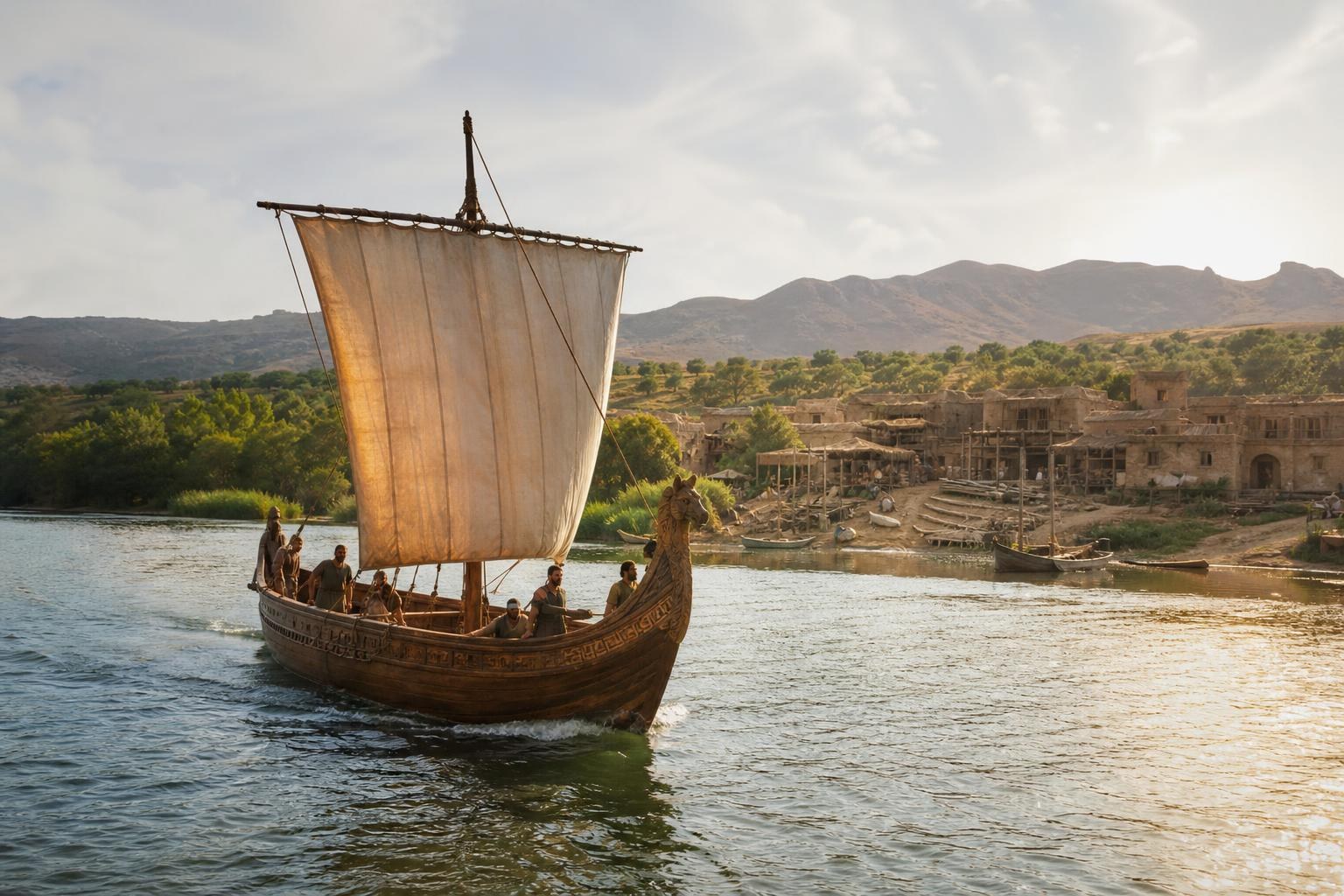
Few places carry the weight of myth and history quite like the ancient kingdom that once sat along the eastern shores of the Black Sea. If you’ve ever heard the story of Jason and the Argonauts sailing in pursuit of the Golden Fleece, you’ve already encountered this region, even if you didn’t know it by name. Colchis occupies a rare space in human knowledge: it’s simultaneously a real historical territory and a cornerstone of Greek mythology, a place where archaeological evidence and epic poetry overlap in fascinating ways. For anyone interested in the ancient world, the Caucasus region, or Georgia’s deep roots as a civilization, understanding this kingdom is essential. The territory roughly corresponds to what is now western Georgia, particularly the lowlands around the Rioni River and the coastal zone near modern-day Batumi and Poti. But reducing it to geography alone misses the point. This was a kingdom that traded with the Greeks, developed its own metallurgical traditions, and became so embedded in Mediterranean consciousness that it shaped one of the most enduring adventure stories ever told. Whether you’re a history student, a traveler planning a trip to Georgia, or simply someone who stumbled across the term and got curious, this guide covers what the ancient kingdom actually was, how it functioned, and why it still matters in 2026.
What is Colchis?
Definition
Colchis was an ancient kingdom and region located on the eastern coast of the Black Sea, primarily in what is now western Georgia. The name appears in Greek sources as early as the 8th century BCE, though the civilization itself likely predates those references by several centuries. Georgian scholars often use the term “Kolkheti” (კოლხეთი), which is the local name for the same territory.
At its broadest, the kingdom stretched from the southeastern Black Sea coast inland through the Colchian lowlands, a subtropical river plain fed by the Rioni (known in antiquity as the Phasis) and its tributaries. The northern boundary roughly followed the foothills of the Greater Caucasus mountains, while the southern edge extended toward the Pontic Alps and parts of what is now northeastern Turkey.
The kingdom wasn’t a single monolithic state for its entire existence. Like most ancient polities, it went through periods of centralization and fragmentation. At its peak, roughly between the 6th and 4th centuries BCE, it functioned as a recognizable political entity with its own coinage, trade networks, and diplomatic relationships with Greek colonies along the coast.
Key Concepts
Several ideas are central to understanding this ancient kingdom properly.
- The Golden Fleece connection: The Greek myth of Jason and the Argonauts places the Golden Fleece in this territory, guarded by a dragon and kept by King Aeëtes. This isn’t purely fiction: ancient Colchians actually used sheepskins to pan for gold in mountain rivers, a practice documented by the geographer Strabo. Gold dust would catch in the wool, producing a literal “golden fleece.”
- Greek colonization: Starting around the 6th century BCE, Greek traders established colonies along the Colchian coast, including Phasis (near modern Poti) and Dioscurias (near modern Sukhumi). These weren’t conquests but trading posts, and the relationship between Greek settlers and local populations was largely commercial.
- Metallurgical sophistication: Archaeological finds from the region show advanced bronze and iron working dating back to the 2nd millennium BCE. The Colchian culture produced distinctive axes, jewelry, and tools that circulated across the Caucasus and into Anatolia.
- Political evolution: The kingdom eventually came under the influence of the Kingdom of Pontus, then Rome, before its identity merged into the broader Georgian kingdoms of Lazica and Iberia during the early centuries CE.
| Period | Approximate Date | Key Development |
|---|---|---|
| Early Colchian culture | 2000-800 BCE | Bronze working, tribal confederation |
| Classical period | 600-400 BCE | Peak political unity, own coinage, Greek trade |
| Hellenistic influence | 400-100 BCE | Greek colonies expand, cultural exchange |
| Roman period | 100 BCE – 300 CE | Roman client state, gradual absorption |
| Late Antiquity | 300-600 CE | Transition to Kingdom of Lazica |
How Colchis Works
Core Mechanism
Talking about how an ancient kingdom “works” might sound odd, but the question is really about what made this civilization function as a coherent entity for centuries. The answer lies in geography, trade, and a specific ecological advantage that most people overlook.
The Colchian lowlands are one of the wettest places in the Caucasus. Annual rainfall in parts of western Georgia still exceeds 2,500mm, creating a subtropical environment where agriculture was remarkably productive. Ancient Colchians grew flax, hemp, and various grains, but their real economic engine was resource extraction: gold, silver, iron, copper, and timber from the forested mountain slopes.
Trade routes connected the interior to the Black Sea coast, where Greek merchants were eager buyers. The Phasis River served as the primary commercial artery. Goods moved downstream to coastal trading posts, where they were exchanged for Greek pottery, wine, olive oil, and luxury items. This wasn’t a one-way relationship. Greek sources consistently describe the region as wealthy and self-sufficient, not a colonial backwater dependent on Mediterranean imports.
The political structure appears to have been a confederation of tribal groups unified under a central authority during periods of strength. Georgian historian Otar Lordkipanidze, whose work on the archaeology of the region remains foundational, argued that the kingdom had a stratified society with a warrior aristocracy, a priestly class, and a large agricultural population. Evidence from burial sites supports this: elite graves contain gold ornaments and imported goods, while commoner graves are simpler but still show access to metal tools.
Components
The civilization rested on several interconnected pillars.
The first was metallurgy. Colchian bronzework was distinctive enough that archaeologists can identify it across a wide geographic range. The so-called “Colchian axes” – a specific type of flat bronze axe – have been found from the Black Sea coast to central Anatolia, suggesting either trade networks or cultural influence that extended well beyond the kingdom’s borders.
The second pillar was maritime access. Control of the eastern Black Sea coastline gave the kingdom a direct connection to the broader Mediterranean trading world. The Greeks didn’t establish colonies in the region by accident; they came because the area offered goods they couldn’t get elsewhere, particularly metals and timber.
Third was the agricultural base. The subtropical climate supported year-round cultivation, which meant the population could sustain itself without heavy dependence on imports. This economic self-sufficiency gave Colchian rulers bargaining power in their dealings with Greek colonies.
Finally, the kingdom’s position between the Greater and Lesser Caucasus mountain ranges provided natural defensive barriers. Invading armies had to approach through a limited number of passes or by sea, which made the territory easier to defend than the open plains to the north and east.
Benefits and Use Cases
Key Benefits
Studying this ancient kingdom isn’t just an academic exercise. There are concrete reasons why the topic has gained renewed attention in recent years, particularly in Georgia and among scholars of the ancient Mediterranean.
For Georgia as a nation, the Colchian heritage represents proof of an advanced, independent civilization that predates many of Europe’s more famous ancient cultures. Georgian museums, particularly the Georgian National Museum in Tbilisi, have invested significantly in displaying Colchian artifacts. The gold collection alone, featuring intricate jewelry and ceremonial objects from the 5th-3rd centuries BCE, rivals anything from contemporary Greek or Etruscan workshops.
For archaeologists and historians, the region fills a critical gap in our understanding of how the ancient Mediterranean connected to the Caucasus and Central Asia. The Black Sea functioned as a kind of inland ocean linking Greek, Anatolian, Scythian, and Caucasian cultures. Colchis sat at the eastern terminus of that network, making it essential for understanding trans-regional trade.
For travelers visiting Georgia in 2026, knowledge of this history transforms a trip to western Georgia from a beach holiday into a genuinely enriching cultural experience. Sites like the Vani archaeological complex, about 240 km west of Tbilisi, contain temple ruins and burial sites that bring the ancient kingdom to life. Admission is around 7 GEL (roughly $2.50 USD), and the on-site museum houses gold artifacts found during excavations.
Common Applications
The study and legacy of this ancient kingdom show up in several practical contexts today.
- Tourism development: Georgia’s government has increasingly promoted archaeological tourism in the western regions, with Colchian heritage sites forming a key part of the itinerary. The Kutaisi-Vani-Batumi corridor is marketed specifically to history-minded travelers.
- Academic research: Universities in Tbilisi, Athens, and several European institutions run ongoing excavation programs. The University of Melbourne and the Georgian National Museum have collaborated on projects analyzing Colchian metallurgical techniques using modern spectroscopic methods.
- Cultural identity: For Georgians, the ancient kingdom is a source of national pride and a reminder that the country’s history extends far beyond the Soviet period or even the medieval Georgian golden age under Queen Tamar. You’ll hear references to it in everyday conversation, particularly in western Georgia around Kutaisi and Zugdidi.
- Mythology and literature: The Jason and Argonauts story continues to inspire films, novels, and academic studies. Tim Severin’s 1984 voyage retracing the Argonauts’ route brought public attention to the historical basis of the myth, and several documentaries have revisited the subject since then.
Best Practices
If you’re approaching this subject as a researcher, student, or curious traveler, a few practical guidelines will save you time and frustration.
Start with primary sources, but know their limitations. Herodotus, Strabo, and Apollonius of Rhodes all wrote about the region, but they were outsiders describing a foreign culture through Greek cultural assumptions. Strabo’s “Geography” (Book 11) provides the most detailed geographical description, while Apollonius’s “Argonautica” is the fullest literary treatment. Read them, but read them critically.
Cross-reference Greek accounts with archaeological evidence. The past three decades of Georgian archaeology have produced findings that sometimes confirm and sometimes contradict what the Greeks wrote. For example, Greek sources emphasize the region’s “barbarism,” but the material culture tells a different story: sophisticated metalwork, planned urban settlements, and evidence of literacy.
If you’re visiting archaeological sites in western Georgia, hire a local guide. I’ve walked through Vani and Nokalakevi (another major site, identified with the ancient fortress of Archaeopolis) with and without guides, and the difference is enormous. A knowledgeable guide, typically available for 50-80 GEL per group, can explain what you’re looking at in ways that signage alone cannot.
Learn a few Georgian terms. “Kolkheti” is the local name for the region. “Oqros Satsmisi” (ოქროს საწმისი) means “Golden Fleece.” Using these terms with locals in western Georgia signals respect and usually opens doors to longer, more interesting conversations. I’ve had taxi drivers in Kutaisi spend entire rides explaining their family connections to Colchian history once they realized I knew the local terminology.
Be cautious with online sources. A lot of what circulates on social media about the ancient kingdom mixes legitimate history with nationalist mythology or pseudoarchaeology. Stick to peer-reviewed publications and reputable institutions. The journal “Anatolica” and the Georgian National Museum’s own publications are reliable starting points.
Related Concepts
Understanding the ancient kingdom of Kolkheti properly requires knowing how it connects to the broader historical picture. Several related topics deserve attention.
The Kingdom of Iberia (Kartli) was the eastern counterpart to Colchis. While the Colchian civilization dominated western Georgia, Iberia controlled the eastern regions around modern Tbilisi and Mtskheta. The two eventually merged into a unified Georgian political identity, but for centuries they were distinct kingdoms with different cultural orientations: Colchis faced the Black Sea and the Greek world, while Iberia looked toward Persia and Central Asia.
The Kingdom of Lazica (Egrisi) directly succeeded Colchis in western Georgia during late antiquity. Lazica became a major flashpoint in the wars between the Byzantine and Sassanid Persian empires during the 6th century CE. If you’re interested in what happened to the region after its classical period ended, Lazica is the next chapter.
The Greek colonization of the Black Sea is the broader context in which Colchian-Greek interaction took place. Cities like Sinope, Trapezus (Trebizond), and Phasis formed a network of trading posts that connected the entire Black Sea rim. The Colchian coast was the easternmost reach of this network.
The Argonaut myth itself deserves separate study. The story evolved over centuries, with different versions emphasizing different elements. The earliest references appear in Homer and Hesiod, but the fullest account is Apollonius’s 3rd-century BCE epic. The myth likely preserves genuine memories of early Greek trading expeditions to the eastern Black Sea, wrapped in layers of supernatural storytelling.
Georgian winemaking traditions also connect to this history. Georgia claims to be the birthplace of wine, with evidence of viticulture dating back 8,000 years. The Colchian lowlands were part of this wine culture, and some scholars argue that Greek interest in the region was partly driven by its viticultural knowledge. If you visit western Georgia, the local wines from Imereti and Samegrelo offer a living connection to this ancient agricultural heritage. A bottle of good Imeretian white runs about 15-25 GEL ($5.50-$9 USD) in local shops.
The study of Colchis ultimately reminds us that the ancient world was far more interconnected than we often assume. A kingdom on the edge of the Caucasus mountains traded with Athens, appeared in Greek epic poetry, and developed metallurgical techniques that influenced cultures across Anatolia. Its legacy lives on in Georgian national identity, in the archaeological sites that dot western Georgia’s landscape, and in the enduring power of the Golden Fleece story. Whether you encounter this history through a university course, a museum visit in Tbilisi, or a conversation with a grandmother in Zugdidi who insists her family descends from King Aeëtes, the depth and richness of the subject rewards serious attention. If you’re planning a trip to Georgia, make western Georgia a priority: the history beneath your feet there is extraordinary.