
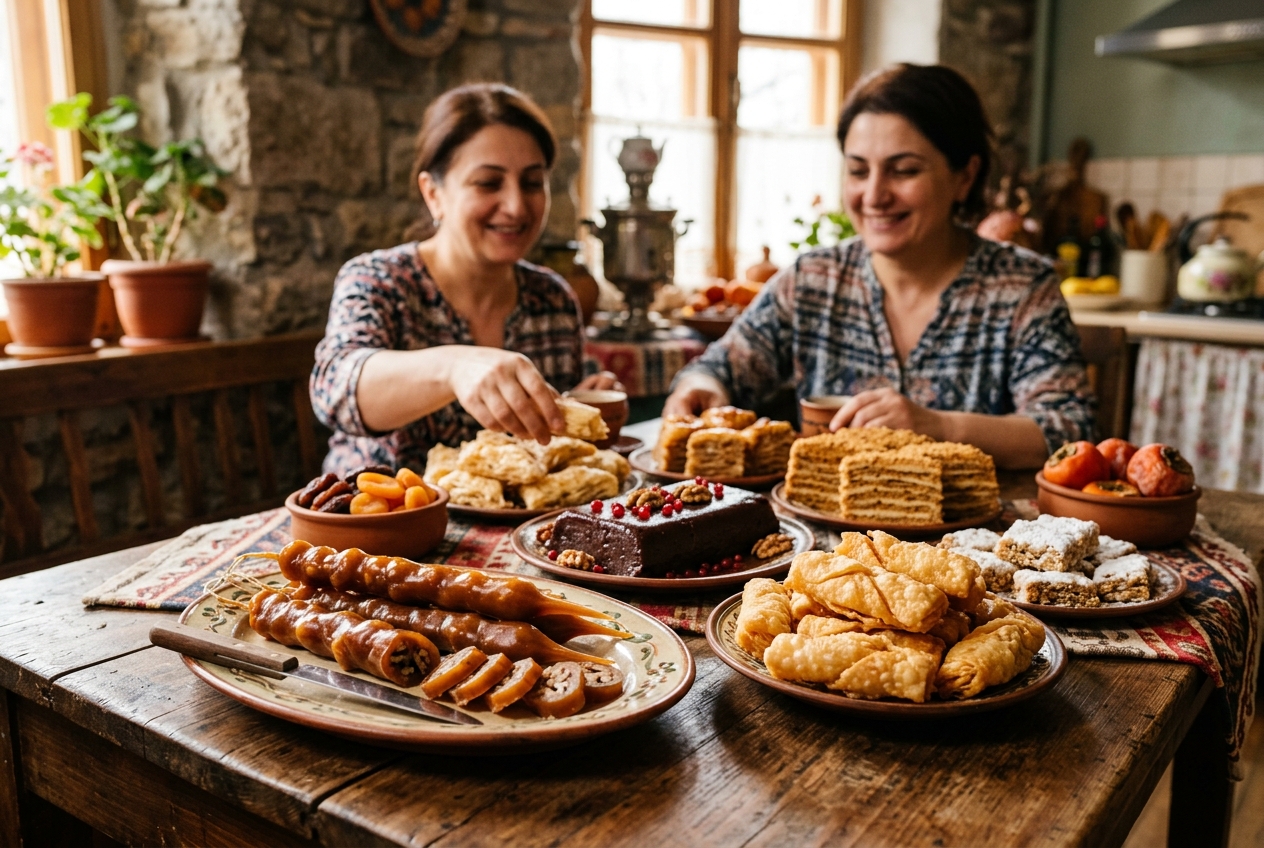
Georgia’s culinary identity runs deep, shaped by centuries of winemaking, mountain agriculture, and a hospitality culture rooted in the belief that stumari ghvtisaa: a guest is a gift from God. Most travelers arrive knowing about khachapuri and khinkali, but the country’s sweet traditions are just as rich and far less talked about. From grape-must candies strung on thread to honey-drenched nut brittle cracked open at midnight on New Year’s Eve, traditional Georgian desserts and sweets reveal a side of the cuisine that’s deeply seasonal, regionally specific, and tied to religious celebrations. I’ve spent time wandering the markets in Tbilisi, Kutaisi, and smaller towns like Sighnaghi, and the sweets always tell a story about the harvest, the family, or the holiday behind them. What follows is a guide to the ones worth seeking out.

The Essence of the Georgian Sweet Table
Georgian desserts don’t follow the Western playbook. You won’t find elaborate pastries layered with buttercream or sugar-spun decorations. Instead, the sweet table, or tkbili magida, relies on a handful of foundational ingredients: grapes, walnuts, honey, and wheat flour. These are the building blocks of nearly every traditional confection in the country.
What makes the Georgian approach distinctive is its connection to the agricultural calendar. Grape-based sweets are made during rtveli, the autumn harvest, when families press juice for wine and set aside the must for churchkhela and pelamushi. Honey and nut confections peak around the winter holidays. Fruit leathers dry on rooftops during the hottest summer weeks. There’s almost no refined sugar in the oldest recipes: sweetness comes from concentrated fruit juice or raw honey.
The regional dimension matters too. Kakheti, the eastern wine region, dominates grape-based confections. Imereti and Racha in the west lean toward baked goods with spiced fillings. Tbilisi, as a crossroads city, pulls from everywhere, but the best versions of any Georgian sweet are usually found in the specific town or valley where the recipe originated. A churchkhela from a Kakhetian grandmother’s kitchen and one from a Tbilisi souvenir shop are barely the same product.
Religion also shapes the sweet calendar. Orthodox Christian feast days, fasting periods, and family celebrations like weddings each have their designated sweets. Gozinaki belongs to New Year’s. Paska belongs to Easter. Eating the right sweet at the right time isn’t just tradition: it carries genuine spiritual weight for many Georgian families.
| Ingredient | Primary Region | Key Sweets | Season |
|---|---|---|---|
| Grape must | Kakheti | Churchkhela, Pelamushi | Autumn (rtveli) |
| Honey and walnuts | Nationwide | Gozinaki | Winter (New Year) |
| Wheat flour and spices | Imereti, Kartli | Kada, Nazuki, Paska | Year-round / Easter |
| Fruit pulp | Nationwide | Tklapi, Muraba | Summer |
Iconic Grape-Based Delicacies
Grapes are the soul of Georgian food culture, and not just for wine. The must, or badagi, left over from pressing serves as the base for two of the most iconic Georgian sweets. If you visit during rtveli in September or October, you’ll see families making both of these simultaneously, often in enormous outdoor cauldrons.
Churchkhela: The Georgian Nut Candle
Churchkhela looks like a lumpy candle and tastes like nothing else. Whole walnuts, almonds, or hazelnuts are threaded onto a string, then repeatedly dipped into tatara: a thick mixture of grape must and wheat flour that’s been cooked down to a pudding-like consistency. Each dipping adds a layer, and after several rounds, the coated strings are hung to dry for weeks, sometimes months.
The result is a chewy, naturally sweet confection with a dense nutty core. The flavor depends entirely on the grape variety used and the drying conditions. Kakhetian churchkhela, made with Rkatsiteli or Saperavi grapes, tends to be darker and more intensely flavored than versions from other regions. The traditional churchkhela-making technology in Kakheti was inscribed on the Intangible Cultural Heritage of Georgia list in 2015, recognizing both the technique and its cultural significance.
You’ll find churchkhela everywhere in Georgia: hanging in market stalls, sold by roadside vendors, stacked in airport shops. But quality varies wildly. The mass-produced versions often substitute corn syrup for grape must. Look for ones that feel firm but slightly pliable, with a matte surface. If it’s shiny or sticky, it’s probably not the real thing. The best I’ve tasted came from a family in Telavi who dried theirs in a barn for three months. The texture was almost like a dense fruit leather wrapped around crunchy walnuts.
Pelamushi: Traditional Grape Juice Pudding
Pelamushi is churchkhela’s softer, spoonable cousin. It uses the same tatara base but is served as a warm or chilled pudding rather than dried into a solid form. Fresh grape juice is thickened with flour (traditionally wheat, sometimes corn) and cooked slowly until it reaches a custard-like consistency.
The pudding is typically poured into shallow dishes or molds and allowed to set. Some families top it with walnuts or pomegranate seeds. It’s deeply purple when made with Saperavi grapes and golden-amber with Rkatsiteli. The flavor is concentrated grape: tannic, sweet, and earthy all at once.
Pelamushi is seasonal in the truest sense. You really can only get it fresh during the harvest, since it doesn’t preserve well. Some restaurants in Tbilisi serve it year-round using frozen must, but the difference between that and a bowl eaten warm from the pot during rtveli is enormous. If you’re visiting Georgia in autumn, this is the dessert to prioritize. It’s one of those foods that simply doesn’t travel.
Festive Honey and Nut Confections
Georgia’s nut and honey sweets occupy a different space from the grape-based ones. These are celebration foods, tied to specific holidays and often made communally. Walnuts grow abundantly across the country, and Georgian honey, particularly from the mountainous regions of Tusheti and Svaneti, has a floral complexity that elevates simple recipes.
Gozinaki: The Essential New Year’s Treat
Gozinaki is the sweet that marks the Georgian New Year. It’s a brittle made from toasted walnuts bound together with hot honey, pressed flat, and cut into diamond or rectangular shapes once cooled. The recipe is ancient and almost absurdly simple, but the execution matters.
The walnuts need to be fresh and toasted just enough to release their oils without burning. The honey is heated until it darkens slightly and develops a caramel-like depth. Timing the pour is critical: too hot and the honey becomes bitter, too cool and it won’t bind properly. Every Georgian family has an opinion about the correct ratio and technique.
Eating gozinaki at midnight on December 31st (or January 13th for Old New Year) is a deeply embedded tradition. The honey symbolizes sweetness in the coming year, and the walnuts represent abundance. In rural areas, families still make enormous batches and distribute them to neighbors. In Tbilisi, you’ll see gozinaki stacked in bakeries and supermarkets throughout December and January. It keeps well for weeks, making it a good souvenir if you visit during winter.
Paska: The Spiced Bread of Georgian Easter
Paska is Georgia’s Easter bread, and while it shares a name with similar breads across Orthodox Christian cultures, the Georgian version has its own character. It’s a tall, cylindrical enriched bread flavored with cardamom, vanilla, and sometimes saffron, studded with raisins and glazed with a sugar or egg-white icing.
The dough is rich with butter and eggs, making paska one of the more indulgent Georgian baked goods. It’s prepared during the days leading up to Easter Sunday, and the baking itself is treated as a ritual. Many families bring their paska to church for blessing before the Easter feast. The bread is meant to be broken and shared at the supra, the traditional Georgian feast table, where the tamada (toastmaster) leads toasts that blend the sacred and the convivial.
Outside of Easter, paska is hard to find. A few bakeries in Tbilisi make it year-round for tourists, but it lacks the context that makes it meaningful. If you happen to be in Georgia during Easter, especially in a smaller town where you might be invited to a family celebration, the combination of fresh paska, red-dyed eggs, and a table groaning with food is an experience that stays with you.
Regional Pastries and Baked Goods
Georgian baked sweets tend to be less about sugar and more about texture and spice. The best ones come from specific towns and carry strong regional identities. These are the sweets you find at roadside stops, village bakeries, and family tables rather than in fancy patisseries.
Kada: The Sweet Crumble Bread
Kada (sometimes spelled k’ada) is a layered pastry filled with a crumbly mixture of butter, sugar, and flour. Think of it as Georgia’s answer to a cinnamon roll, but denser and less sweet. The filling, called a savse, melts into the dough during baking, creating pockets of buttery, slightly caramelized crumble throughout.
The shape varies by region. In Imereti, kada is often round and flat, sliced into wedges like a pie. In Kartli, it might be elongated. Some versions include vanilla; others are plain. The best kada I’ve had was at a roadside bakery outside Kutaisi, pulled from a tone (traditional clay oven) and served still warm. It was barely sweet, mostly buttery, and completely addictive.
Kada is everyday food in western Georgia. It’s what you eat with morning tea, what you bring to a neighbor’s house, what you pack for a road trip. It’s not glamorous, but it’s honest and satisfying in a way that fussier desserts often aren’t.
Nazuki: Aromatic Spiced Loaves from Surami
Nazuki is one of the most geographically specific Georgian sweets. It comes from Surami, a small town on the highway between Tbilisi and Kutaisi, and the roadside vendors there have turned it into a regional institution. You’ll see the loaves displayed on wooden racks, golden-brown and fragrant.
The bread is enriched with butter, sugar, and eggs, then heavily spiced with cinnamon and cloves. Some bakers add raisins or a hint of nutmeg. It’s baked in a tone, which gives it a slightly smoky, charred exterior that contrasts with the soft, aromatic interior. The spice profile of nazuki reflects historical trade routes that brought cinnamon and cloves through the South Caucasus centuries ago.
Stopping in Surami for nazuki is a travel ritual. Every Georgian who drives that highway has a preferred vendor. The bread is best eaten the same day, while the spices are still vivid and the crumb is soft. By the next morning, it’s still good but noticeably different. If you’re making the Tbilisi-to-Kutaisi drive, plan your stop accordingly.
Natural Preserves and Fruit Leather
Georgia’s climate supports an extraordinary range of fruit: figs, quinces, persimmons, cornelian cherries, plums, and dozens of grape varieties. Before refrigeration, preserving this bounty was essential, and the techniques developed over centuries produced sweets that are still central to the Georgian pantry.
Tklapi: Sun-Dried Fruit Sheets
Tklapi is fruit leather in its most elemental form. Ripe fruit, most commonly plums or cornelian cherries (sour, olive-sized fruits called shindi in Georgian), is pureed, spread thin on wooden boards, and dried in the sun until it forms flexible, translucent sheets. No sugar is added. The tartness of the fruit concentrates as it dries, creating an intensely flavored product.
While tklapi is used as a cooking ingredient (it’s dissolved into soups and stews to add acidity), it’s also eaten as a snack and qualifies as one of the oldest preserved sweets in the region. You’ll find rolled-up sheets of it in every bazaar, often in jewel-toned stacks of red, amber, and deep purple. The texture ranges from chewy to brittle depending on how long it’s been dried.
Muraba: Unique Whole Fruit Preserves
Muraba is Georgia’s take on fruit preserves, but it’s nothing like jam. Whole fruits or large pieces are slowly cooked in sugar syrup until they become translucent and candy-like while retaining their shape. The most prized muraba varieties use green walnuts, white cherries, rose petals, watermelon rind, or figs.
Green walnut muraba is the showstopper. Unripe walnuts are soaked for days to remove bitterness, then simmered in syrup until they turn jet black and develop a complex, almost chocolatey flavor. The process takes nearly two weeks from start to finish. It’s traditionally served on a small plate alongside tea, and a single walnut is considered a serving. Georgian families often keep jars of muraba as a sign of household pride: the quality of your preserves says something about your skill and patience.
Rose petal muraba is another standout. The petals are harvested from specific damask rose varieties grown in kitchen gardens, cooked briefly in syrup, and stored in jars where they retain a haunting floral sweetness. A spoonful in tea is a common remedy for everything from sore throats to bad moods.
Tips for Sourcing and Enjoying Georgian Sweets
Finding authentic versions of these sweets requires a little effort but pays off enormously. Here are some practical suggestions:
- Visit the Deserter Bazaar (Dezerterebis Bazroba) in Tbilisi for the widest selection of churchkhela, tklapi, and dried fruits. Vendors will let you taste before buying.
- Time your trip to the season. Autumn for pelamushi and fresh churchkhela, winter for gozinaki, spring for paska, summer for tklapi and muraba.
- In rural areas, don’t hesitate to buy from roadside vendors, especially in Kakheti and Surami. These are often family operations using traditional recipes.
- Download Google Translate offline packs for Georgian before you go. English is widely spoken by younger Georgians in Tbilisi, but in villages and markets, Georgian or Russian will be more useful.
- Store churchkhela and gozinaki in a cool, dry place. They travel well and make excellent gifts. Pelamushi and muraba do not travel as well and are best enjoyed on the spot.
Georgian sweets reward curiosity. They’re not trying to impress with complexity or presentation. They’re the product of a culture that has been growing grapes, cracking walnuts, and keeping bees for thousands of years, and the recipes reflect that accumulated knowledge. Whether you’re biting into a churchkhela on a Tbilisi street corner or sharing gozinaki with a Georgian family at midnight, these are sweets that carry their history in every bite. The best way to experience them is to show up hungry, stay flexible, and let the season guide your choices.