
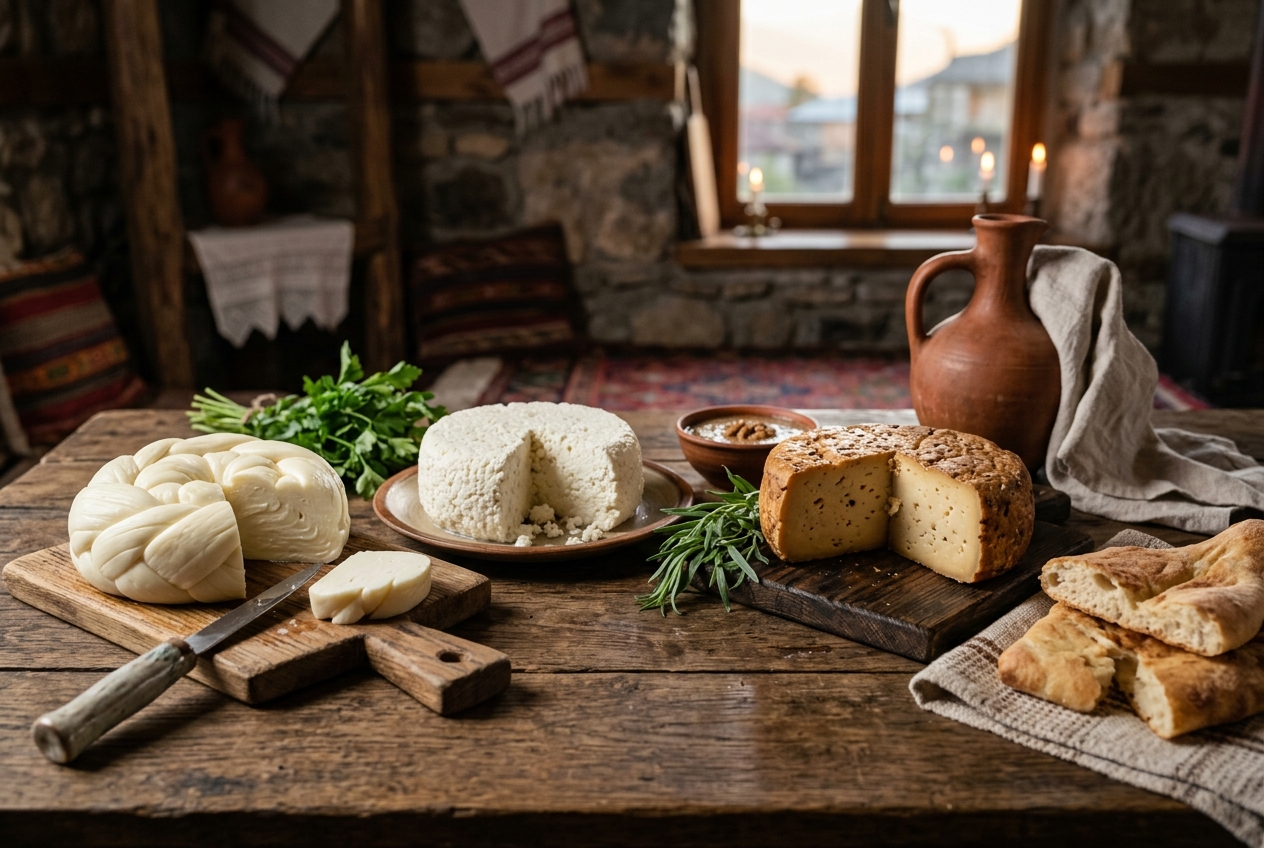
Georgia’s relationship with cheese is unlike anything you’ll find in Western Europe. While France and Italy get most of the international spotlight, this small Caucasus nation has been producing distinctive cheeses for millennia, with techniques passed down through families in mountain villages and lowland farms alike. The country’s dramatic geography – from subtropical Black Sea coastlines to alpine meadows above 2,000 meters – has given rise to radically different cheesemaking traditions within a territory smaller than South Carolina. Three varieties stand above the rest as pillars of Georgian dairy culture: Sulguni, Imeretian, and Guda. Each tells a story about the people and terrain that shaped it, and together they form a cheese tradition that deserves far more global recognition than it currently receives. If you’ve ever bitten into a properly made khachapuri or tasted a sharp, sheepskin-aged mountain cheese at a Tushetian shepherd’s table, you already know what I mean.
The Cultural Significance of Cheese in Georgia
Ancient Roots and the Supra Tradition
Cheese in Georgia isn’t just food – it’s a cultural artifact. Archaeological evidence suggests that cheesemaking in the South Caucasus stretches back at least 7,000 years, roughly contemporaneous with the earliest known wine production in the same region. The Georgian word for cheese, “kveli,” appears in some of the oldest surviving Georgian texts, and dairy products feature prominently in the country’s mythology and religious traditions.
Nowhere is cheese more central than at the supra, the traditional Georgian feast. The supra is governed by a tamada (toastmaster) who guides the evening through a sequence of elaborate toasts, and the table groans under dozens of dishes. Cheese appears in multiple forms: sliced fresh alongside herbs, baked into bread, or melted into hot dishes. A supra without cheese is essentially unthinkable.
The phrase “stumari ghvtisaa” – the guest is a gift from God – captures the spirit of Georgian hospitality, and cheese is one of the first things offered to any visitor. I’ve sat in village homes in Kakheti where a grandmother produced three different homemade cheeses within minutes of my arrival, each one reflecting her family’s particular recipe. This isn’t performative generosity; it’s deeply embedded in how Georgians understand their role as hosts.
Regional Diversity in Dairy Production
Georgia’s cheese diversity maps directly onto its geography. The western lowlands, with their humid climate and lush pastures, favor cow’s milk cheeses with higher moisture content. The eastern highlands, where sheep and goats graze on alpine herbs, produce drier, more intensely flavored varieties. Between these extremes lies a spectrum of styles that few countries of Georgia’s size can match.
The country’s dairy sector faces real pressures, though. Raw milk production decreased by 2.3% in 2024 compared to the previous year, continuing a trend that worries both producers and food policy experts. Small family farms, which still account for the majority of milk production, struggle with aging herds, limited veterinary infrastructure, and competition from imports.
Meanwhile, demand keeps climbing. Cheese and cottage cheese imports reached $33 million during January through October 2025, a 28.1% increase over 2024. That gap between shrinking domestic supply and growing demand creates a tension at the heart of Georgia’s cheese culture: how do you preserve artisanal traditions when the economics increasingly favor industrial production and imports?
Sulguni: The Pickled Queen of Samegrelo
Production Method: Stretching and Brining
Sulguni originates from the Samegrelo region in western Georgia, and its production method places it in the same family as Italian mozzarella and provolone – the pasta filata, or stretched-curd, tradition. But the similarities end with technique. Sulguni has a personality entirely its own.
The process begins with fresh cow’s milk (sometimes buffalo milk in traditional preparations) that is curdled and allowed to acidify. Once the curd reaches the right pH, the cheesemaker heats it and begins stretching and folding by hand, a physically demanding process that requires experience to get right. The stretched curd is shaped into dense, layered discs, typically 1-3 kilograms each, then submerged in brine.
This brining stage is critical. It gives Sulguni its characteristic saltiness and extends its shelf life, which was historically essential in Samegrelo’s warm, humid climate. A well-made Sulguni has what experts describe as a “harmonious blend of salty and slightly sour notes, with a hint of nuttiness” and a texture that is “chewy and becomes creamy when heated”. That melt quality makes it one of the most versatile cooking cheeses in the Georgian kitchen.
Smoked and Fresh Varieties
Fresh Sulguni is white to pale yellow, with a smooth, elastic texture and a clean, lactic tang. It’s eaten sliced with bread, crumbled into salads, or used as a filling for various breads. In Samegrelo, you’ll find it on virtually every table at every meal.
Smoked Sulguni – “shebolvili Sulguni” – is a different experience entirely. The discs are cold-smoked over wood chips (traditionally walnut or alder), which gives the exterior a golden-brown color and adds a deep, woody complexity to the flavor. The smoking also firms up the texture and further extends preservation. In Tbilisi’s Dezerter Bazaar, you can find vendors with towering stacks of smoked Sulguni, and the aroma hits you from several stalls away.
There’s also a braided variety, “Sulguni tenili,” where the stretched curd is pulled into thin strings and woven together. It’s as much a display of craft as it is a cheese, and it’s often smoked as well. If you’re visiting Georgia, seeking out tenili from a Samegrelo producer is one of the best edible souvenirs you can bring home.
Imeretian Cheese: The Foundation of Khachapuri
Characteristics of Fresh Curd Cheese
Imeretian cheese, or “Imeruli kveli,” comes from the Imereti region in central-western Georgia. Unlike Sulguni, it’s a fresh, unaged cheese made by a simpler process: milk is curdled, the whey is drained, and the curds are lightly pressed and salted. The result is a soft, crumbly, mildly acidic cheese with a high moisture content.
Think of it as occupying a space somewhere between fresh mozzarella and a young feta, though neither comparison is quite right. Imeretian cheese has a gentler saltiness than feta and a denser, less stringy texture than mozzarella. Its flavor is subtle – milky, slightly tangy, with a clean finish. This mildness is actually its greatest strength, because it makes Imeretian cheese an extraordinarily flexible ingredient.
The cheese is typically sold in round forms weighing about a kilogram, often still slightly warm from production. In any Georgian market, you’ll see it stacked in shallow plastic tubs, swimming in its own whey. Freshness matters enormously here: Imeretian cheese that’s more than a few days old loses its delicate flavor and becomes overly sour.
Culinary Uses in Georgian Home Cooking
Imeretian cheese is, without exaggeration, the single most important cheese in Georgian cooking. Its primary claim to fame is as the filling for Imeretian khachapuri, the round, pan-fried cheese bread that serves as Georgia’s unofficial national dish. The cheese melts beautifully, creating a gooey, stretchy interior that contrasts with the crisp, golden crust.
The economic importance of this one dish is tracked through the “Khachapuri Index,” a real economic indicator developed by ISET Policy Institute that measures the cost of making a standard Imeretian khachapuri. That index rose by 8.4% in 2024, with cheese prices alone increasing by 12.3% annually. By September 2024, the cost to prepare a single standard khachapuri reached 6.48 GEL, a 13% rise compared to just two months earlier.
Beyond khachapuri, Imeretian cheese appears in dozens of dishes: stuffed into eggplant rolls with walnut paste, crumbled over bean stews, mixed into cornbread (mchadi), and served alongside practically every meal. In Georgian home cooking, running out of Imeretian cheese is a minor household crisis.
Guda: The Mountain Treasure of Tusheti
Aging in Sheepskin Bags
Guda cheese comes from Tusheti, one of Georgia’s most remote and spectacular mountain regions in the northeast. The Tushetians are historically shepherds, and their cheese reflects a pastoral lifestyle that has changed remarkably little over centuries. Guda is made from sheep’s milk (sometimes a blend with cow’s milk), and its defining characteristic is the aging vessel: a “guda,” or bag made from a whole sheepskin, turned inside out so the wool faces inward.
The fresh curd is packed tightly into this sheepskin bag, salted, and sealed. The bag is then stored in a cool place – traditionally a stone cellar or cave – for a minimum of two months, though three to four months produces a more developed flavor. During aging, the wool lining imparts distinctive flavors and aromas to the cheese, while enzymes from the skin contribute to the breakdown of proteins and fats.
This isn’t a technique designed for aesthetics. It evolved from practical necessity: shepherds in high-altitude summer pastures needed a portable, durable container for aging cheese, and sheepskin was the most available material. The guda bag is both packaging and flavor agent, a dual function that no modern substitute can replicate.
Pungent Aromas and Distinctive Textures
Guda is not a cheese for the faint-hearted. The aroma is strong, sometimes aggressively so, with notes of lanolin, fermented dairy, and something almost meaty. First-time tasters often recoil, but those who push through are rewarded with a complex, deeply savory cheese unlike anything else in the Georgian repertoire.
The texture ranges from semi-soft to crumbly depending on age, and the flavor combines sharp saltiness with a funky, almost blue-cheese quality. Older Guda develops crystalline pockets of concentrated flavor, similar to aged Parmigiano-Reggiano but with a wilder, less refined character.
In Tusheti itself, Guda is eaten simply: sliced and served with fresh bread, tomatoes, and herbs, often alongside chacha (grape brandy). The cheese is deeply tied to the annual migration of Tushetian shepherds, who move their flocks to high pastures each summer and return to the lowlands in autumn. Buying Guda directly from a shepherd family in villages like Omalo or Dartlo remains one of the most authentic food experiences available in Georgia.
Comparing Textures and Flavor Profiles
Placing these three cheeses side by side reveals just how much variety exists within Georgian dairy traditions. The following table captures the key differences:
| Feature | Sulguni | Imeretian | Guda |
|---|---|---|---|
| Region | Samegrelo (west) | Imereti (central-west) | Tusheti (northeast) |
| Milk Type | Cow (sometimes buffalo) | Cow | Sheep (sometimes mixed) |
| Texture | Elastic, layered, chewy | Soft, crumbly, moist | Semi-firm to crumbly |
| Flavor | Salty, tangy, nutty | Mild, milky, slightly acidic | Pungent, sharp, funky |
| Aging | Days to weeks (brined) | Fresh (1-5 days) | 2-4 months in sheepskin |
| Best Use | Grilling, melting, snacking | Khachapuri, salads, stuffing | Table cheese, bread pairing |
| Smoking | Common (smoked variety) | Rare | Not traditional |
What strikes me most about these three varieties is how each one is perfectly adapted to its environment. Sulguni’s brining preserves it in Samegrelo’s humidity. Imeretian cheese’s simplicity suits the fertile, dairy-rich Imereti lowlands where fresh milk is abundant. Guda’s sheepskin aging evolved in a place where refrigeration didn’t exist and shepherds needed cheese that could survive months in a mountain hut.
The flavor progression from mild to intense also mirrors a geographic gradient from west to east, from lowland to highland. Georgian cheesemakers didn’t develop these differences through formal classification systems – they emerged organically from local conditions, available animals, and the ingenuity of people working with what they had.
Preserving Georgia’s Gastronomic Heritage
Artisanal vs. Industrial Production
The tension between tradition and scale is real and growing. Factory-produced Sulguni and Imeretian cheese now dominate supermarket shelves in Tbilisi, and while the quality is acceptable, it lacks the character of village-made versions. Industrial Sulguni often uses powdered milk or imported curd, and the stretching is done by machine rather than hand. The result is a blander, more uniform product.
Georgia’s food export sector is substantial – the country exported $1.17 billion in foodstuffs in 2024, with major markets in Russia, Azerbaijan, and Armenia. But cheese, unlike wine, hasn’t yet become a significant export category. Part of the challenge is standardization: artisanal Georgian cheeses vary batch to batch, which is part of their charm but complicates export logistics.
Several organizations are working to protect these traditions. Geographic indication (GI) status has been pursued for Sulguni and other varieties, and the Slow Food movement has included Tushetian Guda in its Ark of Taste catalog of endangered heritage foods. Small-scale producers in regions like Tusheti and Samegrelo are finding new markets through agritourism, selling directly to visitors who trek to their villages.
The path forward probably isn’t choosing between artisanal and industrial but finding ways for both to coexist. Industrial production meets daily demand and keeps prices accessible. Artisanal production preserves knowledge, flavor, and cultural identity. Georgia needs both, but the artisanal side needs active protection because market forces alone won’t sustain it.
For anyone planning a trip to Georgia, seeking out traditional cheeses from regional producers – whether at Tbilisi’s Dezerter Bazaar, in a Samegrelo farmhouse, or at a Tushetian shepherd’s table – is one of the most rewarding things you can do. These aren’t just foods; they’re living connections to a cheesemaking heritage that stretches back thousands of years. Taste them while the traditions that produce them are still alive and thriving.