
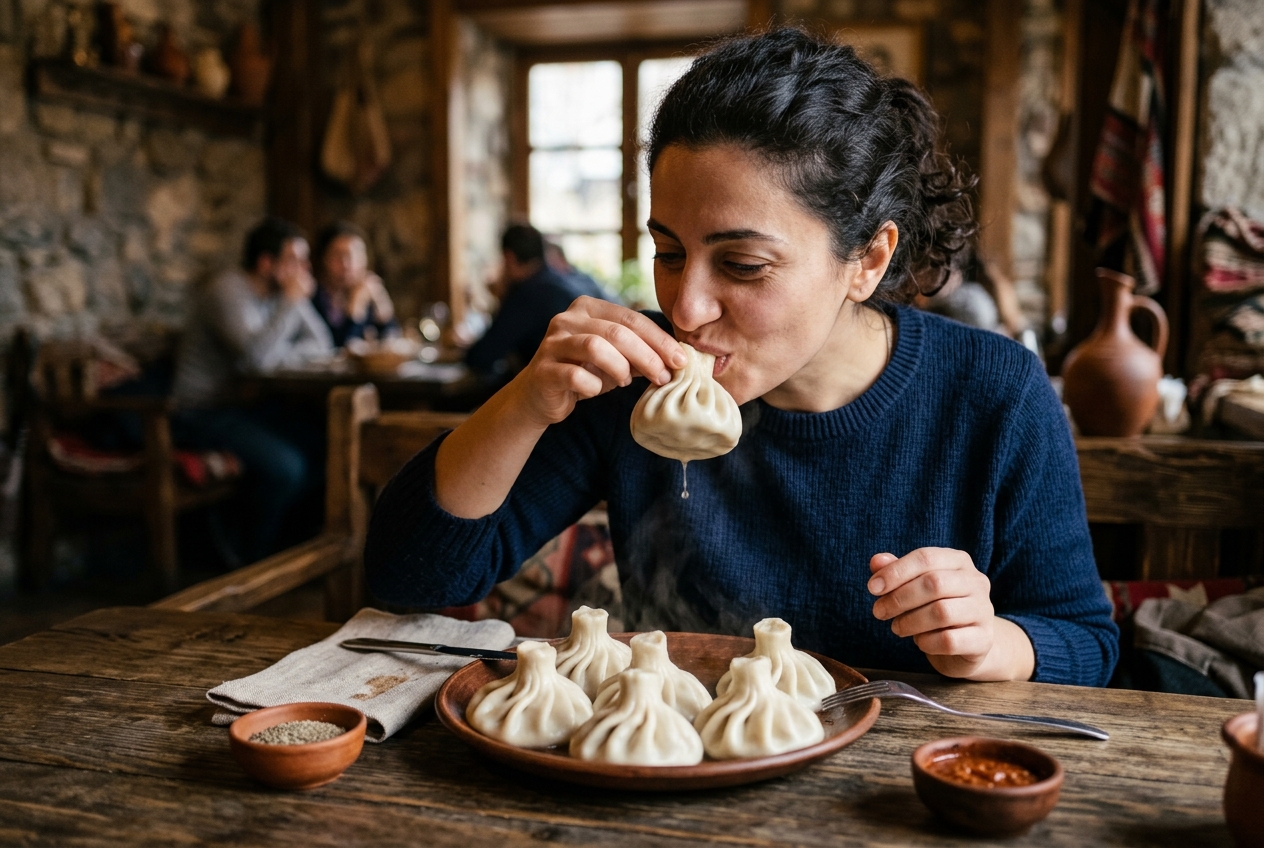
Few dishes carry the weight of a nation’s identity quite like khinkali. These plump, pleated dumplings are more than a menu item in Georgia: they’re a ritual, a point of pride, and a test of table manners all rolled into one. Understanding the history of khinkali and how to eat them properly transforms a simple meal into something far more meaningful. I’ve watched first-time visitors in Tbilisi restaurants pick up a fork, slice into the dumpling, and lose the precious broth inside, all while a table of Georgians looked on in quiet horror. That moment, more than any guidebook passage, tells you everything about why these dumplings matter. They connect you to centuries of mountain tradition, Silk Road trade, and a culture where food is inseparable from hospitality. The Georgian phrase “stumari ghvtisaa” means “a guest is a gift from God,” and nowhere is that philosophy more tangible than when a steaming plate of khinkali lands in front of you.
Origins and Legends of the Georgian Dumpling
The story of khinkali is a story of survival, geography, and cultural exchange. These dumplings didn’t emerge from a royal kitchen or a cosmopolitan capital. They were born in some of the most remote, rugged terrain in the Caucasus, shaped by the needs of shepherds, warriors, and mountain communities who needed portable, calorie-dense food that could be prepared with minimal equipment. The dish has evolved over centuries, absorbing influences from traders and invaders while remaining distinctly Georgian at its core.
The Mountainous Roots in Pshavi and Mtiuleti
Khinkali traces its roots to the mountainous regions of Georgia, such as Tusheti, Khevsureti, and Pshavi, where harsh winters and limited agricultural options forced communities to develop resourceful cooking methods. In these highland villages, families kept small herds of sheep and cattle, and meat was the primary source of protein. The original khinkali was a practical invention: minced meat seasoned with whatever herbs grew wild on the slopes, wrapped in simple flour-and-water dough, then boiled in a single pot over an open fire.
The beauty of the dish was its self-contained design. The sealed dough pouch trapped the meat juices inside, creating a built-in broth that provided warmth and hydration in freezing mountain conditions. Shepherds could carry the raw dumplings and cook them at temporary camps. Warriors reportedly ate them after battles, the hot broth serving as both nourishment and comfort.
In Pshavi and Mtiuleti specifically, the earliest versions used only lamb or mutton, seasoned with mountain herbs like wild cumin and local varieties of mint. There was no pork, no mushroom filling, no urban refinement. These were rough, hearty dumplings built for altitude and endurance. Even today, many Georgians insist that the “real” khinkali can only come from these highland regions, and they’ll argue the point passionately over a bottle of chacha.
The Silk Road Connection and Mongol Influence
Georgia’s position at the crossroads of empires meant that no culinary tradition existed in isolation. The Mongol invasions of the 13th century brought Central Asian cooking techniques into the Caucasus, and many food historians draw a direct line between Mongolian buuz, Chinese baozi, and Georgian khinkali. The concept of meat wrapped in dough and steamed or boiled appears across the entire Silk Road corridor, from Xi’an to Istanbul.
What makes the Georgian version distinct is the broth. Unlike many Asian dumpling traditions where the filling is relatively dry, khinkali are engineered to produce a rich, peppery soup inside the wrapper during cooking. This technique may have been a Georgian innovation layered on top of a Mongol template, or it may have developed independently. The historical record is murky, but the culinary result is unmistakable.
Trade routes through the Caucasus also brought spices that became central to the khinkali recipe. Cumin, black pepper, and chili pepper weren’t native to the Georgian highlands but arrived through merchant caravans. Over time, these imported flavors became so embedded in the dish that most Georgians consider them inseparable from it.
Anatomy of a Perfect Khinkali
A good khinkali is an engineering project as much as a recipe. Every element serves a function, from the thickness of the dough to the number of folds at the top. Getting any one component wrong compromises the entire experience.
The Significance of the Pleats
The twisted knot at the top of each khinkali isn’t decorative. Those pleats, ideally numbering at least 18 to 20, serve as a handle for eating and a seal that locks in the broth. A skilled khinkali maker can produce upward of 28 pleats, and in Georgian kitchens, the pleat count is a genuine measure of craftsmanship.
The pleating technique requires a specific motion: the dough is pinched and rotated with one hand while the other holds the dumpling steady. It takes years of practice to achieve consistent, tight folds. In mountain villages, grandmothers teach the technique to their granddaughters the way other cultures pass down embroidery or weaving. The pleats must be thin enough not to create a thick, doughy mass at the top but strong enough to hold during boiling without splitting.
If the pleats fail, the broth leaks out, and you’re left with a dry, disappointing dumpling. This is why factory-produced or poorly made khinkali are immediately identifiable: the tops are thick, clumsy, and often partially open. A well-made khinkali holds its shape in the pot, arrives at the table glistening and taut, and releases its broth only when you bite through the wrapper.
The Secret to the Savory Meat Broth
The broth inside a khinkali isn’t added separately. It forms during cooking as the seasoned meat releases its juices into the sealed dough pocket. This means the quality of the meat and the seasoning are everything. Traditional fillings include spiced meat such as beef, pork, or lamb, along with herbs, caraway, cumin, chili pepper, onions, and garlic.
The meat must be minced by hand or coarsely ground, never processed into a fine paste. A too-smooth filling won’t produce enough textural contrast or release juices properly. The onion and herb mixture is kneaded into the meat along with a small amount of water or broth, which helps generate steam inside the dumpling during boiling.
The seasoning balance is critical. Too much cumin overwhelms the meat. Too little pepper makes the broth bland. Each family and each restaurant has a proprietary ratio, and debates about the “correct” khinkali seasoning can get surprisingly heated. The broth should taste rich, meaty, and peppery, with a warmth that spreads through your chest on the first sip.
Regional Varieties Across Georgia
Khinkali isn’t a monolithic dish. As it migrated from the mountains to the lowlands and eventually to Tbilisi, it branched into distinct regional styles. The differences are real and worth understanding before you order.
Khevsuruli vs. Kalakuri Styles
The two primary styles represent the mountain-versus-city divide that runs through much of Georgian culture.
| Feature | Khevsuruli (Mountain Style) | Kalakuri (City Style) |
|---|---|---|
| Filling | Lamb or beef only, no pork | Mixed meat (beef and pork blend) |
| Herbs | Wild mountain herbs, minimal seasoning | Cilantro, parsley, more complex spice mix |
| Dough | Thicker, chewier | Thinner, more delicate |
| Broth | Intense, gamey | Milder, balanced |
| Pleats | Fewer, sturdier | More numerous, finer |
Khevsuruli khinkali stay closer to the original highland recipe. The dough is thicker because it needed to survive rough handling during mountain travel. The filling is simpler, letting the quality of the meat speak for itself. Many purists consider this the only authentic version.
Kalakuri, or “city-style,” khinkali emerged as the dish became popular in Tbilisi during the 19th and 20th centuries. Urban cooks refined the dough, introduced pork into the filling, and added more herbs. The result is a more polished, complex dumpling that appeals to a broader palate. Most restaurants in Tbilisi serve kalakuri by default, and most restaurants require a minimum order of 3 to 5 khinkali of one variety, so you can easily try both styles in one sitting.
Vegetarian Alternatives: Mushroom and Cheese
Georgia’s Orthodox Christian calendar includes numerous fasting periods when meat is forbidden, which drove the development of meatless khinkali varieties. Mushroom khinkali, typically filled with a mixture of wild forest mushrooms, onions, and herbs, have become popular year-round. The mushrooms produce their own savory liquid during cooking, creating a broth that rivals the meat version in depth.
Cheese-filled khinkali use a blend of Georgian cheeses, often sulguni or imeruli, sometimes mixed with cottage cheese for texture. These are richer and heavier than the meat versions, and they pair particularly well with a cold beer rather than wine.
Potato-filled khinkali also exist, especially in regions near the Turkish border, where the influence of manti and similar stuffed dough traditions is stronger. Some modern Tbilisi restaurants have experimented with fillings like spinach and walnut or even lobio (bean paste), though traditionalists tend to view these innovations with suspicion.
The Art of Eating Khinkali Like a Local
This is where most visitors go wrong, and honestly, it’s the part that matters most. You can appreciate the history and admire the pleats, but if you eat khinkali incorrectly, you miss the entire point of the dish.
Why You Should Never Use a Fork
Khinkali are considered the most popular Georgian food and one of the national dishes, and they come with strict rules. The first and most important: no utensils. Ever. You eat khinkali with your hands. Picking one up with a fork punctures the dough and releases the broth onto your plate, which is both a waste and a minor social faux pas.
Grab the dumpling by its twisted top knot, the kudi, and lift it from the plate. This is exactly why the pleats exist: they form a natural handle. The dumpling should be hot but manageable. If it’s too hot to hold, wait 30 seconds. Rushing leads to burned fingers and spilled broth.
Some tourist-oriented restaurants in Tbilisi will bring you a fork without being asked. Politely set it aside. Eating khinkali with a fork is like eating sushi with a spoon: technically possible, but it defeats the purpose.
Mastering the First Bite and Sucking the Juice
Hold the khinkali upside down by the knot, with the round belly facing up. Tilt it slightly and take a small bite from the side of the dumpling, near the bottom. This creates an opening through which you can sip the hot broth. This first sip is the best part of the entire experience: a concentrated burst of peppery, meaty juice that no soup bowl can replicate.
Sip carefully. The broth is extremely hot, and burning your tongue on the first khinkali of the evening is a rookie mistake I’ve made more than once. After you’ve drunk the broth, eat the rest of the dumpling in a few bites, enjoying the meat filling and the soft dough together. Black pepper is the classic topping for khinkali, and you should sprinkle it generously over each dumpling before eating.
The entire process is messy. Juice runs down your fingers. Pepper sticks to your lips. This is normal and expected. Napkins are your friend, and no one at a Georgian table will judge you for a few drips.
The Role of the ‘Kudi’ or Dough Tail
Here’s the part that surprises most newcomers: you don’t eat the top knot. The kudi, that thick twist of dough where all the pleats converge, is left on your plate. It’s too dense and chewy to be enjoyable, and it serves purely as a handle.
Leaving the kudi on your plate also serves a practical purpose: it’s how you count how many khinkali you’ve eaten. At the end of the meal, the pile of discarded dough knots on your plate is a badge of honor (or excess, depending on your perspective). Georgians sometimes joke about competitive khinkali eating, and a tall stack of kudi earns genuine respect.
If you accidentally eat the kudi, nobody will arrest you. But a Georgian dining companion will almost certainly correct you, gently, with a laugh and a shake of the head.
Cultural Etiquette and the Supra Tradition
Khinkali exist within a broader cultural framework that visitors should understand. The Georgian supra, or traditional feast, is one of the most elaborate dining rituals in the world, governed by a tamada (toastmaster) who leads structured rounds of toasts. While khinkali aren’t always the centerpiece of a formal supra, the same spirit of communal eating and shared pleasure applies whenever they appear on the table.
“Eating khinkali is more than just food; it’s a cultural experience that brings people together.” This isn’t an exaggeration. I’ve seen tables of strangers in Tbilisi’s Machakhela restaurant chain bond over shared plates of khinkali, offering tips to confused tourists and cheering when someone nails the broth-sipping technique on their first try. The dish creates an instant social leveler: everyone is eating with their hands, everyone is a little messy, and everyone is having a good time.
Ordering etiquette matters too. Khinkali are ordered by the piece, not by the plate. A typical individual portion is five to eight dumplings, though appetites vary. Order in multiples that make sense for the table, and don’t be shy about ordering a second round. The dumplings are best eaten fresh, so stagger your orders rather than requesting everything at once.
One final note on pairing: Georgians typically drink beer with khinkali rather than wine. This might seem surprising in a country famous for its 8,000-year winemaking tradition, but the logic is sound. The carbonation cuts through the richness of the broth, and the lighter flavor doesn’t compete with the spiced meat. A cold bottle of Natakhtari or Kazbegi lager is the traditional companion.
Whether you find yourself in a sleek Tbilisi restaurant or a family kitchen in the Pshavi highlands, the experience of eating khinkali properly connects you to something ancient and alive. Learn the technique, respect the kudi, sip the broth slowly, and you won’t just be eating a dumpling. You’ll be participating in a tradition that has survived empires, revolutions, and centuries of change, and still tastes exactly as good as it should.