
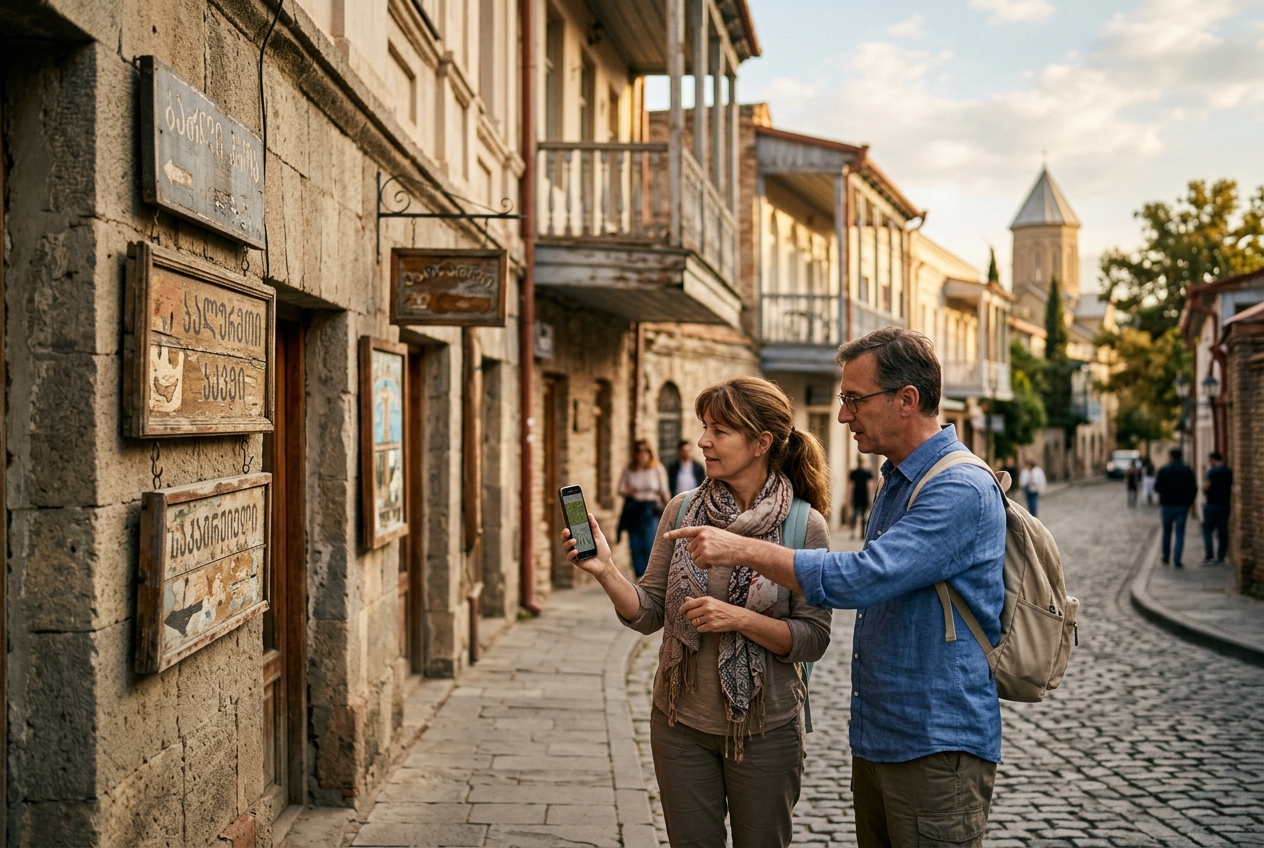
Georgia greets visitors with one of the most visually striking scripts on the planet. Those curling, looping characters you see on storefronts, road signs, and restaurant awnings aren’t decorative flourishes: they’re the Mkhedruli alphabet, a writing system so unique that UNESCO proclaimed it an Intangible Cultural Heritage of humanity in 2016. With Georgia counting 5.5 million tourist visits in 2025, an increase of more than 8% over the previous year, more travelers than ever are encountering these beautiful but bewildering characters. The thing is, once you leave Tbilisi’s central tourist corridor, Latin transliterations on signs become scarce. I’ve watched fellow travelers stand frozen at a marshrutka stop, unable to match the destination scrawled on the windshield to anything on their map. That frustration is completely avoidable. You don’t need to become fluent in Georgian: you just need to recognize enough letters to read the signs that matter. This quick guide to reading Georgian signs is built for exactly that purpose, giving tourists the specific letter recognition skills to get around confidently, order food without pointing blindly, and catch the right bus.
The Basics of the Mkhedruli Script
The Georgian alphabet, called Mkhedruli, is one of only 14 unique alphabets in the world. It doesn’t derive from Latin, Cyrillic, Arabic, or any other script you’ve likely encountered. Each of its 33 letters represents a single sound, which is actually great news for tourists: unlike English, there are no silent letters, no confusing letter combinations, and no ambiguity about pronunciation. What you see is what you say.
The script dates back centuries, and while Georgia has historically used three different writing systems (Asomtavruli, Nuskhuri, and Mkhedruli), the modern Mkhedruli is what you’ll encounter on every street sign, menu, and metro map. The letters are rounded and flowing, almost calligraphic, which gives them their distinctive beauty but can also make them tricky to tell apart at first glance.
Phonetic Nature and Lack of Capital Letters
Here’s something that simplifies things immediately: Georgian has no capital letters. None. Every letter looks the same whether it starts a sentence, begins a proper noun, or sits in the middle of a word. This means you only need to learn one version of each character, cutting your memorization work in half compared to scripts with upper and lowercase forms.
The phonetic consistency is your biggest ally. The letter ბ always makes a “b” sound. The letter მ always makes an “m” sound. There are no exceptions, no context-dependent pronunciations, no irregular spellings. If you can sound out the letters, you can sound out the word. This is radically different from English, where “cough,” “through,” and “though” all use the same letter combination to produce wildly different sounds.
For tourists, this phonetic reliability means that even partial letter recognition pays off. If you know just 10-12 key letters, you can start sounding out city names, food items, and transport destinations with surprising accuracy.
Distinguishing Similar-Looking Characters
The challenge with Mkhedruli is that several letters look remarkably alike, especially to untrained eyes scanning a sign from a moving vehicle. Here are the pairs that trip up most newcomers:
| Georgian Letter | Sound | Commonly Confused With | Sound |
|---|---|---|---|
| მ (m) | “m” | ხ (kh) | “kh” |
| ო (o) | “o” | ე (e) | “e” |
| გ (g) | “g” | ყ (q’) | “q'” |
| ს (s) | “s” | ც (ts) | “ts” |
| რ (r) | “r” | ჯ (j) | “j” |
The trick is to focus on the small details: the tail direction, the loop size, whether a curve closes fully or stays open. I found it helpful to think of them like handwritten versions of familiar shapes. The letter ო (o) is a complete circle, while ე (e) has an opening. The letter მ (m) has a wider stance than ხ (kh), which tucks in tighter.
Spend ten minutes with a chart before your trip, and these distinctions start clicking faster than you’d expect.
Essential Letters for Navigating Public Transport
Getting around Georgia without recognizing any Mkhedruli is possible in central Tbilisi, where metro signs include English. Step outside that bubble, though, and you’re relying entirely on Georgian script. Marshrutkas (minibuses) display their destinations in Georgian on the windshield. Bus stops in smaller cities rarely have Latin text. Even in Tbilisi, the older bus routes sometimes lack English signage.
The good news: you don’t need all 33 letters. Georgian city names use a recurring set of characters, and learning roughly a dozen letters covers most of the destinations tourists actually visit. The Bolt and Yandex Go apps handle ride-hailing without any Georgian reading skills, but for public transport, a bit of letter recognition saves real headaches and real money.
Identifying Metro Stations and Bus Stops
Tbilisi’s metro has two lines and 23 stations. Station names are displayed in both Georgian and English inside the trains and on platform signs, but the entrance signs at street level are often Georgian-only. The word you’ll see most frequently is სადგური (sadguri), meaning “station.”
Break that word down: ს (s) – ა (a) – დ (d) – გ (g) – უ (u) – რ (r) – ი (i). If you can recognize those seven letters, you’ve already unlocked a huge chunk of practical reading ability, because those same characters appear in dozens of common words.
For bus stops, look for გაჩერება (gachereba), meaning “stop.” The metro symbol in Tbilisi is a blue “M,” which is universal enough. But when you’re trying to figure out which stop you’re approaching, the Georgian text on the electronic display is often your only clue. Having even a rough ability to sound out the first few letters of a station name and match it to your map makes the difference between a smooth commute and riding three stops past your destination.
Reading Directional Signs for Major Cities
Road signs between cities are where letter recognition becomes critical. Outside Tbilisi, street signs are primarily in Mkhedruli, often without Latin transliteration. If you’re taking a marshrutka to Kutaisi, Batumi, or Mestia, you need to match the Georgian text on the vehicle to your destination.
Here are the most common tourist destinations in Georgian:
- თბილისი – Tbilisi
- ბათუმი – Batumi
- ქუთაისი – Kutaisi
- მესტია – Mestia
- კახეთი – Kakheti
- სიღნაღი – Sighnaghi
- გორი – Gori
Print this list or save a screenshot. Matching the shape of the word visually, even without reading each letter, is often enough. თბილისი (Tbilisi) starts with a tall, distinctive თ character that looks like nothing else on the list. ბათუმი (Batumi) begins with the rounder ბ. After a day or two, you’ll start recognizing these words as whole shapes, the same way you recognize a stop sign by its octagonal form before reading the text.
Decoding Restaurant Menus and Food Stands
Georgian food is half the reason people visit the country, and many of the best meals happen at places where the menu exists only in Georgian. The tourist-friendly English menus at Tbilisi’s Aghmashenebeli Avenue restaurants are one thing. The handwritten chalkboard at a family-run sakhli (house restaurant) in Kakheti is another experience entirely, and usually a better one.
You don’t need to read the entire menu. Georgian cuisine has a core set of beloved dishes that appear almost everywhere, and their names use a manageable set of letters. Recognizing five or six dish names in Georgian opens up most menus.
Key Letters in Popular Dish Names
The most frequently ordered dishes by tourists tend to be:
- ხინკალი (khinkali) – soup dumplings
- ხაჭაპური (khachapuri) – cheese bread
- მწვადი (mtsvadi) – grilled meat skewers
- ლობიანი (lobiani) – bean-filled bread
- ფხალი (pkhali) – walnut-vegetable paste
- ჩურჩხელა (churchkhela) – grape and walnut candy
Notice how ხ (kh) appears in both khinkali and khachapuri, the two dishes every tourist orders. The letter ი (i) ends almost every word on this list because Georgian words commonly end with this vowel. The letter ა (a) is the most frequent vowel overall and appears in nearly every dish name.
Once you can spot ხინკალი on a menu, you feel a small but genuine thrill. It’s the moment the script stops being abstract shapes and starts being information you can use.
Recognizing Words for Water, Wine, and Beer
Drinks matter just as much as food, especially in a country with an 8,000-year winemaking tradition. Here are the essential drink words:
- წყალი (ts’q’ali) – water
- ღვინო (ghvino) – wine
- ლუდი (ludi) – beer
- ჩაი (chai) – tea
- ყავა (q’ava) – coffee
- ლიმონათი (limonati) – lemonade
The word for wine, ღვინო, starts with the distinctive ღ character, which looks like a small hook. You’ll see this word constantly in the Kakheti wine region, on restaurant walls, and at market stalls. Water, წყალი, begins with the less common წ, making it easy to spot once you know what you’re looking for.
At a traditional supra (feast), the tamada (toastmaster) will be pouring ღვინო generously. Knowing the word won’t help you drink less, but at least you’ll know what’s coming.
Spotting International Loanwords on Street Signs
Here’s a shortcut that most alphabet guides skip entirely: Georgian is full of loanwords from English, Russian, French, and other languages. These words are spelled phonetically in Mkhedruli, which means if you can sound out the letters, you’ll suddenly recognize familiar words hiding in Georgian script.
Walk down any commercial street in Tbilisi and you’ll see ბანკი (banki – bank), აფთიაქი (aptiaki – pharmacy, from the Greek/Russian root), ტაქსი (taksi – taxi), რესტორანი (restorani – restaurant), and სუპერმარკეტი (supermarketi – supermarket). These aren’t translations: they’re the same international words written in Georgian letters.
This phenomenon is especially common with modern businesses. კაფე (kape – café), ბარი (bari – bar), and ჰოტელი (hoteli – hotel) are exactly what they sound like. Even ტუალეტი (tualeti – toilet) is a direct phonetic borrowing. When you’re desperately scanning a building for a restroom sign, recognizing ტ-უ-ა-ლ-ე-ტ-ი can be genuinely lifesaving.
The post-independence generation in Georgia, particularly those born after the Rose Revolution of 2003, tends to speak English well. But signage hasn’t caught up everywhere, and older neighborhoods reflect a time when Russian was the dominant second language. Knowing that loanwords exist in Georgian script gives you a decoding strategy that works even when nobody nearby speaks English.
Practical Tips for Memorizing the Alphabet on the Go
You’re not going to memorize all 33 letters of the Georgian alphabet before your flight lands. And honestly, you don’t need to. The goal for tourists isn’t fluency: it’s functional recognition of the 12-15 letters that appear most frequently in the words you actually need.
The best time to practice is during your trip, not before it. Your brain retains letter shapes far better when you’re seeing them in context on real signs, associating them with real places you’re trying to reach. Abstract flashcard study before departure helps a little, but the real learning happens on the ground.
The ‘Look and Match’ Technique for Tourists
This is the simplest method I’ve seen work for travelers, and it requires zero preparation. Take a photo of a bilingual sign (Georgian and English) whenever you spot one. Tbilisi’s airport, central metro stations, and major tourist sites all have bilingual signage. Build a small collection of these photos on your phone.
Then, when you encounter a Georgian-only sign, open your reference photos and match the letters visually. You’re not reading: you’re pattern-matching. After doing this five or six times with the same word, your brain starts recognizing it automatically.
A practical routine that works well: each morning, pick three Georgian letters to focus on. Write them on your hand or a sticky note. Throughout the day, spot them on signs, menus, and billboards. By evening, those three letters will feel familiar. Over a week-long trip, that’s 21 letters: more than enough for basic sign reading.
Useful Digital Tools and Translation Apps
Google Translate’s camera feature is the single most useful tool for tourists reading Georgian signs. Point your phone camera at any text, and it overlays an English translation in real time. Download the Georgian language pack before your trip so it works offline: cellular data in rural Georgia can be unreliable.
Other tools worth having on your phone:
- Google Lens for photographing and translating menus
- Drops (language app) for gamified Georgian letter learning in five-minute sessions
- Simply Learn Georgian for audio pronunciation of common phrases
- Maps.me with offline Georgian maps that show both scripts
One underrated trick: set your phone’s keyboard to include Georgian as a secondary language. When you need to type a destination into a taxi app or search for a restaurant, you can hunt-and-peck the Georgian letters even without knowing the keyboard layout. It’s slow, but it works when voice input fails.
The combination of partial alphabet knowledge and a translation app creates a surprisingly effective system. The app handles the complex stuff while your letter recognition handles the quick-glance situations: reading a bus destination, scanning a menu, or confirming you’re walking toward the right street.
Your First Day Will Be the Hardest
Everything about the Georgian alphabet feels impossible for the first few hours. The letters blur together, signs look like beautiful but incomprehensible art, and you wonder why you didn’t just memorize the whole script on the plane. By day two, a few letters start jumping out at you. By day four, you’re sounding out restaurant names and feeling unreasonably proud of yourself.
Georgia rewards the effort. When you walk into a village bakery in Kakheti and recognize ხაჭაპური on the handwritten board behind the counter, the owner’s face lights up. Georgians have a saying: stumari ghvtisaa, meaning “a guest is a gift from God.” A guest who tries to read their ancient, beautiful script? That’s a gift they remember. Start with the transport words, learn the food names, lean on your phone for everything else, and let the curving letters of Mkhedruli become part of the story you bring home.