
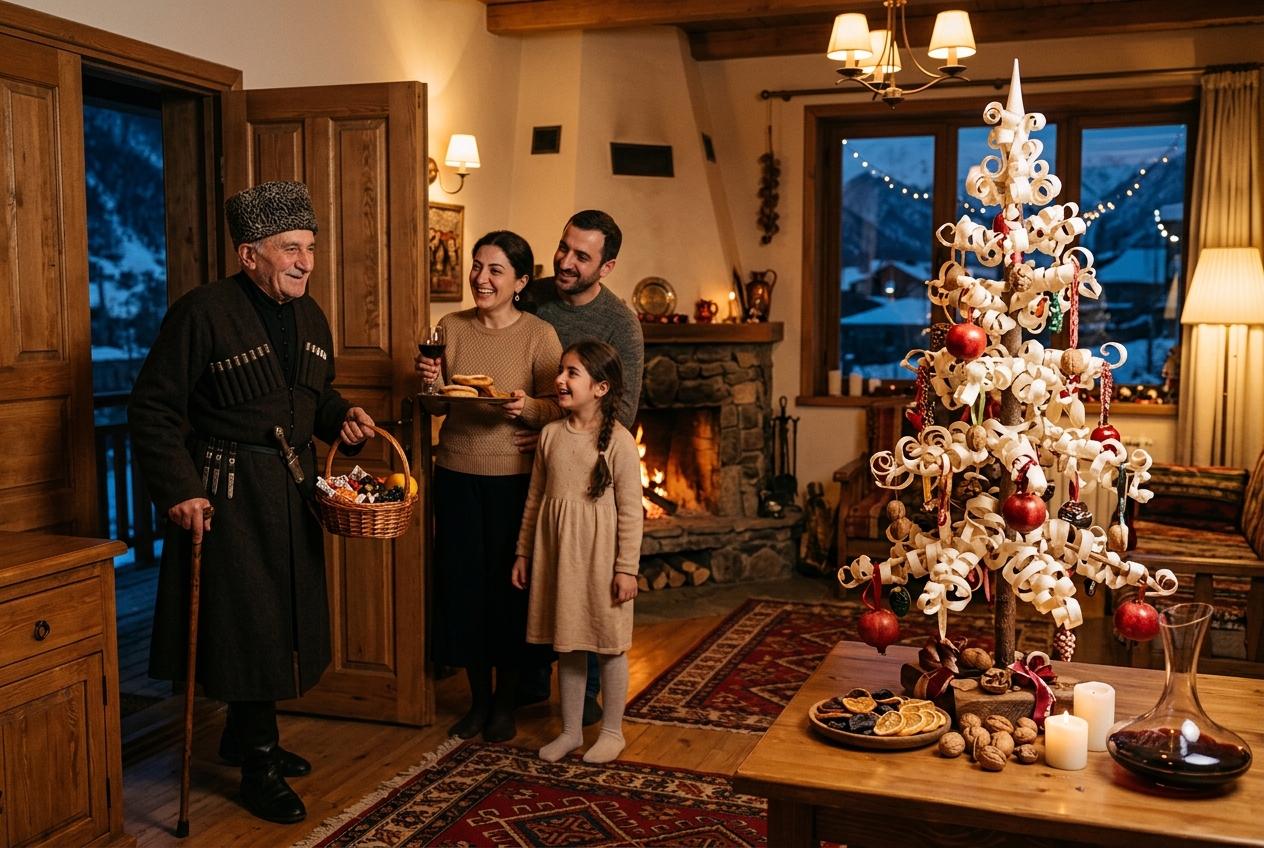
Every country has its own way of ringing in the New Year, but few do it with the same depth of ritual and warmth as Georgia. This small Caucasus nation, known locally as Sakartvelo, treats the transition from one year to the next as something far more than a countdown and a champagne toast. Georgian New Year traditions, from the Mekvle (the lucky first guest) to the Chichilaki (the handcrafted tree of shaved wood), carry centuries of meaning rooted in Orthodox Christianity, pre-Christian folk belief, and a fierce devotion to family and hospitality. The phrase “stumari ghvtisaa” – the guest is a gift from God – isn’t just a saying here; it’s a lived principle that shapes how Georgians celebrate. If you’ve ever sat at a Georgian supra table or watched a grandmother carefully hang sweets on a freshly carved Chichilaki, you know these aren’t museum-piece customs. They’re alive, practiced with genuine feeling, and worth understanding on their own terms.
The Cultural Significance of New Year in Georgia
New Year’s Eve in Georgia isn’t a single night of revelry. It’s the opening act of a holiday season that stretches from December 31 through January 19, weaving together secular celebration and religious observance in a way that feels entirely natural to most Georgians. The emotional weight placed on this period rivals or exceeds what many Western cultures feel around December 25.
What makes the Georgian approach distinct is the layering of pre-Christian folk customs beneath an Orthodox Christian framework. Rituals meant to ensure good harvests and ward off evil spirits were never fully replaced by the church; they were absorbed. The result is a holiday season where you might see a priest blessing a home in the morning and a family performing a folk divination ritual that same evening, with no one seeing a contradiction.
Historical Roots and the Julian Calendar
Georgia’s relationship with the calendar itself adds a fascinating wrinkle. The Georgian Orthodox Church still follows the Julian calendar for its liturgical year, which means Christmas falls on January 7 rather than December 25. This creates a holiday corridor: the secular New Year on January 1 leads directly into Orthodox Christmas a week later, and the celebrations don’t truly end until Epiphany on January 19.
This wasn’t always the case. Before 1918, Georgia used the Julian calendar for civil purposes as well, meaning the New Year itself fell on what the Gregorian calendar calls January 14. Some older Georgians and rural communities still mark “Old New Year” (Dzveli Akhali Tseli) on January 14, effectively giving the country three separate New Year’s celebrations within a two-week span. I’ve met families in Kakheti who set a full table for each one.
The Soviet period complicated things further. Soviet authorities promoted January 1 as a secular holiday while suppressing religious observances. Ironically, this made the secular New Year more prominent while driving Christmas and Epiphany traditions underground. When Georgia regained independence in 1991, the religious holidays roared back, but the January 1 celebration had already become deeply embedded.
The Celebration of ‘Akhali Tseli’ and ‘Bedoba’
Akhali Tseli, literally “New Year,” is the term Georgians use for the January 1 celebration. The night itself looks familiar in some ways: fireworks over Tbilisi, families gathered around tables, a midnight toast. But the real cultural weight falls on what happens after midnight, particularly on January 1 and January 2.
January 2 is known as Bedoba, or “Day of Fate.” Georgians believe that whatever happens on this day sets the tone for the entire year ahead. If you argue with your spouse on Bedoba, expect a year of conflict. If the day is peaceful and abundant, so will the year be. This belief shapes behavior in concrete ways: people avoid lending money, they dress in new clothes, and they make an effort to be cheerful even if they don’t feel it.
The superstition runs deep enough that some Georgians plan their Bedoba activities with real care. Visiting a prosperous friend, eating well, and avoiding any form of conflict are all standard practice. It’s a kind of sympathetic magic: act out the year you want, and you’ll get it.
The Mekvle: The First Foot and the Bringer of Luck
If Bedoba sets the tone for the year, the Mekvle sets the tone for Bedoba. The Mekvle is the first person to cross a household’s threshold after midnight on New Year’s Eve, and Georgians take this role with startling seriousness. The concept has parallels in Scottish “first-footing” traditions, but the Georgian version comes with its own specific rules and expectations.
The word Mekvle comes from “kvali,” meaning footprint or trace. In the Ajara region of western Georgia, the same figure is called Mperkhavi, reflecting the regional linguistic diversity that characterizes so many Georgian customs. Regardless of the name, the idea is the same: this person’s character, appearance, and behavior will imprint on the household’s fortune for the coming year.
Qualities of a Desirable First Guest
Not just anyone can be the Mekvle. Families often pre-arrange who will enter first, selecting someone whose personal qualities match what they hope for in the year ahead. The ideal Mekvle is typically male (though this varies by region), young, healthy, and known to be a person of good character and good fortune.
Here’s what most families look for:
- A person who has had a prosperous year themselves
- Someone known for kindness and honesty
- A male family member or close friend, often a child or young man
- A person with a cheerful disposition who enters smiling
A household that experienced misfortune might quietly steer last year’s Mekvle away from the door this time around. It sounds harsh, but the belief is genuine: if a family had a bad year, the previous Mekvle might carry that bad luck with them. Conversely, a Mekvle associated with a good year will be invited back enthusiastically.
In rural areas, the stakes feel even higher. I’ve heard stories from Svaneti where families would bolt the door and only open it for the pre-selected Mekvle, genuinely worried that an unexpected visitor might bring the wrong energy into the home.
Ritual Greetings and Symbolic Offerings
The Mekvle doesn’t just walk in and sit down. There’s a script, or at least a traditional framework. Upon entering, the Mekvle often recites a blessing. One of the most common phrases is: “Shemovdgi fekhi, gtskalobdet gmerti. Fekhi chemi, kvali angelozisa,” which translates to “I stepped inside, may God be on your side. My foot – trail of an Angel.”
The Mekvle typically brings symbolic gifts: sweets, churchkhela (the walnut-and-grape candy), wine, or coins. These represent the sweetness, abundance, and prosperity the family hopes for. In return, the household feeds the Mekvle generously and often gives a gift in return.
| Mekvle Element | Meaning |
|---|---|
| Sweets or churchkhela | Sweetness in the coming year |
| Wine | Abundance and celebration |
| Coins or money | Financial prosperity |
| Grain or wheat | Fertility and good harvest |
| The greeting prayer | Divine blessing on the household |
The exchange is warm but not casual. There’s a genuine sense that something important is happening, a transfer of fortune from the outside world into the home. Even in Tbilisi, where younger Georgians might joke about the tradition, most families still observe it in some form.
The Chichilaki: Georgia’s Traditional Walnut Tree
If you visit Georgia during the New Year season, you’ll see them everywhere: pale, feathery structures made of shaved wood curls, adorned with fruits, sweets, and small ornaments. These are Chichilakis, and they serve the same role as a Christmas tree in Western homes, but with a distinctly Georgian character and a much longer history.
The Chichilaki is made from a single branch of a walnut or hazelnut tree, carefully shaved so that thin wood curls cascade downward like a beard or a waterfall of white hair. They range from small tabletop versions around 20 centimeters tall to towering creations, with the tallest recorded Chichilaki reaching 4 meters. Most homes use one between half a meter and a meter tall.
Crafting the ‘Beard of St. Basil’
The Chichilaki is sometimes called the “Beard of St. Basil” (Basilis Tsakveri), connecting it to St. Basil the Great, whose feast day falls on January 1 in the Orthodox calendar. The white, flowing curls of shaved wood are said to resemble the saint’s beard, and the connection gives the Chichilaki its religious significance alongside its folk roots.
Making a Chichilaki requires genuine skill. The craftsman selects a straight branch, then uses a knife to shave thin strips that remain attached at the top, curling outward and downward. The technique demands patience and a steady hand; the curls need to be thin enough to be delicate but thick enough not to break. Experienced makers can produce remarkably intricate results, with layers of curls creating a full, almost cloud-like shape.
During the Soviet era, the Chichilaki’s religious symbolism made it a target. The sale of Chichilakis was banned because Soviet authorities viewed the tradition as an expression of religious identity that contradicted the atheist state ideology. Families who continued making them did so quietly, keeping the craft alive through decades of suppression. The tradition’s survival is a testament to how deeply it’s woven into Georgian identity.
Symbolism of Fertility and the Epiphany Burning
The Chichilaki isn’t meant to last. Unlike a plastic Christmas tree stored in the attic for next year, the Chichilaki has a built-in expiration date. On January 18, the day before Orthodox Epiphany, families ceremoniously burn their Chichilakis. The burning symbolizes the destruction of the old year’s troubles and sins, clearing the way for a fresh start.
This cycle of creation and destruction gives the Chichilaki a philosophical weight that a permanent decoration can’t match. You build something beautiful, enjoy it for a few weeks, then release it and everything it represents into the fire. The ashes carry away the past.
There’s also a practical, ecological dimension. The Georgian government actively fines those who illegally harvest pine trees, positioning the Chichilaki as an eco-friendly alternative to cut evergreens. A single walnut branch produces a complete Chichilaki without killing a tree, and since it’s burned rather than discarded, it generates no lasting waste. This environmental angle has helped the tradition gain renewed attention among younger, environmentally conscious Georgians.
Festive Gastronomy and the Supra Table
No discussion of Georgian New Year celebrations is complete without the food. The supra, Georgia’s legendary feast table, reaches its most extravagant form during the New Year season. A tamada (toastmaster) presides over the meal, guiding a series of toasts that can last hours. Each toast follows a traditional order: to God, to the homeland, to the departed, to the family, to the children.
The sheer volume of food is staggering. A typical New Year’s supra might include ten to fifteen dishes, and the table is loaded before guests sit down. Empty space on the tablecloth is considered a bad omen, so dishes are crowded together, often overlapping. Wine flows freely, usually from a family’s own vineyard or a trusted local producer. In Kakheti, Georgia’s wine heartland, the wine is often amber-colored qvevri wine, fermented in clay vessels buried underground.
Satsivi and Gozinaki: Essential Holiday Flavors
Two dishes define the Georgian New Year table above all others: satsivi and gozinaki.
Satsivi is a cold turkey or chicken dish served in a rich walnut sauce spiced with cinnamon, cloves, saffron, and fenugreek. The sauce is thick and complex, with a flavor profile that has no real equivalent in Western cooking. Preparing satsivi properly takes hours, and every family insists their recipe is the best. The dish is always served cold, which surprises visitors expecting a hot main course.
Gozinaki is simpler but equally essential: walnuts fried in honey until golden and caramelized, then cut into diamond-shaped pieces. It’s intensely sweet and crunchy, and it appears on every New Year’s table without exception. Gozinaki represents the sweetness and abundance hoped for in the coming year, and eating it is considered almost obligatory.
Other staples include:
- Khachapuri (cheese bread), in its various regional forms
- Lobiani (bean-stuffed bread)
- Pkhali (vegetable pâté with walnut paste)
- Badrijani nigvzit (eggplant rolls with walnut filling)
- Churchkhela, the candle-shaped walnut and grape candy
The walnut appears in nearly every dish, which isn’t coincidental. Walnuts symbolize prosperity in Georgian culture, and their presence on the New Year’s table reinforces the theme of abundance that runs through every aspect of the celebration.
Preserving Ancient Customs in Modern Georgia
Georgia’s New Year traditions exist in a tension between preservation and evolution that plays out differently across generations. The post-2003 generation, raised after the Rose Revolution and oriented toward Europe, often speaks English and engages with global culture through social media. Yet most still observe the Mekvle tradition, still eat gozinaki, and still recognize the Chichilaki as something distinctly theirs.
In Tbilisi, you can see this tension on any New Year’s Eve. Younger Georgians might attend a rooftop party with a DJ, then rush home before midnight to make sure the right person walks through the door first. The Soviet-educated generation, many of whom speak Russian as their second language, tend to observe the traditions more solemnly, remembering the decades when practices like making a Chichilaki carried real risk.
What strikes me most about Georgian New Year customs is how they resist becoming purely decorative. The Mekvle isn’t a quaint photo opportunity; families genuinely believe in the luck they carry. The Chichilaki isn’t just a pretty object; its burning on January 18 is a real act of release. And the supra isn’t just a meal; the toasts carry emotional weight that can move grown men to tears.
If you’re planning to visit Georgia during the holiday season, prepare yourself for an experience that goes well beyond sightseeing. You’ll likely be pulled into someone’s home, seated at a table groaning with food, and handed a glass of wine before you’ve had time to remove your coat. That’s not tourism. That’s Georgia doing what it has always done: welcoming the stranger, honoring the old ways, and believing that how you begin the year shapes everything that follows.