
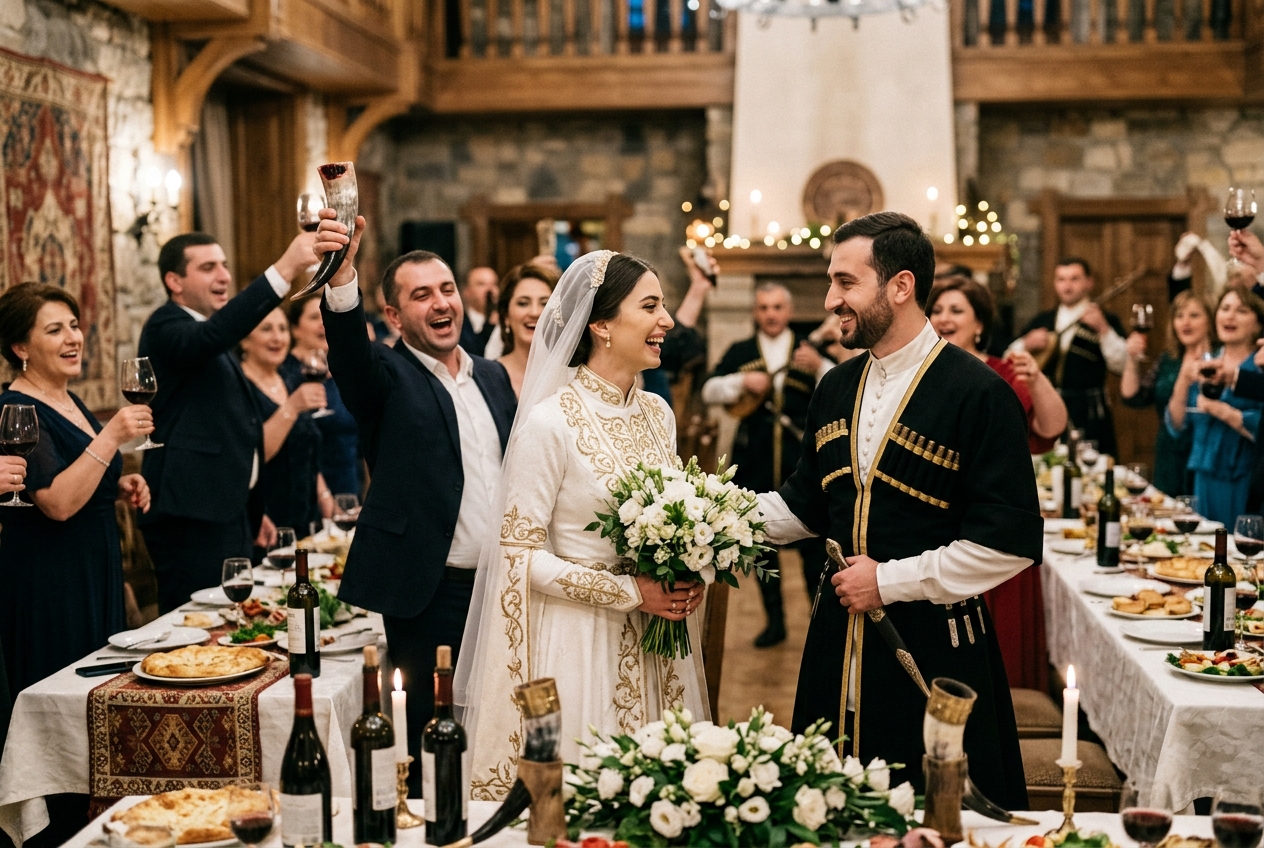
A Georgian wedding is one of those experiences that rewrites your understanding of what a celebration can be. Forget the three-hour receptions you might be used to back home, with their predictable timeline of cocktail hour, dinner, and dancing. In Georgia (the country, nestled between the Caucasus Mountains and the Black Sea), a wedding is an epic, multi-day event rooted in centuries of Orthodox Christian faith, fierce hospitality, and a culture that treats feasting as a near-sacred act. If you’ve been invited to one, congratulations: you’ve been welcomed into something deeply personal and profoundly communal. But you’ll want to know what you’re walking into. Georgian wedding customs as a guest can feel overwhelming if you arrive unprepared, so consider this your honest briefing on everything from church etiquette to surviving a twelve-hour supra. I’ve attended two of these celebrations myself, and both times I left with a hoarse voice, a full heart, and the distinct feeling that Western weddings would never quite compare.
The Warmth of Georgian Hospitality: An Overview for Guests
Georgian culture operates on a principle that predates any modern hospitality industry: “stumari ghvtisaa,” meaning “a guest is a gift from God.” This isn’t a quaint saying printed on tea towels. It’s a deeply held belief, rooted in the country’s Orthodox Christian heritage and its history as a crossroads of empires, where welcoming strangers was both a spiritual duty and a survival strategy. At a wedding, this philosophy is amplified to its maximum intensity.
You are not a spectator at a Georgian wedding. You are a participant. As one cultural tradition holds, guests are not mere observers but active contributors to the celebration, which means you’ll be expected to eat, drink, toast, dance, and emotionally invest in the couple’s happiness. If you come from a culture where wedding guests politely clap and make small talk at assigned tables, prepare for a recalibration.
Guest List Expectations and Inclusivity
The first thing that will shock most Western guests is the sheer scale. Georgian weddings routinely invite several hundred guests, and in rural areas, entire villages may attend. Guest lists of 300 to 500 people are standard, not exceptional. In smaller towns like Sighnaghi or Mestia, the invitation often extends informally to neighbors, distant relatives, and even acquaintances of acquaintances.
Here’s something critical to understand: declining a Georgian wedding invitation is considered a significant insult and can genuinely damage family relationships. If you’ve received an invitation, the family has made a deliberate choice to include you in one of the most important moments of their lives. A casual “I’ll try to make it” won’t cut it. RSVP yes, and show up. If you truly cannot attend due to travel constraints, explain the situation personally and with genuine regret.
Gift Giving Etiquette and Traditional Offerings
Cash is the standard wedding gift in Georgia, and there’s no awkwardness about it. Guests typically bring money in an envelope, and the amounts vary depending on your relationship to the couple and your own financial situation. For a foreign guest, a contribution equivalent to $100 to $300 USD is generally appropriate, though close friends or family members often give more.
Gold jewelry, particularly for the bride, is also a traditional and well-received gift. Some guests bring household items, but cash remains the most practical and appreciated offering. One thing I noticed at both weddings I attended: there’s no gift table or registry. You hand your envelope directly to a designated family member, often near the entrance to the reception. Don’t overthink it. The family genuinely values your presence more than any specific amount.
Sacred Rituals: The Orthodox Church Ceremony
Most Georgian weddings begin with an Orthodox Christian ceremony, and it’s a world apart from the casual church weddings common in many Western countries. Georgian Orthodoxy is one of the oldest Christian traditions on earth, dating back to the 4th century, and the wedding liturgy reflects that depth. The ceremony typically takes place in a centuries-old church, thick with incense and candlelight, and lasts between 30 and 60 minutes.
The Crowning Ceremony and Its Significance
The centerpiece of the Orthodox wedding is the crowning ritual, called “gvirgvinoba” in Georgian. The priest places ornate crowns (or wreaths) on the heads of the bride and groom, symbolizing that they are becoming the king and queen of their own household. These crowns also represent martyrdom, acknowledging that marriage requires sacrifice and selflessness.
The couple then walks around the altar three times while crowned, representing the Holy Trinity and their first steps together as a married unit. This circular procession is one of the most visually striking moments of the entire wedding. The best man and maid of honor (called “mejavare”) hold the crowns if they’re too heavy to rest on the couple’s heads, and this role carries enormous honor.
Dress Code and Behavior Inside the Church
If you’re attending the church portion, dress conservatively. Women should cover their shoulders and wear skirts or dresses below the knee. Head coverings for women are expected in most Georgian churches: bring a scarf. Men should wear long trousers and collared shirts at minimum; suits are preferred.
During the ceremony, silence your phone completely. Photography rules vary by church, but flash photography is almost always prohibited. Stand when others stand, and don’t cross your legs while seated. If you’re not Orthodox, you’re not expected to cross yourself or kiss icons, but showing quiet respect is essential. I made the mistake of whispering to a friend during my first Georgian church ceremony and received a look from a grandmother that could have cured stone.
The Supra: Navigating the Traditional Georgian Feast
The supra is where the real marathon begins. This is the traditional Georgian feast, and at a wedding, it reaches its most elaborate and extended form. Tables groan under the weight of dozens of dishes, wine flows from bottles and clay vessels alike, and the entire event is orchestrated by a single, powerful figure.
The Role of the Tamada (Toastmaster)
The tamada is the soul of the supra. Often described as the “dictator of the table”, this person controls the rhythm, mood, and progression of the entire evening through a series of structured toasts. The tamada is typically a male relative or close friend of the groom’s family, chosen for his eloquence, wit, and ability to hold a room.
Each toast follows a theme: to the couple, to the parents, to the deceased family members, to Georgia itself, to friendship, to the future. These aren’t casual “raise your glass” moments. A tamada’s toast can last five to ten minutes and often includes poetry, historical references, and genuine emotional weight. After each toast, everyone at the table drinks. You’ll understand quickly why Georgians have such legendary endurance for wine.
The Art of Wine and Toasting Protocols
Georgia claims to be the birthplace of wine, with archaeological evidence of winemaking dating back 8,000 years. At a wedding supra, you’ll likely drink wine made using the traditional qvevri method: fermented in large clay vessels buried underground. The amber wines (sometimes called “orange wines” in the West) are distinctive and earthy.
Here’s the protocol you need to know:
- When the tamada raises a toast, you drink. Sipping is acceptable, but putting your glass down untouched is rude.
- If someone offers you a personal toast (called an “alaverdi”), you must respond with a toast of your own. Keep it heartfelt and brief.
- Toasts to the deceased are always followed by drinking the entire glass without clinking.
- Pacing yourself is wise. Nobody will judge you for drinking slowly, but refusing to drink at all requires a solid excuse (health, religion, or pregnancy are understood).
Essential Culinary Highlights on the Table
The food at a Georgian wedding supra is staggering in both quantity and variety. Expect the table to be fully loaded before you even sit down, with new dishes arriving in waves throughout the night.
| Dish | Description |
|---|---|
| Khachapuri | Cheese-filled bread in various regional styles; Adjarian style comes boat-shaped with an egg |
| Khinkali | Large soup dumplings filled with spiced meat or mushrooms; eat with your hands |
| Satsivi | Cold walnut sauce served over turkey or chicken; a holiday staple |
| Badrijani | Fried eggplant rolls filled with walnut-garlic paste |
| Mtsvadi | Georgian-style grilled meat skewers, usually pork or veal |
| Pkhali | Minced vegetable and walnut spreads, served as appetizers |
| Churchkhela | Walnut or hazelnut strings dipped in grape juice and dried; the “Georgian Snickers” |
Eat steadily throughout the night rather than filling up early. The feast can last many hours, and the best dishes sometimes arrive late.
Music, Dance, and Cultural Entertainment
Georgian wedding entertainment isn’t a hired DJ playing top-40 hits. It’s a living expression of one of the world’s most distinctive musical and dance traditions, and it will likely be the most memorable part of your experience.
Polyphonic Singing and Traditional Folk Performances
Georgian polyphonic singing is a UNESCO-recognized art form, and you’ll almost certainly hear it at a wedding. Three-part vocal harmonies, performed without instruments, create a sound that’s simultaneously ancient and hauntingly beautiful. These songs often tell stories of love, war, and the Georgian homeland. Even if you don’t understand a word of Georgian (Kartuli), the emotional impact is unmistakable.
Live bands at Georgian weddings typically feature traditional instruments: the panduri (a three-stringed lute), the chonguri, and the doli (a double-headed drum that drives the dance rhythms). The transition from solemn polyphonic singing to explosive, drum-driven dance music can happen in seconds, and when it does, the entire room transforms.
The Kartuli: The Symbolic Couple’s Dance
The kartuli is the traditional first dance of the married couple, and it’s nothing like a slow sway to Ed Sheeran. This is a highly choreographed, deeply symbolic performance. The groom dances with proud, upright posture, his movements controlled and dignified, while the bride glides with graceful, almost floating steps, her eyes modestly downcast.
The dance represents courtship, respect, and the balance of masculine strength with feminine elegance. Many Georgian couples practice the kartuli for weeks or months before the wedding. When performed well, the room goes silent with admiration. After the kartuli, the floor opens to everyone, and the energy shifts dramatically. Group dances like the lezginka bring explosive athleticism: men drop to their knees, spin, and leap while women circle with elegant precision.
Symbolic Customs Throughout the Celebration
Beyond the church and the supra, Georgian weddings are filled with smaller rituals that carry deep symbolic meaning. These moments punctuate the celebration and connect the couple to generations of tradition.
The Breaking of the Plate for Good Luck
One of the most visually dramatic traditions happens right at the threshold of the reception venue. The couple breaks a plate at the entrance for good luck, smashing it on the ground as they step into their new life together. The shards represent the breaking away of past troubles and the beginning of something fresh.
In some families, the plate is white and decorated, and the number of pieces it breaks into is said to predict the number of happy years ahead. Other families place a glass on the ground for the groom to stomp on. Either way, the crowd cheers, and the celebration officially begins. If you’re standing near the entrance, step back a bit: flying ceramic is a real hazard.
Releasing White Birds and Floral Traditions
White doves or pigeons are released by the couple after the church ceremony, symbolizing love, peace, and the couple’s shared future. The birds typically circle the church before flying away, and the moment creates a beautiful visual against Georgia’s mountain or urban skyline.
Floral traditions vary by region. In some areas, the bride’s bouquet is tossed to unmarried women (similar to the Western tradition), while in others, specific flowers carry symbolic meaning. Roses represent love, while white flowers symbolize purity. The groom’s family sometimes decorates the couple’s car with elaborate floral arrangements and ribbons, and the wedding procession through town involves honking horns and shouting from car windows: a public announcement that a new family has been formed.
Practical Tips for Navigating the Long Celebration
Georgian wedding celebrations can last many hours, sometimes extending well into the next day. Here’s how to survive and actually enjoy the experience:
- Wear comfortable shoes. You’ll be standing, dancing, and moving between venues. Women in particular should consider a heel change.
- Eat bread between wine toasts. Georgian bread (shotis puri or tonis puri) is excellent and will help you pace your drinking.
- Download Google Translate’s offline Georgian language pack before the wedding. Many older guests, especially in rural areas, speak Georgian and Russian but limited English. Younger Georgians (post-2003 Rose Revolution generation) are more likely to speak English.
- Bring a small gift or flowers if you’re visiting the couple’s home before or after the ceremony. This is separate from your cash gift.
- Use ride-hailing apps like Bolt or Yandex Go to get to and from the venue safely. Don’t plan on driving yourself after a supra.
- Pace yourself emotionally and physically. The celebration is genuinely long, and ducking out early can be noticed. If you need a break, step outside briefly rather than leaving altogether.
The single best piece of advice I can offer: say yes to everything. Yes to the toast, yes to the dance, yes to the third helping of khinkali, yes to the stranger who wants to teach you a Georgian song. Georgian weddings reward full participation. The families hosting the event have invested enormous resources, emotion, and pride into this celebration, and your enthusiastic presence is the greatest gift you can offer in return. You’ll leave exhausted, probably slightly overwhelmed, and with stories you’ll tell for the rest of your life.