
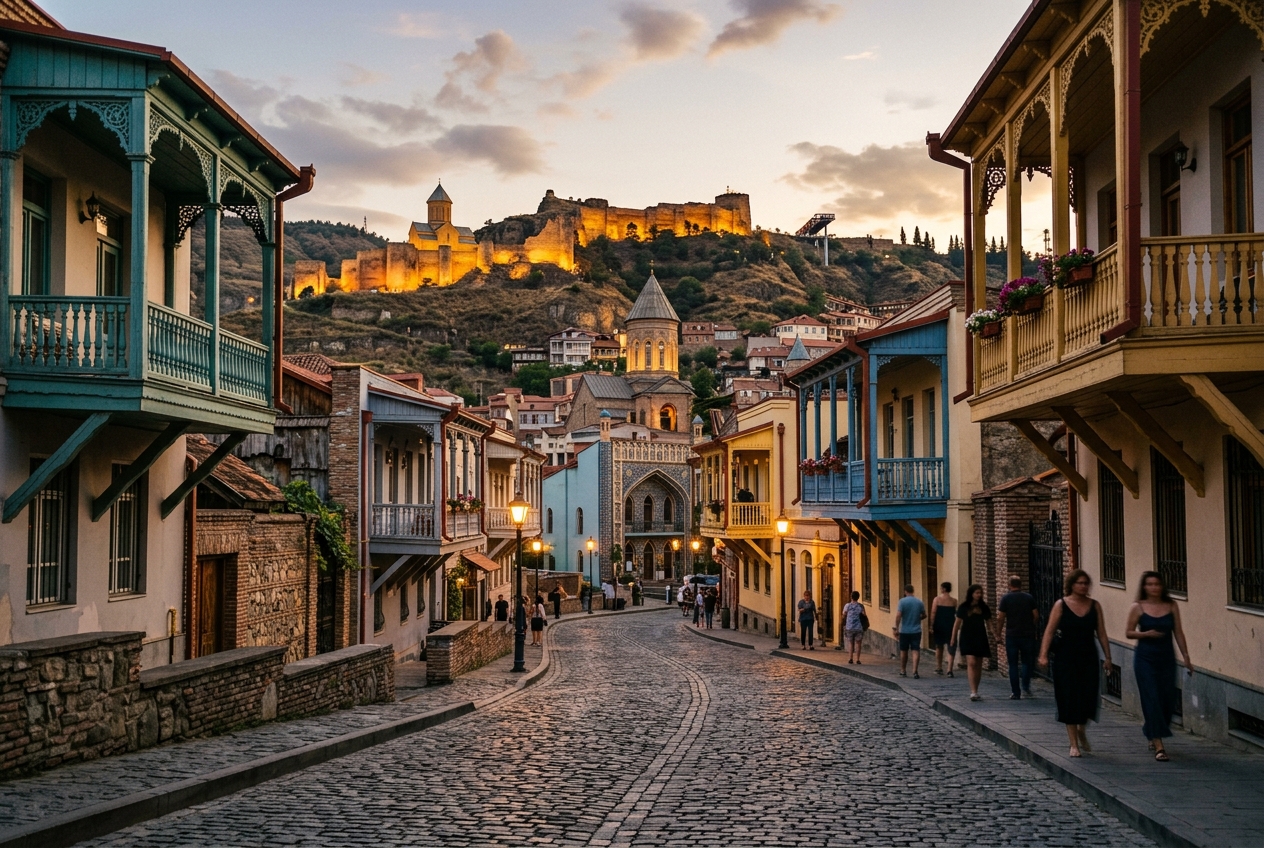
Few cities manage to feel ancient and alive at the same time. Tbilisi does. Its oldest quarter, a tangle of cobblestone lanes, crumbling facades, and sulfur-scented air, sits in a gorge carved by the Mtkvari River, pressed between a hilltop fortress and the thermal springs that gave the city its name. The word “tbili” means “warm” in Georgian, a nod to those very springs. Walking through these streets is less like visiting a museum and more like stepping into someone’s living room: laundry dries on ornate balconies, stray cats claim doorsteps, and grandmothers call down from windows. With Tbilisi attracting 3.76 million foreign visitors in 2025 alone, an 11% jump from the year before, the old quarter is busier than ever. But it hasn’t lost its character. Not yet. If you’re planning a trip, here’s everything you should know about Old Tbilisi before you go: its history, its hidden corners, and how to actually enjoy it without falling into tourist traps.
The Heart of the Capital: History and Architecture
Old Tbilisi occupies the southern bank of the Mtkvari, roughly spanning the neighborhoods of Kala, Sololaki, and Abanotubani. The area has been continuously inhabited since the 5th century, when King Vakhtang Gorgasali reportedly founded the city after discovering the hot springs. Over the centuries, it was sacked by Mongols, Persians, Ottomans, and Russians, each leaving a mark on the architecture and culture. What stands today is a palimpsest: Persian-style bathhouses next to Georgian Orthodox churches next to Art Nouveau buildings from the brief period of independence in the early 1900s.
The street plan itself tells the story. Unlike the gridded Soviet-era districts north of the river, Old Tbilisi grew organically. Streets curve around hillsides, dead-end at cliff faces, and sometimes lead straight into someone’s courtyard. This can be disorienting, but that’s part of the appeal.
The Legacy of the Silk Road
Tbilisi sat at a critical junction of east-west and north-south trade routes for over a thousand years. Merchants traveling between Europe and Asia passed through the Caucasus corridor, and Tbilisi became a natural rest stop, trading post, and cultural crossroads. You can still see this in the old quarter’s DNA: Armenian churches stand beside a mosque and a synagogue, all within a few hundred meters of each other. The Sioni Cathedral, the Jumah Mosque, and the Anchiskhati Basilica coexist in a way that reflects centuries of cohabitation rather than mere tolerance.
This Silk Road heritage also explains the food. Georgian cuisine absorbed influences from Persia, Turkey, and Central Asia, then made them entirely its own. The walnut-heavy sauces, the use of fenugreek and marigold petals, the clay-oven bread called “shotis puri” baked in a tone: all of it traces back to trade.
Distinctive Carved Wooden Balconies
The most photographed feature of Old Tbilisi is its balconies. These aren’t simple railings. They’re elaborate wooden structures, often cantilevered over the street, with carved lattice screens, grape-vine motifs, and sometimes stained glass. Many date to the 18th and 19th centuries, when prosperous merchant families competed to outdo their neighbors.
The balconies served a practical purpose too. In the hot Tbilisi summers, they provided shaded outdoor living space. Families ate, socialized, and even slept on them. Today, many are in rough shape, victims of neglect and the Soviet era’s disinterest in preservation. But restoration efforts have accelerated, partly driven by tourism revenue. The contrast between a freshly restored turquoise balcony and a sagging, weathered one next door captures Old Tbilisi perfectly: a place caught between decay and renewal.
Must-Visit Landmarks and Cultural Sites
Old Tbilisi is compact enough to cover on foot in a day, though you’ll want longer. The major landmarks cluster within a 20-minute walking radius, but the real pleasure is in the detours.
Narikala Fortress and Mother of Georgia
Narikala is the skeletal fortress that dominates the skyline above the old town. Parts of it date to the 4th century, making it older than Tbilisi itself. The easiest way up is by cable car from Rike Park, which costs about 2.50 GEL (less than a dollar) using a transit card. From the top, you get a panoramic view of the city: the river below, the modern Peace Bridge, the cathedral of Tsminda Sameba in the distance.
Just below the fortress stands Kartlis Deda, the “Mother of Georgia” statue. She holds a sword in one hand and a bowl of wine in the other: a symbol of how Georgians see themselves. Hostile to enemies, generous to guests. The Georgian phrase “stumari ghvtisaa” (a guest is from God) isn’t just a saying here; it’s a social contract.
The Leaning Clock Tower of Rezo Gabriadze
This whimsical tower, attached to the Gabriadze Puppet Theatre on Shavteli Street, looks like something Dr. Seuss might have designed after a trip to the Caucasus. It leans deliberately, covered in mismatched tiles and topped with a small angel that emerges on the hour. Rezo Gabriadze, the filmmaker and puppeteer who built it, intended it as a statement about imperfection and beauty.
The puppet theatre itself is worth booking tickets for, even if you don’t speak Georgian. Performances are visual and emotional, transcending language. Shows sell out fast, so reserve online a few days ahead. The tiny cafe next door serves excellent coffee and has walls covered in Gabriadze’s sketches.
Metekhi Church and the Mtkvari River Views
Perched on a cliff across the river from the main old town, Metekhi Church dates to the 13th century, though a church has stood on this spot since the 5th century. The equestrian statue in front depicts King Vakhtang Gorgasali, Tbilisi’s founder. This is one of the best vantage points in the city, especially at sunset when the old quarter glows amber.
The area around Metekhi has been gentrifying quickly. Real estate prices in Tbilisi have been climbing: the average selling price hit $1,341 per square meter in December 2025, up 6% year-over-year. Some of that pressure is visible in the old quarter, where boutique hotels and co-working spaces have replaced residential buildings.
The Sulfur Baths of Abanotubani
The bathhouse district, Abanotubani, sits at the eastern edge of Old Tbilisi in a low-lying area where natural sulfur springs bubble up from underground. The brick-domed roofs of the bathhouses are iconic, and the warm, egg-scented air is unmistakable. Bathing here isn’t a tourist gimmick; it’s a tradition that predates the city.
The Legend of King Vakhtang Gorgasali
The founding myth goes like this: King Vakhtang was hunting with his falcon in the 5th century. The falcon caught a pheasant, and both birds fell into a hot spring. Depending on the version, either the pheasant was cooked by the water or miraculously healed. Either way, the king was so impressed by the thermal springs that he ordered a city built around them. “Tbili” became Tbilisi.
Whether or not you believe in falconry-based urban planning, the springs are real and still flowing. The water emerges at around 40-50°C, rich in sulfur and other minerals. Locals swear by its effects on skin and joints.
Choosing Between Public and Private Baths
You have two options. Public baths like Bathhouse No. 5 cost around 5-10 GEL and offer a communal experience: think Soviet-era tiles, local regulars, and zero pretension. Private rooms at places like the Orbeliani Baths (the blue-tiled, mosque-like building you’ve seen in every Instagram post) run from 50 to 150 GEL per hour depending on room size and whether you add a scrub massage, called a “kisi.”
| Bath Type | Cost (GEL) | Experience | Best For |
|---|---|---|---|
| Public (No. 5) | 5-10 | Communal, authentic, basic | Budget travelers, cultural immersion |
| Private (Orbeliani) | 80-150/hour | Private room, ornate tiles | Couples, first-timers |
| Private (Royal Bath) | 50-100/hour | Mid-range, less crowded | Small groups |
I’d recommend trying a private room for your first visit, then going public once you’re comfortable with the etiquette. Tip: go on a weekday morning to avoid crowds.
Hidden Gems in the Narrow Alleys
The main tourist circuit in Old Tbilisi is well-trodden: fortress, baths, clock tower, done. But the real magic lives off the beaten path, in the alleys that don’t appear on Google Maps and the courtyards you’d never enter without an invitation or a bit of nerve.
Secret Courtyards and Italian-style Patios
Old Tbilisi’s residential buildings are built around shared courtyards, many of which look like they belong in Naples or Palermo. Wrought-iron staircases spiral up three or four floors, laundry lines crisscross overhead, and grapevines climb every available surface. These aren’t tourist attractions; they’re where people live. But most residents won’t mind if you wander in respectfully.
Some of the best courtyards are on Betlemi Street and the streets climbing toward Narikala. Look for open gates and follow the staircases. You’ll find crumbling frescoes, cats sleeping in flowerpots, and occasionally an elderly neighbor who’ll wave you over for a glass of wine. This is the Tbilisi that tourism brochures can’t quite capture.
The Underground Wine Cellars of Sololaki
Sololaki, the hillside neighborhood adjacent to the old town’s core, hides wine cellars beneath many of its buildings. Georgia’s 8,000-year winemaking tradition isn’t abstract here: it’s literally underfoot. Some families still ferment wine in qvevri, the large clay vessels buried in the ground that UNESCO recognized as part of Georgia’s intangible cultural heritage.
A few of these cellars have opened to visitors. Vino Underground on Tabidze Street is a natural wine bar with rotating selections from small Georgian producers. Wine Spirit on Erekle II Street offers tastings in an actual cellar. Neither feels touristy, and both are run by people who genuinely care about Georgian wine culture.
Dining and Nightlife in the Old Quarter
Old Tbilisi’s food and drink scene has exploded in recent years. The challenge isn’t finding a good meal: it’s avoiding the overpriced, mediocre restaurants that cluster around the most photographed spots.
Traditional Taverns on Shardeni Street
Shardeni Street is the old quarter’s main dining strip, and it’s a mixed bag. Some restaurants here serve excellent khinkali (soup dumplings), khachapuri (cheese bread), and mtsvadi (grilled meat), while others coast on location. A few reliable picks: Shavi Lomi, just off Shardeni, serves modern Georgian food that respects tradition without being stuck in it. Machakhela, a chain, is surprisingly good for quick, affordable khinkali.
Shopping is a significant part of the tourist economy here: 26% of tourist expenditures in Georgia during early 2025 went to shopping, and Shardeni’s surrounding streets are lined with antique shops, jewelry stores selling cloisonné enamel, and small galleries. Haggling is acceptable at market stalls but not in established shops.
Artistic Cafes and Rooftop Bars
The younger generation of Tbilisi, mostly English-speaking and post-2003 Rose Revolution in outlook, has built a cafe and bar culture that rivals cities twice its size. Linville on Leselidze Street is a favorite for specialty coffee. Lolita, tucked into a courtyard, draws a creative crowd. For rooftop drinks, Ambasadori’s terrace offers views of Narikala, while Dive Bar (despite the name) is a proper cocktail spot.
Nightlife in the old quarter tends to be mellow compared to the club scene around Bassiani and Khidi near the river. But that’s the point. An evening here is about long dinners, multiple toasts led by a tamada (toastmaster), and wandering home through lamp-lit streets.
Practical Tips for Navigating Old Tbilisi
Getting around Old Tbilisi on foot is the only real option: most streets are too narrow for cars. Wear comfortable shoes with grip, because the cobblestones are uneven and slippery when wet. Download offline maps on Google Maps before you go, since GPS can be unreliable in the narrow alleys.
For transport to and from the old quarter, Bolt and Yandex Go work well and are cheap: most rides within central Tbilisi cost 3-8 GEL. The metro’s Avlabari station is the closest stop to the old town’s eastern side. Georgian is written in its own unique script, so having Google Translate’s offline Georgian pack downloaded is genuinely useful for reading menus and signs.
The old quarter is safe, including for solo female travelers. Georgian culture places enormous value on hospitality and protecting guests. Police are generally reliable and responsive. One thing to be mindful of: avoid bringing up the conflicts with Russia over Abkhazia and South Ossetia unless a local raises the topic first. Feelings run deep, and it’s a sensitive subject.
Hotel occupancy in Tbilisi sits at around 39.5% in the first quarter of the year, meaning winter and early spring offer the best deals and thinnest crowds. Peak season runs from June through September. If you can visit in May or October, you’ll get warm weather, manageable tourist numbers, and the old quarter at its most atmospheric.
Georgia itself is drawing record numbers of visitors, with 5.52 million foreign tourists in 2025, so the window for experiencing Old Tbilisi before it changes dramatically is narrowing. The bones of this place, the springs, the fortress, the balconies, have survived centuries of invasion and neglect. They’ll survive tourism too. But the quieter, more personal version of Old Tbilisi, the one where a stranger invites you into a courtyard for homemade wine, is worth catching while it lasts. Go soon, stay longer than you planned, and leave the main streets behind whenever you can.