
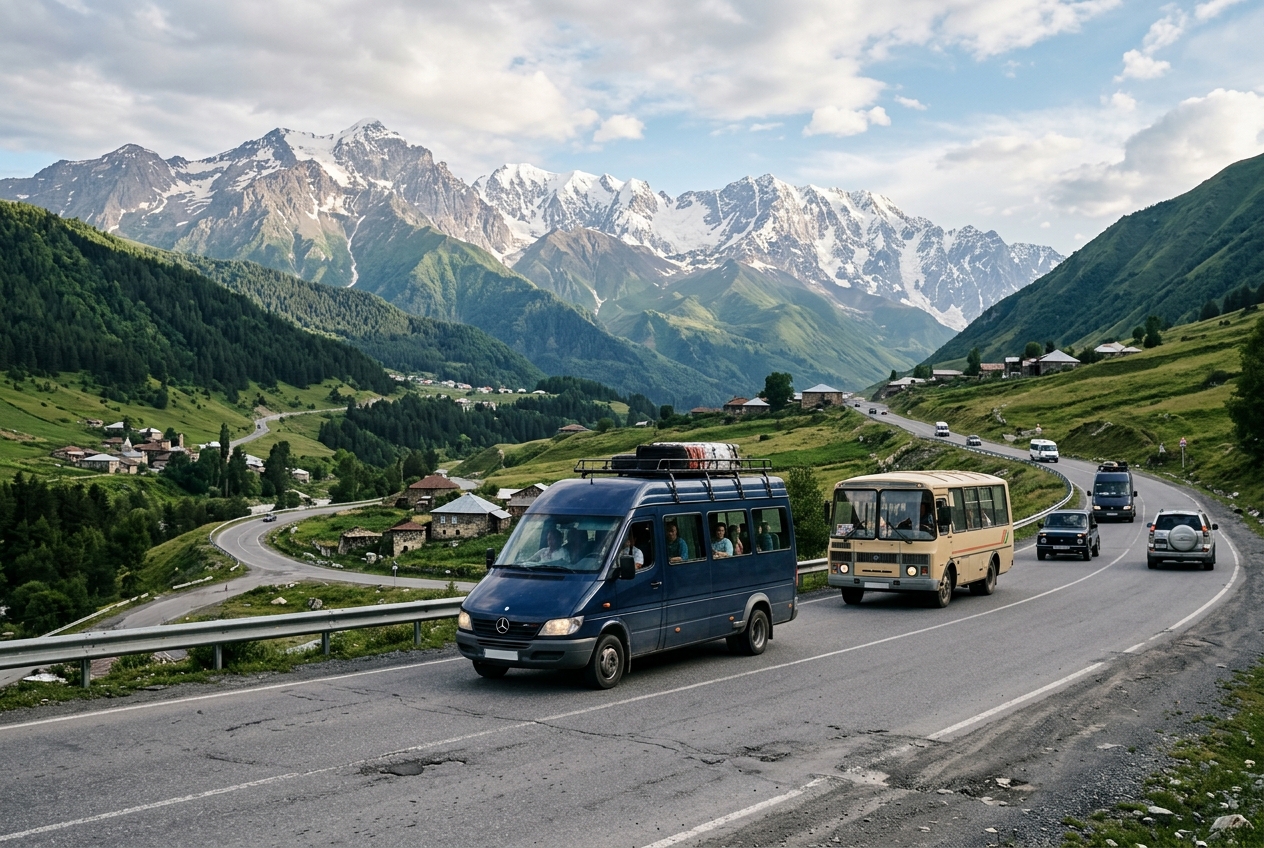
Georgia is one of those countries where getting around is half the adventure. The transport network here reflects a nation caught between Soviet-era infrastructure and rapid modernization, where a sleek metro train might deposit you at a chaotic bus station filled with drivers shouting destinations through open windows. I spent my first week in the country completely bewildered by the system, and my second week wondering how I ever found it confusing. The reality is that transport in Georgia is affordable, surprisingly extensive, and far more logical than it first appears. Whether you are arriving at Tbilisi’s international airport, catching a marshrutka to a remote mountain village, or booking a high-speed train to the Black Sea coast, the system works once you understand its quirks. This guide covers everything you need to know about moving through this beautiful Caucasus country, from the capital’s underground metro to domestic flights that land on airstrips surrounded by 5,000-meter peaks. Pack your patience, download a couple of apps, and you will be fine.
Getting Started: Navigating Georgia’s Major Hubs
Tbilisi is where most travelers begin, and the city functions as the country’s undisputed transport nerve center. Almost every intercity route passes through the capital, making it both a blessing and a bottleneck. Kutaisi, the country’s second city, has grown as an alternative entry point thanks to budget airlines, and Batumi on the coast handles seasonal traffic. Understanding how these hubs connect is the first step to moving through the country efficiently.
Arriving via International Airports
Tbilisi International Airport (TBS) sits about 17 kilometers southeast of the city center. The easiest way into town is Bus 37, which runs from the airport to Liberty Square for just 0.50 GEL (roughly $0.20) if you grab a Metromoney transit card from the vending machines near the arrivals hall. The bus runs from around 7 a.m. to midnight. Outside those hours, taxis are your only option, and you should expect to pay 30-40 GEL ($11-15) to central Tbilisi. I strongly recommend using the Bolt app rather than negotiating with airport taxi drivers, who will quote you double or triple the going rate without blinking.
Kutaisi International Airport (KUT) is actually closer to the village of Kopitnari than to Kutaisi itself, sitting about 22 kilometers from the city. Georgian Bus runs a shuttle timed to flight arrivals, costing around 10 GEL. Some travelers fly into Kutaisi on Wizz Air and head directly to Tbilisi by marshrutka or train rather than spending time in the city. That transfer takes about four hours by road.
Using the Tbilisi Metro System
Tbilisi’s metro is a relic of the Soviet era, and I mean that in the best way. Two lines, 23 stations, and trains that arrive every five minutes during peak hours. A single ride costs 0.50 GEL, and you pay using the same Metromoney card that works on city buses and cable cars. The metro runs from 6 a.m. to midnight.
The Akhmeteli-Varketili line (Line 1) is the one most visitors use, connecting the main train station (Station Square) to the old town area (Liberty Square) and onward to Samgori, where the city’s largest marshrutka hub is located. The Saburtalo line (Line 2) branches off at Station Square and heads northwest. Station announcements are in Georgian and English, and signage is bilingual. The system is clean, safe, and genuinely useful for getting across the city quickly.
Mastering the Marshrutka Network
The marshrutka is Georgia’s workhorse. These yellow or white minibuses connect virtually every town and village in the country, running on semi-fixed schedules that become less predictable the further you get from Tbilisi. They are cheap, frequent on popular routes, and occasionally terrifying on mountain roads. But they are also the most authentic way to travel, and you will share seats with grandmothers carrying bags of churchkhela, construction workers, and the occasional chicken.
How to Find and Board Minibuses
There is no centralized booking system for marshrutkas. You show up at the station, find the minibus with your destination written on a sign (usually in Georgian script), and pay the driver directly when you board or during the ride. Prices are fixed by route, not negotiable, and almost always under 20 GEL for trips within a few hours of Tbilisi.
The key stations to know:
- Didube Station: Serves northern and western destinations, including Kazbegi (Stepantsminda), Kutaisi, and Zugdidi
- Samgori Station: Handles eastern and southern routes, including Sighnaghi, Telavi, and David Gareja
- Ortachala Station: Covers some southern routes and international buses to Armenia and Azerbaijan
Marshrutkas typically leave when full, not on a strict timetable. On busy routes like Tbilisi to Kutaisi, this means departures every 20-30 minutes. On quieter routes, you might wait an hour or more. Arrive early in the morning for the best selection.
Intercity Routes and Major Stations
The most popular marshrutka routes for travelers include Tbilisi to Kazbegi (3-4 hours, about 10 GEL), Tbilisi to Kutaisi (4 hours, 15 GEL), and Tbilisi to Sighnaghi (2 hours, 7 GEL). Georgia’s overall cargo and passenger volumes have been climbing steadily, with total cargo volumes increasing by 5% year-over-year in 2024, reaching about 31 million tons – a sign that the country’s transport corridors are handling more traffic than ever.
For intercity marshrutka travel, download the app “Biletebi” or check the website for Georgian Railways, which sometimes lists connecting bus services. Google Maps has become surprisingly accurate for Georgian bus routes in recent years, showing real-time marshrutka schedules for major corridors. Ask your guesthouse host to write your destination in Georgian script on a piece of paper – this solves 90% of communication issues at bus stations where older drivers may speak only Georgian or Russian.
Rail Travel and Scenic Train Routes
Georgian Railways (Sakartvelo’s Rkinigza) operates a modest but useful network connecting the country’s main cities. The trains are slower than marshrutkas on some routes but infinitely more comfortable, and certain journeys – particularly the Tbilisi to Batumi line – are genuinely scenic.
High-Speed Trains to Batumi
The flagship service is the express train from Tbilisi to Batumi, which covers the 380-kilometer distance in about five hours. “High-speed” is a generous description by European standards, but compared to the alternative of a seven-hour marshrutka ride, it feels luxurious. Trains depart from Tbilisi’s central station (accessible via the metro’s Station Square stop) and follow a route through Zestaponi, Kutaisi, and Ozurgeti before reaching the coast.
First-class tickets cost around 35-45 GEL, while second class runs about 25 GEL. The first-class carriages have air conditioning, reclining seats, and a snack service. During summer months (June through September), these trains fill up fast, so booking a few days ahead is wise. The route passes through some of Georgia’s most beautiful countryside, including the Rioni River valley and lush Adjarian hills.
| Route | Duration | Approx. Price (GEL) | Frequency |
|---|---|---|---|
| Tbilisi – Batumi | 5 hours | 25-45 | 1-2 daily |
| Tbilisi – Kutaisi | 5.5 hours | 15-20 | 1 daily |
| Tbilisi – Zugdidi | 6 hours | 20-30 | 1 daily |
| Tbilisi – Borjomi | 4 hours | 10-15 | 1 daily |
Booking Tickets and Class Options
You can buy train tickets at station counters, but the easier method is through the Georgian Railways website (railway.ge) or their mobile app. The interface has an English option, though it can be glitchy. Payment by international credit card usually works. Print your ticket or save the PDF on your phone – conductors scan QR codes on board.
Night trains still operate on the Tbilisi-Zugdidi route, offering sleeping berths (platskart and kupe classes, using the old Soviet terminology). These are basic but functional, and they save you a night’s accommodation. Expect shared compartments, thin mattresses, and the rhythmic clatter of wheels on tracks. I find them charming. Not everyone agrees.
Driving and Private Transport Options
Renting a car opens up Georgia’s most spectacular regions, particularly Tusheti, Svaneti’s upper valleys, and the wine country of Kakheti. But driving here comes with real challenges that you should understand before signing a rental agreement.
Car Rentals and Road Conditions
International chains like Hertz and Europcar operate in Tbilisi, but local companies such as Rent Car Georgia and MyGeo Car often offer better rates, starting around 80-120 GEL ($30-45) per day for a basic sedan. For mountain roads, you will need a 4×4, which runs 150-250 GEL daily. Always check insurance coverage carefully – many budget rentals include only minimal liability.
Road conditions vary dramatically. The main highways connecting Tbilisi to Kutaisi and Batumi are well-maintained dual carriageways. Secondary roads to popular destinations like Kazbegi have been improved significantly. But venture off main routes and you will encounter unpaved tracks, missing guardrails, and switchbacks that demand real driving skill. Roughly 23% of Georgia’s major roads are in poor or mediocre condition, and this percentage climbs sharply for rural roads. Georgian drivers are aggressive by Western European standards, with frequent overtaking on blind corners and a relaxed attitude toward speed limits. Road safety is a genuine concern: 8,302 traffic fatalities occurred on Georgia’s highways between 2020 and 2024, averaging 1,660 per year.
Ride-Sharing and Taxi Apps
If driving yourself sounds stressful, taxi apps are the way to go. Bolt is the dominant platform in Tbilisi, Batumi, and Kutaisi, offering reliable service at transparent prices. A cross-city ride in Tbilisi rarely exceeds 10 GEL. Yandex Go also operates but has become less popular since 2022 for political reasons related to its Russian ownership.
For intercity travel, the ride-sharing platform GG (formerly GoTrip Georgia) connects drivers with empty seats to passengers heading the same direction. It functions like BlaBlaCar and costs roughly the same as a marshrutka. You book through the app, meet the driver at a designated point, and split fuel costs. I have used it half a dozen times between Tbilisi and Telavi with zero issues – the drivers are ordinary Georgians commuting or visiting family.
Alternative and Regional Transit
Beyond the main networks, Georgia has some genuinely unique transport options that double as attractions in their own right.
Cable Cars in Tbilisi and Chiatura
Tbilisi’s aerial tramway from Rike Park to Narikala Fortress is the one most visitors encounter. It costs 2.50 GEL, accepts the Metromoney card, and delivers stunning views over the old town and Mtkvari River. But the real cable car experience is in Chiatura, a former manganese mining town in Imereti where Soviet-era cable cars have been partially replaced by modern gondolas. Some of the original 1950s cabins still operate on certain lines, swaying over deep gorges in a way that is both exhilarating and mildly concerning. Getting to Chiatura requires a marshrutka from Kutaisi (about 1.5 hours), and the cable cars are free to ride.
Tbilisi also has a funicular railway climbing Mtatsminda Mountain, offering panoramic views of the city and the Caucasus range beyond. It operates from 9 a.m. to midnight in summer, with tickets around 5 GEL.
Domestic Flights to Mestia and Ambrolauri
Vanilla Sky, a small Georgian airline, operates domestic flights from Tbilisi’s Natakhtari airfield to Mestia (the gateway to Svaneti) and occasionally to Ambrolauri in Racha. The Mestia flight takes about one hour compared to 8-10 hours by road, and tickets cost roughly 65-85 GEL. The catch? Flights are weather-dependent and cancel frequently, especially in winter and early spring. Georgia’s air sector is growing rapidly, with air cargo volumes surging 34% in 2024 to reach 26.2 thousand tons, though passenger services to remote regions remain small-scale.
Book these flights as a hopeful option rather than a guaranteed plan. Have a marshrutka backup ready. When the flights do operate, the views of the Greater Caucasus from a tiny propeller plane are unforgettable.
Practical Tips for a Smooth Journey
The single most useful thing you can do before traveling around Georgia is buy a Metromoney card at any metro station. It costs 2 GEL for the card itself and works on Tbilisi’s metro, buses, cable cars, and some marshrutkas within the city. Top it up at any metro kiosk or through the TBC Bank app if you have a Georgian bank account.
Here are the essentials I wish someone had told me on day one:
- Download Bolt, Google Maps offline for Georgia, and the Google Translate offline Georgian language pack before you leave your hotel
- Carry cash in small denominations (1, 5, and 10 GEL notes) because marshrutka drivers rarely have change for 50s or 100s
- Learn the Georgian alphabet enough to read destination signs – there are only 33 characters, and an hour of study goes a long way
- Ask locals for help at bus stations; Georgians under 35 generally speak decent English, while the older generation often speaks Russian
- Travel between cities before noon when possible, as marshrutka frequency drops sharply after 2-3 p.m. on many routes
- Road freight in Georgia reached a record 14.8 million tons in 2024, meaning highways are busier than ever – plan driving time accordingly
Georgia’s transport system rewards flexibility. The country is compact enough that you can reach almost any destination within a single day from Tbilisi, and the mix of trains, marshrutkas, shared rides, and domestic flights means there is almost always a way to get where you are going. The infrastructure is improving year by year, with new roads, modernized stations, and better digital booking options appearing regularly. Treat the occasional delay or confusion as part of the experience, and you will find that getting around this country is not just manageable – it is one of the most memorable parts of visiting.