
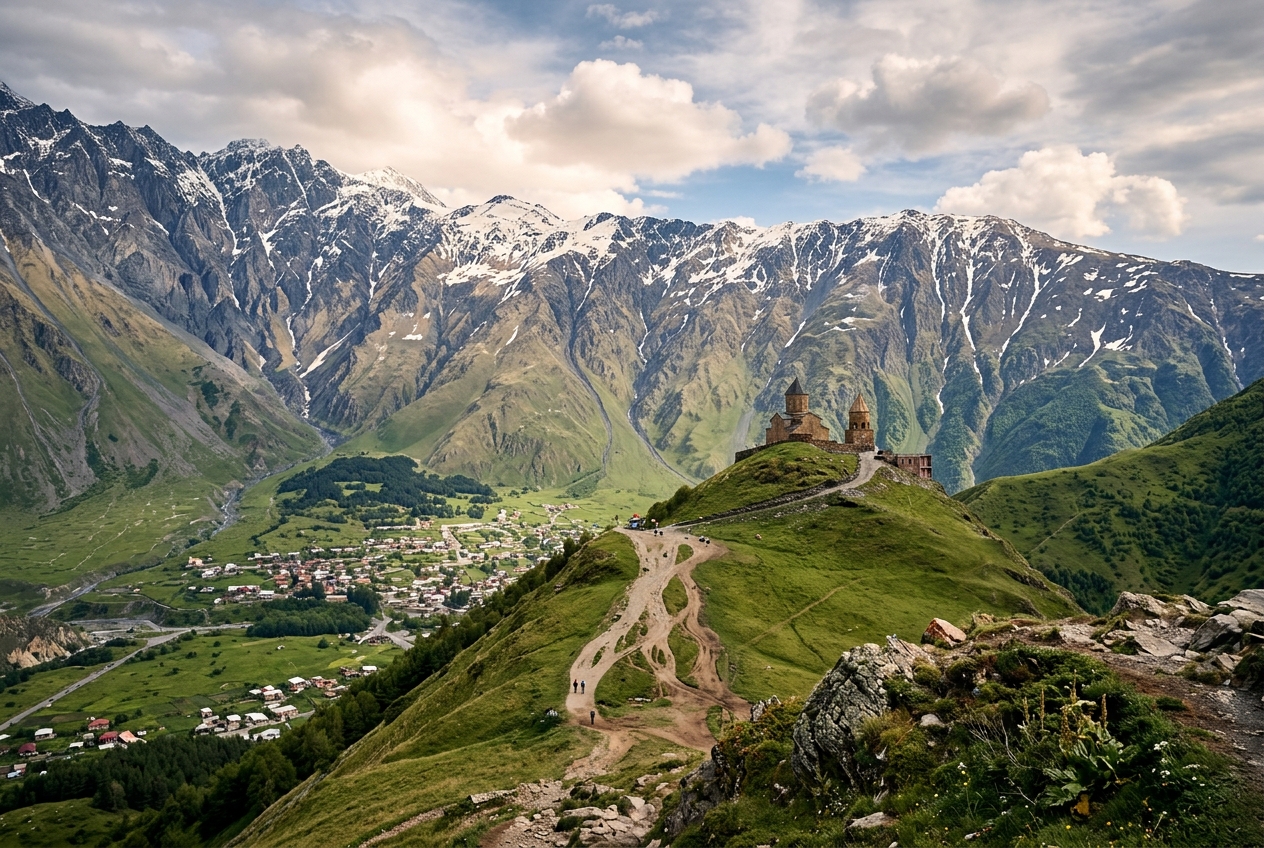
Kazbegi sits at the northern edge of Georgia, pressed against the Russian border where the Caucasus Mountains rise like a wall of stone and ice. The town’s official name is Stepantsminda, though almost everyone still calls it Kazbegi, and it has become one of the most visited mountain destinations in the country. The region pulled in 1.14 million visitors in 2025, a 2.3% increase over the previous year, and for good reason. This is a place where 5,000-meter peaks loom over medieval churches, where mineral springs bubble up through travertine deposits, and where a plate of hand-pinched khinkali costs less than a coffee in most European capitals. If you’re trying to figure out what to do in Kazbegi, the honest answer is that you’ll run out of days before you run out of options. The challenge isn’t finding activities: it’s choosing which ones to prioritize. What follows is a practical breakdown of the best experiences this corner of Georgia has to offer, from iconic hikes to cultural encounters that stick with you long after you’ve left.
Iconic Landmarks and Spiritual Sites
Kazbegi’s spiritual landmarks aren’t museum pieces behind ropes. These are active, living places of worship set against backdrops that make you understand why someone decided to build a church on a mountaintop in the 14th century. Georgia adopted Christianity in 337 AD, making it one of the oldest Christian nations on earth, and the churches here carry that weight of history in their stone walls and faded frescoes.
Gergeti Trinity Church
This is the image you’ve seen on every Georgian tourism poster, and it deserves the attention. Gergeti Trinity Church (Tsminda Sameba) sits at 2,170 meters on a ridge directly below Mount Kazbek, surrounded by nothing but alpine meadow and sky. The hike up from Stepantsminda takes about 90 minutes on foot along a steep, zigzagging trail. You can also hire a 4×4 for roughly 50 GEL round trip, though walking gives you time to appreciate the scale of the landscape.
The church dates to the 14th century and was used during invasions as a hiding place for Georgia’s most sacred relics, including the cross of Saint Nino. Inside, it’s small and dim, with the smoky scent of incense and beeswax candles. Women should bring a headscarf, and both men and women need to cover their shoulders. The best time to arrive is early morning, before 9 AM, when the tour buses haven’t arrived and you might have the churchyard to yourself with only the sound of wind and distant cowbells.
Dariali Monastery Complex
About 30 minutes south of Stepantsminda by car, the Dariali Monastery Complex is a modern construction built on ancient foundations. The original fortress here guarded the Dariali Gorge, one of the most strategic mountain passes in history, mentioned by Pliny the Elder and Strabo. The new monastery, completed in 2011, features the tallest religious structure in the South Caucasus.
The setting is dramatic: sheer rock walls on both sides, the Terek River churning below, and a sense of standing at the edge of empires. The drive alone is worth it, as the road passes through a narrow canyon that feels almost claustrophobic before opening up to the monastery grounds. Entry is free, and there’s a small shop selling churchkhela and candles.
Sno Giant Stone Heads
On the road between Gudauri and Stepantsminda, the village of Sno sits quietly along the riverbank. Here, Georgian sculptor Merab Piranishvili carved enormous stone heads depicting famous Georgian writers and poets, including Vazha-Pshavela and Ilia Chavchavadze. The sculptures are striking: rough-hewn faces emerging from boulders, staring across the valley with an almost confrontational intensity.
Most people stop here for 15 to 20 minutes on the drive up from Tbilisi. It’s a good place to stretch your legs, and the village itself offers a glimpse of rural mountain life that feels very different from the tourist-oriented guesthouses in Stepantsminda. A small medieval watchtower stands nearby, and locals sometimes sell honey and dried fruit from roadside stalls.
Outdoor Adventures and Hiking Trails
The Kazbegi region is built for people who like to move. Trails range from gentle valley walks to serious glacier approaches, and most of them require nothing more than decent boots and a willingness to get your heart rate up. Trail markings can be inconsistent, so downloading offline maps on apps like Maps.me before you arrive is a smart move.
Trekking to the Gergeti Glacier
This is the big one. The hike to the Gergeti Glacier from Stepantsminda is approximately 20 km round trip and takes 7 to 9 hours, depending on your pace and how long you spend staring at the scenery. The trail passes Gergeti Trinity Church and continues upward through rocky moraine to the edge of the glacier itself, sitting at roughly 3,600 meters.
You don’t need technical climbing gear for the approach, but you do need to be in reasonable shape. The altitude gain is significant, and the final stretch over loose rock can be tiring. Bring at least two liters of water, sun protection, and layers: temperatures drop sharply above the treeline. Starting early, around 7 AM, gives you the best chance of clear skies and avoids the afternoon clouds that often roll in.
Exploring the Truso Valley Travertines
The Truso Valley feels like stepping onto another planet. The 22 km round-trip hike takes roughly 5 to 6 hours and leads through a wide, treeless valley dotted with abandoned villages, mineral springs, and travertine formations stained orange and yellow by iron deposits. Carbonated water bubbles up from the ground in several spots, and you can literally drink sparkling mineral water straight from the earth.
The trail is mostly flat, making it accessible to hikers of varying fitness levels. The trailhead sits about 12 km from Stepantsminda, reachable by taxi for around 30 to 40 GEL. At the far end of the valley, you’ll find a small turquoise lake and the ruins of a medieval fortress. The valley was historically populated by Ossetian communities, and the empty stone houses add a haunting quality to the walk.
Hiking to Gveleti Waterfalls
If you want something shorter, the Gveleti Waterfalls are a solid half-day option. The trailhead is about 7 km south of Stepantsminda along the Georgian Military Highway, and the hike to the main waterfall takes roughly 30 to 40 minutes each way. There are actually two falls: the smaller one is easy to reach, while the larger waterfall requires a slightly more challenging scramble up a rocky path.
The big waterfall drops about 25 meters into a natural pool, and on a hot summer day, plenty of hikers strip down and wade in. The water is freezing, but that’s part of the experience. The trail can be muddy after rain, so waterproof boots help. This is an ideal hike for families or anyone looking for a quick nature fix without committing to a full-day expedition.
Experiencing Mountain Culture and Cuisine
Kazbegi’s culture is shaped by altitude and isolation. The Mokheve people who traditionally inhabited this region developed customs and a cuisine adapted to harsh winters and limited ingredients. Hospitality here follows the old Georgian principle of “stumari ghvtisaa,” meaning the guest is a gift from God, and you’ll feel it in every interaction from guesthouse owners pressing extra food on you to strangers offering directions with genuine enthusiasm.
Mastering the Art of Mountain Khinkali
Khinkali are Georgia’s beloved dumplings, but the mountain version is different from what you’ll find in Tbilisi restaurants. Up here, the filling is typically a mix of beef and pork seasoned with cumin, black pepper, and fresh herbs, and the dough is thicker and chewier. The correct way to eat them is to grab the twisted top knob, bite a small hole, sip the broth inside, then eat the dumpling. The top knob itself is traditionally left on the plate, uneaten, and your pile of discarded knobs serves as a count of how many you’ve consumed.
Several guesthouses and restaurants in Stepantsminda offer khinkali-making classes where you can learn the pinching technique yourself. It’s harder than it looks: getting 18 to 22 pleats in each dumpling is the mark of a skilled cook. A plate of five khinkali costs around 5 to 7 GEL in local restaurants, making this one of the best food bargains in the Caucasus. Pair them with a cold Natakhtari beer and you’ve got a perfect post-hike meal.
Relaxing at the Rooms Hotel Terrace
The Rooms Hotel Kazbegi has become a destination in itself. Perched on a hillside above Stepantsminda, the hotel’s terrace offers what might be the best view of Mount Kazbek available without hiking. Even if you’re not staying there, as rooms are pricey by Georgian standards, you can visit the restaurant and bar for a coffee, a glass of Saperavi wine, or a full meal.
The interior design blends Soviet-era industrial elements with warm wood and modern Georgian aesthetics. On clear evenings, the sunset over Kazbek from the terrace is genuinely spectacular. Budget travelers who are spending around €10 to €15 per night on dormitory beds at local guesthouses often splurge on a single meal here as a treat, and it’s worth every lari.
Natural Wonders and Scenic Viewpoints
The raw geography of Kazbegi is its greatest asset. This is a place where mountain scenery, local traditions, and Georgian hospitality converge in ways that feel unmanufactured. The viewpoints here aren’t observation decks with guardrails: they’re ridgelines, glacier moraines, and high-altitude meadows that demand some effort to reach.
Mount Kazbek Summit Views
Mount Kazbek (Mkinvartsveri in Georgian, meaning “ice-topped”) rises to 5,054 meters and is one of the highest peaks in the Caucasus. Summiting it requires technical mountaineering experience, crampons, ropes, and a guide, and typically takes 4 to 5 days from a base camp at the old meteorological station at 3,675 meters. This is not a casual hike.
But you don’t need to summit to appreciate it. The mountain dominates every view from Stepantsminda, and its appearance changes dramatically throughout the day: pink at dawn, blinding white at noon, golden at sunset. Some of the best vantage points include the terrace behind Gergeti Trinity Church, the ridge trail above the Rooms Hotel, and the road heading toward the Dariali Gorge. On clear days, the double-coned peak seems impossibly close.
Juta Village and the Chaukhi Massif
Juta is a tiny settlement at 2,200 meters, accessible by a rough dirt road that branches off the main highway near Sno. A private taxi to Juta costs around 60 GEL, and the ride itself is an adventure as the road winds through a narrow valley with no guardrails and occasional livestock crossings.
The village has a handful of guesthouses and serves as the starting point for hikes to the Chaukhi Massif, a jagged wall of rock towers that looks like something from a fantasy novel. The most popular route is the Chaukhi Pass trail, a moderate 4 to 5 hour round-trip hike that rewards you with views of the rock spires and the green valley below. Juta is also the starting point for the multi-day trek over Chaukhi Pass to Roshka, one of the finest long-distance hikes in Georgia.
Practical Travel Tips for Stepantsminda
| Category | Details |
|---|---|
| Getting There | Shared marshrutka from Tbilisi Didube station: 25 GEL, ~3 hours |
| Private Transfer | Bolt or taxi from Tbilisi: 150-200 GEL one way |
| Budget Accommodation | Dormitory beds: €10-€15/night |
| Mid-Range Accommodation | Private rooms in guesthouses: €25-€40/night |
| ATMs | One Bank of Georgia ATM in town center; bring cash backup |
| Mobile Coverage | Magti and Geocell work in town; spotty on trails |
| Language | Younger locals speak some English; older generation speaks Russian |
Best Time to Visit for Clear Skies
The window between mid-June and mid-September gives you the best combination of warm weather, accessible trails, and clear skies. July and August are peak months, meaning more crowds at Gergeti Church and higher guesthouse prices, but also the most reliable conditions for glacier hikes. Late September brings autumn colors and fewer tourists, though some higher trails may see early snow.
Spring, from April through May, is unpredictable. The road from Tbilisi is usually open, but trails above 3,000 meters are often still snowbound, and cloud cover can obscure the mountains for days at a time. Winter visits are possible and increasingly popular with a small but dedicated crowd, but many guesthouses close and road conditions on the Georgian Military Highway can be treacherous. If you visit between December and March, check road status daily through local Telegram groups or your accommodation host.
Navigating the Georgian Military Highway
The Georgian Military Highway is one of the most famous road journeys in the Caucasus, running 212 km from Tbilisi to the Russian border through Kazbegi. The drive takes about three hours by car, passing through the ski resort of Gudauri, the Jvari Pass at 2,379 meters, and the Aragvi River valley. It’s a spectacular ride, but the road has earned its reputation for white-knuckle moments: hairpin turns, overtaking trucks, and occasional rockfalls.
If you’re not renting a car, shared minibuses (marshrutkas) depart from Tbilisi’s Didube bus station throughout the morning. They cost 25 GEL and are reliable if not exactly comfortable. For more flexibility, book a private driver through your guesthouse or use the Bolt app in Tbilisi. Many travelers stop at the Ananuri Fortress and the Gudauri viewpoint on the way up, so building in a full day for the journey rather than rushing through is the better approach. Download offline maps and a Georgian language pack on Google Translate before you leave Tbilisi: cell service gets patchy once you’re in the mountains.
Your Kazbegi Game Plan
Kazbegi rewards both the ambitious hiker and the traveler who’s happy to sit on a terrace with a glass of wine and stare at a mountain. Three days is the minimum to cover the highlights: one day for Gergeti Church and the glacier approach, one for Truso Valley or Juta, and one for the waterfalls and town itself. A week lets you do it all without rushing, including a rest day that you’ll probably need.
The region is still remarkably affordable, the people are warm in that distinctly Georgian way that makes you feel like a welcomed guest rather than a walking wallet, and the scenery is among the most dramatic in Europe. Pack good boots, bring cash, and leave room in your schedule for the unplanned moments: the invitation to a stranger’s table, the shepherd offering fresh cheese on a trail, the sunset that stops you mid-sentence. Those are the things you’ll remember most about Kazbegi.